Week 3 - PHYS 20008
 Call Kai
 Learn
Learn Practice Test
 Spaced Repetition
 Match
Match Flashcards
 Knowt Play
1/25

There's no tags or description
Looks like no tags are added yet.
Name | Mastery | Learn | Test | Matching | Spaced | Call with Kai |
|---|
No analytics yet
Send a link to your students to track their progress
26 Terms
What is the hierarchical structure of muscle? (largest to smallest structure)
1) Muscle (whole muscle belly)
2) Fascicle (bundles of muscle fibres)
3) Myofibrils (each muscle fibre is made of this)
4) Sarcomeres (the basic contractile unit of muscles)
What defines a sarcomere and why is it important?
It’s the region between 2 Z-lines. In between the Z lines are thick filaments (myosin) and thin filaments (actin). It is responsible for muscle contraction. It is also the basic functional unit of muscles.
What causes the striped (striated) appearance of muscle?
The regular arrangement of: Myosin (thick filaments and Actin (thin filaments). Their overlapping pattern creates visible stripes.
What are the key features of myosin (thick filaments)?
It’s shaped like a 2 headed golf club. It has a head which contains binding sites for actin (thin filaments) and ATP. It has a tail. It also has a hinge region which allows movement (Hinge movement is crucial for contraction).
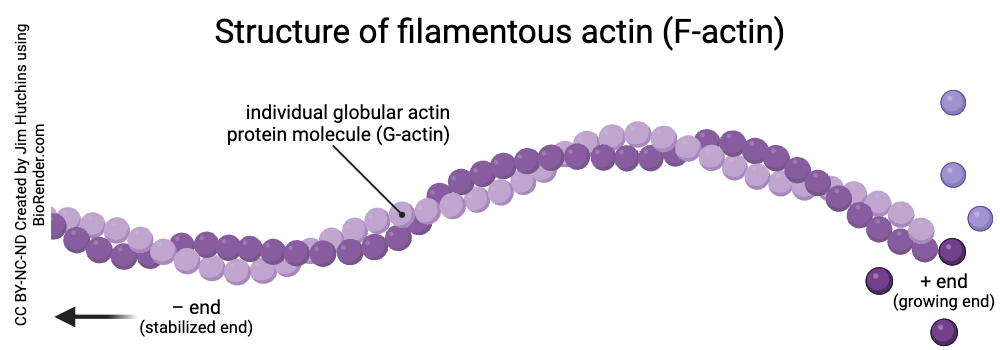
How is actin structured and regulated?
Actin is arranged in helical strands and contains binding sites for myosin. It’s regulated by Tropomyosin (which blocks binding sites) & Troponin (controls tropomyosin). At rest, binding sites are blocked by Tropomyosin leading to no unnecessary muscle contraction.
How does calcium enable muscle contraction?
1) Calcium released from sarcoplasmic reticulum (SR)
2) Binds to troponin
3) Moves tropomyosin away
4) Exposes actin binding sites
5) Myosin can now attach
Why is ATP essential for muscle contraction?
Myosin detaches from actin due to ATP binding. Myosin head gets energised due to ATP splitting. It provides energy for cross-bridge cycling. Without ATP, rigour mortis will be caused (permanent attachment causing stress on muscles seen during death)
What is the role of cytoskeletal proteins like titin and nebulin?
They provide structural stability, keep filaments aligned and prevent damage during contraction. Loss of these proteins will lead to muscle diseases (due to fragility & damage).
What is the function of the tendon’s elastic component?
It acts as a spring. It stores and releases elastic energy. It must be stretched before force is transmitted. The component is important for force production and injury risks like avulsions.
What does the sarcoplasmic reticulum do?
It stores calcium and releases it during contraction. It also reabsorbs calcium via ATP dependent pumps. It keeps calcium levels tightly regulated.
What is excitation–contraction (EC) coupling?
It’s a process linking electrical signal to muscle contractions. (elec to chem to mechanical)
Steps:
1) Action potential generated from nerve
2) It travels along membrane + T Tubules
3) Triggers calcium release from sarcoplasmic reticulum
4) Calcium enables contraction
What is the role of T-tubules?
Carry action potentials deep into muscle fibre and Trigger calcium release from SR. Overall ensures rapid, uniform contraction.
How does cross-bridge cycling produce force?
Myosin binds actin
ATP binds → detachment
ATP splits → energises head
Myosin reattaches
Power stroke (hinge movement)
Repeats while ATP + calcium present
👉 Thousands occur simultaneously → muscle shortens.
How do muscles shorten (sliding filament theory)?
Filaments do NOT shorten (Actin and myosin simply slide past each other)
Sarcomeres shorten causing whole muscle to shorten
What determines how much force a muscle produces?
The degree of actin–myosin (filament) overlap (More optimal overlap → more force)
What are the 2 main types and causes of muscle fatigue?
Two main types:
Central fatigue → brain/spinal cord
Peripheral fatigue → muscle-level issues
Causes include:
ATP depletion
Calcium handling problems
Metabolic stress
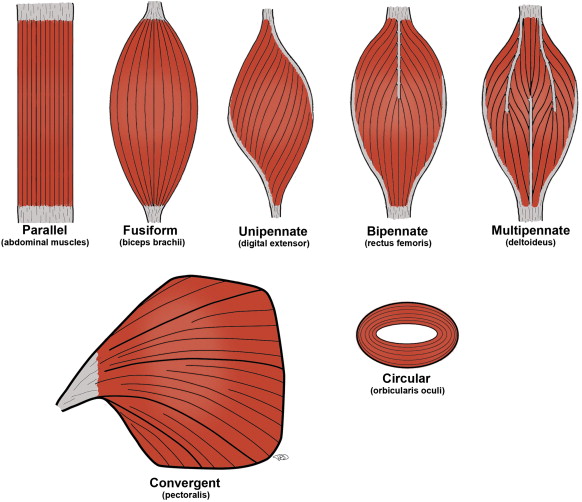
How does muscle structure/shape affect function?
Fusiform (parallel) → long fibres, more movement
Pennate (angled) → more fibres packed → more force
👉 Structure = function specialisation.
What determines how strong a muscle is?
The cross sectional area. A larger cross sectional area = more fibres = greater force
Why do different muscles have different functions?
Small muscles → fine control (e.g., eye, hand)
Large muscles → power and force (e.g., legs)
What are the three types of muscle actions?
Concentric (shortening)
Force > load
ex// pumping with dumbbels
Isometric (same length)
Force = load
ex// pulling at something impossible to lift like strong barbed wire causing straight arm
Eccentric (lengthening)
Load > force
ex// like holding heavy grocery bags
How do muscles coordinate movement?
Agonist → produces movement
Antagonist → opposes movement
👉 One shortens while the other lengthens.
How does muscle length affect force?
F∝ overlap between actin and myosin (filaments)
Ascending limb →sarcomere is overly compressed, so actin filaments overlap and interfere. Myosin won’t have proper space to bind = fewer effective cross-bridges → low force
Plateau → optimal overlap of actin and myosin→ max force
Descending limb → sarcomere is too stretched. actin and myosin barely overlap → low force
What is the difference between active and passive force?
Active force (contractile) → from contraction (cross-bridges)
Passive force (elastic) → from stretching elastic tissues (tendons)
Why are eccentric contractions significant?
Produce higher force
Common in injuries
Important in:
Sport
Rehabilitation
What happens if calcium regulation fails?
Excess calcium → muscle damage
Poor reuptake → continuous contraction
Thus its linked to muscle diseases.
Why do we need to understand basic muscle structure?
Because it explains:
Movement
Fatigue
Injury
Disease
Adaptation to exercise