APES Textbook Ch 22
 Call Kai
 Learn
Learn Practice Test
 Spaced Repetition
 Match
Match Flashcards
 Knowt Play
1/31

There's no tags or description
Looks like no tags are added yet.
Name | Mastery | Learn | Test | Matching | Spaced | Call with Kai |
|---|
No analytics yet
Send a link to your students to track their progress
32 Terms
Urbanization
The creation and growth of urban areas or cities and their surrounding developed land. Measured as percentage of people in a country or in the world living in urban areas
Urban growth
The rate of increase of urban populations
The worlds first cities emerged around 6,000 years ago. Since then, the world is increasingly urbanized.
79% of Americans and 50% of world population live in urban areas
Natural increase
Method of urban area growth where theres more births than deaths
Immigration
Method of urban area growth where people are pulled to urban areas searching for jobs food housing etc
Four major trends in urban population dynamics
The proportion of global population living in urban areas is increasing
Urban areas are expanding rapidly in number and size. each week 1 million people are added to the worlds urban areas
Urban growth is slower in developed countries than developing
Poverty is becoming more urbanized in developing countries. At least 1 billion in developing countries live in unsanitary slums and shanty towns. Could double in 30 years
Megacities (Megalopolises)
Cities with 10 million+ people
There are 18 as of the book publishing
Phases of US population shift
People migrated from rural areas to large central cities
Many people migrated from large central cities to suburbs and smaller cities
Many people migrated from the North and East to South and West
People have fled both cities and suburbs and migrated to developed rural areas (since 1970s-1990s). Result: Rapid growth of ex-burbs
ex-urbs
housing developments scattered over vast areas that lie beyond suburbs and have no socio-economic centers.
aging infrastructures
The United States has fallen $1.5 trillion behind in maintaining its vital public infrastructure.
This main- tenance backlog amounts to an average of $5,000 for each U.S. citizen. Maintenance is not glamorous, but without it, urban areas and much of the country can suffer from physical and economic collapse as the costs of long-neglected repairs rise sharply.
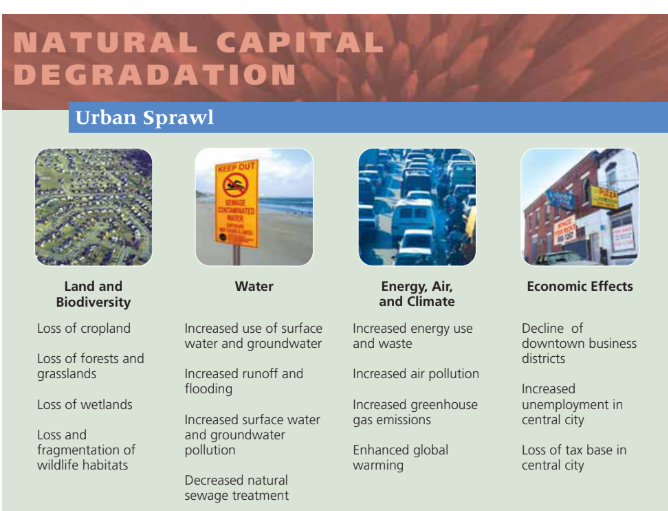
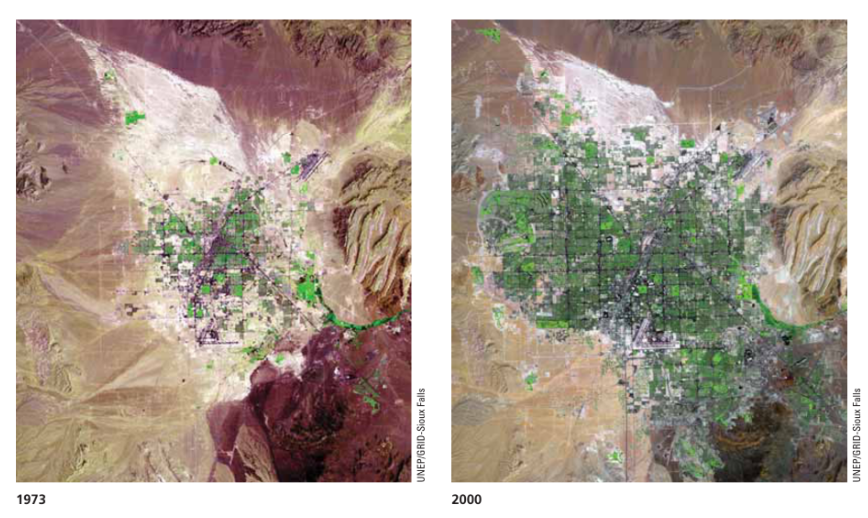
Urban sprawl
The growth of low-density development on the edges of cities and towns.
This is eliminating surround- ing agricultural and wild lands
It results in a far-flung hodgepodge of housing developments, shop- ping malls, parking lots, and office complexes that are loosely connected by multilane highways and freeways.
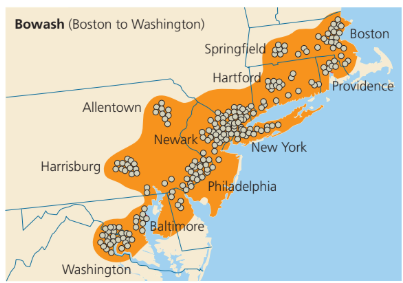
megalopolis.
separate urban areas some- times merge
For example, the remaining open spaces between the U.S. cities of Boston, Massachusetts, and Washington, D.C., are rap- idly urbanizing and coalescing.
problems with cities
Huge ecological problems
They lack vegetation
They have water problems
They concentrate pollution and health problems
They have excessive noise
They have a different climate (warmer, rainier, foggier cloudier)
Light pollution
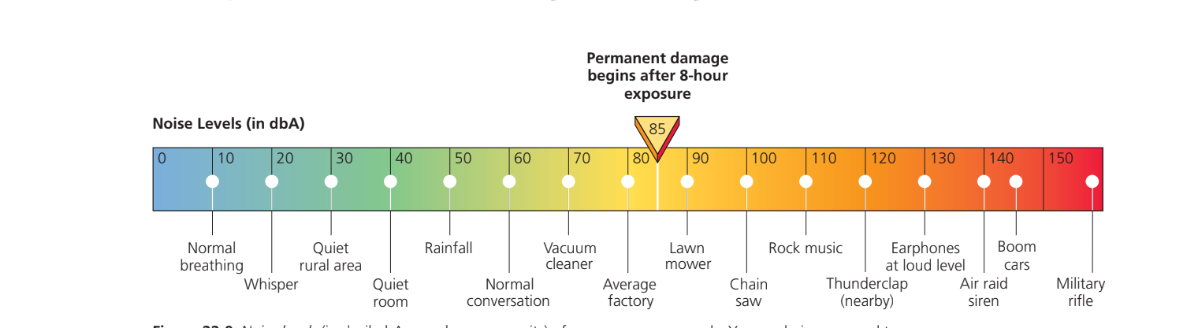
Noise pollution
Any unwanted, disturbing, or harmful sound that impairs or interferes with hearing, causes stress, hampers concentration and work efficiency, or causes accidents.
Urban heat island
a phenomenon where cities and metropolitan areas experience significantly higher temperatures than their surrounding rural landscapes
Slums
Areas dominated by tenements and rooming houses where several people might live in a single room.
The world’s largest slum, Dharavi, in Mumbai (Bombay), India, is home to 2.8 million people.
Barrios
Slums in Mexico City
mexico city suffers from severe air pollution, close to 50% unemployment, deafening noise, overcrowding, traffic congestion, inadequate public transportation, and a soaring crime rate.
More than one-third of its residents live in slums called barrios or in squatter settlements that lack running water and electricity.
Compact cities
Cities like Hong Kong, China, and Tokyo, Japan, get around by walking, biking, or using mass transit such as rail or buses.
Many new high-rise apartment buildings in these Asian cities contain everything from grocery stores to fitness centers.
Dispersed cities
Cities where residents depend on motor vehicles for travel
A combination of plentiful land, cheap gasoline, and networks of highways have produced this
This dependency is a growing problem for elderly with no sidewalks or people who cant drive
Many essentially become prisoners in their homes.
US Canada Australia
User pays approach
one way to reduce the harmful effects of au- tomobile use is to make drivers pay directly for most environmental and health costs of their automobile use
Full cost pricing
an economic practice that ensures the market price of a product or service reflects its total environmental and societal impacts, rather than just the direct costs of production
ex: Charging a tax on gasoline to cover the estimated harmful costs of driving.
Heavy-rail systems
subways, elevated railways, and metro trains
light-rail systems
streetcars, trolley cars, and tramways
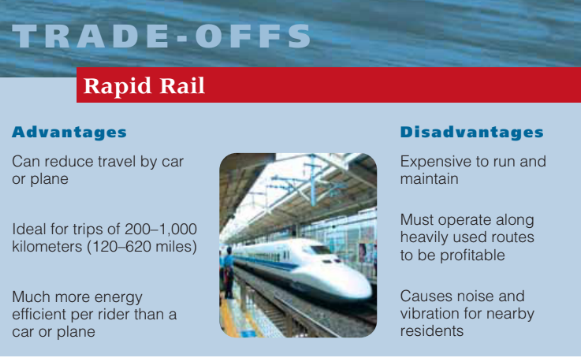
Rapid rail
High speed bullet trains
In western Europe and Japan, high-speed bullet trains travel between cities at up to 306 kilometers (190 miles) per hour.
Million passengers a day
Advantages
Reduce travel by car/plane
Energy efficient
Disadvantages
Expensive
Causes noise/vibration for nearby residents
Land use planning
Determining the best present and future use of each parcel of land
Much land-use planning encourages future population growth and economic development, regardless of the environmental and social consequences.
Typically, this leads to uncontrolled or poorly controlled urban growth and sprawl.
Zoning
Parts of land are designated for certain uses
Smart growth
One way to encourage more environmentally sustainable development that reduces dependence on cars, controls and directs sprawl, and cuts wasteful resource use.
It recognizes that urban growth will occur.
Urban growth boundary approach
One way to preserve open space outside a city is to draw an urban growth line around each community and to allow no urban development outside those boundaries.
Greenbelt
an open area reserved for recreation, sustainable forestry, or other nondestructive uses. Satellite towns are of- ten built outside these greenbelts.
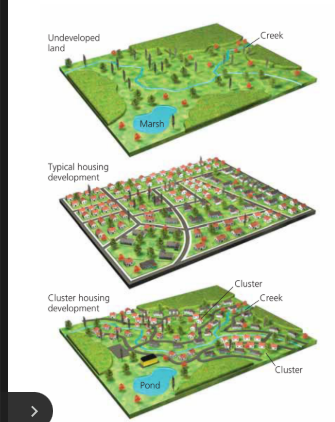
Cluster development
density housing units are concentrated on one portion of a parcel, with the rest of the land (often 30–50%) used for commonly shared open space
New urbanism
A modern form of what could be called old villageism, to develop entire villages and promote mixed-use neighborhoods within existing cities. These principles include:
walkability
mixed use and diversity
quality urban design
environmental sustainability
smart transoprtation with well designed train and bus systems
Ecocities (Green cities)
Sustainable cities
Emphasize:
Build and redesign for people not cars
Use solar and renewable energe sources
Use solar powered living machines
Depend largely on recycled water
Use energy/matter efficiently
Prevent pollution and reduce waste
Protect and support biodiversity
Promote urban gardens and farmers markets
Ecovillage movement
Small groups of people come together to design and live in sustainable villages