accounting final
 Call Kai
 Learn
Learn Practice Test
 Spaced Repetition
 Match
Match Flashcards
 Knowt Play
1/79

There's no tags or description
Looks like no tags are added yet.
Name | Mastery | Learn | Test | Matching | Spaced | Call with Kai |
|---|
No analytics yet
Send a link to your students to track their progress
80 Terms
3 primary responsibilities of manager
planning, directing and controlling
managerial vs finacial accounting
Managerial - Internal, No GAAP, Forward and future focused,
Financial - external, history past based, Gaap involved
Ethical Standards - IMA statements
competence - education/training
confidentiality - keeping information private
integrity - confflicts of interest purposely mistake financials
credibility - information
Chapter 2
service company
provides services, no inventory
merchandising company
buys finished goods and resells them
manufacturing
makes products and has raw material inventory, work in process inventory, and finished goods inventory
value chain
Research and Development - expensed immediately
Design - prouct/ process of making product
Production - Manufacturing / Purchases (Merchandising)
Marketing - Advertising
Distribution - Shipping to Customer
Customer Service
Direct vs Indirect Costs
Direct - easily traceable
Indirect - not easily treaceable
What are direct and indirect costs in a merchandising company?
direct - direct materials, direct labor
indirect costs - moh (made up of ID material and ID labor) plus any plant rent, or factory, glue, screws
Product vs Period Costs
Product - costs whihch go into inventory direct materials, direct labor, moh, indirect material, indirect labor, other costs with word plant, factory, freight in, assembly line workwer, anything factory
Period - cost expenses in periond incurred expenses seeling, general, administrative (HQ, SHIPPING, ACCT, HR)
Direct material Used calculation
Beginning Raw Material inventory + Purchases of Raw DM used (plus freight in) = Raw material available for use - Ending RM inventory = Direct Material used
Cost of Goods Manufactured
Beginning WIP + Total manufacturing costs incurrect (DM, DL, MOH) = Total manufacturing costs to account for - end WIP inventory = Cost of Goods Mnufactured
Manufacturing Company
Beginning inventory + COGM = Cost of goods available for sale - ending finished goods inventory = COGS
Merchandising Company - COGS calculation
Beginning Inventory + Purchases ( freight in ) = GAFS - Ending Merchandising Inv = GOGS
DATA types
structured data - organized data strucutre
unstructured data - photos, videos, (social media posts)
semi structured - in between (likes on facebook posts)
chapter 3
job costing
costum unique, small batches, service
process costing
large volume, homogenous, product mix
job costing process
production schedule - bill of materials (recipe card for prod and purchases order) - material recquisition ( required material from raw material invetory to go to WIP) - job cost record ( we can see all the direct material, direct labor, and manufacturing overhead
Predetermined MOH rate
Total Estimated MOH costs / Total estimated amount of allocation
MOH allocated to a job
predetermined moh rate x actual amount of allocation base used
MOH - over or under
overallocated - allocated > incurred (overcosted)
underallocated - allocated < incurred (undercosted)
how we handle over or under
over - reduce cogs
under - increase cogs
service firm
directly traceable - DL, travel ,liscensing
Indirect costs - (operating expenses) we need to allocate these
direct - directly to the job
indirect - allocate to the job
Activity based Costing
allocating for each activity
cost hirarchy
unit - label on each bottle
batch — machine set up
product - machine lease cost
facility - supervisor custodial, utilities
traditional vs lean thinking
traditional - similar machines grouped together, karger set up times, large batches ,high inv many suppliers
lean - more efficient, self contained, shorter set up times, low inv
4 categories of quality related costing
prevention - avoid problems ( training, design, process evaluate suplies)
appraisal - inspecting or testing
internal failure - find defects before shipping rework
external failure - customer finds defects warranty or customer
correlation coefficient ( r value )
ranges from -1 to 0 to 1
-1 being least correlated (moving opposite direction)
1 being most correlated (moving same direction)
variable osts
- same per in unit basis, the more units the higher total cost
fixed costs
same costs regardless of how many units we produce
mixed
both fixed and variable costs
setp costs and curviliniar
step - a range (ex 1 babysitter for every 10 kids)
Regression analysis
(Intercept) - Y intercept (fixed cost)
X variable - Variable cost per unit
Formula
TC = VC (# of units) + FC
high low question
practice computation question
r²
from 0-1 the closes to 1 the better the fit
absorption costing
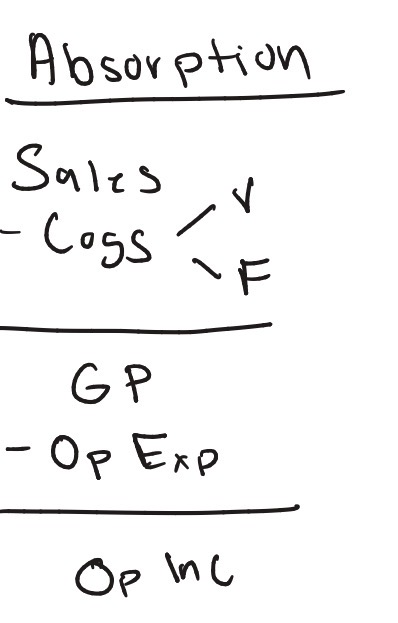
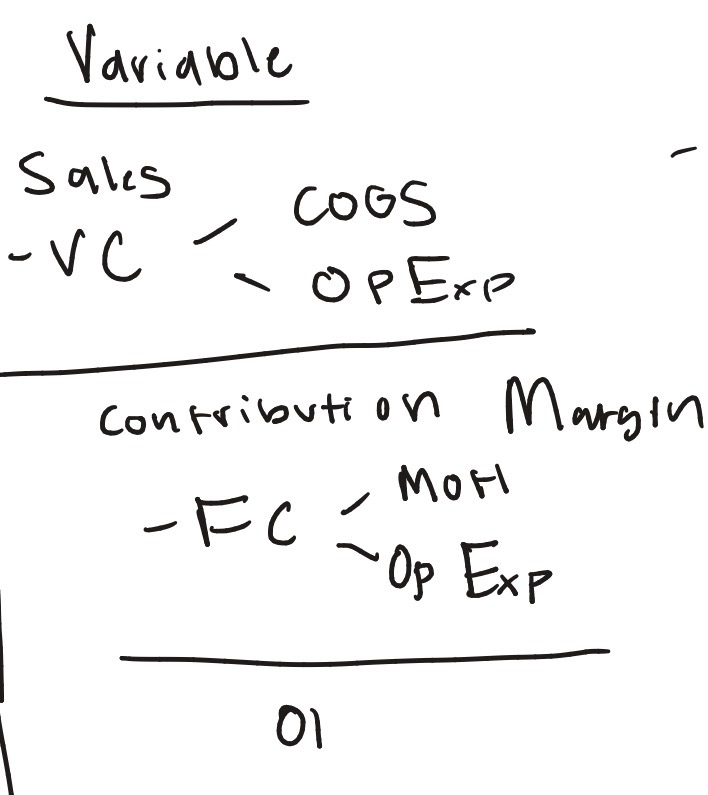
variable costing
chapter 7
Contribution Margin Formula
Sales - Variable Cost
Contribution Margin Ratio
Contribution Margin / Sales
Break Even units
Fixed Costs + Target Profit / Contribution Margin Units
Break Even Dollars
Fixed Costs + Target Profit / Contribution Margin Percentage
Be able to know the effect on contribution margin and break even point
use the formulas -
Sales - VC = CM & BE = FC/CM
Margin of Safety Dollars
Expected or Actual Sales $ - Break Even $
Ooerating Leverage
HIGH OL - high fixed costs + low variable costs
LOW OL - low fixed costs + high variable costs
Operating Leverage Factor formula
Contribution Margin / Operating Income
Chapter 8
Relevant information
Pertains to the future
Differs across alternatives
Price taker vs price setter
Price taker - product lacks uniqueness, not brand name, lots of competition, and uses target costing
Price setter - product is unique, brand name, less competition, cost plus pricing
Target costing formula
revenue @ market price - desired profit
Cost plus pricing
total cost (v +f) + desired profit
special order question
computaional - discontinuing a product/dept/store
consider
Lost CM margin
add avoidable Fixed Costs
Add operating income from space
work question s8-9
Outsourcing
proffesor said we would do an exaple in class
but use the formuala
vc + fc = vc +fc comparing make and buy
sell as is or process further
things to consider
how much revenue will we receive if we sell the product as is?
how much revenue will we receive if we sell the product after proccesing it further?
how muc hextra will it cost to process further?
make sure to ignore sunk costs
chapter 9
whats the first budget?
the sales budget
computation production budet question, direct material budget
know the formulas for both of these
MOH and operating expenses
both have variable and fixed components
Capital Expenditure Budget
plans to purchase property, plant and equipment
Cash collections budget
know its formuala
Cash pyament budget
understand the formula
Combined Cash budet
Beg Cash Balance + collection - payments = balance before borrowing (blank how much to borrow) = ending cash balance
comprehensive budget for merchandising company
Beg Invty + Purchases = GAFS - End Invty + COGS
chapter 10
decentralization advantages vs disadvantages
when a compnay splits operations into different operating segments
advatages - frees top management, encourages use of expert knowledge, iimprove customer + supplier relationships, provide training
disadvantages- duplication of costs, goal incongruence
resposinility center
cost - focus on costs only - internal dptmts (it, acct, hr, legal)
revenue - focus on revenues only - regional sales office territory, call center sales units
profit - concerned about revenues and costs - stand alone stores or restruarants
investments - c0ncerned about revenue + costs and managing assets (parent or large division of a corp)
facorale vs unfavorable
favorable - (good) sales > budget, costs <budget
unfavorable - (bad) sales < budget, costs > budget
management by exception
only investigate variances which meet some threshold
ROI
Return on investment
Operating Income/ Total Assets
Sales Margin
Operating Income / Sales
Capital Turnover
Sales/ Totall Assets
Residual INncome
Operating Income - ( Target rate of return x total assets)
Flexible Budget
budget using actual sales volume with budget per unit information
Work Happy balloon company question
solve for flexible budget and volume variance
KPI’s - key performance indicators
financial perspective - “ how do we look to shareholders” sales, growth, sales margin, gp, roi
customer perspective - customer satisfaction rating, number of repat customers.