Chapter 15: Genomics and Proteomics
 Call Kai
 Learn
Learn Practice Test
 Spaced Repetition
 Match
Match Flashcards
 Knowt Play
1/17

There's no tags or description
Looks like no tags are added yet.
Name | Mastery | Learn | Test | Matching | Spaced | Call with Kai |
|---|
No analytics yet
Send a link to your students to track their progress
18 Terms
Most scientists consider the Human Genome Project to be the most significant scientific project of the 21st century. What statements describe the key findings of the HPG?
There are approximately three billion base pairs in the human genome.
The human genome contains approximately 25000 genes.
The genome of Drosophila melanogaster, a fruit fly, was sequenced in 2000. However, this sequence consisted mainly of euchromatin. The heterochromatin was not sequenced unil 2007. Most completed genome sequences do not include heterochromatin. Why is heterochromatin usually not sequenced in genomic projects?
Heterochromatin contains many short repeated sequences, which makes it difficult to assemble heterochromatin sequences into large contigs.
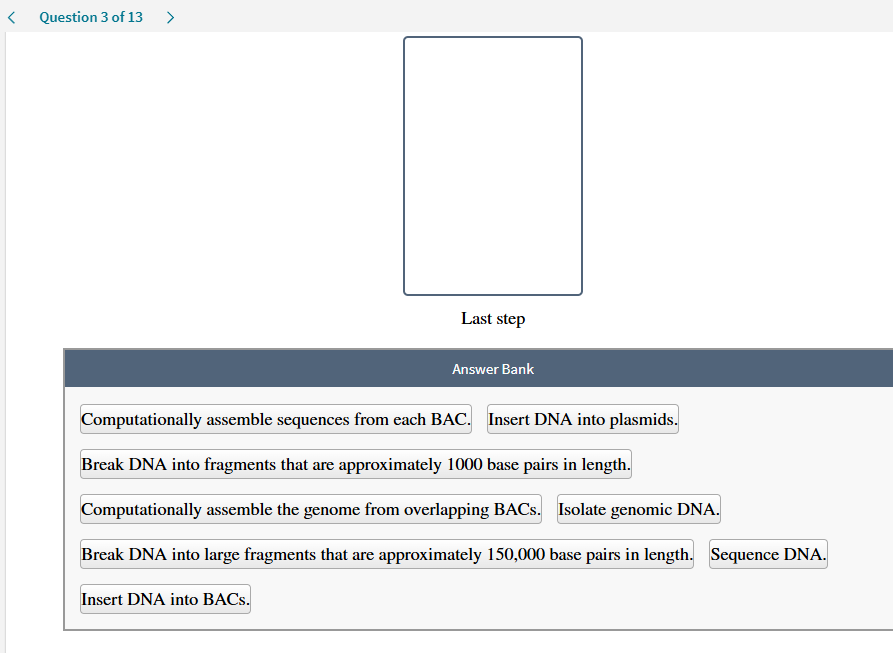
Whole-genome shotgun sequencing is a method used to sequence genomic DNA. Arrange the steps of whole-genome shotgun sequencing in order from first to last.
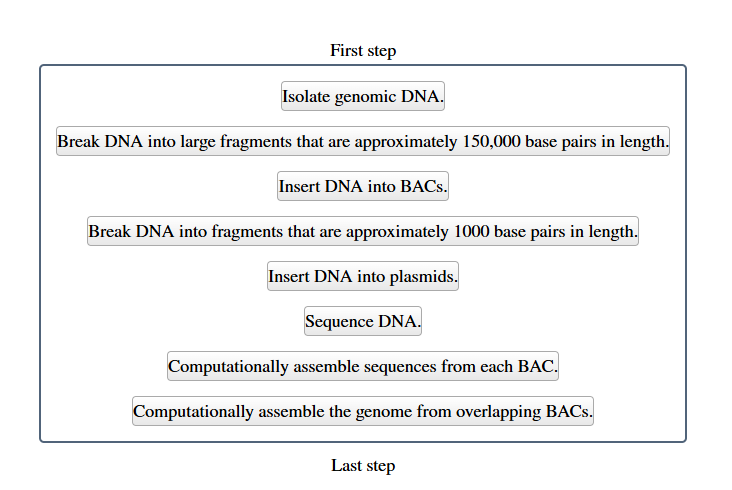
With current sequencing technology, contigs are integral to understanding the entire genome of an organism. What is a contig?
a continuous DNA sequence constructed from overlapping DNA fragments
Select the metagenomic studies:
genetic analyses of deep sea sediment samples characterize regional microbial composition
gene profiles associated with bacterial infection-induced cognitive changes are identified.
DNA sequencing is used to determine gut microbiota change after altering a primate’s diet
Genome structure and function of a Staphylococccus aureus sample is determined.
DNA sequencing is used to determine gut microbiota change after altering a primate’s diet
genetic analyses of deep sea sediment samples characterize regional microbial composition
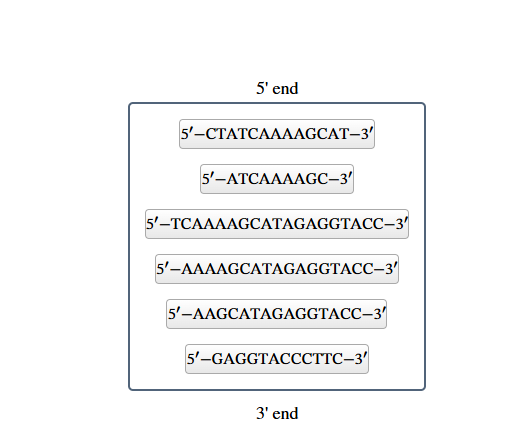
A linear piece of DNA was broken into random, overlapping fragments and each fragment was then sequenced. The sequence of each fragment is shown here, listed in random order. Using the overlapping regions shared between sequences, create a contig sequence of the original fragment by placing the sequence that is closet to the 5’ end first and moving towards the 3’ end.
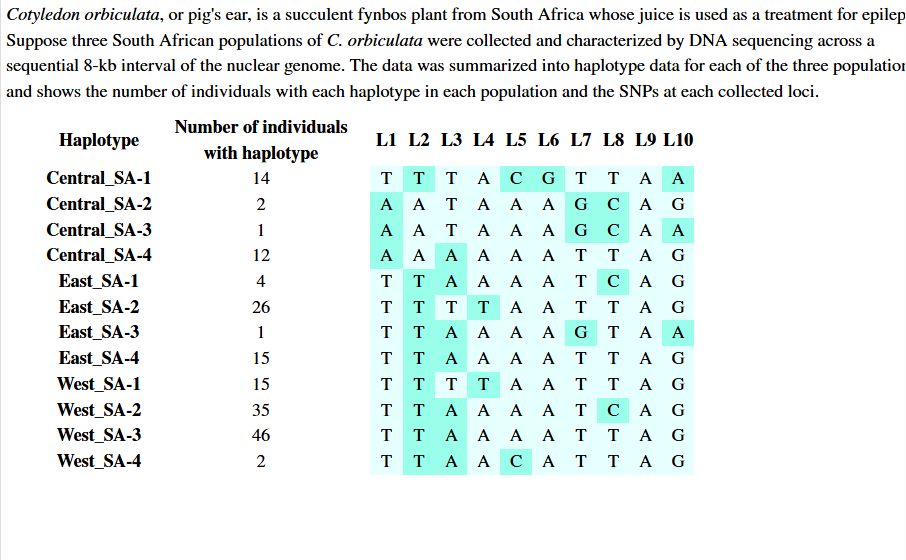
Suppose the sequence characterized previously contains part of the unknown gene responsible for the medicinal properties of C. oribulata that allow the plant to treat epilepsy. Choose the statement that correctly identifies why it is important to collect haplotype data for each population.
Central_SA-2, West_SA-1, East_SA-3
Haplotypes can be used to determine the genetic association with the medicinqal properties to treat epilepsy within each population
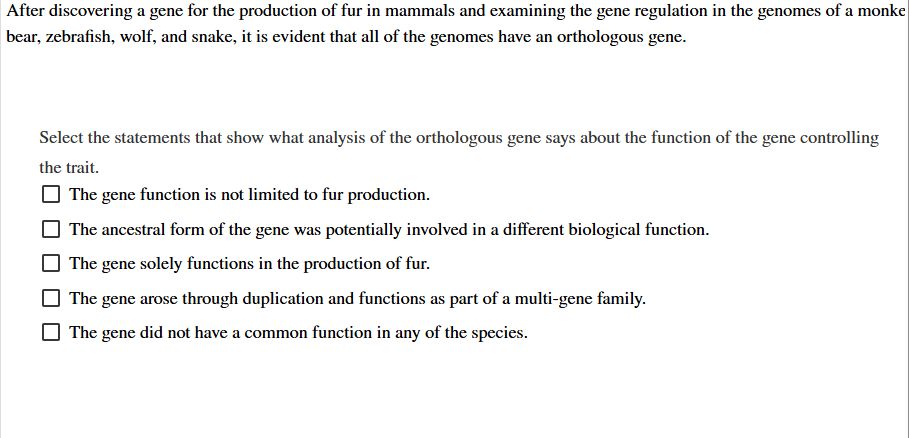
The gene function is not limited to fur production and the ancestral form of the gene was potentially involved in a different biological function.
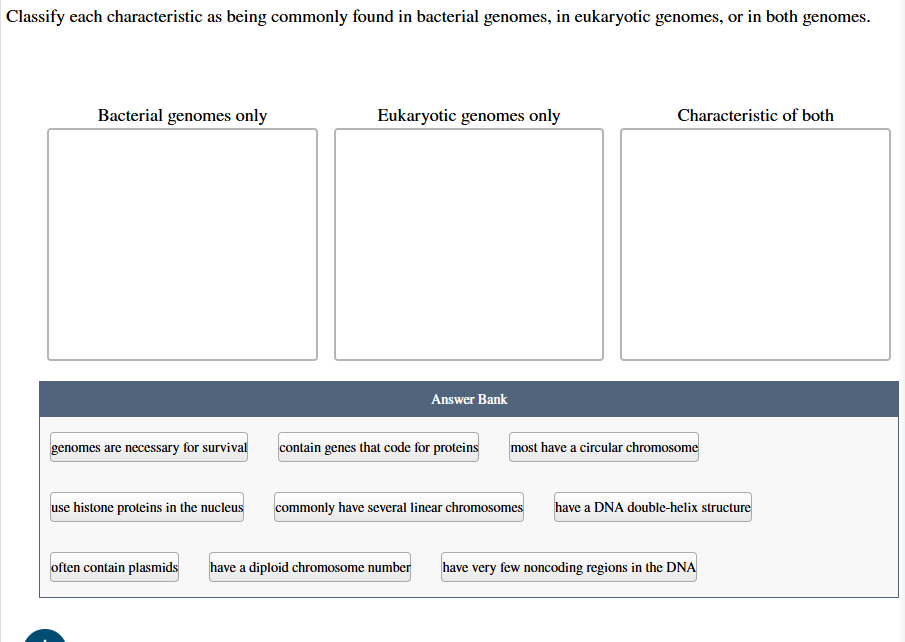
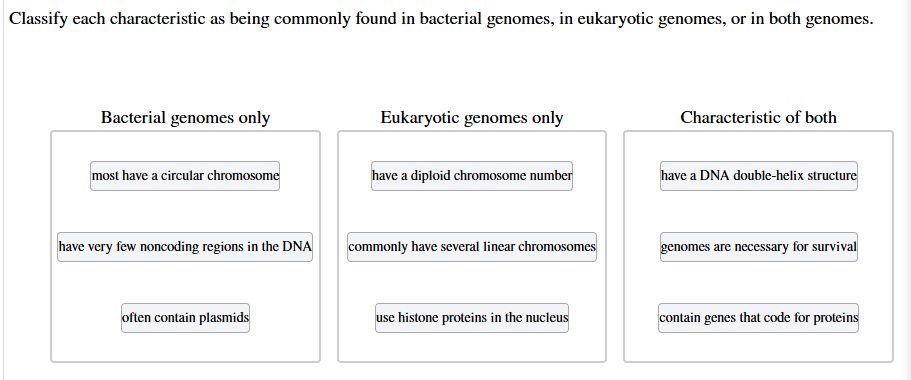
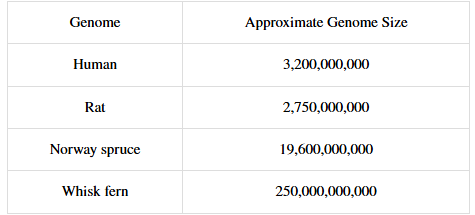
As depicted in the table, certain plant genomes are significantly larger than mammal genomes, including the human genome. Why do these diploid plants have more DNA, but less organismal complexity compared with humans?
Repetitive DNA from transposons accounts for the majority of these plant genomes.
How does comparative genomics aid in the search for factors that contribute to complex human conditions?
Conserved genetic sequences likely influence similar phenotypic traits across species.
Suppose a team of researchers sequenced the genome and measures the proteome of a human skin cell and a human kidney cell. Will there be a greater difference between the genome or the proteome between these two cells?
Differences in gene expression and post-transcriptional mRNA processing lead to a greater difference in the proteome than the genome between the two cells.
Denisovans were first discovered in 2009, when scientists found a single 40,000-year-old finger bone in the Denisova cave in Siberia. Although the bone was too fragmentary to draw any conclusion about its origin based on anatomy, the bone was determined to be a new species. The species was given the name Denisovans, after the cave from which the bone came. Scientists were able to determine that the DNA from the finger bone belonged to a new species because its ___________ differed from that of _________________.
genome
Neanderthals and other known hominids.
A contig is a
set of overlapping fragments that form a continuous stretch of DNA
Several new fields of biological investigation have emerged from genome sequencing projects. Which of the following is not a correct match of a field and its description or goal?
a) bioinformatics: combines molecular biology and computer science to develop databases of DNA and protein sequences and the tools for their analysis
b) Functional genomics: develops and uses methods that allow gene function and expression to be determined from DNA sequence alone
c) Metagenomics: examines genomes of communities of organisms that inhabit a common environment
d) synthetic biology: creates from scratch novel genomes and organisms that are going to be released into natural environments
e) Proteomics: identifies, localizes, and characterizes structure and function of all proteins in a given cell
synthetic biology
You are studying a prokaryote that lives in the gut of a termite species. Compares to a free-living prokaryote living in a changing environment, your organism’s genome
a) should be smaller (in numbers of base pairs)
b) should have approximately the same number of genes for basic housekeeping functions.
c) should have fewer genes overall.
d) all of the above
e) both a and c
all of the above
A large proportion of human genes have functions that are yet to be determined. Using fig. 15.10, determine the most common known function affect human genes.
a) oxidoreductase
b) immunoglobuilin
c) cell adhesion
d) nucleic acid enzyme
e) intracellular transport
nucleic acid enzyme
Which of these describes the function of trysin in mass spectrometry?
a) cleaves a protein into short peptides
b) separates protein fragments based on charge
c) separates protein fragments based on size
d) labels protein fragments for identification by a mass spectrometer
cleaves a protein into short peptides