gel 1 - week 5
 Call Kai
 Learn
Learn Practice Test
 Spaced Repetition
 Match
Match Flashcards
 Knowt Play
1/46

There's no tags or description
Looks like no tags are added yet.
Name | Mastery | Learn | Test | Matching | Spaced | Call with Kai |
|---|
No analytics yet
Send a link to your students to track their progress
47 Terms
what are Intrusive igneous rocks?
crystallize below ground
what are extrusive igneous rocks?
crystallize on Earth’s surface
what is magma?
a mixture of melt and crystals
what is lava?
refers to magma that reaches the surface
what are the three ways to melt a rock?
Decrease pressure
Increase temperature
Add volatiles
how are igneous rocks classified?
on the basis of silica (SiO2) content (Mafic versus intermediate versus felsic
what are processes that affect magma (or melt) composition?
Partial melting of parent rock
Assimilation of country rock
Magma mixing
Fractional crystallization
how do minerals crystallize?
at predictable temperatures and in a predictable sequence during magma cooling
what does fractional crystallization lead to?
a diversity of rock compositions
what does mafic magmas crystallize?
olivine, pyroxene, and Ca-rich plagioclase
what does felsic magma crystallize?
quartz, K-spar, Na-rich plagioclase, biotite, and amphibole
what do crystal zonations do?
record changes in magmatic conditions
cooling vs crystals
faster cooling = smaller crystals
slower cooling = larger crystals
what does magma viscosity depend on?
temperature, composition, and water content
what are sills?
horizontal, sheet-like intrusions between rock layers
what are dikes?
vertical or cross-cutting wall-like intrusions
what are cylindrical pipes?
vertical conduits that bring magma to the surface
what do magma pathways lead to?
sills, dikes, and cylindrical pipes
plutons vs. batholiths
plutons are medium-sized intrusive bodies; batholiths are massive features composed of many individual plutons.
what is the igneous classification?
crystalline (coarse vs. fine) vs. fragmental vs. glassy
what are magma chambers?
Underground reservoir of molten rock
what are vents/fissures?
Openings (circular or linear) where eruption occurs
craters vs. calderas
Craters are small bowl-shaped depressions; Calderas are giant depressions formed by the collapse of a volcano
what are the types of volcanoes?
shield volcanoes, cinder cones, stratovolcanoes
what are shield volcanoes?
broad/low profile
what are cinder cones?
small, steep piles of tephra
what are stratovolcanoes?
large, classic cone-shaped
what are explosions favored by?
High SiO2
High gas pressure
High viscosity
what is volcanic behavior?
complicated and difficult to predict because these factors can vary in space and time
size of eruptions vs frequency
Large volcanic eruptions are less frequent
what is the “magnitude scale” for volcanic eruptions?
the VEI (Volcano Explosivity Index)
what does the VEI depend on?
Plume height
Volume of magma
what do flood basalts represent?
the eruption of the head of a mantle plume
what do hot spot tracks represent?
the eruption of the tail of a mantle plume
what can flood basalt cause?
mass extinctions
Volcanoes are hazardous due to?
Lava flows and pyroclastic flows
Ash fall (aviation)
Landslides
Lahars
Earthquakes & tsunamis
Dangerous gasses
what do volcanoes do?
often provide warning of an imminent eruption
volcanic monitoring
There are numerous tools for monitoring activity
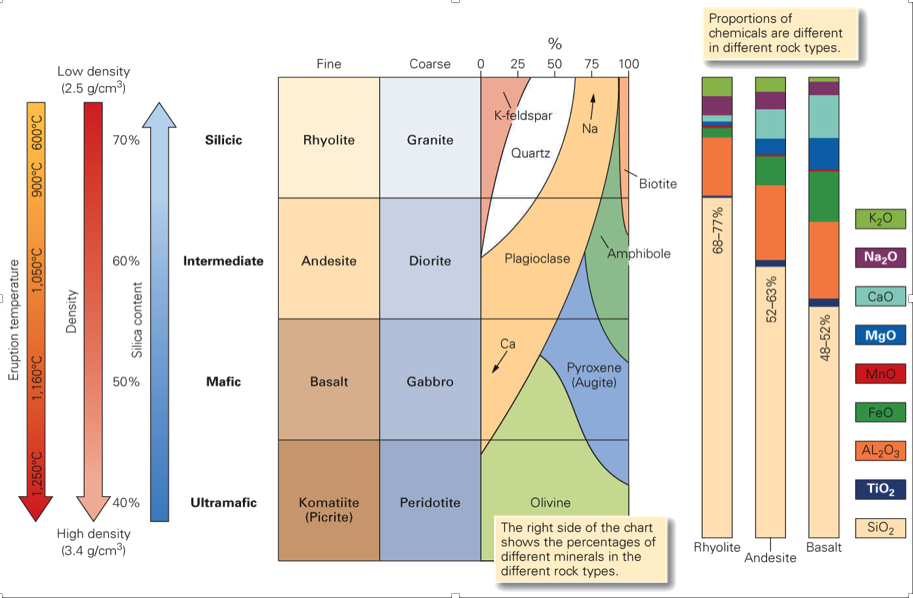
Based on the diagram below, which rock is more dense: granite or peridotite?
peridotite
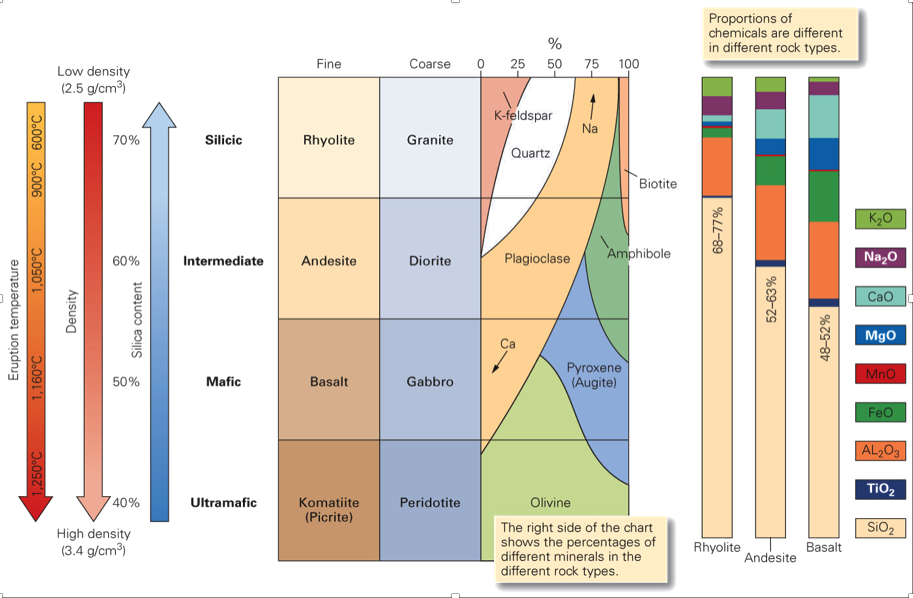
Based on the diagram below, which of the following rocks contains the most FeO?
rhyolite, andesite, basalt
basalt
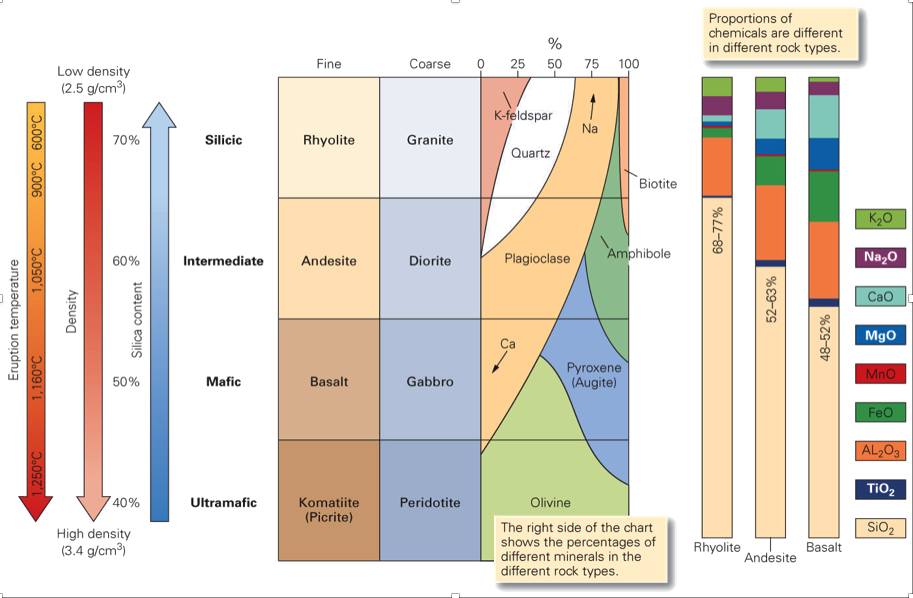
Based on the diagram below, what minerals would you find in a granite or rhyolite? (select all that apply)
olivine
amphibole
pyroxene
plagioclase
K-feldspar
biotite
quartz
amphibole
plagioclase
K-feldspar
biotite
quartz
In comparison to mafic rocks, silicic (or felsic) rocks tend ________.
to be less dense and erupt at lower temperatures
to be more dense and erupt at higher temperatures
to be less dense and have lower silica content
to be less dense and have lower viscosity
to be less dense and erupt at lower temperatures
The three ways to melt a rock are _________
increase temperature, decrease pressure, increase volatile contents
increase temperature, increase pressure, increase volatile contents
increase temperature, increase pressure, decrease volatile contents
increase temperature, decrease pressure, decrease volatile contents
increase temperature, decrease pressure, increase volatile contents
Intrusive igneous rocks that form by slow cooling of magma in the subsurface tend to have ________ than extrusive igneous rocks
more glass
larger crystals
smaller crystals
faster cooling rates
larger crystals
Andesite and rhyolite lavas are ______ viscous and are generally _______ in gas than basalt lavas. These properties tend to make rhyolite eruptions more explosive than basalt eruptions.
more / richer
more / poorer
less / richer
less / poorer
more / richer
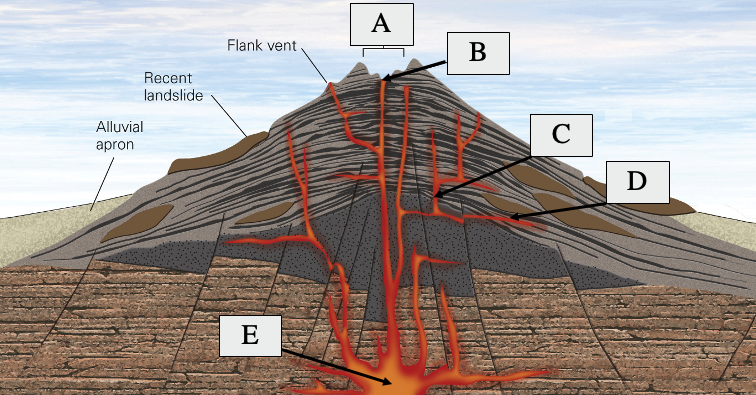
Match the letter with the volcanic feature. Not all words will be used.
options: crater, pre-volcanic basement, vent, lava flows, dike, tephra, sill, alluvium, magma chamber
a. crater
b. vent
c. dike
d. sill
e. magma chamber
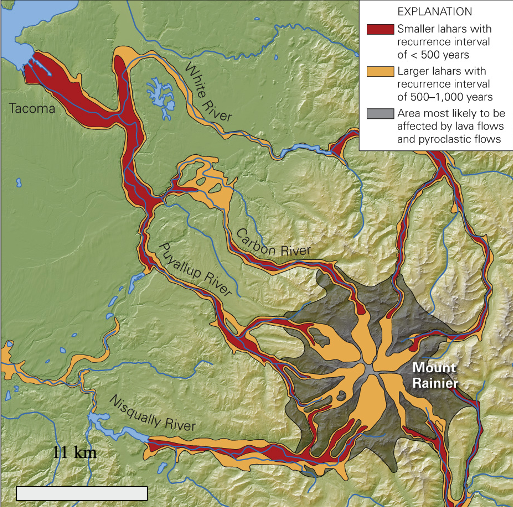
Examine the hazard map below. Approximately how far from the summit of Mount Rainier does the "area most likely to be affected by lava flows and pyroclastic flows" extend?
less than 1 kilometer
several kilometers
several tens of kilometers
several hundreds of kilometers
several kilometers