non-linear acoustics and contrast agents
 Call Kai
 Learn
Learn Practice Test
 Spaced Repetition
 Match
Match Flashcards
 Knowt Play
1/28

There's no tags or description
Looks like no tags are added yet.
Name | Mastery | Learn | Test | Matching | Spaced | Call with Kai |
|---|
No analytics yet
Send a link to your students to track their progress
29 Terms
what are the assumptions in linear acoustic (5)
system is linear:
doubling source amplitude doubles pressure everywhere
total acoustic pressure is the sum of individual waves
two pulses can cross without interacting
a propagating plane wave stays the same shape unless absorption occurs
sound speed depends only on the medium
what are some non-linear effects (6)
radiation pressure
streaming
cavitation
harmonic generation
shock formation
wave steepening
when does non-linear effects occur
high frequencies → non-linear effects are noticeable even at low acoustic pressures
large amplitude waves
material non-linearity: fluids become harder to compress the higher the pressure
convective non-linearity: change in wave speed due to particle movement
explain convective non-linearity
it is the change in waves speed (C) due to particle movement
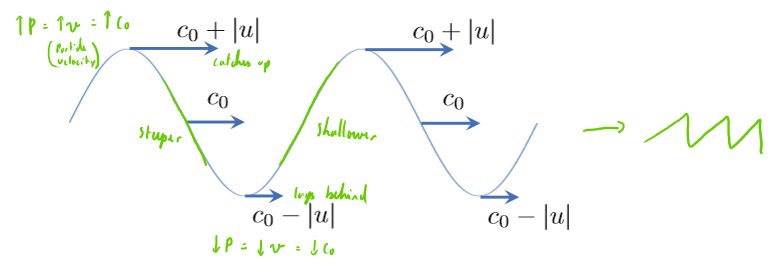
in areas of high pressure in the wave (compression) particles have increased velocity → sound wave travels faster C+=Co+∣u∣ → peak catches up with trough → gradient steepens
in areas of low pressure in the wave (rarefaction): particles have decreased velocity → wave travels slower C−=Co−∣u∣ → trough lags behind peaks → gradient shallows (decreases)
results in a sawtooth pattern which can lead to a shock (straight line)
convective non-linearity in the wave equation
affects the conservation of mass equation dtdρ=−ρo∇⋅u−2ρ∇⋅u
explain material non-linearities
when a fluid is compressed sufficiently → stiffness increases → sound speed increases at higher pressures → peaks travel faster than troughs
affects constitutive equation: p=co2(ρ+21ABρ0ρ2) where AB is the non-linearity parameter
see notes for derivation
why is material and convective nonlinearities the only nonlinearities that are kept
because their effect is cumulative as the wave travel → cumulative non-linearities
all other non-linear effect do not carry forward with the wave and only affect local waves → local-nonlinearities
what is the non-linearity coefficient?
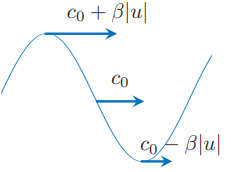
β = 1+21AB it is a measure of how a medium distorts an ultrasound wave as it propagates
what is the effect size of convective and material nonlinearities
the effect of material non-linearities is larges than convective ones
how does non-linearity affect frequency
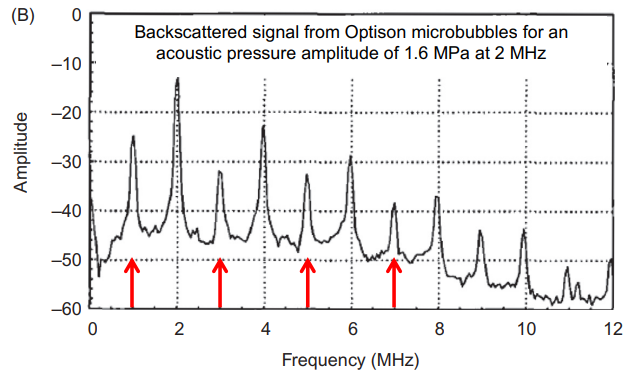
Single frequency input, : As the wave steepens, harmonics are generated
Energy from the lowest fundamental frequency gets moved up into higher frequencies
Frequencies appear at 2fo,3f0…
dual frequency input: f1 and f2 simultaneously
harmonics from each frequency is generated
sum and differences of the frequencies also appear

what is a shock
when the gradient is steep/large enough for the pressure change to occur on an intermolecular scale
what is the shock formation distance
x=ωβuoco2=2πfβpoρoco3
why is shock formation not likely?
as the wave energy is pushed to higher frequencies absorption also increases with frequencies → energy never reaches threshold for shock formation
where is non-linear effects most likely to occur
at the focus because they require high energy acoustic pressure
what is tissue harmonic imaging
in normal imaging you send and listen for the fundamental frequency
in harmonic imaging you listen for the second harmonic
what are the advantages of harmonic imaging
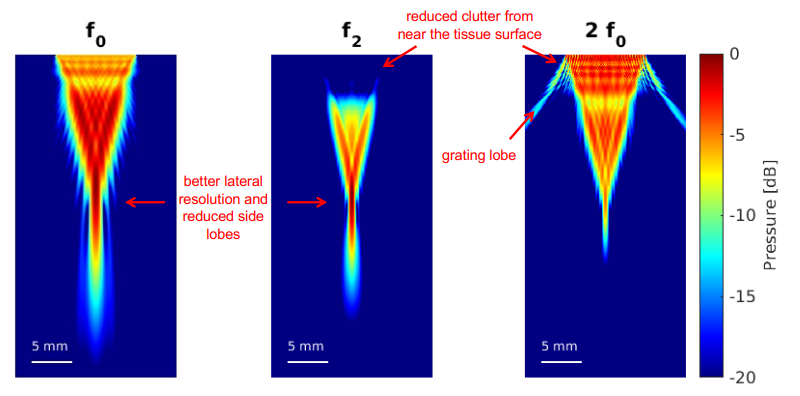
harmonics are not generated near the probe → less noise at tissue surface
harmonic beams are thinner → better lateral resolution
does doubling frequency have the same effect as the first harmonic
no
increased grating lobe
increased clutter and noise at the surface of the tissue
how is the 1st harmonic isolated
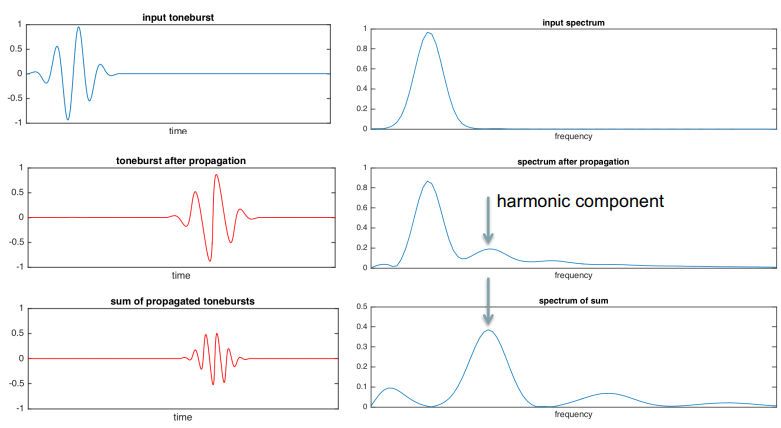
A narrowband transmit pulse is used → transmit spectrum does not overlap with that of the second harmonic
2 pulses are sent with inverted phase:
non-linear effect causes part of the signal to move to higher frequency
add the two signals together → fundamental parts sum to 0 → leaves non-linear component
no change in pulse length → no change in axial resolution
what are the drawbacks of harmonic imaging
use of narrowband pulse → longer pulse length → worse axial resolution
need to send 2 pulses → reduced frame rate
instead of 2 inverted pulse what is another way of isolating the harmonic
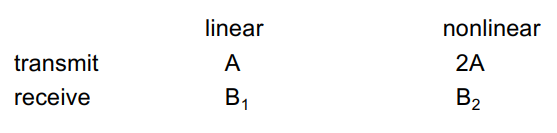
amplitude modulation:
send a pulse with twice the amplitude of the 1st one
linear parts are subtracted forming an image from B2−2B1
what are the disadvantages of amplitude modulation
halves frame rate
amplitude energy needs to be limited for safety
what are contrast agents in US
microbubbles → small enough to pass through the lungs and long lived enough to pass to the organs → micron sized
what is the pressure inside the bubble
pressure of the gas inside the bubble is greater than the liquid outside → due to surface tension
PGas=Pliquid+Plaplace=Pliquid+R2δ
where:
delta: surface tension
R: bubble radius
how do you prolong bubble life
high internal gas pressure causes diffusion out of the bubble → dissolve in under 1s
lower surface tension → reduced laplace pressure → reduce diffusion
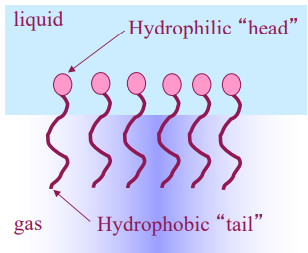
ex: coating surface with amphiphilic molecules that act as a surfactant (ex: mixing patient blood with microbubble) → lowers surface tension + creates a barrier to gas diffusion
make the bubble larger
use large molecular weight gas → makes diffusion more difficult
bubble behaviour with frequency
<0.1MPa: linear behaviour and linear cavitation
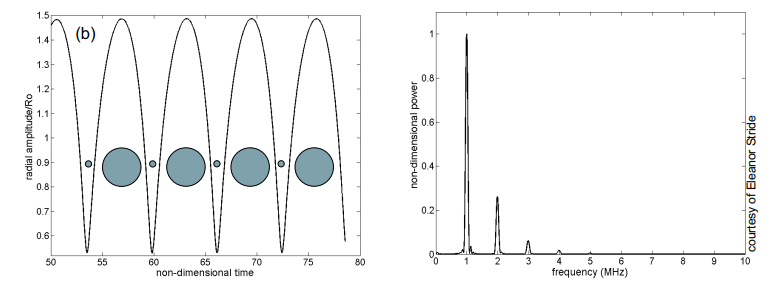
>0.1MPa: high amplitude pulsation → slight non-linear effect
pulsation is not symmetrical as when the bubble is compressed the gas acts as a spring → produces large amplitude waves
generates harmonics
how does coating affect non-linear effect
phospholipid coating → non-linear behaviour at low acoustic pressures
polymer coating → non-linear behaviour at higher acoustic pressures
when are subharmonics generated
at very large frequencies:
bubble shape may distort instead of bouncing
surface oscillations
bubble may miss some driving cycles
leads to the generation of subharmonics → fractions of the fundamental frequency
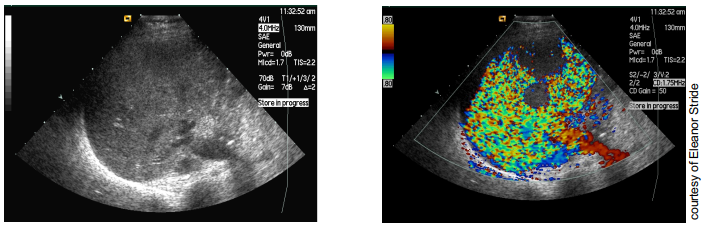
what is loss of correlation imaging
colour doppler mode is used to produce high pressure waves popping the contrast agent
released gas produces strong reflections
doppler interprets this as large random velocity fluctuations
used for perfusion studies → areas without bubbles → not perfused
very sensitive but low frame rate
dynamic contrast enhancement ultrasound
Method 1: Bolus injection
A bolus of USCA is injected
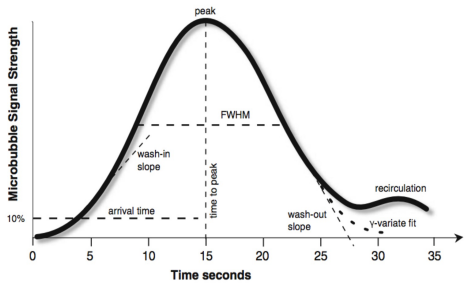
The Time-Intensity Curve shows wash-in/wash-out time
Method 2: Flash replenishment
USCA in image plane destroyed by a high amplitude pulse.
Time-Intensity Curve shows the replenishment time