Class 21, Ch 11.3 - Reducing Prejudice
 Call Kai
 Learn
Learn Practice Test
 Spaced Repetition
 Match
Match Flashcards
 Knowt Play
1/37

There's no tags or description
Looks like no tags are added yet.
Name | Mastery | Learn | Test | Matching | Spaced | Call with Kai |
|---|
No analytics yet
Send a link to your students to track their progress
38 Terms
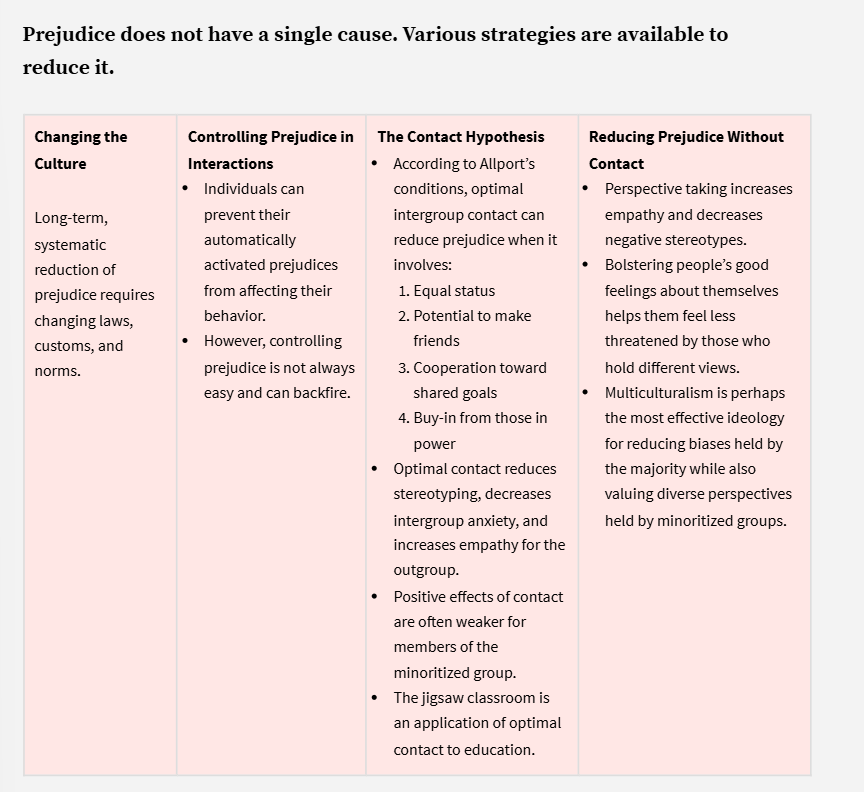
factors that make prejudice difficult to combat
people’s values and beliefs are long-standing basis of their psychological security
prejudice serves psychological functions for people (allowing them to displace their hostile feelings or fix their insecure self-esteem
prejudiced views and stereotypes constitute schemas, tend to bias perceptions, attributions, and memories in self-perpetuating way
people arent even aware of their prejudices and their influence'
prejudice and culture
it exists in cultural context and is legitimized by laws, customs, and norms of a society
reducing prejudice means changing these standards
a change in behavior often can lead to a change in attitudes because people strive for consistency between the two.
institutional changes can
stem from changing attitudes
help break down stereotypes
the more people are exposed to counterstereotypic fictional examples of marginalized groups, the less they show automatic activation of stereotyped associations
like nonbinary person playing a nonbinary character
like shows representing LGBTQ+
dual process view of prejudice
Process 1:
stereotypes and biased attitudes are brought to mind quickly and automatically through a reflexive or experiential process (sometimes called System 1
Process 2:
people employ reflective or cognitive processes (sometimes called System 2) to regulate or control the degree to which those thoughts and attitudes affect their behavior and judgment.
Education efforts are only successful when
individuals are motivated to control their biases
and some motivations can stem from different goals
when it stems from internal goal of being nonprejudiced= people can proactively keep implicit biases from influencing their decisions and judgment
when it stems from perception of external pressures = individuals may not genuinely change their biases. become resentful abt having to censor themselves
Trump’s presidency and prejudice
it was generaly decreasing over time, but now Trump supporters feel justified in expressing explicit prejudice so they do so agaisnt Blacks, Hispanics, Muslims, Jews, and immigrants
how to increase people’s intrinsic motivation to control prejudice?
1) impress on them necessity of cooperating with outgroup person
at some level, ppl realize that stereotypes arent accurate impressions of person’s ability when they work together
What did Bartholow et al. (2006) find about the neurological control of stereotyping?
Procedure:
White participants were shown pictures of Black targets
Researchers measured electrical brain signals linked to cognitive control
Some participants’ cognitive control was impaired by alcohol consumption
Results:
More cognitive-control brain signals = lower accessibility of stereotypic thoughts
When participants consumed alcohol, fewer control signals were emitted
As a result, they were less able to suppress stereotyping tendencies
Conclusion:
Stereotype control relies on active cognitive control processes in the brain, and when these processes are impaired, stereotypes become harder to regulate.
What did neuroscience research find about automatic vs. controlled stereotype responses?
Procedure:
White participants were shown Black faces very briefly (30 ms) and then for longer exposure (250 ms)
Researchers measured brain activation patterns
Results:
30 ms exposure: increased amygdala activation (automatic fear/threat response)
Greater amygdala activation was linked to stronger implicit negative associations
250 ms exposure: increased DLPFC activation (controlled judgment and decision making)
More DLPFC activation = less amygdala activation
The right posterior insula may also help control stereotype application
Conclusion:
Initial stereotype reactions may be automatic, but with more time, controlled brain processes can regulate and reduce those reactions.
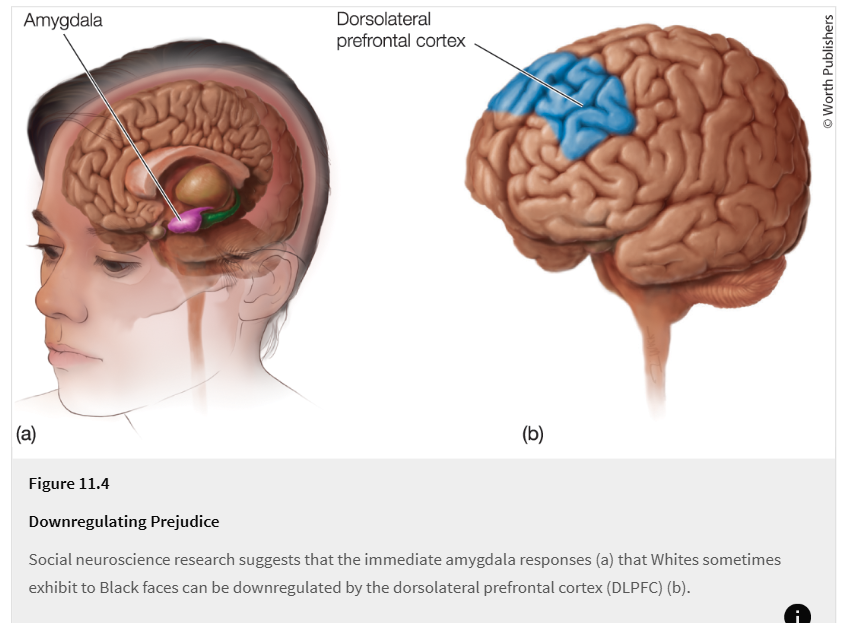
Downregulating Prejudice
Downregulating Prejudice Social neuroscience research suggests that the immediate amygdala responses (a) that Whites sometimes exhibit to Black faces can be downregulated by the dorsolateral prefrontal cortex (DLPFC)
What did Rogers & Prentice-Dunn (1981) find about emotion and prejudice?
Procedure:
White participants believed they were delivering shocks in a behavior-modification study
The “recipient” was either a White or Black confederate
Half of participants were first angered by an overheard insult
Results:
When not angry, participants chose a less severe shock for the Black confederate than for the White confederate
When angered, participants gave the Black confederate a stronger shock than the White confederate
Conclusion:
Negative emotion and arousal can reduce cognitive control and cause people to fall back on automatic prejudiced attitudes.
Prejudice isnt easy to control: Limitations
people make judgments of others when they’re already upser/aroused
congitive control is impaired so fall back to stereotypes
if they are distracted or busy, difficult to regulate automatic prejudice
What did Bodenhausen (1990) find about circadian rhythms and stereotyping in jury decisions?
Procedure:
Participants acted as jurors in an ambiguous case
The offense either matched or did not match a stereotype of the defendant’s group
Researchers compared decisions made at participants’ optimal vs. nonoptimal time of day
Results:
At their optimal time of day, participants were less influenced by stereotypes
At their nonoptimal time (ex. morning people at night), verdicts were more strongly shaped by stereotypes
Conclusion:
When people are mentally less alert, they are more likely to rely on stereotypes in judgment and decision making.
What are some negative consequences of controlling bias?
Mental depletion: controlling bias requires cognitive effort, which can reduce performance on later demanding tasks
Example: White students performed worse on a difficult computer task after talking with a Black peer compared to a White peer
Rebound effect: trying to suppress stereotypic thoughts can make them more likely to return later
This effect is stronger when cognitive resources are limited (stress, fatigue, distraction)
Bias control can be mentally exhausting, and suppressing stereotypes may ironically increase their later accessibility.
What did early desegregation research find about intergroup contact and prejudice?
Procedure / Observation:
In the late 1940s–1950s, White and Black merchant marines served in racially mixed crews
Researchers examined how continued contact affected racial attitudes
Results:
The more time White and Black marines worked together, the more positive their racial attitudes became
Conclusion:
This supports the contact hypothesis / mere exposure effect: increased interaction and familiarity between groups can help reduce prejudice and increase liking.
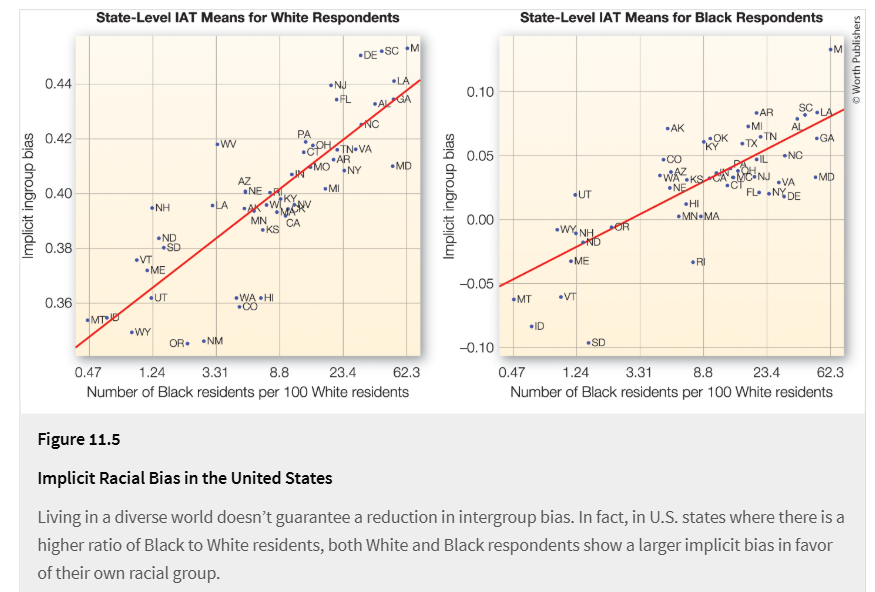
What did Rae et al. (2015) find about racial composition and implicit bias?
Procedure:
Researchers compared states with different proportions of Black residents
Implicit bias was measured using the Implicit Association Test (IAT)
Results:
In states with a higher proportion of Black residents, both White and Black participants showed a stronger tendency to favor their own racial group
Conclusion:
Greater group presence does not always reduce bias; in some contexts it can increase ingroup favoritism and outgroup bias.
According to Allport (1954), what conditions make intergroup contact reduce prejudice?
Optimal conditions for positive intergroup contact:
Equal status between groups in the interaction
Intimate and varied contact so people can genuinely get to know one another
Cooperation toward a superordinate goal that requires both groups to work together
Institutional support from authority, law, or social norms
Conclusion:
Intergroup contact is most effective at reducing prejudice when these four conditions are present.
subordinate goal
A common problem or shared goal that groups work together to solve or achieve.
The Robbers Cave Study
Sherif and colleagues
Procedure:
22boys participate in summer camp Oklahoma
assigned to two groups (rattlers or eagles)
keep groups separate first week (ingroup bonding) then make them learn about other group’s existence
2nd week, competitive tasks between groups
3rd week: need to get them to work together with subordinate goal
Results:
prejudice towards other group, viewed as opponent
competitive tasks = hostility, prejudice, violence with other team
subordinate goal: common goal requiring cooperation, hostilities disintegreated
shared threat of going without water → as people think abt the fate they share with others, sense of common humanity can help reduce prejudice
the robbers cave study cleaner version
Procedure:
Conducted by Muzafer Sherif and colleagues
A group of boys at a summer camp was split into two separate groups
Each group formed its own identity and norms
The groups were then placed in competition for prizes, which created hostility and prejudice
Later, researchers introduced superordinate goals (ex. fixing the camp’s water supply, pulling a truck together) that required cooperation
Results:
Competition led to ingroup favoritism and outgroup hostility
Cooperative tasks reduced conflict and improved attitudes
Conclusion:
The study showed that intergroup conflict can arise from competition over resources, but cooperation toward shared goals can reduce prejudice.
why does optimal contact (Allport) create positive change?
reduce stereotyping
they have to get to know each other when working together
decategorization, more individual impression
reduce anxiety
ppl usually have anxiety interacting with those different from themselves. enhance familiarity
foster empathy
adopt another’s perspective and see what they have in common
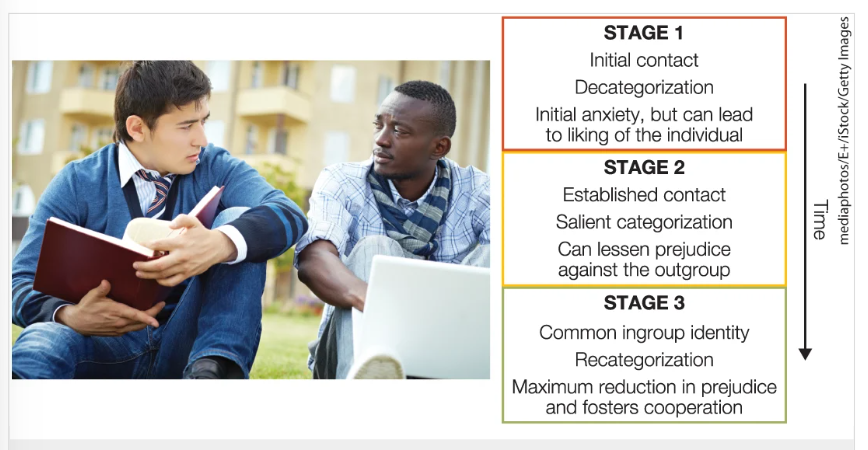
stages for intergroup contact
Positive contact with an individual from an outgroup is most likely to generalize to the outgroup as a whole when group categorization processes are initially reduced but then reintroduced over time.
1: initial contact & decategorization
2: salient categorization
3: common ingroup identity, recategorization
overall impression of outgroup changes if he regards the single person as representative of outgroup as a whole
if he sees the single person as unlike the whole outgroup, then his positive feelings are only towards the person and not to broader view of outgroup
multiculturalism vs colorbling
Multiculturalism: recognizes and values different cultural identities and group differences
Often preferred by minoritized groups because it can feel more empowering and validating
Emphasizes that group identities matter and should be acknowledged
Colorblind ideology: encourages people to ignore or “not see” group membership
Assumes differences do not matter, but may dismiss real experiences of bias and identity
Can make people feel as though their background is being overlooked or invalidated
Minoritized groups often prefer multiculturalism because it affirms identity, whereas colorblindness may minimize meaningful social differences.
common ingroup identity
A recategorizing of members of two or more distinct groups into a single, overarching group.
further reduces prejudice by harnessing the biases people have in favor of their ingroups
Green Circle Program - common ingroup identity
Elementary students completed activities emphasizing that all people belong to one human family, increased cooperation towards shared goal
Students later showed greater willingness to share and play with children of different races, genders, and body types
Demonstrates that emphasizing a shared identity reduces prejudice and increases inclusion
Key takeaway:
Seeing others as part of one larger group (“us”) can reduce ingroup–outgroup bias.
optimal distinctiveness
A theory that suggests individuals strive to balance their need for inclusion in a group with their desire for uniqueness, leading to a preference for group memberships that allow both belonging and distinctiveness.
we are most likely to identify with groups providing this
large enough to foster sense of commonality, small enough to allow us to feel distinct frm others
Does intergroup contact always improve attitudes for marginalized-group members?
Contact can be a mixed experience for marginalized-group members
Many contact situations are designed mainly to reduce majority-group prejudice (whites to POC)
This can make marginalized individuals feel that an important part of their identity is ignored or stripped away
Early contact may expose them to prejudice or bias from the majority group
This can actually increase negative attitudes toward the majority group
Therefore, contact situations may need to be specifically structured to support marginalized-group experiences and reduce mutual bias
Key idea:
Intergroup contact is not equally beneficial for everyone unless it accounts for the experiences of marginalized groups.
jigsaw classroom by Elliot Aronson
A cooperative learning strategy designed to reduce prejudice and improve intergroup relations
The class is divided into racially mixed small groups
Each student is assigned one subtopic of the lesson
Students with the same subtopic meet in expert groups to learn and prepare material
They then return to their original group and teach their section to teammates
Success depends on interdependence and cooperation, since each person holds an important piece of the lesson
Conclusion:
The jigsaw classroom reduces prejudice by promoting equal-status contact, cooperation, and shared goals.
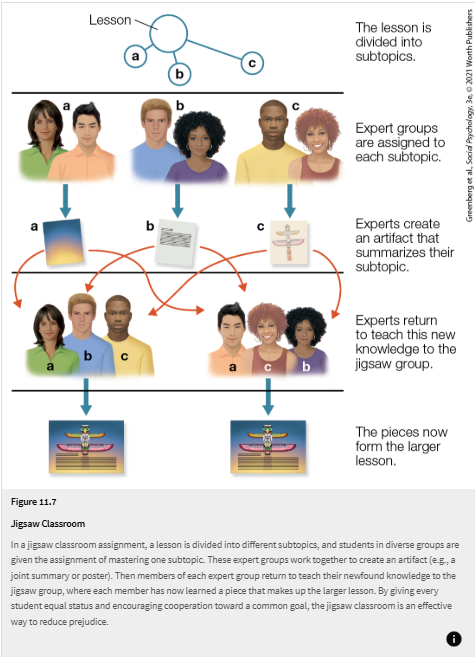
how jigsaw classroom satisfies Allports conditions for optimal contact
Institutional support: the activity is teacher assigned and authority sanctioned
Equal status: each student becomes the expert on one subtopic, so everyone has an important role
Superordinate/common goal: the group works toward a shared grade and successful completion of the lesson
Cooperation + intimate/varied contact: students must teach, learn from, and depend on one another
Key takeaway:
The jigsaw classroom fulfills all of Allport’s optimal contact conditions by creating equal-status, cooperative interaction toward a shared goal with authority support.
How can prejudice be reduced without direct intergroup contact?
Prejudice can be reduced through perspective taking
Jane Elliott created the Blue Eyes/Brown Eyes classroom exercise in 1968
She divided her all-White class into blue-eyed and brown-eyed groups
One group was treated as privileged, the other as stigmatized and inferior
Students directly experienced what it felt like to be discriminated against
This created a strong and lasting awareness of the harm caused by prejudice
Conclusion:
Perspective-taking exercises can reduce prejudice by helping people emotionally understand discrimination without direct contact between real social groups.
What did Todd et al. (2011) find about perspective taking and implicit prejudice?
Procedure:
White participants wrote about a day in the life of a young Black man
Perspective-taking condition: imagine what he is thinking and feeling
Control condition: write about his day objectively
Later, they set up chairs for an interview with either “Jake” (White) or “Tyrone” (Black)
Researchers measured chair distance as an implicit measure of prejudice
Results:
In the control condition, participants placed chairs farther from Tyrone than Jake
In the perspective-taking condition, they placed chairs at the same distance regardless of race
Conclusion:
Perspective taking reduces subtle implicit bias, shown by less social distancing toward a Black target.
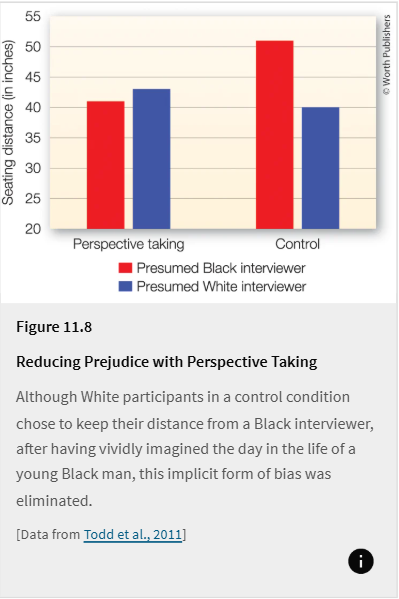
How does perspective taking (including virtual reality) reduce prejudice, and what are its limits?
Procedure / Example:
In Barcelona, light-skinned women used virtual reality to experience having darker skin
Compared with control groups, they later showed weaker implicit negative attitudes toward Black people on the IAT
Key findings:
Perspective taking can increase empathy and reduce implicit prejudice
Learning about majority privilege can also strengthen empathy for marginalized groups
Limitations:
May reduce prejudicial attitudes more than stereotypes
People are often inaccurate at imagining others’ true feelings
More effective to listen and learn directly from others’ experiences rather than assume
Conclusion: Perspective taking helps reduce bias, but it works best when combined with direct understanding of others’ lived experiences.
How can self-esteem and terror management theory explain prejudice?
People may hold negative attitudes toward others to protect a positive self-view
When self-esteem is threatened, individuals may derogate outgroups to restore self-worth (Fein & Spencer, 1997)
Terror Management Theory suggests:
Exposure to different worldviews can threaten one’s belief system
This can increase mortality (death) concerns
People respond by clinging more strongly to their own worldview
Often leads to greater prejudice toward outgroups
Implication: boosting or affirming self-esteem may reduce prejudice
Key idea:
Threats to self-worth or worldview can increase prejudice, while strengthening self-esteem can help reduce it.
self-affirmation theory Steele
suggests prejudice can be a defensive response to self-threat
In Fein & Spencer (1997):
Participants who received negative feedback were more likely to derogate a Jewish student
This reflects using outgroup bias to restore self-esteem
When participants first affirmed their personal values, they showed no increased discrimination
Self-affirmation reduced the need to defend the self through prejudice toward others
Key idea:
Affirming personal values can reduce prejudice by lowering the need to protect self-esteem through outgroup derogation.
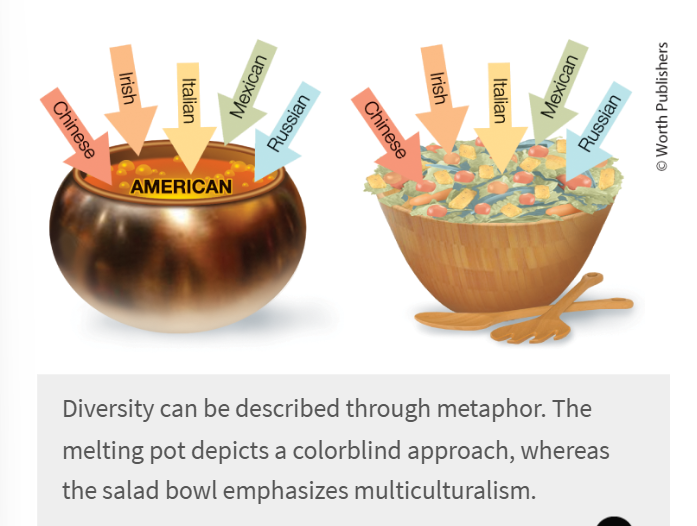
colorblind ideology
A worldview in which group identities are ignored and people are judged solely on their individual merits, thereby avoiding any judgment based on group membership.
Can lead to attempts to simply suppress or control bias, which may sometimes backfire
Can result in people avoiding even mentioning race, even when it is relevant or descriptive. erase meaningful group differences and experiences
multicultural ideology
A worldview in which different cultural identities and viewpoints are acknowledged and appreciated.
actively embracing diversity
U.S. = melting pot:
place where ppl of different ethnicities and former nationalities might blend to form a single group
Canada = salad bowl:
citizens form integrated collective while still maintaining distinct ethnic heritage
How can approach vs. avoid training influence interracial interactions? (Kawakami et al., 2007)
Participants completed a joystick task:
Pull = “approach”
Push = “avoid”
Subliminal Black faces were shown before the cues
Some participants repeatedly associated Black faces with approach, others with avoid
Results:
Those in the approach condition later behaved more friendly and open in an interracial interaction
Those in the avoid condition showed less positive behavior
Conclusion:
Approach/avoid tendencies can be unconsciously trained, and an approach mindset toward outgroups reduces biased behavior and improves interaction quality.
Section Review: Reducing Prejudice