Exam 2 MCQ
 Call Kai
 Learn
Learn Practice Test
 Spaced Repetition
 Match
Match Flashcards
 Knowt Play
1/164

There's no tags or description
Looks like no tags are added yet.
Name | Mastery | Learn | Test | Matching | Spaced | Call with Kai |
|---|
No analytics yet
Send a link to your students to track their progress
165 Terms
What kind of joint is a surture?
Synarthrosis
Which is a structure that is placed in high areas of friction that provides protection for tissues?
Ligaments
Cartilahe
Joint Capsule
Tendon Sheaths
Tendon sheaths
How many degrees of freedom does a saddle joint have?
2
Which lever has the effort furthest away from the fulcrum?
Second class lever
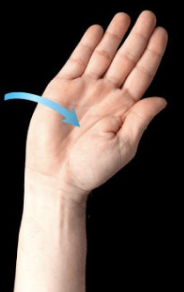
what is depicted ?
radial flexion
When you stand on your tippie toes what anatomical position?
plantar flexion
What is the purpose of Glenoid Labrum?
To deepen the socket of the humeroscapular joint for added stability
Identify 4 major ligaments of the knee joint. Then choose one ligament and explain how it helps stabalize the knee> The — ligament prevents the tibia from moving —-
Anterior cruciate ligament (ACL)
Posterior cruciate ligament (PCL)
Medial collateral ligament (MCL)
Lateral collateral ligament (LCL)
Example explanation (ACL):
The ACL prevents the tibia from moving anteriorly (forward) relative to the femur. It also helps control rotational stability of the knee during movement like cutting, jumping, and pivoting.
What kind of joint is a tooth joint
Synarthrosis
Which lever has the effort closest to the fulcrum which allows for better range in motion?
Third class lever
What are the small thin fluid structures that are placed around areas of high friction
Bursae
The ball and socket joint has how many degrees of freedom?
3
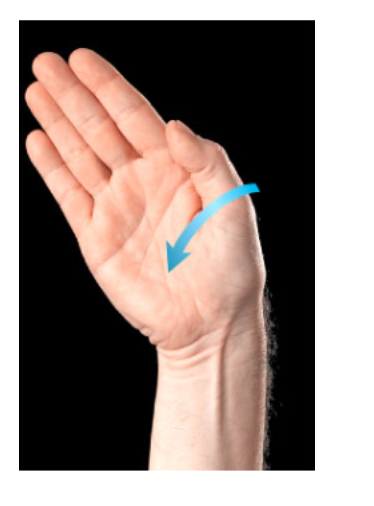
What is depicted?
ulnar flexion
When balancing on the heels of your feet without your toes touching the ground, what antomical position?
Dorsiflexion
What is NOT a muscle apart. ofthe rotator cuff?
Teres Major
Supraspinatus
Teres Minor
Subscapularis
Teres Major
Name three of the six different synovial joints, how many degrees they have, and one location in which you might find that joint?
1. Hinge joint
Degrees of movement: 1 degree of freedom (uniaxial — flexion/extension only)
Location: Elbow (humeroulnar joint) or knee
2. Ball-and-socket joint
Degrees of movement: 3 degrees of freedom (multiaxial — flexion/extension, abduction/adduction, rotation)
Location: Shoulder (glenohumeral joint) or hip
3. Pivot joint
Degrees of movement: 1 degree of freedom (rotation only)
Location: Atlantoaxial joint in the neck (C1–C2), or proximal radioulnar joint
The —— is the shaft region of a long bone
Diaphysis
What is the name of the cartilaginous structure that allows for bone growth?
Epiphyseal plate
Hydroxyapatites are good at resisting which type of force?
Compressional forces
What is the primary function of osteoclasts?
Breaking down bone tissue
Wolffs law explains?
Bone tissue will remodel in relation to mechanical stress
Which statement about spongy bone is true?
avascular
contains red blood marrow
organized in mostly osteons
it will resist bending to prevent malformation
Contains Red blood marrow
What is the last step of Endochondral Ossification?
Fusion of epiphyseal plate
Name two canals that house blood vessels in compact bone and identify which direction these blood vessels run in?
central canals: parallel to long axis
perforating/volkmans canal: horizontal to long axis
The —- is found on both the proximal and distal ends of a long bone
Epiphyses
What is the name of the calcified structure that has ceased bone growth?
Epiphyseal line
Collagen is good resisting which type of forces?
Tensile forces
What is the primary action of osteoblasts?
Building a new bone
Bone tissue is being remodeled due to stress from force, is an example of
Wolffs Law
Which statement is not true regarding spongy bone?
is organized mainly into osteons
contains trabeculae
reduction of the weight of the bones
contains red bone marrow
Is organized mainly into osteons
What is the first step of Endochondral Ossification?
Formation of primary ossification center
Name two types of bone marrow and their function?
Red bone marrow: active blood cell forming regions—> Production of RBCs
Yellow bone marrow: Storage of fat, soluble vitamins and nutrients used as an energy reserve
What type of cartilage is the zone of reserve composed of?
Hyaline
Wolff’s Law of Bone describes which of the following?
Bone adapts to the amount of stress placed upon it by remodeling over time
What does a Comminuted fracture indicate?
The bone decreased amount of organic material and increased in mineral content
What is the 3rd step of healing a fracture?
a) Bone remodeling
b) Soft callus formation
c) Hematoma formation
d) Hard callus formation
Hard callus formation
What cells are involved with the production of Hydrochloric acid?
a) Osteoclasts
b) Osteocytes
c) Osteoblasts
d) Osteogenic cells
Osteoclasts
The solubility product of calcium phosphate describes...
a) The pH level needed for bone growth
b) How much calcium is absorbed from food in the stomach
c) The amount of calcium stored in the bones at birth
d) The exact balance point where calcium and phosphate concentrations are favorable for mineral formation
The exact balance point where calcium and phosphate concentrations are favorable for mineral formation
What is the the first step in the healing of fractures?
a) Hard callus formation
b) Hematoma Formation
c) Soft callus formation
d) Bone remodeling
Hematoma Formation
Identify and describe what occurs in the zone of proliferation in the epiphyseal plate. Explain how the zone contributes to bone growth?
The zone of proliferation in the epiphyseal plate is where chondrocytes rapidly divide and form columns of cartilage cells which is later replaced by bone
Which zone contains rapidly dividing chondrocytes arranged in stacks or columns which are responsible for
longitudinal growth?
a) Zone of proliferation
b) Zone of hypertrophy
c) Zone of reserve cartilage
d) Zone of calcification
Zone of proliferation
Which of the following is an example of Wolff’s Law of Bone in action?
a) A person who begins weightlifting regularly develops increased bone density in their arms over time.
b) A person’s bones stop growing after puberty.
c) Calcium levels in the blood rise after drinking milk.
d) A child inherits their bone structure from their parents
A person who begins weightlifting regularly develops increased bone density in their arms over time.
What does a Greenstick fracture indicate?
a) The bone has broken into many fragments
b) The bone has a high protein content and low mineral content
c) This fracture is probably in a young and healthy individual.
d) The bone has a high mineral content but low protein content
The bone has a high protein content and low mineral content
How long does it take after a fracture for remodeling to start?
a) 1 to 2 weeks
b) 1 year
c) 3 to 4 months
d) 7-10 months
3-4 months
What cells associated with bone contain hydrogen pumps?
a) Osteoclasts
b) Osteocytes
c) Osteoblasts
d) Osteogenic cells
Osteoclasts
Who is at the greatest risk for Osteoporosis?
a) Postmenopausal black women
b) Postpartum women
c) Postmenopausal white women
d) Young adult women
Postmenopausal white women
What does the solubility product of Calcium Phosphate tell us?
a) The equilibrium points at which calcium and phosphate ions are balanced between dissolving and forming
solid minerals
b) The optimal ratio of calcium to phosphate required for bone ph.
c) The amount of calcium that must be present in blood for normal muscle contraction.
d) The rate at which calcium phosphate is transported into bone tissue
The equilibrium points at which calcium and phosphate ions are balanced between dissolving and forming solid minerals
Identify and describe what occurs in the zone of calcification in the epiphyseal plate. Explain how the zone contributes to bone growth.
Rest → Proliferation → Hypertrophy → Calcification → Ossification
In this zone, the cartilage matrix becomes calcified, and the chondrocytes die because nutrients can no longer diffuse through the hardened matrix. The spaces left behind form small cavities.
The process of calcium regulation in the body is an example of which of the following?
a) Positive feedback
b) Negative feedback
c) Calcium
d) Filtration
Negative feedback
Which of the following would be related to a decrease in blood calcium ?
a) Consistent tanning booth sessions
b) Intestinal disorders such as Crohn’s
c) Consuming vitamin A and D fortified dairy products
d) Hydroxyapatite resorption
Intestinal disorders such as Crohn’s
If a hormone is increasing blood calcium levels, which of the following would be true.
a) Increased osteoblast activity and decreased osteoclast activity
b) Osteocytes are dividing rapidly
c) Increased osteoclast activity and decreased osteoblast activity
d) Bone is becoming stronger
Increased osteoclast activity and decreased osteoblast activity
Which hormone primarily increases blood calcium levels by stimulating osteoclast activity
a) Calcitonin
b) Parathyroid hormone (PTH)
c) Growth hormone
d) Insulin
Parathyroid hormone (PTH)
What does calcitriol NOT do
a) Increase intestinal absorption
b) Increase stem cell differentiation into osteoclasts
c) Promote urinary reabsorption of calcium ions
d) Convert pituitary hormone into PTH
Convert pituitary hormone into PTH
Which of the following would promote bone deposition?
a) Intestinal exertion of phosphate
b) Increased parathyroid hormone level
c) Increased osteoblastic inhibition
d) Increase kidney reabsorption of calcium
Increase kidney reabsorption of calcium
Continuous high levels of PTH will most likely lead to:
a) Increased bone density
b) Increased bone resorption
c) Increased calcitonin secretion
d) Reduced calcium in blood
Increased bone resorption
Name the three hormones involved in blood calcium regulation and explain the function of one of the three hormones.
Calcitriol: raises blood calcium concentration. Increases intestinal absorption and absorption from the skeleton. Increases stem cell differentiation into osteoclasts. Promotes urinary reabsorption of calcium ions.
Calcitonin: Decreases blood calcium levels. Reduces osteoclast activity and increases osteoblast activity.
PTH: Increases blood calcium levels: Increases osteoblasts and decreases osteoclasts. Promotes calcium resorption by the kidneys. Promotes calcitriol synthesis.
The process of calcium regulation in the body is an example of which of the following?
a) Positive feedback
b) Negative feedback
c) Calcium
d) Filtration
Negative feedback
Which of the following would promote bone deposition?
a) Intestinal exertion of phosphate
b) Increased parathyroid hormone level
c) Increased osteoblastic inhibition
d) Increase kidney reabsorption of calcium
Increase kidney reabsorption of calcium
If a hormone is decreasing blood calcium levels, which of the following would be true.
a) Increased osteoblast activity and decreased osteoclast activity
b) Osteocytes are dividing rapidly
c) Increased osteoclast activity and decreased osteoblast activity
d) Bone is becoming weaker
Increased osteoblast activity and decreased osteoclast activity
Which of the following is NOT one of the hormones involved in blood calcium regulation?
a) Calcitonin
b) Parathyroid hormone
c) Calcitrol
d) Cortisol
Cortisol
Which hormone primarily decreases blood calcium levels by stimulating osteoblast activity
a) Parathyroid hormone (PTH)
b) Calcitonin
c) Growth hormone
d) Insulin
Calcitonin
Calcitonin is secreted from which structure?
a) Parathyroid glands
b) Adrenal Cortex
c) Thyroid gland
d) Pituitary gland
Thyroid gland
Which would be related to a decrease in blood calcium?
a) Intestinal disorders like Crohn’s
b) Consuming vitamin A and D products
c) Consistent tanning booth sessions
d) Hydroxyapatite resorption
Intestinal disorders like Crohn’s
Explain the difference between absorption, resorption, and deposition
.Absorption is the uptake of substances into the body (like nutrients from the gut), resorption is the breakdown and release of stored materials from tissue (like bone releasing calcium), and deposition is the buildup or addition of new material into tissue (like forming new bone).
Why is the force a muscle can generate decreased when the muscle is overly contracted?
a. The thin filaments begin to overlap, decreasing the number of binding spots for the myosin heads
b. ATP production is decreased due to the strain on the muscle
c. It is not more difficult, this is a common misconception
d. The myosin heads have used up all of the available ATP
The thin filaments begin to overlap, decreasing the number of binding spots for the myosin heads
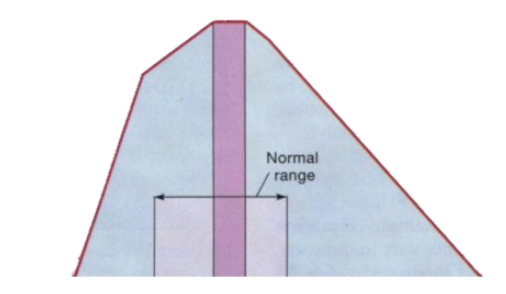
In this graph, the X-Axis shows the ____ and the Y-Axis shows the _____
a. Time; muscle mass
b. Time; Energy production
c. Sarcomere length; tension generated upon stimulation
d. Time; Stage of twitch contraction
Sarcomere length; tension generated upon stimulation
A muscle in a contractile phase that is active against a constant load, like a free weight, is a _______
contraction.
a. Concentric
b. Isotonic
c. Isometric
d. Eccentric
Isotonic
What energy system is in use when we are jumping up and down, as fast as we can, for 10 seconds?
a. Phosphagen System
b. Glycogen-lactic Acid System
c. Aerobic Respiration
d. Citric Acid Cycle
Phosphagen System
What type of muscle is best for aerobic energy production?
a. Red muscle
b. Mixed muscle
c. White muscle
d. Pink muscle
Red muscle
Rank the muscle fiber types in order of low to high mitochondrial content
a. Mixed muscle, red muscle, white muscle
b. Red muscle, mixed muscle, white muscle
c. Red muscle, white muscle, mixed muscle
d. White muscle, mixed muscle, red muscle
White muscle, mixed muscle, red muscle
At rest, what is the dominant pathway of ATP production?
a. Food ingestion
b. Aerobic respiration
c. Glycogen-lactic acid system
d. Phosphagen system
Aerobic respiration
At what sarcomere length does a muscle have maximum potential for force generation?
a) When the sarcomere is fully shortened
b) At moderate sarcometic lengths
c) When the sarcomere is fully stretched
d) Both when the sarcomere is fully shortened and fully stretched
At moderate sarcometic lengths
What mechanism allows a muscle to change its length during contraction?
a) Sliding of filaments
b) Actin and myosin wrapping around eachother
c) Actin dissolving and reforming
d) Filaments moving in a spring like motion
Sliding of filaments
Immediately after a muscle is stimulated, there is a brief delay before a force is produced. What is this
period called?
a) Refractory period
b) Recovery phase
c) Contraction phase
d) Latent period
Latent period
What occurs between the excitation of the muscle membrane and the start of contraction?
a) Calcium is released, binds to troponin, tropomyosin moves out of the way, cross bridges form
b) ATP is converted directly into shortening the muscle
c) Myosin heads permanently detach from actin
d) Oxygen is released into the muscle fiber
Calcium is released, binds to troponin, tropomyosin moves out of the way, cross bridges form
Which of the following describes an isometric contraction?
a) The muscle shortens while producing force
b) The muscle lengthens while producing force
c) The muscle is neither lengthening nor shortening while producing force
d) The muscle alternates between shortening and lengthening while producing force
The muscle is neither lengthening nor shortening while producing force
What is the correct order in which the body uses energy systems to produce ATP during exercise?
a) Aerobic → Phosphagen → Glycogen-lactic acid
b) Glycogen-lactic acid → Aerobic → Phosphagen
c) Aerobic → Glycogen-lactic acid → Phosphagen
d) Phosphagen → Glycogen-lactic acid → Aerobic
Phosphagen → Glycogen-lactic acid → Aerobic
What primarily determines the types of muscle fibers a person has?
a) Activity
b) Genetics
c) Diet
d) Hormones
Genetics
Which of the following is NOT one of the primary functions of the nervous system?
a) Effect
b) Translation
c) Sensation
d) Integration
Translation
Which of the following makes up the Central Nervous System?
a) Brain and Spinal Cord
b) Brain Stem and Glial Cells
c) Frontal Lobe and Spinal Cord
d) Nerve Roots, Axons
Brain and Spinal Cord
In the Central Nervous System the major anatomical subdivisions are tracts and nuclei, what are these
called in the Peripheral Nervous System?
a) Tracts - Ganglion, Nuclei - Nerve
b) Nuclei - Tracts, Nerve - Ganglion
c) Tracts- Nerve, Nuclei - Ganglion
d) They are referred to as tracts and nuclei in both the CNS and PNS
Tracts- Nerve, Nuclei - Ganglion
Which of the following describes the function of afferent neurons?
a) Transmit signals from the CNS to muscle effectors
b) Transmit signals from sensory receptors to the CNS
c) Connect motor neurons directly to target cells
d) Only function in the spinal cord, operating within the CNS
Transmit signals from sensory receptors to the CNS
Which correctly matches the main functional properties of neurons?
a) Excitability; response to stimuli, Conductivity; transmission, Secretion; release neurotransmitters
b) Excitability; response to stimuli, Contractility; shortening, Elasticity; ability to stretch
c) Excitability; grow rapidly, Conductivity; digest nutrients, Secretion; storage of energy
d) Excitability; move muscles, Conductivity; neuron division, Metabolism; signals ATP production
Excitability; response to stimuli, Conductivity; transmission, Secretion; release neurotransmitters
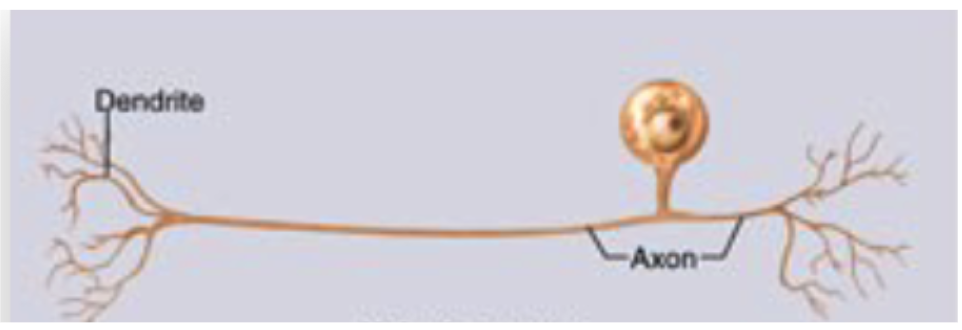
What type of neuron does this image depict
a) Multipolar neuron
b) Bipolar neuron
c) Unipolar neuron
d) Anaxonic neuron
Unipolar neuron
What is the primary function of myelin in the nervous system?
a) To produce neurotransmitters at the synapse
b) To insulate axons and increase speed of nerve impulses
c) To receive incoming signals from other neurons
d) To break down damaged nerve cells
To insulate axons and increase speed of nerve impulses
Name the four main differences between the endocrine and nervous system. Pick one difference and explain what this means/specifically how they differ.
Speed and persistence: Nervous system is faster and short-lived, endocrine is slower and longer-lived.
Communication: Nervous is Chemical and Electrical, Endocrine is only Chemical
Adaptability: Nervous system adapts quickly, endocrine adapts slowly.
Area of Effect: Nervous is specific and Endocrine is widespread
The _________ utilizes only chemical signals while the ___________ utilizes both electrical and
chemical signals.
a) Nervous System, Endocrine System
b) Nervous System, Muscular System
c) Lymphatic System, Nervous System
d) Endocrine System, Nervous System
Endocrine System, Nervous System
Tracts refer to which part of the neuron?
a) Axons
b) Dendrites Only
c) Clusters of Cell bodies and Dendritic attachments
d) Ganglion
Axons
Which of the following describes the function of efferent neurons?
a) Transmit signals from the CNS to effectors like muscle
b) Transmit signals from sensory receptors to the CNS
c) Connect motor neurons directly to target cells
d) Only function in the spinal cord, operating within the CNS
Transmit signals from the CNS to effectors like muscle
What is TRUE about astrocytes in the CNS
a) Generate action potentials and transmit impulses
b) Formation of myelin sheath
c) Maintain blood-brain barrier
d) Production of CSF within the ventricles of the brain
Maintain blood-brain barrier
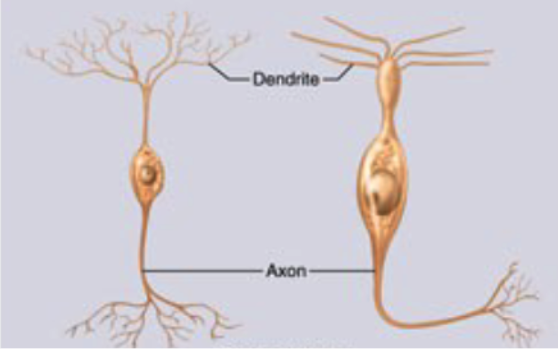
What type of neuron does this image depict
a) Multipolar neuron
b) Bipolar neuron
c) Unipolar neuron
d) Anaxonic neuron
Bipolar neuron
What is the role of interneurons?
a) Carry sensory information from receptors to CNS
b) Carry motor information from CNS to effectors
c) Carry and filter sensory information between sensory and motor neurons, in CNS
d) Formation of myelin sheath in between neurons
Carry and filter sensory information between sensory and motor neurons, in CNS
Name the two subdivisions of the motor division of the PNS. Explain the function of each of these divisions and whether they are under voluntary or involuntary control
Visceral Motor Division or Autonomic Nervous System (ANS): Impulses from brain and spinal cord out to Organs of the body. Involuntary control.
Somatic Motor Division: Impulses going to your muscles. Voluntary control. 2
Threshold is reached at _____
-55mV
During Resting Membrane Potential, the ____ is positive and the _____ is negative.
ECF; ICF
For a Local Depolarization to occur, what needs to happen first?
a. Acetylcholine is released and binds to a ligand gated channel.
b. Threshold needs to be reached.
c. K+ voltage gated channels need to open.
d. Acetylcholine needs to be broken down
Acetylcholine is released and binds to a ligand gated channel
What is NOT a characteristic of Local Potential?
a. Graded
b. Can be excitatory or inhibitory
c. Non-Decremental
d. Reversible
Non-Decremental
Why is a concentration gradient across the cell membrane essential for local and action potentials?
a. To allow for different solubility on both sides
b. To allow for osmosis to occur
c. To ensure that not too many neurotransmitters will be released.
d. To create a “driving force” for ions to move
To create a “driving force” for ions to move
What is the voltage of the resting membrane potential?
a) + 70 mV
b) - 55 mV
c) - 70 mV
d) + 55 mV
- 70 mV
In the local depolarizing phase, the ICF becomes less negative due to....
a) An influx of sodium ions
b) An efflux of chloride ions
c) An efflux of sodium ions
d) An influx of potassium ions
An influx of sodium ions