9a - retrieval processes
 Call Kai
 Learn
Learn Practice Test
 Spaced Repetition
 Match
Match Flashcards
 Knowt Play
1/22

There's no tags or description
Looks like no tags are added yet.
Name | Mastery | Learn | Test | Matching | Spaced | Call with Kai |
|---|
No analytics yet
Send a link to your students to track their progress
23 Terms
what is retrieval?
a progression from one or more retrieval cues to a target memory trace through associative connections
retreival cues
bits of information about the target memory that guide the search
associations
bonds that link together items in memory
target memory trace
the particular memory we are searching for
activation level
the internal state of a memory, reflecting its level of excitement, determines accessibiity of the item
increases when
something related to the memory is encountered
persists for some time
spreading activation
the automatic transmission of ‘energy’ from one memory to related items via associations
proportional to the strength of connections
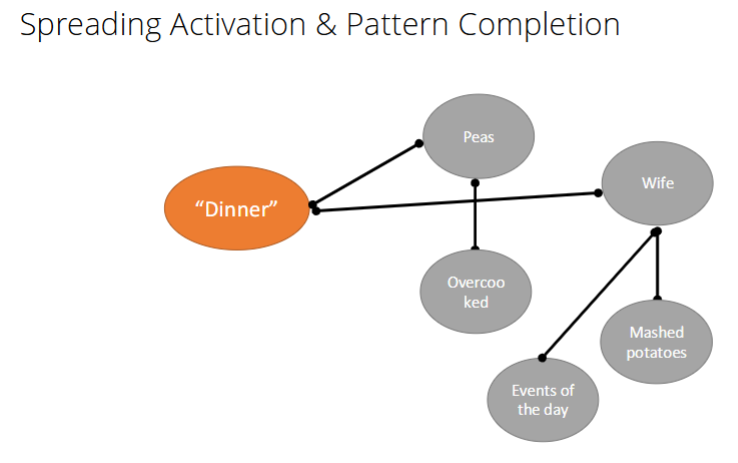
what is pattern completion
pattern completion = the process by which spreading activation from a set of cues leads to the reinstatement of a memory
hippocampal mechanism
what factors determine retrieval success?
attention to cues → reduced attention impairs its use
relevance of cues → most strong if present at encoding
cue-target associative strength
number of cues
strength of target memory
retrieval strategy
retrieval mode
what are direct/explicit memory tests
ask people to recall particular experiences
require a contextual cue
reveal impaired performance on amnesics
in many cases rely on hippocampus
what are indirect/implicit memory tests
measure the unconscious influence of experience without asking the subject to recall the past
priming: recent experience with the stimulus improves performance
reveal normal performance in amnesics
what tasks might be used to test explicit memory
free recall
cued recall
yes/no recognition
forced-choice recognition
what tasks might be used to study implicit memory
stem completion
fragment completion
conceptual fluency
what types of contextual cues are there
spatio-temporal/environmental → location and time cues during an event
mood → emotional state during event
physiological → physical state during event
cognitive → collection of concepts one has thought about during the event
outline a study that shows context-dependent memory
godden & baddeley: taught divers words in pairs either on land or in water
materials were recalled best in the environment learned
what did grant et al find about context-dependent memory
pps did better when the testing condition was same as study condition (quiet vs noisy)
what is state dependent memory
recall depends on the match between pps internal environment at encoding and retrieval
outline some studies that show state-dependent memory
drunk
under the influence of weed or caffiene
exercising or at rest
mood
cognitive context-dependent memory
retrieval is better if the same cognitive features/tasks are involved
e.g. Marian and Neisser → bilingual people find it easier to access memories that are encoded in same language as retrieval
how is memory reconstructive
retrieved memories are not entirely intact → reconstructive memory: inferential aspect of memory
what is recognition memory
decide whether one encountered a stimulus before
presents the stimulus (i.e. target) unlike in recall
discrimination between OLD and NEW stimuli
old = studied stimuli, new = non-studied distractors, lures or foils
what is signal detection theory (SDT)
to understand and explore recognition memory decisions, developed from auditory perception
e.g. detect a tone (signal) presented against background noise (hard or easy to detect)
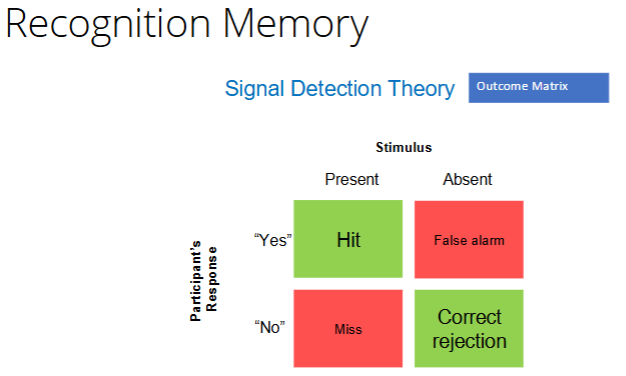
evaluate SDT and dual-process theory
SDT cannot account for all recognition memory phenomena
word frequency effect: low frequency words are better recognised although high frequency words are better recalled
SDT incorrectly predicts low-frequency words should be less familiar
what does Mandler say are the 2 types of memory or processes associated with recognition
Familiarity: a sense of memory without being able to remember contextual information. described by signal detection, faster and more automatic
Recollection: retrieving contextual details about a stimulus - like cued recall. slower and more attention demanding.