F5 T1 - Fragile environments
 Call Kai
 Learn
Learn Practice Test
 Spaced Repetition
 Match
Match Flashcards
 Knowt Play
1/32

There's no tags or description
Looks like no tags are added yet.
Name | Mastery | Learn | Test | Matching | Spaced | Call with Kai |
|---|
No analytics yet
Send a link to your students to track their progress
33 Terms
abiotic factors
non living factors
biotic factors
living factors
a fragile environment
a region that is
easily disturbed
difficult to restore if disturbed
unable to adapt to changes brought on by physical activities
natural hazards such as volcanoes and human causes eg. global warming
desertification
process which arable land in the drylands degrades where there is a decline in soil quality and loss of nutrients, making the land turn into a desert
difference between droughts and desertification
droughts are naturally occuring event in which precipitation levels are below normal recorded levels for an extended period of time. this reduces amount of water available in waterbodies and vegetation.
an area is described as arid when it has little or on rain
impacts of desertification
loss of biodiversity as plant and animal species decrease
increased deforestation as people clear more land to grow crops
increrase in rural poverty
increased food shortages (famine)
malnutrition, people lack essential nutrients → increased number of diseases
migration
conflict between migrants and local populations
less trade due to lack of agricultural output, making country dependent on aid
causes of desertification
human causes
overgrazing (vegetation disappear due to high number of animals and land does not have a chance to recover)
overcultivation (nutrients taken up by cash crop and leave none for the future vegetation to grow)
deforestation
a. removes shade for the soil, increasing evaporation and reduces soil moisture
b. reduces roots which bind the soil together, increasing soil erosion and reduces infiltration and interceptionpopulation growth (more crops grown and animals reared → more pressure on land
migration (additional pressure on land)
conflict - crops and animals are destroyed eg. mali, sudan
natural causes
soil erosion ( result of sandstorms and intense rains) lead to loss of nutrients, preventing the plant from growing
changing rainfall patterns → increased surface runoff and soil erosion
droughts (reduces supply of water stored in aquifers and soil
technology
application of scientific knowledge for practical purposes
solutions to desertification
water management (supply and demand can be managed). water use can be monitored, reduce demand by installing water metres in houses and limiting the use of water by law. eg. hoover dam, three gorges dam in china
desalination (a water supply option used widely around the world and involves taking the salt out of water to make it drinkable.
water transfers (involve systems of dams, reservoirs, pipes, canals to transfwer large amounts of water from a donor basin to a recipient basin) eg. sugarloaf pipeline in australia
satellites (used to map progressing desertification), then GIS can be used to find and help areas prone to desertification
using technology in agriculture
a. terracing (method of farming and soil conservation on hills and sloped lands, involving the building step-like structures along a slope. prevents surface runoff, encourages percolation and prevents soil erosion)
b. magic stones (or bunds) - circles of stones places on the ground to hold water on the soil rather than it running off. percolation and prevents erosionc. c. drip irrigation (where water drops slowly into ground from pin-sized holes in a hose. minimizes water loss, maximises effectivenessd.
d. agroforestry (practice which integrates high-value multi-purpose trees and shrubs into croplands)planting more trees (roots of trees hold soil together, reduce soil erosion from wind and rain) eg. Great Green Walls
migration (establish economic opportunities outside drylands for people to migrate to
intermediate technology
use of equipment and techniques that are suitable for their country of use. Some poorer countries lack the skills needed to maintain complex equipment. With this in mind, small-scale, basic solutions are often more appropriate
sustainability
actions that meet today’s needs and also save enough for the next generation whilst minimising the negative impacts on the environment eg. pollution and promote human wellbeing
deforestation
cutting down of trees; deliberate clearing of forested land, often causing serious env problems such as soil erosion
why would some countries encourage clearance of forests?
eg. brazil and malaysia
1. revenue earned from selling timber, minerals and sources of medicinal drugs help pay off debts and fund economic development
provides land and food for growing populations
logging
cutting down trees for timber
characteristics of rainforests
very high annual rainfall (over 2,000mm/year)
high average temperatures; very warm (daily temp of 28degrees), never drops 20degrees and rarely exceeds 35degrees. no seasons, consistent.
nutrient-poor soil: thin layer of fertile topsoil found at surface where dead leaves decompose.
high levels of biodiversity
causes of deforestation
commercil timber extraction - selective logging done but they fall and damage other trees. clear felling is more damaging
agricuture - areas of tropical rainforests have been cleared for plantatinos growing a single crop such as rubber. grasslands grown for cattles
mining - large areas of forests clearde for open-cast mining of minerals
transport - roads built through rainforests to enable transports of minerals etc.
settlement - build houses and services for growing population
energy extraction (HEP) - rivers dammed and huge areas of forests flooded as a result
land for farmers
impacts of deforestation
loss of biodiversity (provides humans w a whole range of goods and services from food to timer, medicines, clothes and resins)
climate change and contribution to global warming - co2 is greenhouse gas building up in the ozone layer, causing global warming
increased soil erosion - forest cover removed, topsoil washed or blown away easily, reducing fertility of the remaining soil significantly
benefit of economic developement - simulate economic development in brazil and guyana selling trees for various purposes. madagascar needs to pay off debts
sustainable use and management
use resources now in such a way that future generations will be able to use the same resource
sustainable management in general
respect the env and local cultures
use traditional skills and knowledge
give people control over their lands and lives
use appropriate technology that are cheap, easy to use and not harm env
generate income for local communities, not transnational companies (TNCs)
protect biodiversity
sustainable management in forestry
protection of forests - designated conservatino areas and national parks where little development can take plafce
carefully planned and controlled logging in forests - logging licenses, bans on cutting certain trees essential for biodiversity
restricting number of logging licenses
selective logging
heli-logging (helicopters used to remove logs so less damage done to remaining forests)
replanting forested areas
developing alternate energy supplies
agro foresetry - combining trees and crops
a. by allowing crops to be grown in carefully controlled areas within the forest
b. by growing trees on farms outside the rainforestsubstitution
using saetllites to monitor illegal logging (Greenpeacce and wildlife fund for nature WWF does this along w gov.)
global warming
an increase in average temperature of the earth’s surface for at least 30 years
climate change
changes of average weather patterns (such as rain, wind, temperatures) over a
period of at least 30 years. It can be natural or caused by humans
natural greenhouse effect
natural warming of the Earth’s atmosphere due to the trapping of heat that would otherwise be radiated back into space (see diagram below). It keeps the earth warm and habitable at about 15 degrees Celsius; without this process, the earth would be about -18 degrees Celsius.
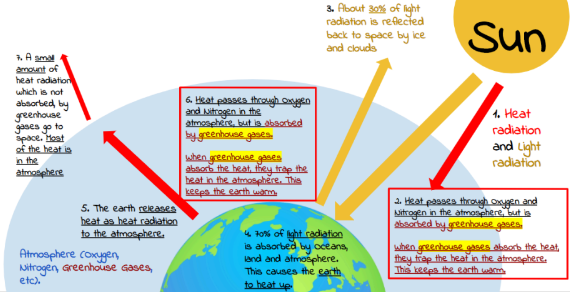
greenhouse gases
are gases in Earth’s atmosphere that trap heat. They let light pass through the atmosphere, but they absorb heat from sunlight.
human- enhanced greenhouse effect
current increased heating of the earth, which is caused by the additional greenhouse gases released through human activities.
causes of global warming
human causes
1. carbon dioxide released when fossil fuels are burnt (coal, oil and natural gas from power stations and motor vehicles), when wood is burnt as fuel, and through deforestation.
methane released from the decay of organic matter eg. waste from landifll sites, animal manure, large areas of crops
nitrous oxide released from the burning of fossil fuels and use of artificial fertiliser
chlorofluorocarbons; gases from aerosols and coolants in fridges
natural causes
solar output: changes the avg amount of solar radiation that reaches earths outer atmosphere. correlate w number and frequency of “sunspots”
milankovich cycles: earths position with respect to the sun varies slightly every 23,000 to 100,000 years. (little impact on shorter timescales bc they take place so slowly)
volcanic eruption: large quantities of dust and ash scattered by huge eruptions circulate and reflect solar radiation outward, keeping earth slightly cooler. mount pinatubo in the phillippines in 1991 cooled the earth 0.4 degrees.
impacts of climate change
1. Global land temperatures are 1 degree Celsius higher than they were in the 19th Century. Most of the warming occurred in the past 40 years, with the seven most recent years being the warmest. The years 2016 and 2020 are tied for the warmest year on record. The ocean has absorbed much of this increased heat, with the top 100 metres of ocean showing warming of more than 0.33 degrees Celsius since 1969
2. Greenland lost an average of 279 billion tons of ice per year between 1993 and 2019, while Antarctica lost about 148 billion tons of ice per year.Glaciers are retreating almost everywhere around the world — including in the Alps, Himalayas, Andes, Rockies, Alaska, and Africa.
3. Global sea level rose about 8 inches in the last century. The rate in the last two decades, however, is nearly double that of the last century and accelerating slightly every year. This is mainly due to thermal expansion, but is also due to the release of meltwater from glaciers. Note: melting of sea ice does not contribute much as the sea ice is already frozen sea water.
4. Since the beginning of the Industrial Revolution, the acidity of surface ocean waters has increased by about 30%.This increase is the result of humans emitting more carbon dioxide into the atmosphere and hence more being absorbed into the ocean. The ocean has absorbed between 20% and 30% of total anthropogenic carbon dioxide emissions in recent decades (7.2 to 10.8 billion metric tons per year).
tipping points
point in a system, where a tiny change on the point could push a system into a completely new state, irreversible change.
solutions to climate change
adaptation: adjusting to actual or expected climate impacts (eg. building sea walls to protect against sea level rise/ investing in drought resistant crops)
mitigation: reducing or preventing the emission of greenhouse gases, limiting future warming. (eg. switching to renewable energy or implementing carbon taxes)
montreal protocol (1987)
countries come together and agreed to reduce carbofluorocarbons - destroying o-layer
agreement was a success, o-zone healing
success because:
a. effective and more ozone friendly alternative chemical to replace CFCs
b. p.m of uk and president of usa led the movement
earth summit, rio 1992
set out aims to stabilise greenhouse gas levels
kyoto protocol 1997
created in 1997, only agreed and signed in 1005
150 countries agreed to reduce g.g emissions
stated industrialised countries would reduce emissions to below levles in 1990
us dropped out
china and india exempt from the agreement, only developed countries given targets to reduce emissions
countries did not reach goals, treaty failed
canada withdrew in 2011
paris agreement 2015
historical global agreement, ALL countries participated
limited to well below 2 degrees celcius
all countries had to submit a plant and goals to reduce emissions
countries voluntarily agree, un monitor individual countries
created a climate action fund of 100b/year usd
countries meet once a year, called conference of parties
currently almost no countries are meeting their targets