Toxicology - Risk assessment
 Call Kai
 Learn
Learn Practice Test
 Spaced Repetition
 Match
Match Flashcards
 Knowt Play
1/16

There's no tags or description
Looks like no tags are added yet.
Name | Mastery | Learn | Test | Matching | Spaced | Call with Kai |
|---|
No analytics yet
Send a link to your students to track their progress
17 Terms
What is a risk assessment?
The process by which hazard, exposure and risk are determined.
Risk = hazard x exposure
What are different routes of exposure?
gastrointestinal tract (oral)
lungs (inhalation)
skin (dermal)
injections (for medicines)
How do you assess duration and frequency of exposure?
Acute —> <24 hours, single dose
Sub-acute —> one month or less, repeated exposure
Sub-chronic —> 1-3 months, repeated exposure
Chronic —> >3 months, repeated exposure
What is an example of acute exposure?
Methyl isocyanate
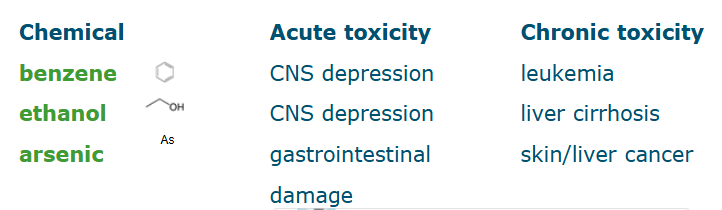
arsenic —> skin cancer
what are examples of acute vs chronic toxicity?
What does EDI stand for?
EDI = estimated daily intake
assessed using probability (concentration x consumption)
How do you assess non-genotoxic compounds?
NOAEL (no observable adverse effect level)
LOAEL (lowest observed adverse effect level)
Benchmark dose approach
ADI & TDI
Poor quality data
What are advantages & disadvantages of the benchmark dose approach?
Advantages:
Use all data
independent of choice of exposure
Disadvantages:
effect levels, no info on non-effect levels
low effect levels are difficult to quantify
How do you characterize a risk?
Margin of safety (MOS) should be:
(ADI/EDI) >/= 1
(NOAEL or BMDL/EDI) >/= 100
What is the margin of exposure for substances that are neither genotoxic nor carcinogenic?
the uncertainty of effects does not allow an established ADI or TDI
min. MOE is 100 or larger
below 100 is public health concern
What is an example of a non-genotoxic chemical?
vomitoxin (DON)
trichothecene from fusarium spp on wheat —> immunotoxicity, growth retardation
cyclamate
ADI cannot be unchanged
MPL will be reduced
How do you conduct a risk assessment for genotoxic carcinogenic compounds?
Avoidable contaminants:
zero tolerance —> compound cannot be used
Unavoidable contaminants:
ALARA —> as low as reasonably achievable
VSD (virtual safe dose) —> define dose with acceptable cancer risk
MOE (margin of exposure)
What are examples of genotoxic carcinogenic compounds?
acrylamide
estragole
Is a quantitative risk assessment for genotoxic carcinogens accepted?
No, it is not accepted
low dose cancer risk extrapolation —> differences by different models
linear extrapolation —> unrealistic (too many assumptions)
outcomes give false sense of accuracy
chances of misuse and misinterpretation of outcome
too much considered as true by consumers, politicians and managers
species differences are not taken into account
How do you find and interpret the MOE for genotoxic carcinogenic compounds?
MOE = BMDL/EDI
MOE used by risk managers to set priorities
MOE > 10000 low priority for risk management
Why is the MOE for genotoxic compounds 10000?
The 100 fold factor (from not genotoxic carcinogens) is multiplied by an additional factor of 10 to account for differences in human cell ability to repair DNA. To account for any other uncertainties an additional factor of 10 is added.
What is risk management?
An action taken by risk managers based on toxicological risk assessment, social, economical and political aspects.