history (Dalton, J. J. Thomson, Rutherford, Maxwell, Planck, Einstein)
 Call Kai
 Learn
Learn Practice Test
 Spaced Repetition
 Match
Match Flashcards
 Knowt Play
1/14

There's no tags or description
Looks like no tags are added yet.
Name | Mastery | Learn | Test | Matching | Spaced | Call with Kai |
|---|
No analytics yet
Send a link to your students to track their progress
15 Terms
Dalton Atomic Theory
All matter was composed of small indivisible particles termed atoms
Atoms of a given element possess unique characteristics and weight
Three types of atoms exist: simple (elements), compound (simple molecules), and complex (complex molecules)
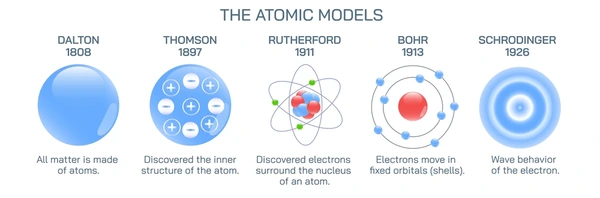
what did Thomson discover
electrons and showed that it was part of the structure of the atom.
what did Thomson theorize
electrons were much like raisins in pudding, where the pudding is the positive particle
Radiation comes in 3 types (rutherford)
Alpha particles (helium nuclei; 2 protons, 2 neutrons, NO electrons)
Beta particles (electrons only)
Gamma waves (high energy electromagnetic waves)
what did Rutherford theorize
according to Thomson’s model of the atom alpha particles should pass through atoms unaffected
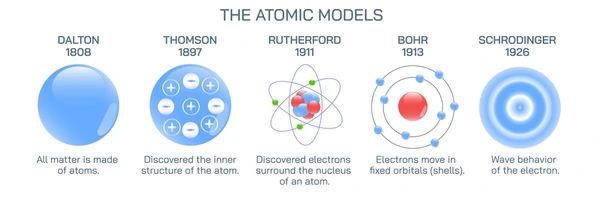
what did Rutherford conclude?
the atom contained a tiny, dense core that was positively charged.
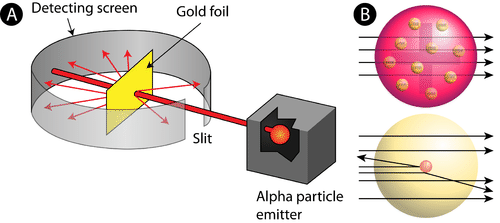
rutherford gold experiment
bombarded very thin sheets of gold foil with fast moving alpha particles
a very small percentage of alpha particles bounced off the gold foil at very large angles
He concluded that all of the positive charge and the majority of the mass of the atom must be concentrated in a very small space in the atom's interior (nucleus)
rutherford electron problem/experiment flaws
failed to explain why individual atoms produce discrete line spectra
electrons orbit the nucleus in a circular fashion. If this was in fact true, then as electrons accelerate around the nucleus, the acceleration would cause the electron to radiate energy, meaning lose energy. its velocity would decrease, causing it to spiral and eventually smash into the nucleus, meaning not stable, which is false.
Maxwell what did he propose
light is an electromagnetic wave (electric + magnetic component). visible light is just a small part of the entire range of the Electromagnetic Spectrum (range of all possible waves)
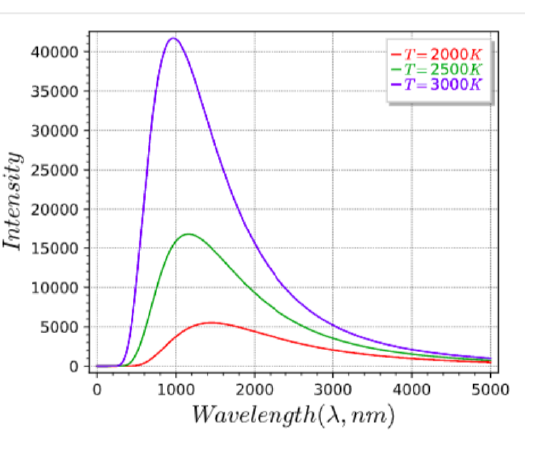
black body radiation (Planck)
idealized physical body that absorbs all incident electromagnetic radiation, regardless of frequency or angle of incidence
When a solid is heated, it begins to glow. The hotter the object, the more energy the electromagnetic waves emitted by the object have
Planck theory and solution
if light is a continuous wave, then the math predicts a curve that is not experimentally observed. Planck was able to find a mathematical formula that fit the empirical data IF he treated light as if it was a particle instead of a wave.
The photoelectric effect (Einstein)
the process where light (made of particles called photons) hits a material and knocks electrons loose
occurs when electromagnetic waves (light) is shone on a metal plate, which results in flowing electrons. It is the collision of photons with electrons that breaks them free from the atom. The higher the energy/frequency, the greater the chance the collision will break an electron free. The light frequency determines the kinetic energy of the released electron
about the photoelectric effect
The frequency (colour/energy) of the light determines how much energy the freed electron has
Intensity (brightness) does not change the energy of the electrons; it only increases the number of photons → current unaffected
Threshold Frequency: Every metal has a specific minimum energy level required to release an electron
What 3 characteristics of the nucleus of an atom did Rutherford’s gold foil experiment determine?
all mass is centered in the middle → dense
nucleus is positive
nucleus verrry small (cuz only a very small portion managed to deflect the gold foil)
Planck’s constant
6.63 x 10⁻³⁴ J/Hz