Stats 5 Midterm
 Call Kai
 Learn
Learn Practice Test
 Spaced Repetition
 Match
Match Flashcards
 Knowt Play
1/96

Earn XP
Description and Tags
hi ryan
Name | Mastery | Learn | Test | Matching | Spaced | Call with Kai |
|---|
No analytics yet
Send a link to your students to track their progress
97 Terms
Census
we collect data for every individual in a population
Parameter
numerical summary of the population- values are usually unknown
Statistic
numerical summary of a sample- use sample statistics to estimate the value of population parameters
Descriptive Statistics
Methods for summarizing the collected data
describe data through tables, graphs, and numerical summaries such as averages or percentages
allow an overview of data to determine statistical methods researcher should use
Inferential Statistics
Methods that take a result from a sample, extend it to the population, and measure the reliability of the result
contains uncertainty
Qualitative
Categorical variables
classification based on attribute or characteristic
Quantitative
Numerical variables
values can be added or subtracted and provide meaningful results
Nominal Variable
Qualitative used to represent names, labels, or categories
used to differentiate between different categories
do not represent any quantity or order
Ordinal Variable
Qualitative not only represent categories but also indicate an order or ranking
Although can be arranged in a certain sequence, intervals between them are not defined
Binary Level
Qualitative- “Yes or No”
Continuous Variable
Quantitative- can have infinite values within possible range
Ex. 3.564 grams
Discrete Variable
Quantitative- observations can only exist at limited values
Ex. 8 legs
Process of Stats
Identify research objective
Collect data needed for Qs
Describe data
Perform inference
Selection Bias
When study participants are not representative of the target population, leading to skewed, inaccurate, and non-generalizable results
Underestimation of Effectiveness
bias where a study or statistic consistently reports a lower value for an effect, treatment, or relationship than actually exists in the population
Simple Random Sampling
Let chance determine the sample
n subjects from a population of size N is one in which each possible sample of size n has the same chance of being selected.
Stratified Sampling
divides the population into separate groups, called strata, and then selects a simple random sample from each stratum
This guarantees that each stratum is represented in the sample.

Cluster Sampling
divides the population into a large number of clusters, such as city blocks
Then a simple random of clusters is selected, and all individuals in the selected clusters are included in the sample.

Systematic Sampling
by selecting every kth individual from a population

Convenience Sampling
individuals are easily obtained and not based on randomness
individuals are self-selected, also called voluntary response samples
Sampling Bias
technique used to obtain the sample favors one part of the population over another
Nonresponse Bias
individuals selected who do not respond to the survey have different opinions from those who do respond.
Response Bias
when the answers on a survey do not reflect the true opinions of the respondent
because lying, wording of the questions, or way in which the interviewer asks the question is confusing or misleading.
Explanatory Variables
IV- or factors has on a response variable
Element of a Good Experiment
Control Comparison group
Randomization
Blinding the Study
Replication
Replication
when each treatment is applied to more than one experimental unit
ensures the effect of a treatment is not due to some characteristic of a single experimental unit
Frequency Distribution
lists each category of data and the number of observations in each
Relative Frequency Distribution
lists each category of data together with the relative frequency, the proportion of observations in each category
Relative Frequency
taking the frequency for a particular category and dividing by the total number of observations
Bar Graph
bar for each category, where the height of each bar is either the frequency or the relative frequency of the category.
Pareto Chart
bar graph with categories ordered by their frequency or relative frequency, from tallest bar to shortest bar
useful comparing 2 qualitative variables with emphasis on comparing different parts, but nut necessarily the whole
Pie Chart
circle divided into sectors for each category
area of each sector is proportional to the relative frequency of the category
useful for showing the division with emphasis on comparing the part to the whole
Histogram
constructed by drawing rectangles for each class of data.
The height of each rectangle is the frequency or relative frequency of the class
Dot Plot
horizontal axis that spans from the minimum to the maximum data values
a dot above its corresponding value on the axis
Stem-and-Leaf Plot

Shape of Distribution
symmetry or skewness, the number of peaks, any clusters or gaps, and outliers
Uniform
frequency of each class is relatively the same
Bell-Shaped
Symmetric and unimodal is described as bell-shaped.
How can we Describe Distribution
Shape – symmetry or skewness, the number of peaks, any clusters or gaps, outliers
Center – mean or median.
Spread – spread of the distribution describes the variability in the data
are either clustered together or spread out.
range, variance, standard deviation, and interquartile range
Left-Skewed with Mean and Median
Mean < Median
Symmetric With Mean and Median
Median = Mean
Right Skewed with Median and Mode
Mean > Median
Measures of Spread
Range
IQR
Variance
Standard Deviation
Range
difference between the largest and the smallest observations
R = maximum – minimum
affected severely by outliers.
Deviation from Mean
how far each value is from the mean
Deviation =( Value - Mean )=
Positive deviation = above average
Negative deviation = below average
Standard Deviation
measure of how spread out the numbers in a data set are and how much the data varies from the mean
A small SD-close to the mean.
A large SD-wider range of values.
assess the risk or volatility in fields like finance, quality control, and research.
Standard Dev Formula
:max_bytes(150000):strip_icc()/calculate-a-sample-standard-deviation-3126345-v4-CS-01-5b76f58f46e0fb0050bb4ab2.png)
Variance Formula
Outliers
observation that is unusually large or small relative to the other values in a data set
observed, recorded, or entered into the computer incorrectly.
comes from a different population.
correct but represents a rare event.
Percentile
n observations arranged in order, the pth percentile is a number such that p% of the observations fall below the pth percentile and (100 – p)% fall above it.
Ex. 90th percentile
90% of test takers scored below
10% of test takers scored higher
Quartiles
most common percentiles, dividing data into four equal parts:
First Quartile (Q₁): The 25th percentile (the lowest 25% of data).
Second Quartile (Q₂): The 50th percentile, which is also the median.
Third Quartile (Q₃): The 75th percentile (top 25% of data below the maximum)
Interquartile Range IQR
distance between the first and third quartiles
IQR = Q3 – Q1
measure of spread; the more spread out the data the larger the IQR.
represents the range of the middle 50% of observations
Fences
To spot outliers
Lower fence = Q1 - 1.5 x IRQ
Upper fence = Q3 + 1.5 x IRQ
For distributions that are symmetric report the
Mean and Standard deviation
For distributions that are skewed report the
Median and IRQ
Boxplot
A Graphical Representation of the Five-Number Summary
box extending from the lower quartile (Q1) to the upper quartile (Q3).
line at the median (Q2).
whiskers to smallest and largest observation that is not an outlier
data below the lower fence or above the upper fence are considered outliers and are marked with an asterisk
Boxplots used for
Large data sets (5+ data points)
Unimodal Distributions (can obscure bimodal)
A Boxplot that is symmetric will have
median near center of the box
left and right whiskers same length
A Boxplot that is skewed right will have
median left of the center
right whisker will be longer than the left whisker (or there may be high outliers)
A Boxplot that is skewed left will have
median right of the center
left whisker will be longer than the right whisker (or there may be low outliers)

Comparing two Boxplots
Provide a measure of center for each, and which one is larger/smaller
Provide a measure of spread for each, and which is larger/smaller
(Skewed- compare medians and IQR, Symmetric- means and SD)
Univariate Analysis
Analysis of a single variable to understand its distribution or characteristics
Categorical Visualization Methods
Bar graph
Pie chart
Pareto chart
Quantative Visualization Methods
Stem plot
Histogram
Boxplot
Bivariate Analysis
Analysis of relationship between two variables
Two Quantitative Variables Visualization Method
Scatter Plot
One Quantitative and one Categorical Variable Visualization Methods
Boxplot
Bar Graph
Response Variable
DV- measures outcome of study
Scatter Plot
graph showing the relationship between two quantitative variables measured on the same individual
if roughly straight-line trend, the relationship between x and y is said to be approximately linear
When Two Variables have Linear Relationship
we can describe the direction of their association:
Positive association: As x increases, y also tends to increase
Negative association: As x increases, y tends to decrease
No association: As x increases, there is no clear pattern in changes of y
Correlation Coefficient Formula
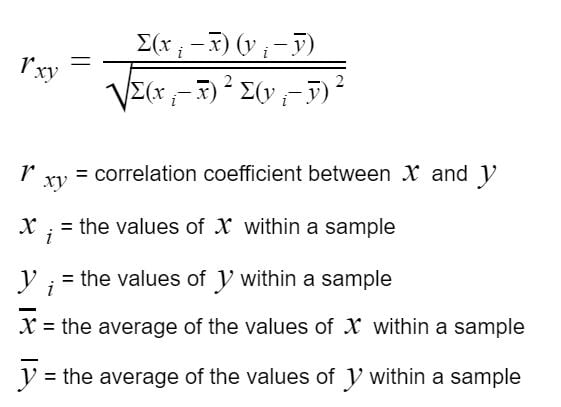
Iinear Correlation Coefficient
Direction:
r > 0 → positive association.
r < 0 → negative association
Form:
r close to 0 = not linear.
Strength:
The closer r is to ±1, the stronger the linear relationship.
The closer r is to 0, the weaker the linear relationship.
*NOT RESISTANT
Correlation Coefficient and Critical Value
If the absolute value of the correlation coefficient is greater than the critical value, we say a linear relation exists between the two variables.
Otherwise, there is no relation
Least-Squares Regression
used to predict the value of the response variable (y) based on a given value of the explanatory variable (x)
Creates linear equation (regression line)
NOT FOR VALUES OUTSIDE RANGE OF DATA COLLECTED (extrapolation)
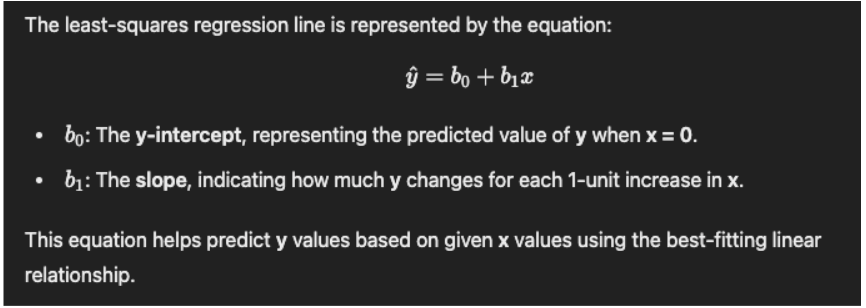
Extrapolation
the estimation of values beyond a known dataset's range
can lead to answers that don’t make sense bc we cannot be certain of the behavior of data for which we have no observations
Residuals
prediction error for any given value of x.
Formula: Residual = Observed y - Predicted y
In a scatterplot, the residual is the vertical distance between a data point and the regression line (smaller distance the better)
R2 (coefficient of determination)
Evaluates strength fit of a linear model
calculated with square of correlation coefficient
tells us what percent variability in response variable is explained in model
Limitations of Regression Models
Approximation- average value of y given x, not exact
Influence of Other Variables
Random Variation- will be unexplained random variation in y
Line of Means- regression line predicts mean value of y for all specific x
Probability Experiment
act or process of observation with uncertain results that can be repeated
Probability of outcome- proportion of times that the outcome would occur in a long run of observations
Probabilities are ALWAYS between 0 and 1
Independent Random Experiment
if the outcome of any one trial is not affected by the outcome of any other trial
Ex. No matter how many times heads or tails have appeared before, the 11th flip is still a new event, and the probability of getting heads or tails remains 50%
Probability Model
Description of probability experiment, includes:
list of all possible outcomes (sample space (S))
probability for each outcome
Sample Space
(denoted S) is the set of all possible outcomes
Ex. Rolling a Die: S = {1, 2, 3, 4, 5, 6}
Ex. Flipping a Coin: S = {H, T}
Tree Diagram
Sample space if experiment consist of more than one technique
Ex. S = {HH, HT, TH, TT}
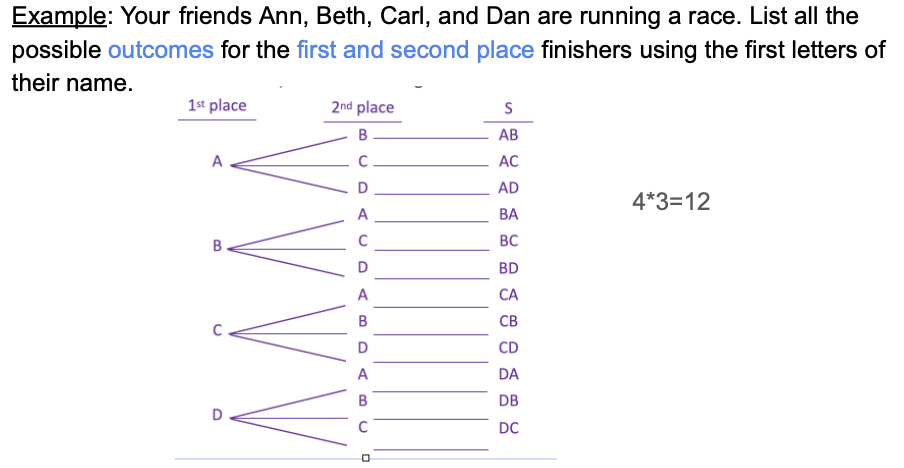
All Possible Outcomes Without Replacement
Multiply first and second amounts in tree graph
All Possible Outcomes With Replacement
Multiplication Rule for Counting: n^r
repeating task with n outcomes r times
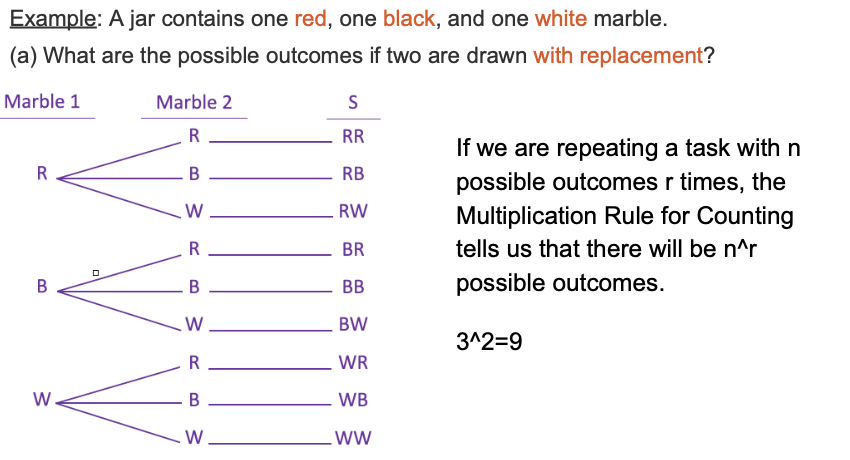
(3 marble types taken 2 times —> 3² = 9)
Event
any collection of outcomes from a probability experiment
Denoted A or B
impossible event- the probability of the event is 0
certainty event- the probability of the event is 1
unusual event- low probability of occurring
Typically, an event with a probability less than 0.05 (or 5%)
Simple Events
events w only one outcome denoted e
Equally Likely Outcomes
when each outcome has the same chance of occurring
Probability Range
Probability of event A (denoted as P(A)) must be between 0 and 1
0 < P(A) < 1
Sum of Probabilities
Sum of probabilities of all possible outcomes must equal 1
If S = {e1, e2, e3}, P(e1) + P(e2) + P(e3) = 1
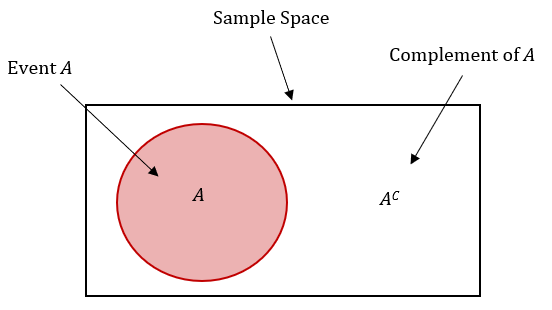
Complement
consists of all outcomes in the sample space that are not in event A.
denote with Ac
P(Ac) = 1 - P(A)
Mutually Exclusive Events
Disjointed- do not have any common outcomes

P(A or(U) B) = P(A) + P(B)
Intersection Event
two events A and B consists of the outcomes in both A and B.
ONLY THE OVERLAP (A and B at once)
P(A ∩ B) = P(A) x P(B)
Union Event
two events A and B consists of outcomes that are in A or B.
P(A or B) = A or B or Both
P(A ∪ B) = P(A) + P(B) - P(A ∩ B)
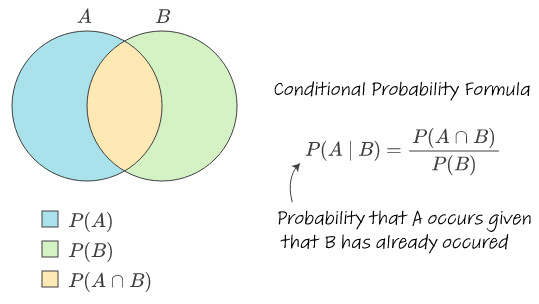
Conditional Probability
Of the cases in which B occurred, P(A|B) is the proportion in which A also occurred
P(A and B) / P(B)
Finding probability of event when you know what the outcome was for another event
General Multiplication Rule
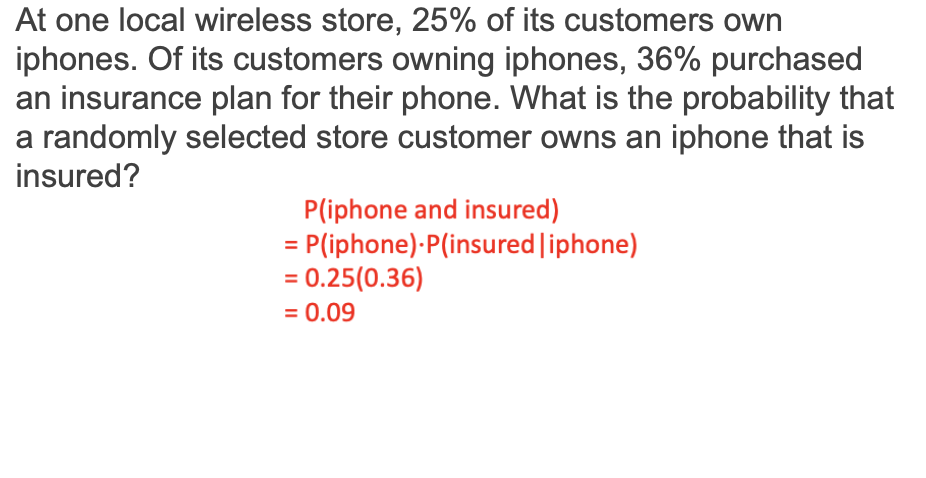
P(A and B) = P(A|B) x P(B) or
P(A and B) = P(B|A) x P(A)
3 Ways to Determine if A and B are independent events
Is P(A|B) = P(A)?
Is P(B|A) = P(B)?
Is P(A and B) = P(A)∙P(B)?
If any true, others true and they are independent