International Trade Agreements: GATT, WTO, Tariffs, and Trade Policies
 Call Kai
 Learn
Learn Practice Test
 Spaced Repetition
 Match
Match Flashcards
 Knowt Play
1/53

There's no tags or description
Looks like no tags are added yet.
Name | Mastery | Learn | Test | Matching | Spaced | Call with Kai | Chat |
|---|
No analytics yet
Send a link to your students to track their progress
54 Terms
What was the Smoot-Hawley Tariff Act?
A 1930 act that raised U.S. average tariffs to ~60% on protected imports, triggering global trade retaliation.
What was the result of the Smoot-Hawley Tariff Act?
World trade collapsed by nearly two-thirds within two years.
What lesson was learned from the Smoot-Hawley Tariff Act?
Unilateral protectionism invites retaliation, leading to losses for all.
What did the Reciprocal Trade Agreements Act of 1934 accomplish?
It reversed protectionism and launched a wave of trade liberalization.
What is the Most-Favored-Nation (MFN) clause?
A provision that requires if the U.S. lowers tariffs for one country, it must extend the same rate to all trade partners.
What key institutions were founded at the Bretton Woods Conference in 1944?
The International Monetary Fund (IMF) and the International Bank for Reconstruction and Development (IBRD).
What is GATT and when was it signed?
The General Agreement on Tariffs and Trade, signed in 1947 by 23 countries to reduce tariffs through multilateral negotiations.
When was the WTO established?
January 1, 1995, replacing GATT with a permanent institution.
What is one of the most important functions of the WTO?
Dispute settlement, where formal panels rule on trade disputes between members.
What is the current crisis facing the WTO?
Deep disagreements between advanced and emerging economies and the stoppage of the Appellate Body in 2019.
What are the two types of regional trade agreements?
Free Trade Areas (FTA) and Customs Unions.
What is the difference between a Free Trade Area and a Customs Union?
FTA has zero internal tariffs but members set their own external tariffs; Customs Union has zero internal tariffs and a common external tariff.
What is trade creation?
When a member country imports from another member what it previously produced itself, increasing welfare.
What is trade diversion?
When a member country switches imports from a cheaper non-member to a more expensive member, decreasing welfare.
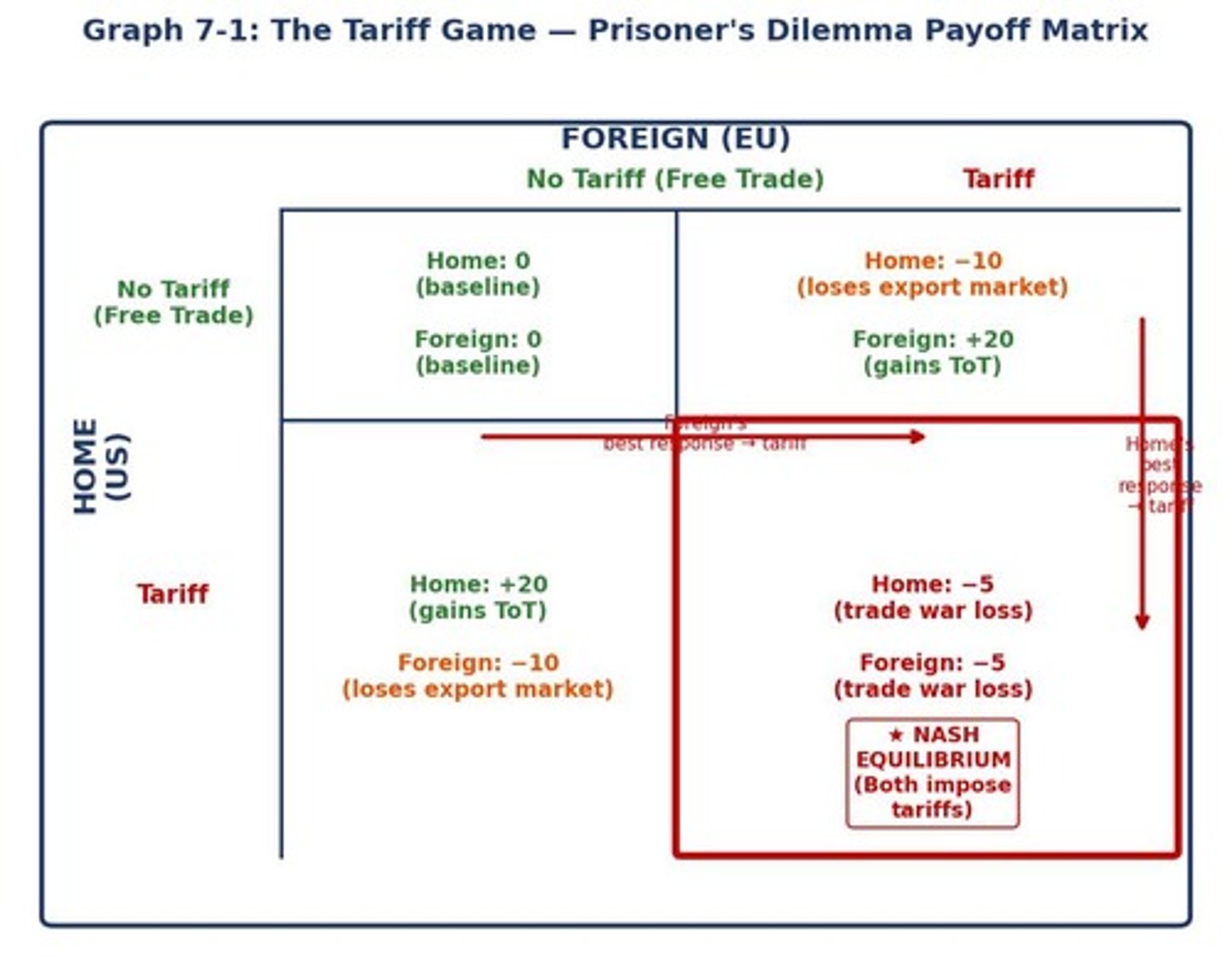
What is the Nash Equilibrium in the context of tariffs?
A situation where both countries impose tariffs, leading to a collectively worse outcome.
What happens if neither country imposes a tariff?
Both achieve free-trade optimum, which is best for the world.
What is the role of the WTO in tariff reduction?
To facilitate multilateral negotiation rounds for reducing tariff rates.
What does it mean to bind tariff rates?
Countries agree not to raise tariffs above their 'bound' level in the future.
What are non-tariff barriers?
Quotas and export subsidies that the WTO aims to eliminate by converting them to tariffs.
What is the significance of the WTO Appellate Body?
It provides a mechanism for appealing dispute rulings; its stoppage in 2019 has led to unresolved appeals.
What is the impact of unilateral trade policies?
They can lead to increased tensions and conflicts in international trade relations.
What is a common external tariff?
A tariff policy that is uniformly applied by all members of a Customs Union towards non-members.
What is the historical significance of the Reciprocal Trade Agreements Act?
It marked a shift from protectionism to trade liberalization in U.S. trade policy.
What is the relationship between tariffs and the Prisoner's Dilemma?
Both countries have an incentive to impose tariffs, leading to a worse outcome if both act on their individual incentives.
What is the main function of the WTO regarding non-tariff barriers?
To convert non-tariff barriers into tariffs for more transparent and negotiable costs.
What is the significance of the term 'normal trade relations'?
It is the renamed version of the Most-Favored-Nation clause as of 1998.
What is the primary goal of trade agreements?
To facilitate trade by reducing or eliminating tariffs and other trade barriers.
What is the primary effect of trade creation?
Welfare rises due to new or increased trade resulting from a free trade agreement (FTA).
What was the tariff rate before NAFTA on imports from Asia?
20% tariff.
What is the cost of imports from Asia after a 20% tariff?
$22.80.
What happens to US imports from Mexico after NAFTA?
Imports from Mexico become cheaper at $20, leading to trade creation.
What is the key welfare condition for FTAs?
Net welfare improves if trade creation gains exceed trade diversion losses.
What does the Nash equilibrium in a non-cooperative tariff game typically result in?
Both countries imposing tariffs.
What is the outcome of the Reciprocal Trade Act of 1934?
Introduced the Most Favored Nation (MFN) clause and granted presidential negotiating authority.
What is the significance of the General Agreement on Tariffs and Trade (GATT)?
It facilitated multilateral tariff negotiations among 23 countries starting in 1947.
When was the World Trade Organization (WTO) established?
1995, replacing GATT.
What is the function of the WTO Appellate Body?
To settle disputes and bind tariffs among member countries.
What is the MFN principle in the WTO?
It requires that the lowest tariff rate be extended to all member countries.
What is the difference between a Free Trade Agreement (FTA) and a Customs Union?
An FTA allows each member to set its own external tariffs, while a Customs Union has a common external tariff.
What is the impact of tariffs on world welfare?
Tariffs generally reduce world welfare due to deadweight losses.
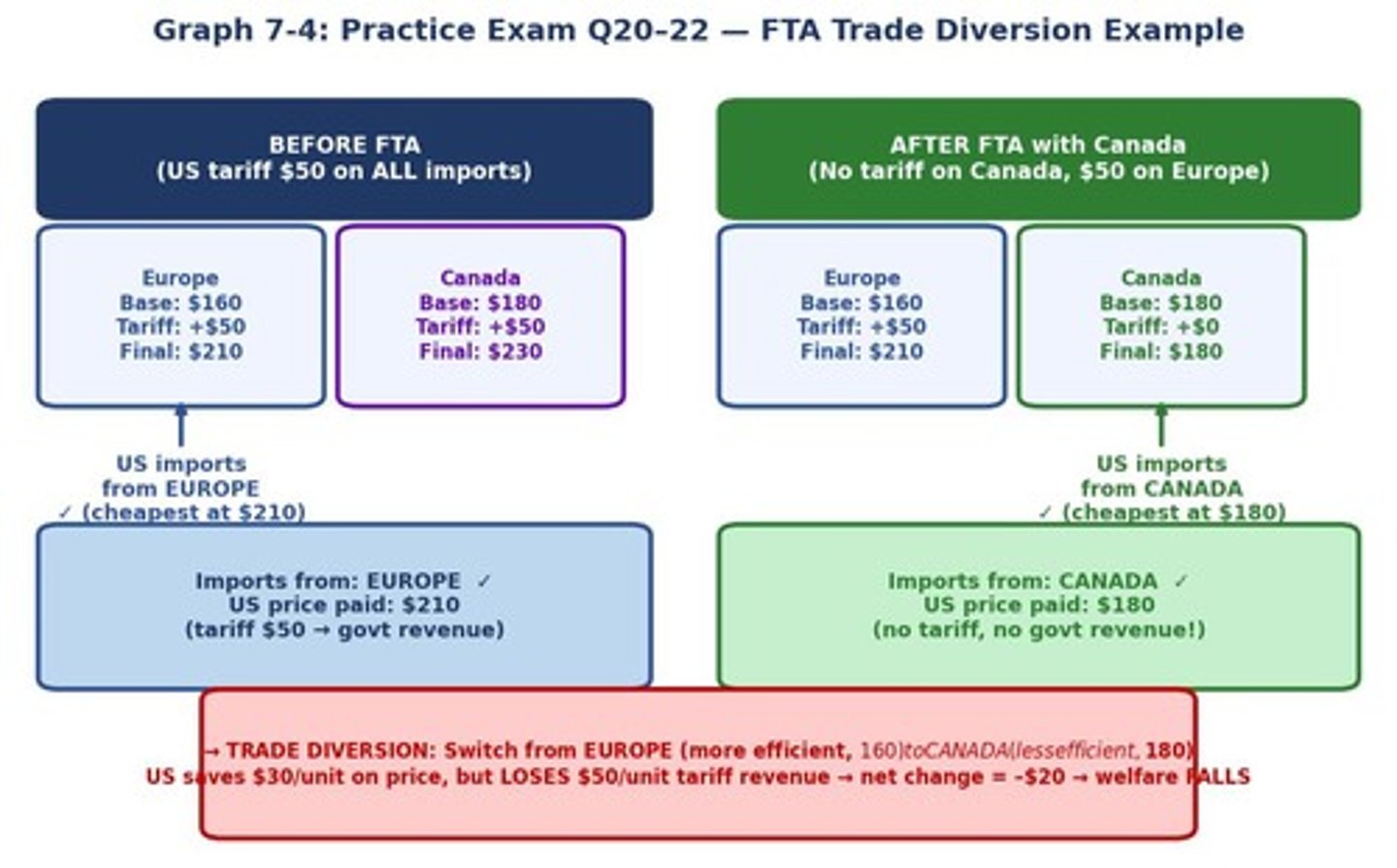
What is an example of trade diversion?
The US switching imports from Europe (more efficient) to Canada (less efficient) after forming an FTA.
What was the result of the Smoot-Hawley Tariff of 1930?
Raised tariffs to ~60%, leading to retaliation and a significant drop in world trade.
What does the term 'welfare loss' refer to in trade?
The loss of economic efficiency when trade is diverted from a more efficient producer to a less efficient one.
What is the cost of imports from Canada after the FTA?
$180, with no tariff applied.
What is the price of imports from Europe after the FTA?
$210, due to the $50 tariff still being applied.
What is the result of trade creation in terms of consumer surplus?
Consumer surplus rises as prices decrease due to increased competition from imports.
What is the dominant strategy for large countries in a tariff game?
To impose tariffs, as it is the best response regardless of the other country's actions.
Which trade agreement was established in 1995?
The World Trade Organization (WTO).
What is the primary concern with trade diversion?
It can lead to a situation where countries are worse off than before the FTA.
What does the term 'deadweight loss' (DWL) refer to in trade?
The loss of economic efficiency when the equilibrium for a good or service is not achieved.
What is a key factor that makes trade diversion likely?
When the FTA partner is not the world's most efficient producer.
What is the effect of tariffs on tariff revenue?
Tariffs can generate revenue for the government but may also lead to trade diversion.
What was the tariff on imports before the FTA with Canada?
$50 on all imports.
What is the significance of the 'trade creation' area in trade analysis?
It represents new trade that arises due to lower prices from an FTA.