Amino Acids EXAM 1 MATERIAL
 Call Kai
 Learn
Learn Practice Test
 Spaced Repetition
 Match
Match Flashcards
 Knowt Play
1/31

There's no tags or description
Looks like no tags are added yet.
Name | Mastery | Learn | Test | Matching | Spaced | Call with Kai |
|---|
No analytics yet
Send a link to your students to track their progress
32 Terms
Gross Ass Virgins Love Intense Morning Porn With Friends- NON POLAR AMINO ACIDS
Glycine, Alanine, Valine, Leucine, Isoleucine, Methionine, Proline, Tryptophan (trip... Whoops), Phenylaline (ph... F)
Sexy Thots Need Good Toys Constantly- POLAR AMINO ACIDS
Serine, Threonine. Asparagine (N is letter for it), Glutamine, Tyrosine. Cysteine
ACIDS version: Angry Girls Love Rough Head
Acids: Aspartic acid (aspartate), Glutamic acid (glutamate)
Bases Version: Angry Girls Love Rough Head
Bases: Lysine. Arginine (ARG- R sound), Histidine
Polar - HYDROPHILIC
"polar people are clingy": uneven charges, like interacting with other charged things , form attractions aka hydrogen bonds, love water : OH, NH, CHARGED ATOMS
Nonpolar- HYDROPHOBIC
Nonpolar people just wanna be left the fck alone: evenly shared electrons. no partial charges, avoid water, mostly HYDROCARBONS: "DON'T touch me"
Covalent
covalent couples are married as fck: share electrons,. STRONG bonds, hard to break= peptide bonds. disulfide bonds "PERMANENT RELATIONSHIP"
Noncovalent HYDROPHOBIC- hate water more than they hate each other
Noncovalent is just hookup energy: weak temporary interactions, hydrogen bonds, ionic attractions, hydrophobic interactions, van der waals "SITUATIONSHIP" form and break just as easily
Acids vs bases (acids addition)
acids give head (donate H+)
Acids vs bases (bases addition)
Bases beg for Head (accept H+)
amino acid structure
Carbon likes four hookups (4 C's) a nut (amino group), cock (central carbon), a hoe (COOH), a random side btch (R group)
peptide bond
OH removed from carboxyl group, H removed from amino group= COOH + NH2--> CO-NH+ H20 "one amino acid loses the OH the other loses the H and they smash together"
Electronegativity
Oxygen's a needy c*nt (most electronegative, then follows Nitrogen and Carbon
ionic interactions
Opposite charges attract = electrostatic interaction Water cockblocks them = weaker in biology (ionic interaction)
pI
the ph where the molecule has NO net charge pI= perfectly indifferent "At pI, the molecule stops giving a charge."
low
pH
POSITIVE - low pH= lots of H+ around (amino acid grabs extra protons), "Below the pI, the amino acid is thirsty and takes head (H+)"
Protonated
more protonated --> more positive (MORE H+)
pH> pI
NEGATIVE- high pH= dry environement (loses protons). "Above the pI, the amino acid gets dry and bitter"
pH= pI
neutral- emotionally balanced low pH → more H⁺ attached → more positive
high pH → fewer H⁺ attached → more negative
Alanine at pH 2 and pI 6
very protonated because pH
Alanine at pH 11 and pI 6
pH> pI so that means it is more deprotonated (NEGATIVE) and therefore less H's to go around "dry and negative"
Alanine at pH 6 and pI 6
neutral = net 0
default rule at physiological ph 7 aspartate (aspartic acid)
side chain has COOH ph 7> pha (4)= negative= turns into COO- = -1 N terminus NH3+= positive (beginning amino acid)
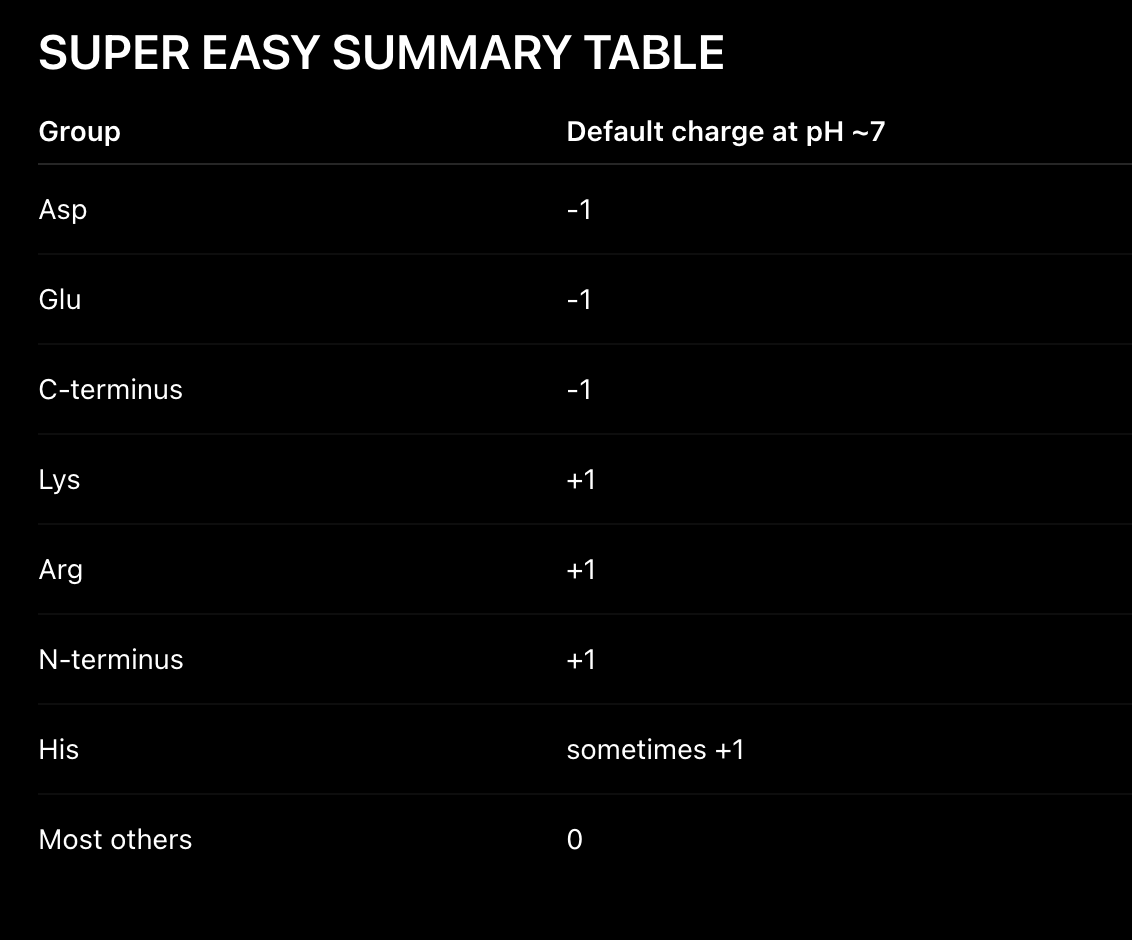
At pH 7 - acids addition
negative (acids lose H+)
at pH 7 Bases addition
positive (bases keep H+)
DNA’s charge overall
NEGATIVEEE “DNA is a bitter negativre bitch” so it attracts positive residues “clingy basic amino acids”
at pH 7 positive ones
Positive team
Lys
Arg
sometimes His
N-terminus
at pH 7 negative ones
Negative team
Asp
Glu
C-terminus
Then just compare:
More positives? → overall positive
More negatives? → overall negative
Equal? → neutral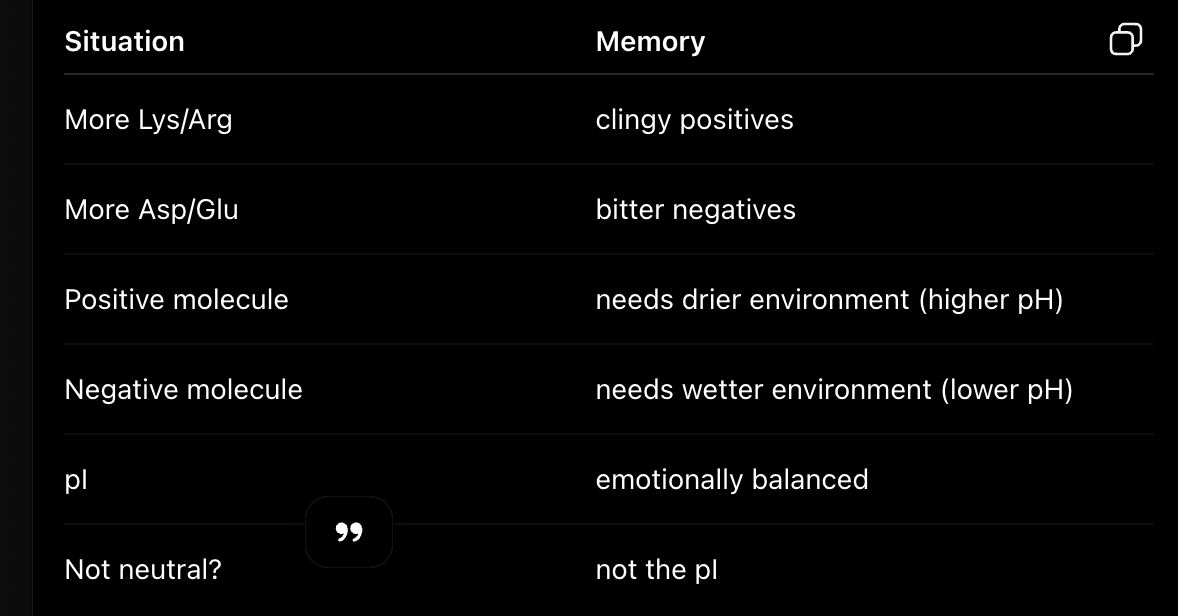
SDS is a detergent that…
unfolds proteins, coats them with negative charge “SDS spray paints every protein negative”
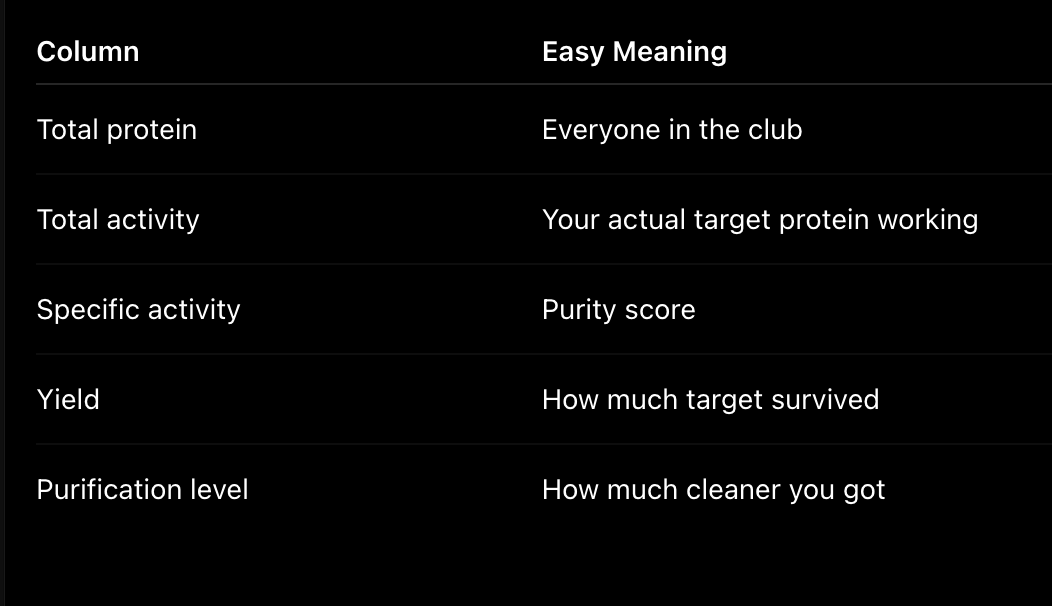
Calculating purification process
more purity = less yield (protein loss)
OIL RIG
“oxidation is loss” “reduction is gain”