Legal Services
 Call Kai
 Learn
Learn Practice Test
 Spaced Repetition
 Match
Match Flashcards
 Knowt Play
1/18

There's no tags or description
Looks like no tags are added yet.
Name | Mastery | Learn | Test | Matching | Spaced | Call with Kai |
|---|
No analytics yet
Send a link to your students to track their progress
19 Terms
Reserved legal activities
Reserved activities
Only 6 activities (in s12 LSA 2007) are reserved.
→ only authorised / exempt persons can do them
→ unauthorised = criminal offence (2 years’ imprisonment)
→ rights of audience / conduct of litigation unauthorised may also = contempt
6 reserved activities:
• rights of audience → appear/address court; call/examine witnesses
• conduct of litigation → issue / commence / prosecute / defend proceedings + ancillary steps
↳ trap: lodging/issuing docs = reserved; merely drafting for party to lodge = not
• reserved instrument activities [administration of estates] → prepare/lodge formal docs re:
land → transfer / charge / registration
real or personal estate
court proceedings
↳ excludes wills / power of attorney / non-deed agreements
• probate activities → prepare docs to obtain/oppose:
grant of probate
grant of letters of administration
• notarial activities* → certify/authenticate docs
• administration of oaths → administer oath / swear affidavits
_
Non-reserved activities (anything outside the 6 reserved activities)
→ can be done by unregulated persons; no formal qualification required
e.g. legal advice / will writing / mediation
_
Authorisation traps:
• once regulated, provider must follow regulator rules for all legal work
↳ e.g. solicitor drafting a will = non-reserved, but still subject to SRA rules
_
• law society = approved regulator for solicitors; but function in practice carried out by SRA
_
• Legal Services Board (LSB) oversees pproved regulators; does not authorise lawyers/firms.
_
• *notarial work needs separate authorisation (Master of the Faculties)
↳ solicitor authorisation covers reserved activities except notarial
![<p><strong>Reserved activities</strong><br>Only <strong>6 activities (</strong>in s12 LSA 2007) are reserved.<br>→ only <strong>authorised / exempt</strong> persons can do them<br>→ unauthorised = <strong>criminal offence</strong> (2 years’ imprisonment)<br>→ rights of audience / conduct of litigation unauthorised may also = <strong>contempt</strong></p><p><strong>6 reserved activities:</strong><br><u>• </u><strong><u>rights of audience</u></strong> → appear/address court; call/examine witnesses</p><p><u>• </u><strong><u>conduct of litigation</u></strong><u> </u>→ issue / commence / prosecute / defend proceedings + ancillary steps<br>↳ trap: <strong>lodging/issuing docs = reserved</strong>; merely <strong>drafting for party to lodge = not</strong></p><p><u>• </u><strong><u>reserved instrument activities</u></strong> [administration of estates] → prepare/lodge formal docs re:</p><ul><li><p>land → transfer / charge / registration</p></li><li><p>real or personal estate</p></li><li><p>court proceedings<br>↳ excludes <strong>wills / power of attorney / non-deed agreements</strong></p></li></ul><p><u>• </u><strong><u>probate activities</u></strong> → prepare docs to <strong>obtain/oppose</strong>:</p><ul><li><p>grant of probate</p></li><li><p>grant of letters of administration</p></li></ul><p><u>• </u><strong><u>notarial activities*</u></strong><u> </u>→ certify/authenticate docs</p><p><u>• </u><strong><u>administration of oaths</u></strong> → administer oath / swear affidavits<br>_</p><p><strong>Non-reserved activities </strong>(anything outside the 6 reserved activities)<br>→ can be done by <strong>unregulated persons</strong>; no formal qualification required<br>e.g. <strong>legal advice / will writing / mediation</strong><br><strong>_</strong></p><p><strong>Authorisation traps:</strong><br><strong>• once regulated, provider must follow regulator rules for all legal work</strong><br>↳ e.g. solicitor drafting a will = non-reserved, but still subject to SRA rules<br>_</p><p>• law society = approved regulator for solicitors; but function in practice carried out by SRA <br>_<em><br></em>• Legal Services Board (LSB) oversees pproved regulators; does not authorise lawyers/firms.<em><br></em>_<br>• *<strong>notarial work needs separate authorisation </strong>(Master of the Faculties)<br>↳ solicitor authorisation covers reserved activities except notarial</p>](https://assets.knowt.com/user-attachments/2dd5417c-81f9-4b6a-8e0b-2efed056bb7d.png)
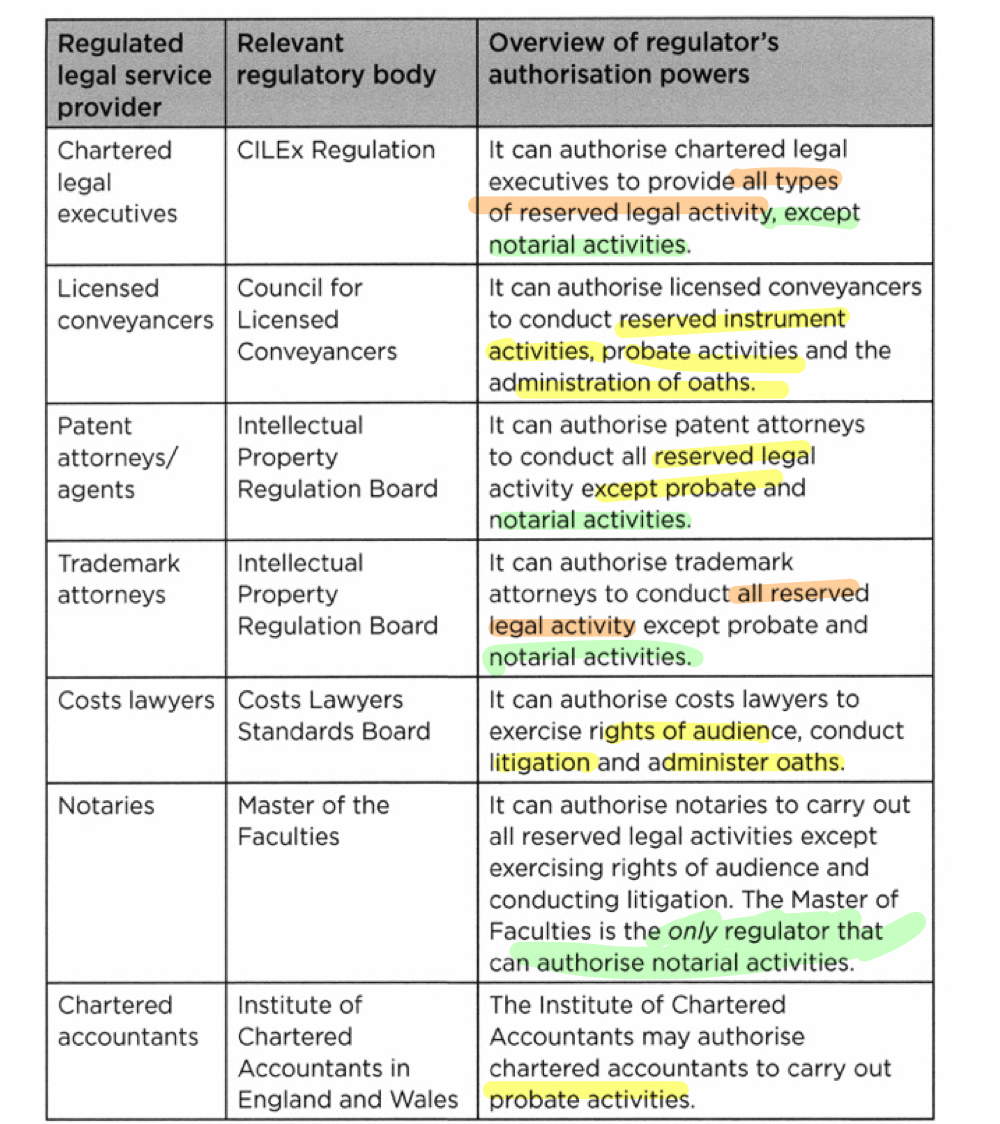
Regulated legal services providers + what activities can be authorised
Other regulated legal service providers – roles + authorisation scope
• Barristers
→ advocates in civil/criminal courts; legal advice + drafting
→ may be directly instructed in some civil cases
→ Bar Standards Board can authorise: all reserved activities except notarial
• Chartered legal executives
→ similar work to solicitors; often specialist area
→ work under solicitor supervision, but can be involved in firm ownership
→ CILEx Regulation can authorise: all reserved activities except notarial
• Licensed conveyancers
→ property transactions
→ Council for Licensed Conveyancers can authorise: reserved instruments / probate / oaths
• Patent attorneys
→ patents + intellectual property
→ Intellectual Property Regulation Board can authorise: all reserved activities except probate + notarial
• Trade mark attorneys
→ trade mark law + practice
→ Intellectual Property Regulation Board can authorise: all reserved activities except probate + notarial
• Costs lawyers
→ legal fees/costs; bills, costs estimates, costs hearings
→ Costs Lawyers Standards Board can authorise: rights of audience / litigation / oaths
• Notaries
→ certify/authenticate signatures + docs, often foreign element
→ Master of the Faculties can authorise: all reserved activities except rights of audience + litigation
→ only regulator that can authorise notarial activities
• Chartered accountants
→ Institute of Chartered Accountants in England and Wales can authorise: probate activities only
_
Claims management companies – regulated by the Financial Conduct Authority.
Immigration advisers – regulated by the Office of the Immigration Services Commissioner.
Insolvency practitioners – regulated by the Insolvency Practitioners Association
regulatory objectives each regulatory body must try to achieve
Legal Services Board (LSB) - role, powers?
*Regulatory objectives of LSB + approved regulators:
• protecting and promoting the public interest
• supporting the constitutional principle of the rule of law
• improving access to justice
• protecting and promoting the interests of consumers
• promoting competition in the provision of services in the legal sector
• encouraging an independent, strong, diverse and effective legal profession
• increasing public understanding of citizens’ legal rights and duties
• promoting and maintaining adherence to the professional principles of:
independence and integrity
proper standards of work
observing the best interests of the client and the duty to the court
maintaining client confidentiality
• promoting the prevention and detection of economic crime
_
Role of LSB
LSB = oversight regulator for legal services in England + Wales.
→ day-to-day regulation done by separate approved regulators
→ LSB oversees / coordinates / holds regulators to account
→ does not directly authorise lawyers/firms
_
Approved regulators
A body can only regulate legal services under LSA 2007 if approved by LSB.
LSB powers re regulators:
• make recommendations
• impose penalties
• withdraw approval
• LSB consent needed for any regulatory changes
McKenzie Friends
Non-legally qualified, unregulated advisors
Role: provide moral support, take notes, help organize documents, and give quiet advice.
Restrictions: They generally do not have the right of audience to address the court, act as the litigant's agent, or examine witnesses.
Rights: Courts will generally allow them unless there is a specific reason to believe their presence impedes the administration of justice
The regulatory role of the SRA
7 SRA Principles
In its regulatory capacity, the SRA is responsible for:
• licensing individuals and firms to practise
• setting the standards of the profession
• enforcing compliance against those standards.
_
Regulatory role of the SRA
SRA = independent regulatory arm of the Law Society
→ regulates solicitors, SRA-authorised firms, registered European lawyers + registered foreign lawyers
→ also regulates non-lawyers employed by SRA-regulated firms
_
Core regulatory role:
• authorises individuals + firms to practise / carry out reserved legal activities
• controls training + admission to profession
• sets professional + ethical standards
• makes rules re client money
• supervises firms
• enforces compliance / takes disciplinary action
_
Purpose of SRA regulation:
• protect consumers of legal services
• support rule of law + proper administration of justice
↳ poor legal services harm both client + justice system
_
SRA Standards + Regulations
All solicitors + authorised firms must comply.
→ underpinned by 7 SRA Principles:
uphold rule of law + proper administration of justice
uphold public trust + confidence
act with independence
act with honesty
act with integrity
encourage equality, diversity + inclusion
act in best interests of each client
_
Risk-based regulation
SRA targets resources at greatest regulatory risk.
Risk = impact × probability
• impact = harm if risk materialises
• probability = likelihood of risk materialising
Risks may be:
• individual solicitor risk
• firm risk
• profession-wide risk
SRA response must be proportionate
→ e.g. restrict solicitor’s work / supervise firm / fine / warning notice / amend Codes
Freelance solicitors / Solicitors carrying on reserved legal activities
prac cert?
Solicitors carrying on reserved legal activities
General rule
Practising certificate is personal to solicitor.
→ but reserved activities usually must be done through authorised body
→ solicitor needs valid practising certificate + authorised firm/body
_
Freelance solicitors
Usually need authorisation as recognised sole practice if providing reserved activities direct to public.
No recognised sole practice needed if:
• only doing non-reserved work; or
• reserved work done through authorised body; or
• freelance conditions met, e.g. 3+ years qualified, own name, insurance, no employees, limited client money, notify SRA.
_
In-house solicitors
May do reserved activities for employer only.
→ cannot offer reserved services to general public.
_
Non-commercial organisations
Solicitors in charities / not-for-profits / trade unions etc may provide reserved activities to public on organisation’s behalf.
_
Residual rule
All other solicitors doing reserved activities must have:
• valid practising certificate; and
• provide work through authorised firm/body.
Authorisation of firms – 3 types of SRA-authorised firm
SRA can authorise firms as well as individuals.
3 types of authorised firm:
• recognised sole practice
→ sole solicitor practising alone
→ organisation authorised by SRA, not just the individual personally
• recognised body
→ legal services body mainly owned/managed by legally qualified persons
→ at least 75% managers + ownership/voting rights legally qualified
→ at least 1 manager must be a solicitor / registered European lawyer
→ managers not legally qualified are approved by SRA
→ Forms: partnership / limited liability partnership / company
• licensed body
→ alternative business structure (ABS); can provide legal services alongside non-legal services
→ where ownership/control/management not wholly legally qualified
→ must have at least 1 manager authorised by a approved regulator
→ must be a “licensable body”, i.e. where a non-authorised person:
• is manager of the body; or
• is interest holder of the body, e.g. shares / voting rights; or
• has indirect control via another body
↳ e.g. another body is manager/interest holder + non-authorised persons control ≥10% voting rights in that body
_
Effect of authorisation
Recognised / licensed body can carry out reserved legal activities (except notarial), and also immigration work, subject to SRA terms.
→ business limited to legal/professional services lawyers provide + annex 2 services e.g. ADR / estate agency / financial services
→ Recognised body - must have SRA-approved 1) Compliance Officer for Legal Practice (COLP) + 2) Finance and Administration (COFA)
→ Licensed body - must have Head of 1) Finance and Administration (HOFA) and 2) Legal Practice (HOLP)
Professional indemnity insurance
PII = insurance covering solicitor/firm liability for breach of professional duty causing client financial loss/damage.
→ covers compensation + usually defence costs
→ does not absolve solicitor from liability
_
Who needs PII?
• SRA-authorised firms → must maintain qualifying insurance
• freelance solicitors providing reserved legal services to public
• solicitors in non-commercial bodies providing reserved legal services to public
↳ must ensure body has adequate + appropriate insurance
• employees/trainees usually covered by firm’s policy
_
Minimum cover
• recognised / licensed bodies → at least £3m per claim
• all other cases → at least £2m per claim
↳ exclusive of defence costs
_
Adequate + appropriate cover
Minimum terms = baseline only.
May need top-up cover depending on:
• nature of work
• number/type of clients
• value of potential claims
• claims history
• ability to meet liabilities otherwise
_
Continuity / policy trap
PII usually annual + claims-made.
→ covers claims made during policy year, not just acts done that year
→ cover must be continuous
If no new policy:
• extended cover up to 90 days
• after 30 days without cover → notify SRA + no new work
• after 90 days without cover → cease practising
_
Client information
Solicitors must be open about PII.
→ give insurer + territorial coverage details
→ freelance solicitors must tell clients if not covered by SRA minimum terms
9 protected characteristics (Equality Act)
Equality Act 2010 protects 9 finite characteristics:
→ discrimination based on something outside the list = not unlawful under the Act (but may still raise professional conduct issues)
_
Protected status for….
• age → particular age / age group
• disability → physical/mental impairment + substantial and long-term adverse effect on normal day-to-day activities
↳ disability has extra positive duty angle: reasonable adjustments (substantial disadvantage; anticipatory)
• gender reassignment → proposing / undergoing / undergone process to reassign sex
↳ no need to have medical treatment/supervision to fall within
• marriage + civil partnership → only legally married / civil partnership
↳ (not cohabitants / single / divorced / engaged)
• pregnancy + maternity
• race → colour / nationality / ethnic or national origins
• religion or belief → religion / philosophical belief / absence of religion or belief
• sex → male / female
• sexual orientation → same sex / opposite sex / both
Disability – Duty to make reasonable adjustments
Equality Act imposes positive duty to make reasonable adjustments (failure = discrimination)
Duty = take reasonable steps to avoid disabled person being put at substantial disadvantage because of:
• provision, criterion or practice
↳ e.g. only providing info in standard format (e.g. MCQ test format adjustment for asperger’s)
• physical feature
↳ e.g. inaccessible office / no wheelchair access
• lack of auxiliary aid
↳ provide aid where needed to avoid disadvantage
(Substantial disadvantage = more than minor or trivial.)
_
as Service providers
Duty owed to disabled people generally.
→ anticipatory duty!
→ cost cannot be passed to client
→ no need to fundamentally change nature of service
_
as Employers
Duty owed to specific disabled employee / prospective employee (not anticipatory generally)
→ only arises where employer knows / ought to know person is disabled + likely disadvantaged
→ vicarious liability: employer may be vicariously liable for employee discrimination in course of employment (even if unaware/condemned behaviour)
↳ defence: took reasonable steps to prevent it, e.g. training
Direct discrimination
A treats B less favourably because of a protected characteristic.
Test:
the treatment is…
different; → another actual/hypothetical person would have been treated differently (same or not materially different circumstances)
less favourable'; → any disadvantage; no need for material loss
because of protected characteristic → need not be sole/main reason; can be based on assumed characteristic
_
No general defence of justification
Exception: age discrimination can be justified if proportionate way of achieving legitimate aim.
Indirect discrimination
(neutral rule with unequal impact)
A policy/practice of universal application but with adverse impact on those sharing B’s protected characteristic.
_
A provision, criterion or practice is discriminatory if it:
• applies / would apply to others too;
• puts the group sharing B’s protected characteristic at particular disadvantage;
• puts B at that disadvantage; and
• is not justified as proportionate means of achieving legitimate aim.
_
indirect discrimination provisions do not apply to pregnancy/maternity → use use direct discrimination / specific pregnancy protections.
Discrimination arising from disability
where A treats B unfavourably because of something arising in consequence of B’s disability.
Requires:
• B is disabled;
• A treats B unfavourably;
• unfavourable treatment is because of something arising from / in consequence of B’s disability; and
• A knew / ought reasonably to have known B had the disability.
_
No comparator required.
_
treatment may be justified if show: proportionate means of achieving legitimate aim
Harassment
1.Unwanted conduct which is either:
• related to a relevant protected characteristic*;
↳ (*excludes pregnancy and marriage)
• sexual in nature; or
• related to sex / gender reassignment, where B is treated less favourably because B rejected or submitted to it.
2.The conduct must have the purpose or effect of:
• violating B’s dignity; or
• creating an intimidating, hostile, degrading, humiliating or offensive environment.
Victimisation
A victimises B if…
A subjects B to a detriment because:
• B does a “protected act”; or
• A believes B has done / may do a protected act.
Protected acts:
• bringing Equality Act proceedings
• giving evidence/information in Act proceedings
• doing anything related to the Act
• alleging breach of the Act
_
Note: Victim does not need to have a protected characteristic.
Equality Act -
When is positive discrimination lawful?
Positive action/discrimination - firm may treat person more favourably because of protected characteristic
_
Lawful only if requirements met:
Firm must reasonably believe persons sharing protected characteristic:
• suffer disadvantage connected to characteristic; or
• have different needs; or
• are disproportionately underrepresented / have low participation;
and
• action taken is proportionate way of redressing situation (e.g. extra resources / targeted training / tailored services)
_
Tie-break limit:
Only lawful where candidate is as qualified / as suitable as others.
→ can use protected characteristic as tie-break
→ cannot automatically prefer all candidates with protected characteristic regardless of suitability
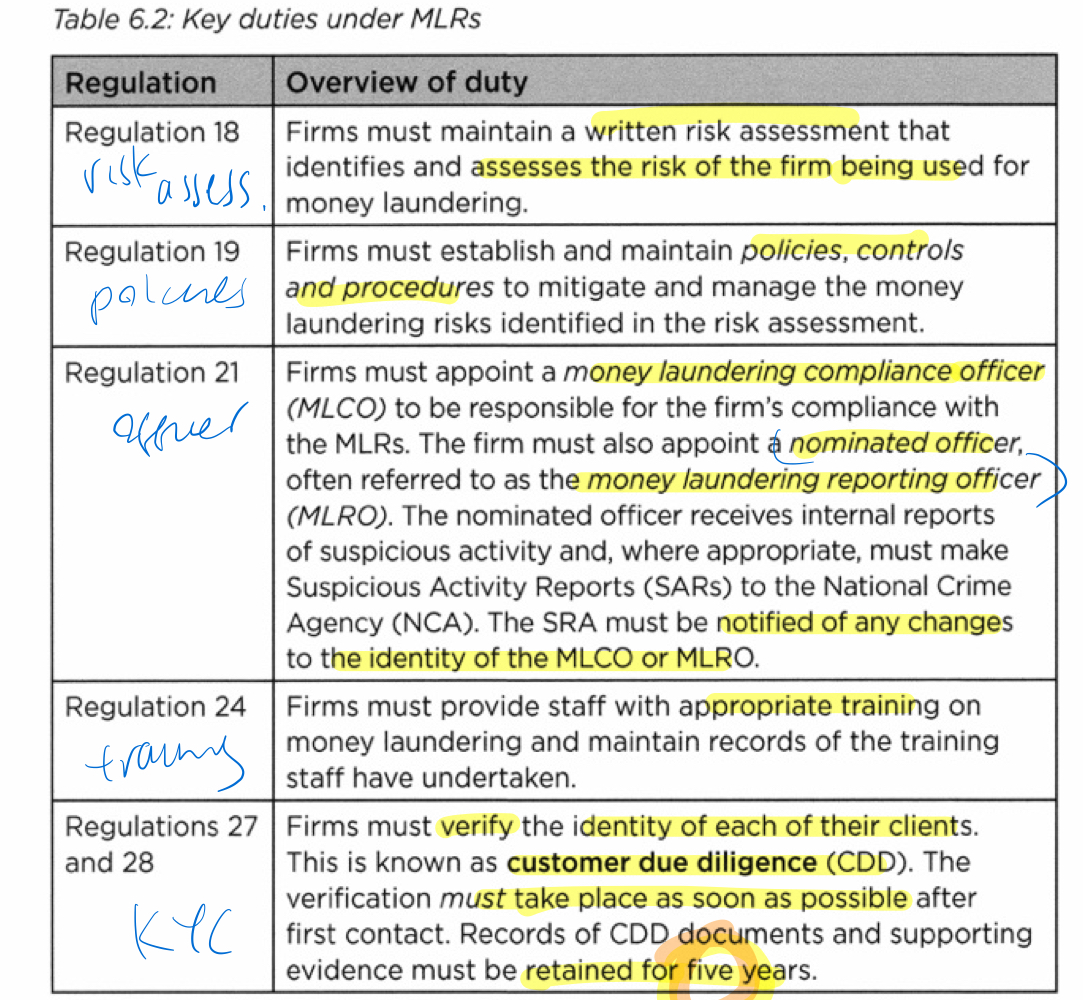
MLRs – firm-level duties
Key duties imposed on law firms under MLRs:
• written risk assessment
→ identify + assess risk firm may be used for money laundering
→ keep up to date
→ covers clients, services, delivery methods, sectors, jurisdictions
• written policies, controls + procedures
→ proportionate to firm size/nature
→ approved by senior management
→ manage risks identified in risk assessment
• nominated officer (MLCO / MLRO)
→ MLCO: compliance officer - senior management person responsible for MLR compliance
→ MLRO: reporting officer - receives internal reports of suspicious activity; decides whether to make suspicious activity report (SAR) to National Crime Agency (NCA)
→ MLCO/MLRO can be same person
• screen relevant employees
→ skills / knowledge / conduct / integrity
• independent audit function
→ review + monitor AML policies / controls / procedures
• training
→ staff must know law + recognise/deal with suspicious transactions
→ keep training records
• record keeping
→ CDD docs + transaction records retained for 5 years
_
SRA must be notified of changes to MLCO / MLRO.
CDD – when required / timing / if incomplete..?
CDD = customer due diligence.
→ measures to identify + verify client to reduce money laundering risk
CDD required when:
• forming a business relationship
• carrying out occasional transfer of funds > €1,000
• carrying out occasional transaction ≥ €15,000 (£13K)
↳ single transaction or linked transactions
• solicitor suspects money laundering / terrorist financing
• solicitor doubts accuracy / adequacy of previous ID docs or info
_
Timing
CDD must be done as soon as possible after first contact
and before business relationship / transaction begins.
May delay verification only if:
• little ML/TF risk;
• necessary not to interrupt normal business; and
• identity verified ASAP after first contact
_
If CDD cannot be completed:
• do not establish business relationship
• do not carry out transaction
• terminate existing relationship if necessary
• consider disclosure to NCA / MLRO
↳ e.g. weak ID + cash payment proposal = refuse to act