perception exam 3
 Call Kai
 Learn
Learn Practice Test
 Spaced Repetition
 Match
Match Flashcards
 Knowt Play
1/99

There's no tags or description
Looks like no tags are added yet.
Name | Mastery | Learn | Test | Matching | Spaced | Call with Kai |
|---|
No analytics yet
Send a link to your students to track their progress
100 Terms
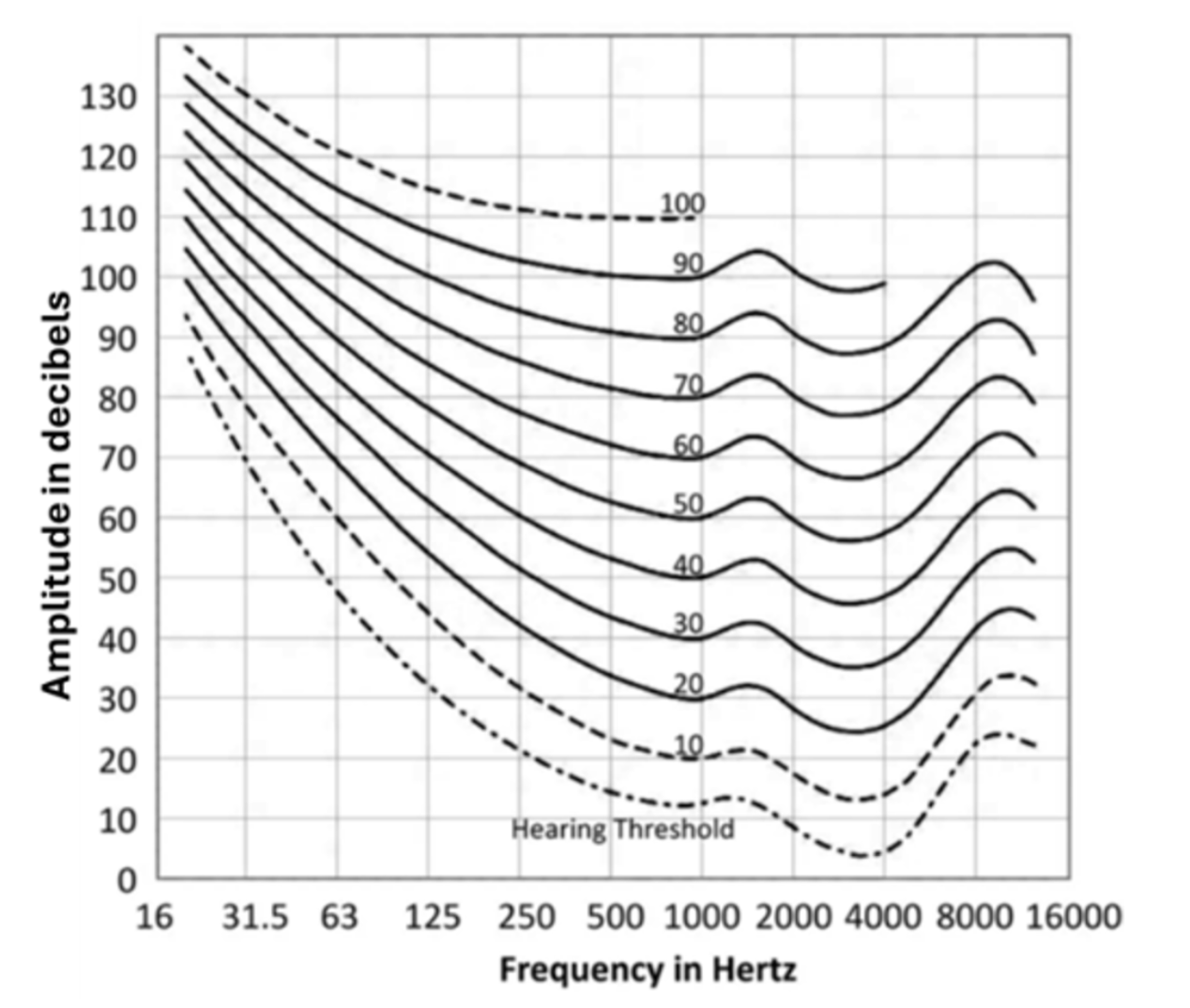
Refer to the figure below: Which statement is true about point 1 and point 2 (note: On the exam, I will label 2 points and you will need to tell me what is true about them).
Equal Loudness Curve: perceived loudness is a mix of decibels and frequency
Each line is the same loudness
X-axis: Freq; Y-axis: dB (pressure changes)
Can’t hear sounds under 80 dB- audibility threshold
A sound played at 40 dB- one at 2000hz and one at 100 Hz- same physical decibels (pressure change in the real world is identical)- tied to different ratings- change in frequency altered the perceived loudness
Don't hear the sounds as the same
Just because 2 things are the same amplitude in reality, doesn't mean were going to perceive them like that
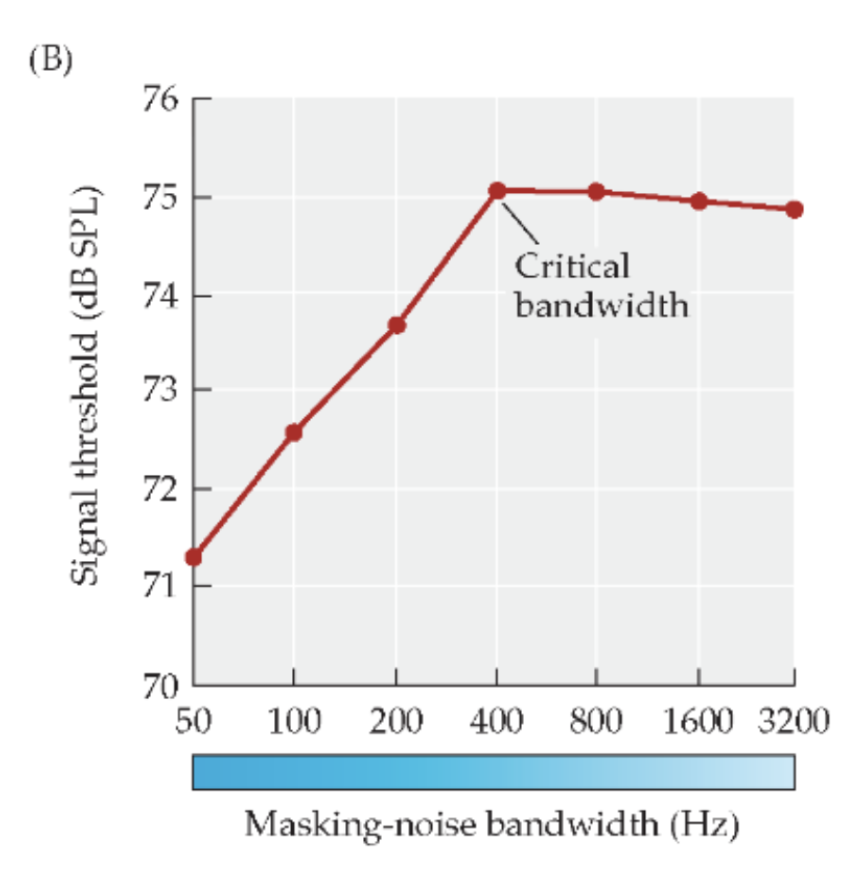
During an auditory masking task, how can you identify the critical bandwidth?
Bandwidth: the width of that noise (how many Hz it covers)
All the frequencies across the range (80-95 has all between)
When noise bandwidth increases, you need to increase the amplitude of the original tone to hear it… to a point
Small tone, small bandwidth = block– keep adding on both
Eventually, we hit the critical bandwidth, where further bandwidth increases don’t impact the tone
So far away from the tone frequency, it stops blocking it
How is sound information organized in the Primary Auditory Cortex?
Primary Auditory Cortex (A1): First part of the cortex to respond to sound, relatively basic processing of any noise. The dorsal part of your temporal lobe
Still tonotopic!- tonotopic map
Small portion of it- like V1 and V2; have A1 and “A2” (belt and parabelt)
Processes more complex sounds
Front: from base- high frequency– Back: from apex- low frequency
Which of the following statements about phase-coding is FALSE:
Tone is not producing a continuous fire
Firing at particular locations
happening across multiple cells— share the load
Which method(s) of sound localization between the two ears is/are used most often for tones of very low frequencies?
Interaural Time Difference: difference in time when sound hits both ears
Lower frequencies = WL longer than width of the head, so brain can detect the timing of the sound waves as they pass one ear to the other without being blocked
Which direction on the azimuth would have the smallest interaural time difference?
Closest number to 0 and 180 (forward and behind)
If something is directly in front or behind you, the sound will hit your ears at the same time, so NO time difference
Which of the following pairs of locations along the azimuth would be indistinguishable based on interaural timing differences?
0 and 180
-60 and -120
60 and 120
-20 and -160
20 and 160
How is interaural timing difference perception similar to color perception in scotopic settings?
They both become a univariance issue
In ITD, you cannot differentiate between either side of the curve in scotopic vision, you cannot differentiate between colors
Let’s say you sit at the back of class. While Dr. Dulas is lecturing, your friend turns to you and starts telling you something. The sound you hear from Dr. Dulas is __________ while the sound from your friend is __________.
Reflected/reverberated; direct
Which of the following can be used to solve the “cone of confusion” problem in hearing?
CoC: Lots of locations have similar ITS/ILD: indistinguishable
Move your head– changing ITD and ILD, and can better localize
Learn the shape of your pinna and how sound is reverberated off of it
Directional transfer function
Which of the following are true about both the Lateral Geniculate Nucleus and the Medial Geniculate Nucleus?
LGN and MGN:
Both regions of the thalamus
MGN: sound
LGN: vision
Despite being part of the same structure, they function differently
MGN already has cells receiving input from both ears
In LGN, its still only 1 eye until V1
LGN cells are divided into single-eye layers
Both do already have a map representation of their stimulus domains:
LGN: retinotopic (spatial)
MGN: tonotopic (frequency)
Neurons that are sensitive to [INTESINTY or TIMING] differences between the two ears can be found in the:
Intensity: Lateral superior olives
Timing: Medial (minutes) superior olives
According to the inverse-square law, what is the best explanation of how sound travels through space?
Decrease in intensity is equal to the distance squared
As distance increases, intensity decreases as you keep going
High frequencies decrease in energy more than low frequencies as sound travels over distance
Which of the following is true about the fundamental frequency?
Two Key parts
Lowest possible frequency for a given note/sound (might be missing)
Smallest common multiple across the harmonic spectrum
Ex. 100, 200, 300, 400 Hz– FF is 100
200, 300, 400– FF is still 100
200, 300, 500– FF is still 100
A complex sound is played with the following harmonic frequencies: [I will give you a series of 3 frequencies that make up the harmonic]. What is the fundamental frequency of this complex sound?
Harmonics are spaced as multiples of the FF
Ex. 100, 200, 300, 400 Hz– FF is 100
200, 300, 400– FF is still 100
200, 300, 500– FF is still 100
What aspect(s) of the inferior colliculus is similar to the superior colliculus?
Both are also midbrain regions
Superior: tied to eye movements
Automatic eye movements and processing eye movements
Not just retina, but your efferent information of how you're moving your head
Inferior: sound integration
Integrating afferent and efferent
Integrating the sounds you yourself are making
KEY: Both take external inputs and inputs from our own efferent signals!
Your own output with external inputs
Gabe puts on a song that contains 2 instruments he’s never heard before. The first time these instruments are played, they have the same onset, but later they go on to have separate attacks/decays and tempos. What do you predict Gabe’s perception of these sounds will be at the beginning and then end of the song?
Not great at distinguishing sounds when played at the same time at first
But if you keep hearing a unique sound paired with changing ones, you learn to segregate them
So, the first time he hears- parse as a single stream can't discriminate
Keep hearing unique sounds with changes- by the end, he can discriminate
Statistical regularities– do they attack/decay at the same time?
Bartleby is talking to Loki on speaker phone while on a train, which makes a loud banging sound every so often. The signal keeps cutting out for Bartleby, so that Loki’s speech is sometimes cut off for a syllable. However, Bartleby doesn’t even notice; Loki’s speech sounds continuous. What must be happening?
Phonemic restoration
Masking sound HAS to correspond to when the gap in the primary stream occurs
Noise HASSSS to happen at the same time as the drop-out
Perceptual continuity: the brain assumes sound continues
Opie is in a bad accident and his ear lobe is damaged. What part of his hearing ability will be most impacted?
The pinna: Damage to the pinna would impact sound localization
Directional transfer function
If you lose your pinna, ruin your Directional transfer function
During an fMRI study, a sound of a given frequency is played. The imaging data shows that this sound evoked a response in [Anterior or Posterior] Primary Auditory Cortex. What can you conclude about this sound?
Response in Anterior: Low-frequency sound
Response in Posterior: High-frequency sound
Clarette is participating in a dichotic listening task. She is shadowing information in her left ear, and ignoring information in her right ear. Which of the following statements about the information going to her right ear is true?
Right ear = unattended
Participants report almost none of the messages in the unattended ear
Even if the information switched languages or words were repeated
Some physical characteristics are noticed
Change of gender
Some high level info gets through
Your name
If the stream from the attended ear switches to the unattended ear- you will then start following the unattended ear (object-based attention)
Filtered not blocked
ERP studies of dichotic listening have suggested that information from the unattended ear is __________.
Filtered NOT blocked very early (immediately)
When you are watching a scary movie, a sudden sound is more likely to produce a(n) _____________ than during a romantic comedy.
Acoustic startle reflex
Which of the following statements about tone chroma and tone height are true?
Tone chroma: a sound quality shared by tones in the same octave interval
Hue of sound (A, B, C)
Same letter = same FF
Tone height: how high or low a tone is (tied to that frequency)
Tone height is increasing the octave
C3 and C4 have different tone heights
As you increase tone height, you return to the same FF but at a different height (same color)
Two songs have the same melody. Which of the following MUST be the same between them then?
Melody: sequence of notes/chords with a coherent structure
Less about exact pitches/timing, but their contour
Contour: the relative rises and declines in pitch over time
Can play the same melody at different octaves/tempos/rhythms
Ochette is studying for an English Literature exam, and is debating playing music to help her study. What type of music would be the WORST choice for her? (not asking about genres of music, but the nature of the music being played).
Music with lyrics in her native language
Which of the following is evidence that attention must filter auditory information at SPECIFICALLY an [EARLY or LATE] stage? [if something supports BOTH stages, it won’t be correct]
EARLY: Physical aspects- ignoring phonemes, languages, etc.
ERP: fast temporal resolution; something unattended is getting processed, so at the first step of the auditory process, filtering is happening
LATE: “Meaning” aspects (evidence = you notice)
Where meaning changes what you're doing– meaning makes it through
Phonemic restoration, noticing your name, and interpretation
NOT NOTICING SOMETHING COULD BE EITHER
If you see “you don't notice…” NOT the answer
Refer to the figure. [On the exam I will pick 2 points along this figure]. Which statement about these 2 points is true? [Those lines on the right side ARE NOT the points I’m picking].
Tone hight = up and down the spiral: A1, B1, C1
Tone chroma = the letters: A, B, C
If he picks 2 letters on different heights: A1, A2 = different octaves but same FF
If he picks two different letters next to each other: A1, B1 = same pitch height (FF are in the same range) but different chroma
A1, A2 & B1, B2: Same chroma, different height (Fq)
A1, B1 & A2, B2: Same tone height (Fq), different chroma
To initiate speech sound, the _______ pushes air out of the lungs, through the _________.
Diaphragm ; Larynx (or Vocal Folds)
Who will be relatively good at discriminating between Ta and Tha in Hindi?
Native Hindi speakers and any infant under 8 months
Formant [#] will have a _______ frequency when the tongue is positioned relatively ______. [I will pick a formant # for this, and the question is asking you to know the relationship between different formants, tongue placement, and frequency].
Formant 1 (F1): high/low
Higher tongue = lower frequency (bOOt)
Lower tongue = high frequency (bEEt)
Formant 2 (F2): front/back
Forward tongue = higher frequency (bEEt)
Backward tongue = lower frequency (bOOt)
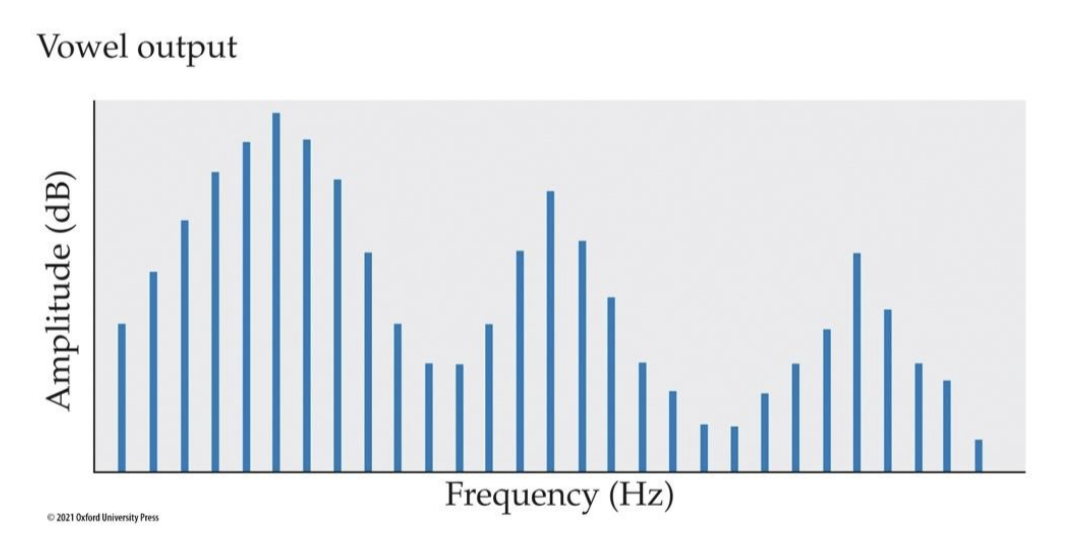
Refer to the graph. In this graph, the peaks are referred to as:
Formants
Which of the following is an example of a coarticulation problem?
Coarticulation is an issue of phonemes sounding different based on the other phonemes around them
Produce an OO sound or an EE sound before a BAH, transitioning to the BAH will have a different output from both
Instead of processing as continuous differences, use categorization “baaah” and “buuuaah” are basically the same– not that deep, since same meaning
Which of the following is NOT a point of articulation?
Where airflow is obstructed:
IS a point of articulation:
Lower lips
Tongue
Alveolar ridge
Soft palate
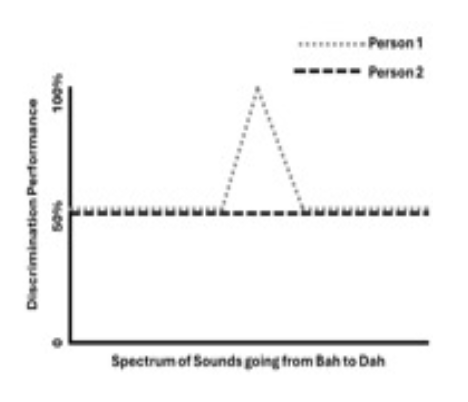
Refer to the figure below:
Let’s say this figure represents the data from a discrimination task where participants here different variations of Bah and Dah and must decide if they are the same or different phonemes. The black dashed line and the gray dotted line represent discrimination performance of two different people. What can you conclude from this data?
Person 1: can distinguish Bah and Dah at the meaningful boundary– can be a native english speaker
Person 2: cannot distinguish Bah and Dah as well (50% performance)-- would not be a native english speaker
Become perfect at identifying the meaningful boundaries between distinct sounds within your culture (bah vs dah)
Damage to [I will give you one of the areas we discussed causing speech deficits] causes ___________ aphasia, which is typified by ______________ [so you’ll need to know the aphasia type and what the actual symptoms are].
Broca’s Area = expressive aphasia
Deficit in speech production NOT comprehension
Can understand you, but trouble producing the action of speech
Wernicke’s Area = receptive aphasia
Deficit in comprehension NOT production
Can string phonemes together but cant understand- word salad
What is NOT a reason why music tends to use frequencies lower than 4000 Hz?
Reason:
We can hear less of the auditory spectrum
Hard time perceiving octave relationships beyond 5000 Hz (sound buns)
High frequency doesnt travel as far - bad for performance
How is speech production important for speech perception?
Speech production plays a crucial role in speech perception as it provides the necessary auditory feedback and phonetic cues that help listeners distinguish and identify speech sounds. This interconnection allows individuals to better understand spoken language by recognizing patterns and variations in speech production.
McGurk effect: part of our statistical learning about sound is reading lips/mouths
Seeing sound changes how our brains hears it
Suggest that speech perception is tied to invoking motor processes involved in speaking (Motor theory- debated)
Huge portion of perceiving language based sounds ties to your bility to speak language
If you can’t produce or identify a phoneme, you cant percieve it
In a phonemic restoration experiment participants heard the following sentences where the _ was masked by another noise:
It was found that the _eel was on the axle.
It was found that the _eel was on the shoe.
What do you predict the participants will hear in each sentence for “_eel” and why?
Sentence 1: WHeel
Sentence 2: Heel
Why?-- Language learning and restoration-
Learn the grammar/syntax of our language and use that to predict what phonemes an ambiguous sound signifies in a particular context
Filling in sound and also altering the perception of what you are hearing
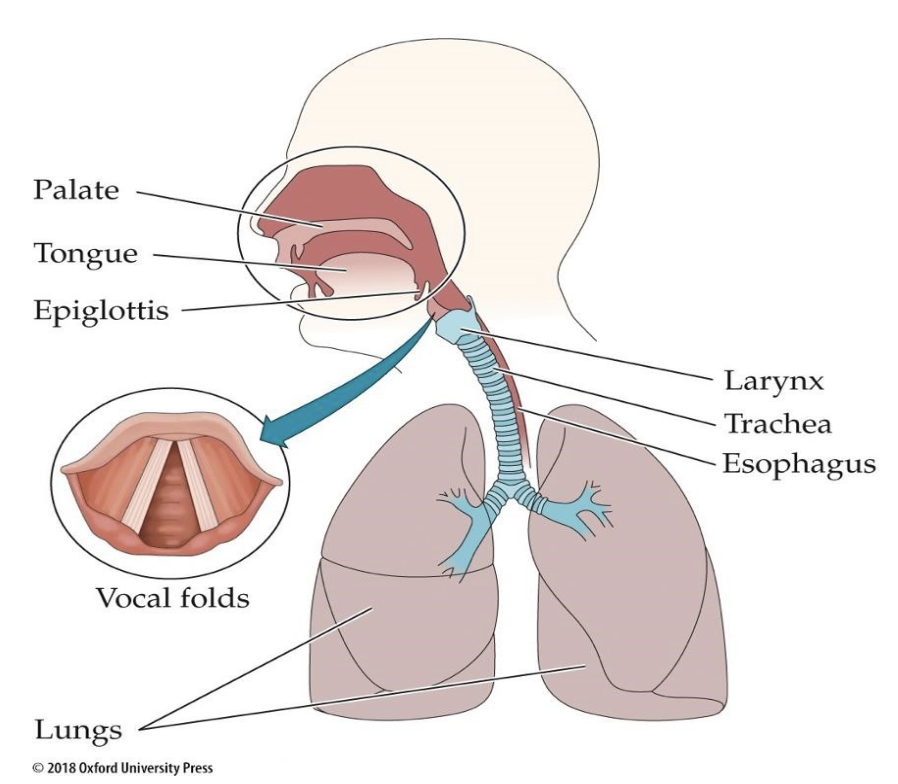
Refer to the figure: In the figure, _________ occurs in the [I will pick one of the regions; you’ll be identifying which step in speech production occurs here
Respiration: Lungs, diaphragm
Phonation: Larynx, Vocal Folds (cords)
Articulation: Vocal/Nasal tract, tongue, palate
The reason that videos shot with handheld cameras seem so shaky and hard to follow is because when we see something with our own eyes, our _______ allows us to compensate for our own motion and maintain a steady image on the retina.
Vestibulo-ocular reflex
What does it mean when we say the vestibular system is an “active sense”?
We are both taking in information around us and using the information about our own movements (sensing and sending)
Afferent: external inputs about the world
Body understands gravity: graviception
Efferent: inputs about muscle movements
Changing your own balance (tilting and not tripping
Jack and Jill went up a hill. Jack fell down, and when he did, he fell so that he was doing a perfect sideroll all the way down, rotating on his z-axis. Which vestibular structure(s) allowed him to process this rotation [BE SPECIFIC]?
Horizontal Semicircular Canal
Jack and Jill went up a hill. After Jack fell down, Jill almost fell too, but instead just tilted her body relative to gravity for about 20 seconds and then returned upright. Let’s say the initial tilt caused a depolarization of her hair cells in her otolithic organs. What can we assume happened 1) during the remaining 20 seconds of her tilt and 2) once she tilted back upright.
1- During the 20 second tilt: depolarization of the HC is maintained during the tilt
2- once tilted upright: the HC do the opposite— HYPERPOLARIZE
What is a key difference between auditory hair cells and vestibular hair cells?
AHC did not send NT at rest, but VHC fire at baseline
![<ol start="46"><li><p><span style="background-color: transparent;"><strong>In the figure below: Which structure is the [I will pick a structure, you’ll just have to select the right name]? </strong></span></p></li></ol><p></p>](https://assets.knowt.com/user-attachments/85f58bed-a995-4624-b8b4-1425373ea6b5.png)
In the figure below: Which structure is the [I will pick a structure, you’ll just have to select the right name]?
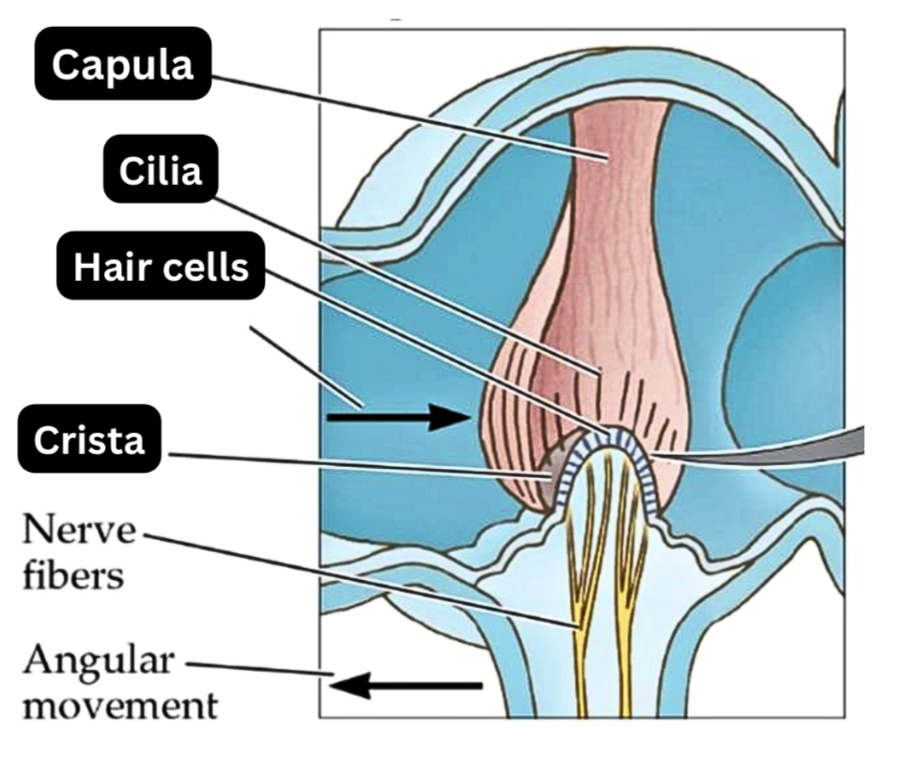
Semicircular-canal neurons respond to _______ and _______, but not _______.
Acceleration and deceleration, NOT constant velocity
Rotational speed and angular velocity, NOT linear acceleration
What is a key difference between the otolithic organs and the semicircular canals that allow the otolithic organs to sense gravity?
Otolithic Organs have OTOCONIA that weigh down and increase inertia to detect gravity and linear acceleration
Filomina is sitting upright in the backseat of her car. Without warning the driver accelerates quite quickly before reaching a steady speed. How does her vestibular system code these each change in speed, from rest, to acceleration, to constant velocity?
Rest– cells fire at a baseline rate
Larger acceleration– move otoconia more on the URTICLE (pushes hair cells open) in direct proportion to the magnitude/rate of the acceleration (depolarize)
Constant velocity– the otoconia catch up and the acceleration becomes 0 and goes back to the resting firing rate
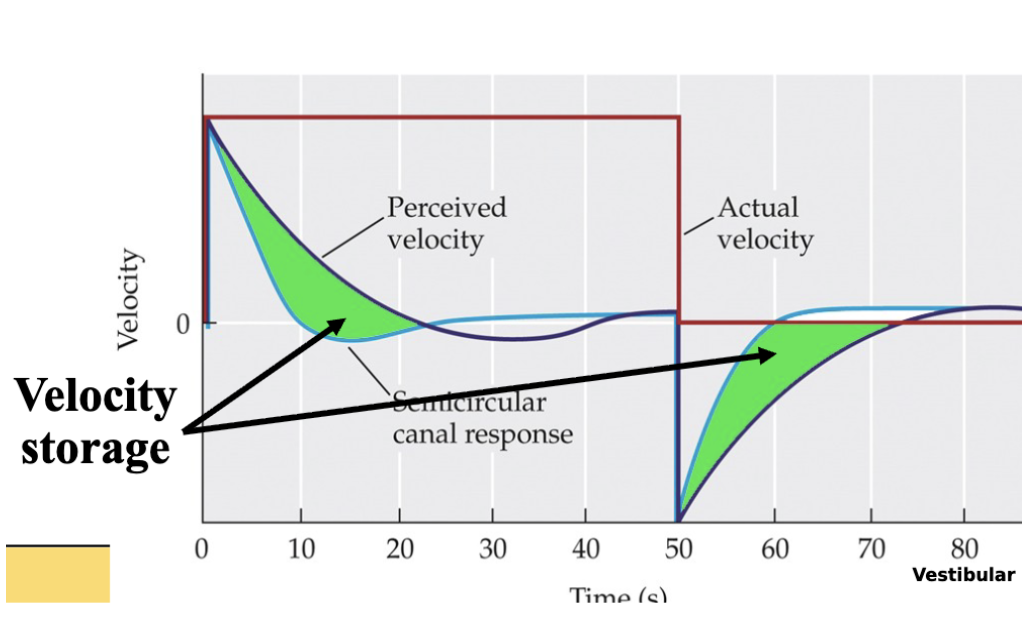
What is the best definition of velocity storage?
Perceived velocity “dips” later and is on a lag in relation to the vestibular system
Your perception of movement lags behind the SSC movement
Think youre still moving but SSC is at rest
Stored information about your velocity
What is meant by the “push and pull” complementary nature of the vestibular system?
Fluid has inertia to the left, bcs SSC are flipped, as you push fluid to the L in L ear, it pushes away from the kinocilia (hyperpolarize), other ear has the opposite orientation- it pushes down in the opposite direction
push/pull complementary system (principle)
Parallel nature of SCs means as you rotate, cupulae are pushed in opposite directions
This means that when one side is depolarized, the other is hyperpolarized
The ____________ part of the vestibular system has kinocilia that are all aligned __________. [Note: I will fill in the first blank and you need to know the how kinocilia alignment differences across various parts of the system]
SSC/ampulla: same direction with respect to the kinocilia
Utricular: Horizontal– towards the striola
Saccular: Vertical– away from the striola
What is the purpose of the semicircular canal structure outside of the ampulla?
Circle- allow for rotational movement of fluid– inertia
Code for CHANGE in rotational speed (acceleration/deceleration)
Use fluid rotational inertia
Har cells are always aligned in the same direction along the crista
Capula is pushed by fluid to open hair cells
If an angular rotation causes stereocilia to bend __________ the kinocilia, it will result in the hair cell becoming _________. [First blank is a direction, 2nd blank is about polarization].
Push away from kinocilia– hyperpolarize
Push towards the kinocilia– depolarize
If you are facing a person and they are moving [a direction relative to you], then they are moving along their ___________ axis.
X: forward or back
Y: left or right
Z: up or down
Uche is in an experiment where he is in the dark with no other sensory input. He is then [Type of motion]. What will be his perception of [Type of Motion] when he has no other sensory inputs? [I will fill in Type of motion with either Tilt, rotation, sheer movement, and will note if it is constant or accelerating].
Tilt:
Accelerating: perceive the initial acceleration (via Otolithic organs)
Constant: he will feel he is tilting the entire time
Rotation:
Accelerating: perceive the rotation in the direction of acceleration (via SSC)
Constant: after time the signal stops and he’ll feel like he stopped turning
Sheer movement:
Accelerating: he will feel the movement on his body (via otolithic organs)
Constant: he will feel stationary
In both the auditory and vestibular systems, amplitude is coded by how much stereocilia are deflected. However, what is a key difference in the coding of these amplitudes between the two systems?
Auditory Hair Cells
Quick vibrations so stereocilia do not stay deflected for a period of time
Little NT release at rest
Usually only seen as an increase in firing rate above the threshold of hearing
VS Hair Cells
Capitalize on fluid inertia that moves the stereocilia and stays deflected for a period of time due to gravity
bend from the middle so there is bidirectional coding (increase/decrease)
At rest, they are at baseline
The left ______ semicircular canal and the right ______ semicircular canal are complementary to each other.
Left Horizontal x Right Horizontal
Left Anterior x Right Posterior
Left Posterior x Right Anterior
Which of the following is an example of mathematical integration in the vestibular system?
When reproducing translations (linear movement), were not only good at reproducing direction, but also velocity– The VS detects acceleration
The brain does the math of Δv/Δt to output velocity
The hair cells in a semicircular canal in the left ear have become [Depolarized or Hyperpolarized; I’ll pick one on the exam]. What can you conclude about the hair cells in the complementary semicircular canal in the opposite ear?
Left Hyperpolarized (away kinocilia) = Right Depolarized (towards kinocilia)
Left Depolarized (towards kinocilia) = Right Hyperpolarized (away kinocilia)
Which functionality would be most affected if you lost your [I’ll pick one of the 4] touch receptors?
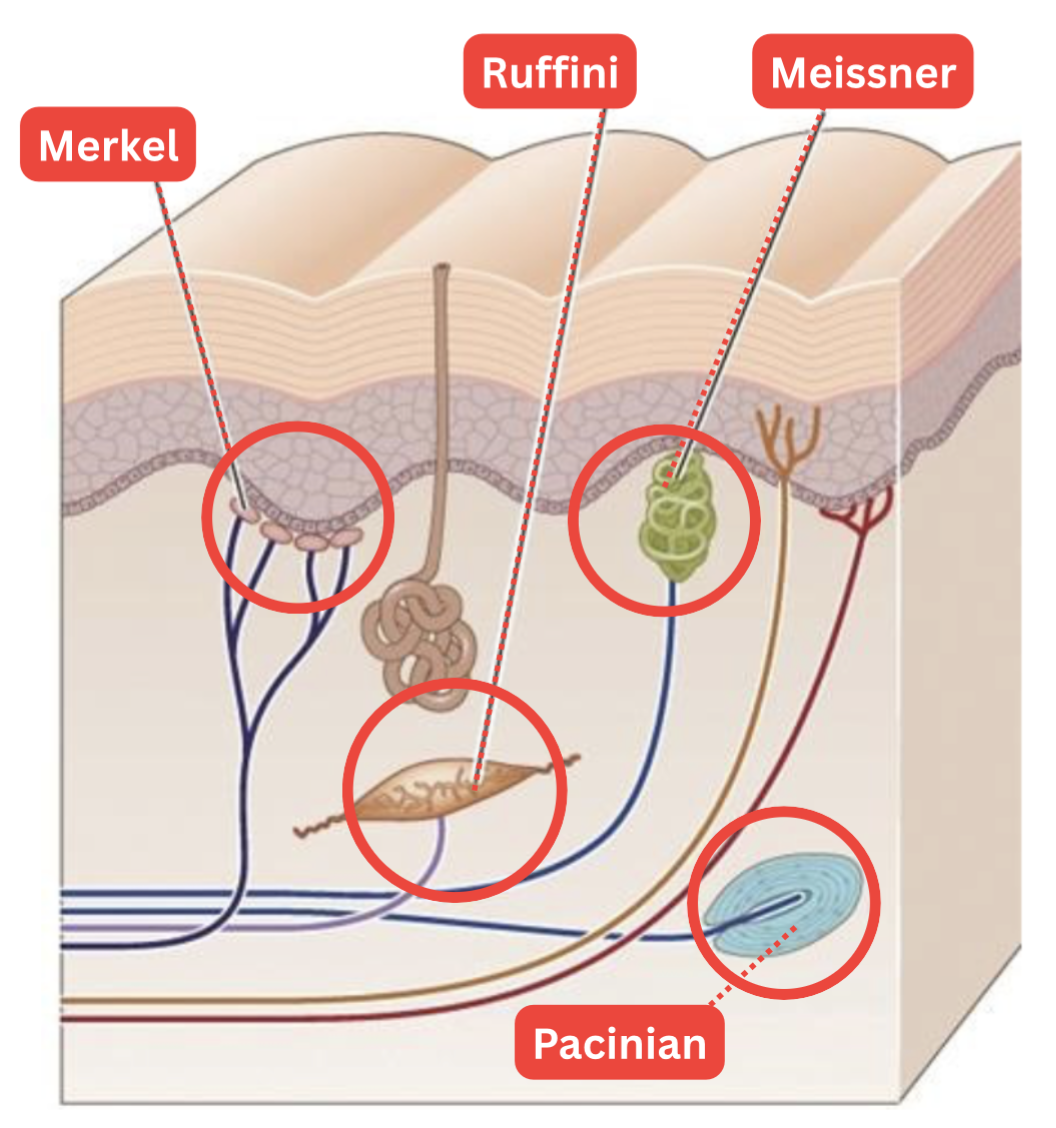
Merkel- Course texture and pattern (sand paper, gravel)
Meissner- low frequency vibration; grasp stability
Ruffini- finger position (how you're moving fingers)
Pacinian- high-frequency vibration; fine texture (silk)
Mechanoreceptors that have a slow adaptation rate and small receptive field size are called
Merkel Discs
The ______ nerve fiber has the slowest conduction speed, in part because _______.
C-Fiber; unmylinated
dull throb- because it doesn't tell you a NOW pain that needs attention, it tells you to avoid an area that’s BEEN hurt
[FIBER TYPE]s have the primary perceptual function of detecting _____________.
SA I- Course texture and pattern (sand paper, gravel)
FA I- low frequency vibration; grasp stability
SA II- finger position (how you're moving fingers)
FA II- high-frequency vibration; fine texture (silk)
How do thermoreceptors detect changes in heat/cold on the skin?
TRP channels
Separate hot/cold fibers that cover different ranges
Have ion channels that respond to temperature changes
Key mechanism for transduction is having physical properties opening ion channels: temp change = ion channels open or close
Generally measured in comparison to skin temperature
![<ol start="66"><li><p><span style="background-color: transparent;"><strong>Refer to the figure. </strong></span></p></li></ol><p><span style="background-color: transparent;"><strong>Which label matches the [Cell type]. [I will give you a cell type and 4 labels and you’ll pick the right one. </strong></span></p><p></p>](https://assets.knowt.com/user-attachments/0eea2116-9d6c-4a83-80dc-ad626c97bb33.png)
Refer to the figure.
Which label matches the [Cell type]. [I will give you a cell type and 4 labels and you’ll pick the right one.
What do studies of phantom limb patients tell us about the organization of Somatosensory cortex?
PL: perceiving touch in a limb that is no longer there
Research found that face stimulation would cause a sense of touch in the phantom limb
Those cells review and try to make connections with other parts of the brain that are “nearby,” but they haven’t figured out the output
Which of the following is an example of [Proprioception or Kinesthesia; will be specific about being 1 but not the other]?
Proprioception: our sense of where our body is
Ex. You know where your nose is
Kinesthesia: our sense of how our body moves through space (how to move)
Ex. You can touch your nose
Manuela is playing soccer. The game is close, and she is playing hard. She finally manages to kick the game winning goal just as time expires. After the game, she sees the team doctor and realizes she had been playing with a broken ankle. Why didn’t she notice the pain during the game?
In situations of high stress, the body can release endogenous opioids that block neurotransmissions of pain
When you stub your toe, you first feel a quick, sharp pain transmitted by _______, and then a moment later, a dull, throbbing pain transmitted by _______.
Sharp= A-Delta Fibers; Dull= C-Fibers
Which of the following is the correct order of body parts, from the largest two-point threshold to the smallest with regards to [TOUCH or PAIN; I’ll pick one]?
Touch: Shoulder- back- palm- fingertips
Pain: Foot- calf- hand- thigh- lower back- forearm- shoulder- palm- fingertip
Tactile agnosia can be referred to as a deficit in what?
Inability to recognize objects via touch
Deficit in touch recognition
How are V1 and S1 similar in their representations of their domains?
Topographic mapping, contralateral representation, cortical magnification
__________ receptors are strictly mechanoreceptors, while ___________ can also be chemical based receptors.
Auditory receptors, vestibular receptors, proprioceptors, tactile receptors ; nociceptors
The [body part] is ______ to touch and ______ to pain. [Note: asking to know how sensitive different body parts are to pain vs. touch, like “very” or “more” or “less”].
Hand-related and top of foot: touch is more sensitive than pain – use it to touch
Shoulder: Significant flip– more sensitive to pain than touch
How does the “pop out” effect in haptics relate to the “pop out” effect in visual search?
Some features “pop out” during haptic search (Rough vs. smooth)
Bottom-up processing– effortless
Unlike vision, not just about one single feature popping out
Vision vs. Haptics:
Vision: any single TARGET FT- automatic parallel process
Haptics: some will pop out but its not nay single feature- has to be a sharp change
Touch processing is faster than _____________ but slower than _____________. [other sensory domains]
Faster VISION, slower than HEARING
What is the best description of how the placebo effect impacts pain perception, based on our class discussion?
Endogenous opioids can be released (to reduce pain NT) when you think something is reducing your pain
Pain is perception, which is not the same as sensation
Which type of fibers are involved in [I will pick a somatosensory type]?
A-alpha- proprioception
A-beta- tactile touch mechanoreception
A-delta- fast pain and temperature
C- slow pain, temperature, itch
Which of these somatosensory sensations has the fastest conduction speed?
Proprioception
How are stereoisomers differentiated in olfaction?
Temporal Order: If you flip something (which changes the molecule), as it passes through the receptors, it might miss one and even have a different pattern
Not just how many they can bind to, its also the patterns in which they bind– the order of stereoisomers matters with temporal order
Which of the following could cause anosmia?
Anosmia: loss of smell
A hard blow to the front of your head that would cause the Cribriform Plate to fracture or jar backward and sever OSNs
Sinus infections can block odorants and even prevent the fibers from moving
Which cells are not found in the olfactory epithelium?
ARE: Olfactory sensory neurons (OSNs), Supporting cells, basal cells
Which of the following statements is TRUE about the olfactory cilia?
NOT mechanoreceptive (like touch and hearing)
Use chemoreception
Extend the surface for chemical receptors that odorants can bind to
Need a buildup of odorants hitting the cilia
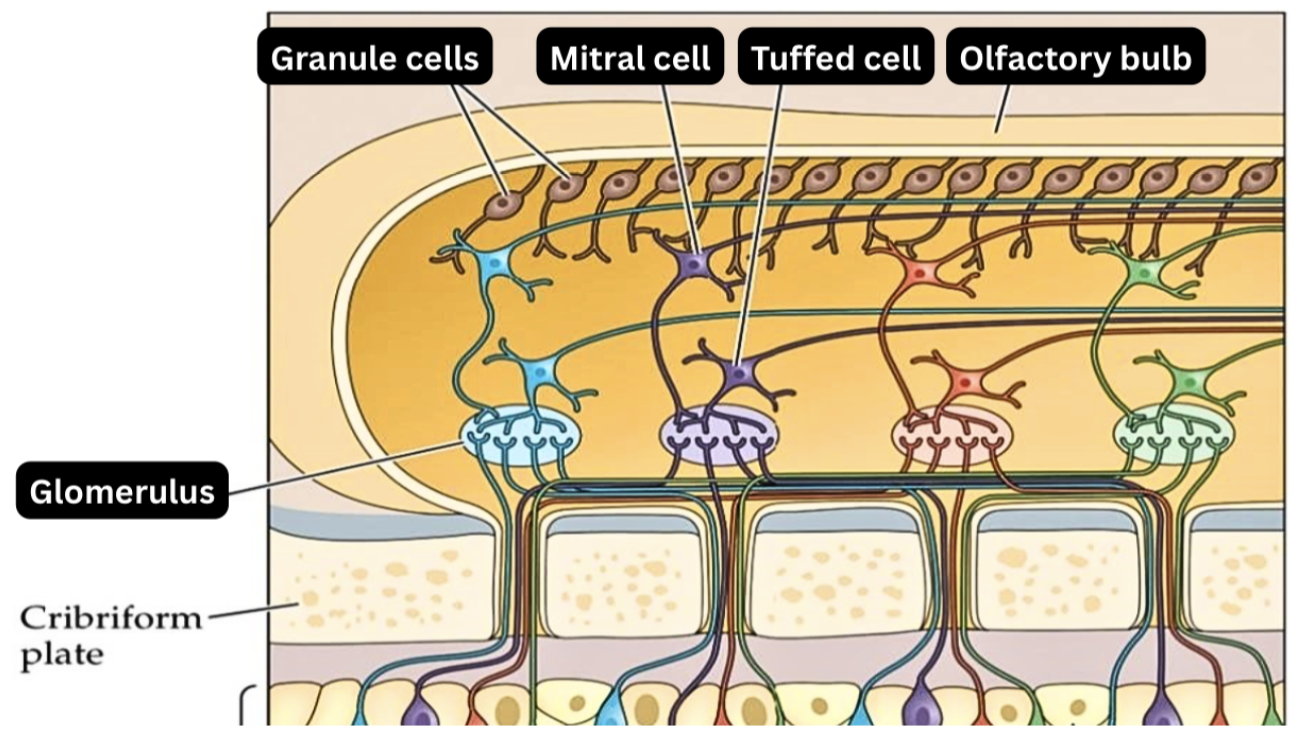
Each olfactory sensory neuron (OSN) converges onto ___________.
Glomerulus
What cells in the olfactory bulb are most similar to horizontal cells in the retina, and why?
Granule Cells
Activating neurons in one area makes it harder to activate neurons in a nearby area in order to skillfully clarify “edges and boundaries” and be able to differentiate smells well– finer tuning
Ex. this smells almost like X, but not quite
Why is olfaction unique among all of the senses in terms of its neural wiring?
It's the only sense that bypasses the thalamus
Goes through the limbic system
Ipsilateral NOT controlateral
The shape-pattern theory of olfaction is based on the idea that
Scents have different odorant shapes that can bind to multiple odorant receptors in a particular pattern
How does changing the intensity of an olfactory stimulus compare with changing the intensity (i.e., amplitude) of an auditory stimulus?
Olfactory: The cilia are chemoreceptive, fire action potentials immediately, go through the limbic system, processed ipsilaterally
Auditory: The cilia are mechanoreceptive, use graded potentials, go through the thalamus, processed contralaterally
BOTH: have little to no activity at baseline, and both see adaptation effects, meaning they are more interested in CHANGE than constant
Suppose a person’s olfactory system is “rewired” such that olfactory signals pass through the thalamus and are processed more in the left hemisphere of the brain. What might be a consequence?
Smell might be more integrated with other senses via the thalamus
Could identify smells better and place the memory
The left side of the brain processes more language, so it could be easier to name smells since it would have access to direct language
![<ol start="91"><li><p><span style="background-color: transparent;"><strong>Refer to the figure below- Which label corresponds to [Cell type]. [I will give you a cell type, you’ll need to identify it]. </strong></span></p></li></ol><p></p>](https://assets.knowt.com/user-attachments/0adbb0ec-036e-442c-9f27-85799ac4557f.png)
Refer to the figure below- Which label corresponds to [Cell type]. [I will give you a cell type, you’ll need to identify it].
Yelena is on a trip to the botanical gardens. However, there is a hot dog vendor on the other side of the gate, and Yelena claims she can’t smell the flowers because all she can smell is hotdogs. What is she experiencing and why?
Cross-adaptation because the smell of the hot dogs is blocking the detection of the flowers
Could be due to shared components, or those odorants overlap in some of their receptors
Your friend Otho has 20 dogs. He swears his place doesn’t smell badly, though. He then takes a trip for a few weeks, and when he comes back he complains his place smells like dogs now and that they must not have been taken care of very well. What is another explanation for why Otho suddenly smells his dogs after the trip?
Cognitive habituation: adaptation to a constant smell at the level of the brain
Getting detection, but the brain deems it as meaningless
Takes a long break for your system to reset and be able to notice the smell
When cutting onions, what type of receptors provide the olfactory response, and what type of receptors produce the burning sensation and eye-watering?
Olfactory response: OSNs; Burning: Nociceptors
The _______ is the part of the brain responsible for processing olfaction and for assigning affective value to stimuli.
Orbitofrontal cortex
How is olfactory intensity perception similar to auditory intensity perception?
Olfactory intensity: the perception of smell is tied both to the concentration (the amount of odorants), BUT also has the component of odor hedonics
Auditory intensity: the perception of loudness is both tied to the actual amplitude of a sound (the dB), BUT also based on the frequency
In both, the perception is not tied to the singular output, and both have another factor that affects how they are perceived
How is olfactory receptor adaptation similar to vestibular perception in the semicircular canals?
Adaptation in Olfactory Receptors: the brain stops detecting constant stimuli
Vestibular Perception in SSC: brain stops detecting constant rotation and will go back to baseline
Both are not wired for constant stimuli– detect new stimuli
They will go back to baseline
THEY CODE FOR CHANGE
What is meant by the idea that olfaction is a synthetic sense?
We almost always smell a mixture of odorants
Most smells are mixtures ( a synthesis) of underlying odorants
Like vision metamers
Bacon as a mixture of odorants (timbre)
What is the correct order of the layers of cells in the olfactory system surrounding the glomeruli?
Tufted, Mitral, Granule (deepest)
Which statement, based on what we discussed in class, best captures our perception of smell while we sleep?
The brain can’t attend to smell during sleep, but it still impacts neural processing
Not attended (conscious awareness), but IS filtered