using sentences + atypical language development
 Call Kai
 Learn
Learn Practice Test
 Spaced Repetition
 Match
Match Flashcards
 Knowt Play
1/20

There's no tags or description
Looks like no tags are added yet.
Name | Mastery | Learn | Test | Matching | Spaced | Call with Kai |
|---|
No analytics yet
Send a link to your students to track their progress
21 Terms
how many different languages are there in the world
over 5000
what is one issue with child language acquisition research
what we know about language development has been sourced on a very small set of languages → vast majority of studies are on the English language, when acquisition differs massively between languages
more diversity is therefore required
around what age does the average child produce their first word
12 months
around what age do most children start to produce two-word utterances
24 months
what is the function of grammar
a powerful tool of language that enables us to combine words in different ways in order to convey different meanings (e.g. dog chased cat vs cat chased dog)
allows us to produce an unlimited number of utterances with a limited number of words
what are the 2 key components to grammar
syntax
morphology
what is syntax
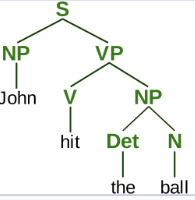
the branch of grammar dealing with the organisation of words into larger structures, which aids us in understanding meaning → sentences are divided into noun + verb phrases, which have components within them
using what grammatical phenomenon is syntactic development tested + when do children develop this understanding
through agent-patient relations → descriptors of who did what to whom. experimenters will test whether children understand agent-patient relations by using novel verbs e.g. ‘point to where the lion weefed the dog’ (whether they infer the lion is the agent)
found that infants have understanding of agent-patient relations at two years old (point to the correct video)
what is morphology
the branch of grammar dealing with the analysis of word structure
what are 4 examples of things that inflectional morphology can mark
shortest meaningful units of language → includes:
tense (walk → walked)
person (I walk → he walks)
number (dog → dogs)
possession (my dog’s bone)
what is morphological productivity
the understanding of the function of inflectional morphemes
how did Berko (1958) test when children gain morphological productivity
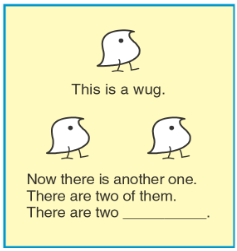
showed a novel object (‘wug’) to children + instructed children to finish the sentence with correct morphemic structure → tests their ability to pick up on productive patterns
what is the usual 3-stage developmental trajectory of morphological productivity
children tend to:
discover an inflection, before which time they made errors of omission (e.g. one dog, two dog)
begin to over-apply the inflection through overregularisations (e.g. I like mouses)
manage to balance applying inflections productively and remembering exceptions (e.g. mouse → mice)
what models capture the sequence of morphological productivity (Rumelhart + McClelland, 1986)
neural network (connectionist) models → computational models that capture human systems of speech acquisition
what kind of approach did Chomsky take to grammatical development + what two problems did he propose to support this
a nativist approach → argued (against behaviourist approaches) that children cannot learn by creatively copying what they hear around them because of:
the poverty of the stimulus problem → children don’t hear enough language to be able to make generalisations about grammar, implying an innate knowledge/understanding of grammar
the no negative evidence problem → adults don’t tend to correct incorrect grammar directly; because children don’t get enough feedback, they should make more errors + not be able to produce it properly
what was Chomsky’s universal grammar proposal
universal grammar = grammatical categories + rules used to generate the grammatical sentences of all the world’s languages → this is proposed to be innate + available to guide language acquisition
what are 3 omissions in Chomsky’s universal grammar theory
it provides no complete account of:
what innate knowledge makes up universal grammar → later proposals suggest that it is made up of recursion (application of the possessive), but this can’t account for all grammar
how children could use it to learn the specific language the are exposed to → how does it apply to nearly 6000 incredibly diverse languages
consideration of possible learning algorithms or children as social beings
what is the main argument of constructivist approaches
argue that there is no problem of the poverty of the stimulus, nor no negative evidence (contrasts nativism) → grammar is learnable based on children’s considerable capacity for statistical learning from social interaction
if children can learn from language they hear by picking up patterns, the proposal of an innate grammar = redundant
what databases prompted the popularity of constructivist approaches
corpora = databases of children’s transcribed speech + interactions with caregivers → these have more recently become available + evidence children’s capacity for statistical learning
also contain the computational linguistic tools to analyse them
what 2 factors do constructivist processes emphasise on how children acquire language
social context of development
learning mechanisms → intention reading, imitation, statistical learning, generalisation + analogy making
what is a problem with constructivist approaches
while popular, there is no fully worked-out account of how different learning mechanisms interact to allow children to creatively produce language based on what they’ve previously heard