Strategic Compensation Exam 2
 Call Kai
 Learn
Learn Practice Test
 Spaced Repetition
 Match
Match Flashcards
 Knowt Play
1/191

There's no tags or description
Looks like no tags are added yet.
Name | Mastery | Learn | Test | Matching | Spaced | Call with Kai |
|---|
No analytics yet
Send a link to your students to track their progress
192 Terms
What is external competitiveness in compensation?
Pay relationships among organizations, where firms pay relative to their competitors.
What are the major policy choices in external competitiveness?
Pay Level and Pay Mix.
What are the three choices for Pay Level?
Lead, Lag, or Match market rates.
What components make up Pay Mix?
Base salary, bonuses, stock options, and benefits.
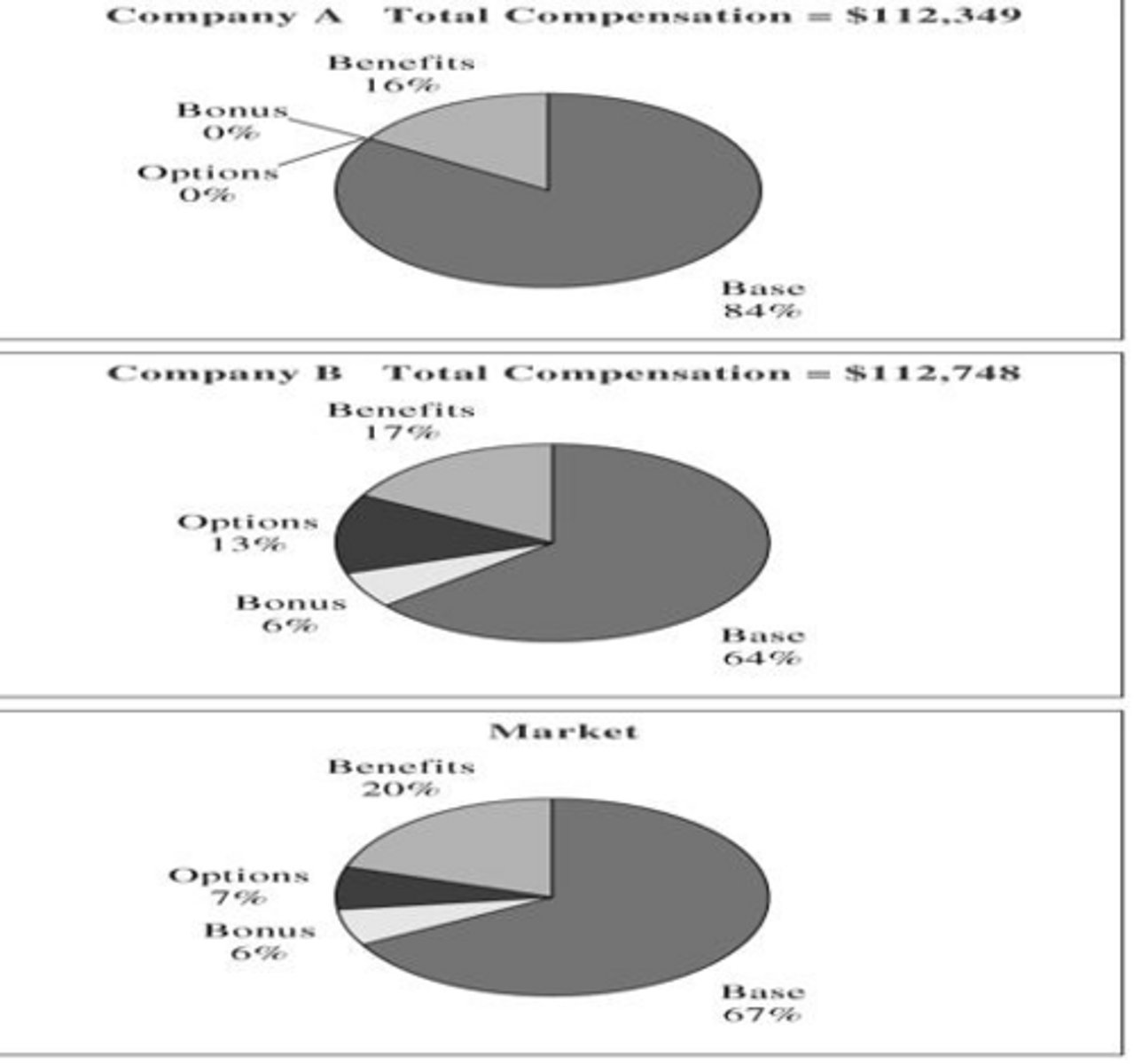
What is 'Total cash' in compensation?
The sum of base salary and bonuses.
What is the difference between short-term and long-term incentives?
Short-term incentives are bonuses, while long-term incentives are stock options.
What economic theory explains how firms decide pay for jobs?
Classical Economic Theory, which considers market supply and demand for labor and marginal revenue product.
What is a limitation of Classical Economic Theory in determining pay?
It is hard to calculate marginal revenue and costs for many jobs.
What is the significance of efficiency wages?
Higher wages may lead to greater efficiency and lower turnover.
How does Costco's turnover compare to Sam's Club?
Costco has a turnover rate of 17%, while Sam's Club has 44%.
What is the operating profit per employee for Costco compared to Sam's Club?
Costco: $21,805; Sam's Club: $11,615.
What does 'shrinkage' refer to in retail?
Loss of inventory due to theft, fraud, or error.
What is Costco's inventory shrinkage rate?
Less than 0.20 percent of sales, the lowest in the industry.
What are organization factors affecting pay level decisions?
Industry capital intensiveness, employer size, people preferences, and organizational strategy.
What is the impact of industry capital intensiveness on pay?
More capital-intensive industries tend to offer higher pay.
How do larger firms typically compare in pay to smaller firms?
Larger firms tend to pay more.
What is the effect of pay level policy on employee outcomes?
It affects the ability to attract, retain, and motivate the right employees.
What is the conclusion of the small business owner's experience with pay?
He was paying more than necessary, leading to financial strain but no employee defections.
What is the significance of the 'sorting effect' in signaling theory?
It refers to how pay level and type attract and retain different types of employees.
What is the role of equity theory in compensation policy choices?
It helps understand the impact of different pay policies on employee perceptions of fairness.
What is the overall goal of external competitiveness policy?
To affect outcomes such as employee attraction, retention, motivation, and cost control.
What are employee benefits?
That part of the total compensation package, other than pay for time worked, provided to the employee in whole or in part by employer payments.
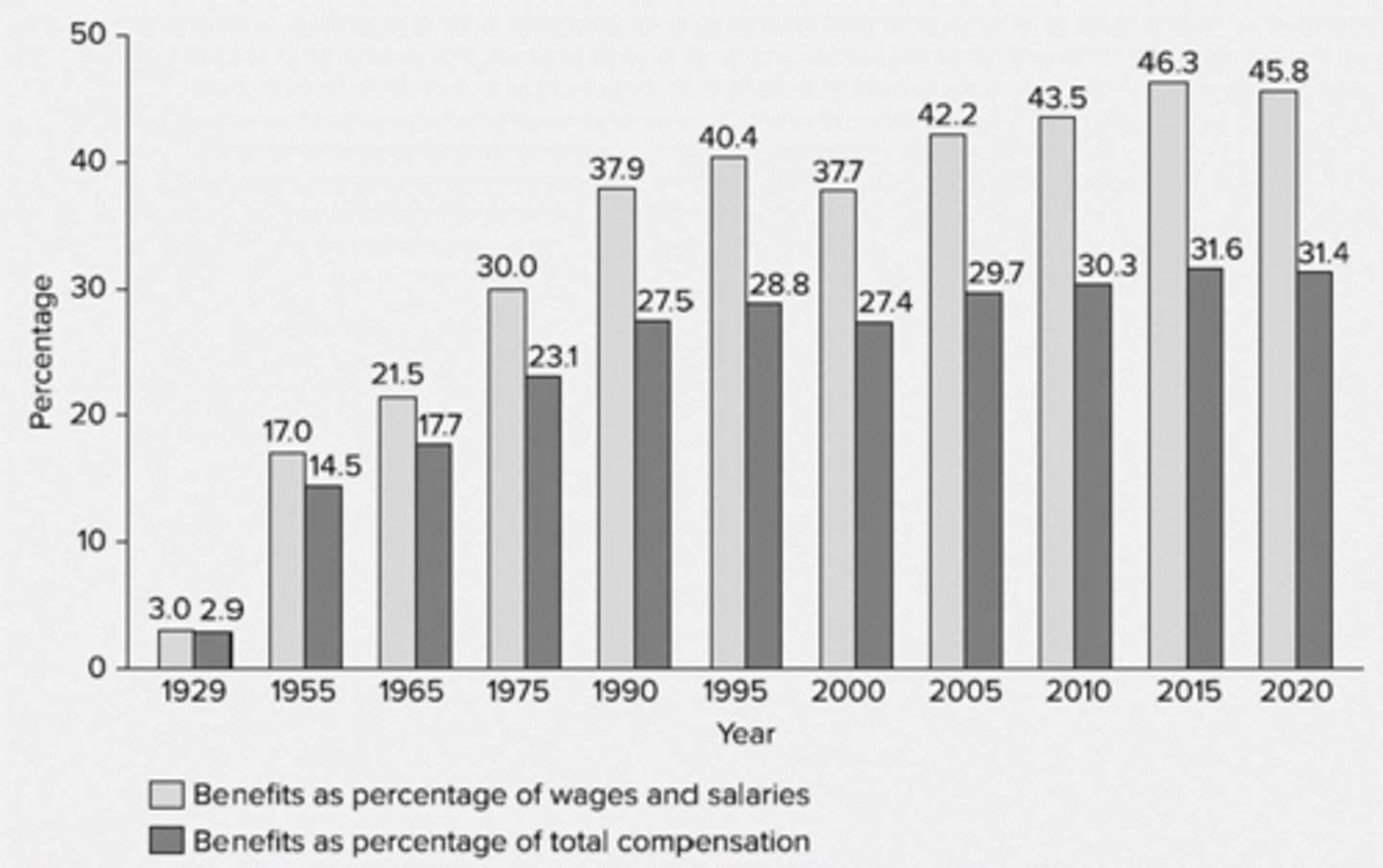
What percentage of total compensation is represented by benefits on average?
31.7 percent
What are some examples of employee benefits?
Life insurance, pensions, social security, vacation, health insurance.
What historical factors contributed to the increase in employee benefit costs from the 1950s to the 1970s?
Historical reasons, tax breaks, group rates.
What percentage of employees report being very satisfied with their benefits?
About 27%
Why do employers offer benefits?
Some benefits are legally required, employees expect them, and they help attract and retain employees.
What are the advantages of employer-provided benefits over cash compensation?
Tax advantages and group rates.
Who should be included in employee benefits?
Full-time, part-time, retirees, etc.
What are flexible benefits?
Benefits that allow employees to choose from a variety of options, often referred to as 'cafeteria style' benefits.
What are some advantages of flexible benefits?
They cater to employee preferences and can enhance satisfaction.
What are some disadvantages of flexible benefits?
Complexity in administration and potential for employee confusion.
What activities are involved in benefits administration?
Communicating employee benefits, processing claims, and containing costs.
How does effective communication affect employee satisfaction with benefits?
Increased effective communication correlates with higher employee satisfaction.
What are some strategies for containing benefit costs?
Implementing probationary periods, caps on payouts, and co-pays.
What goals do companies hope to achieve with employee benefits?
Signal company values and attract/retain the 'right' employees.
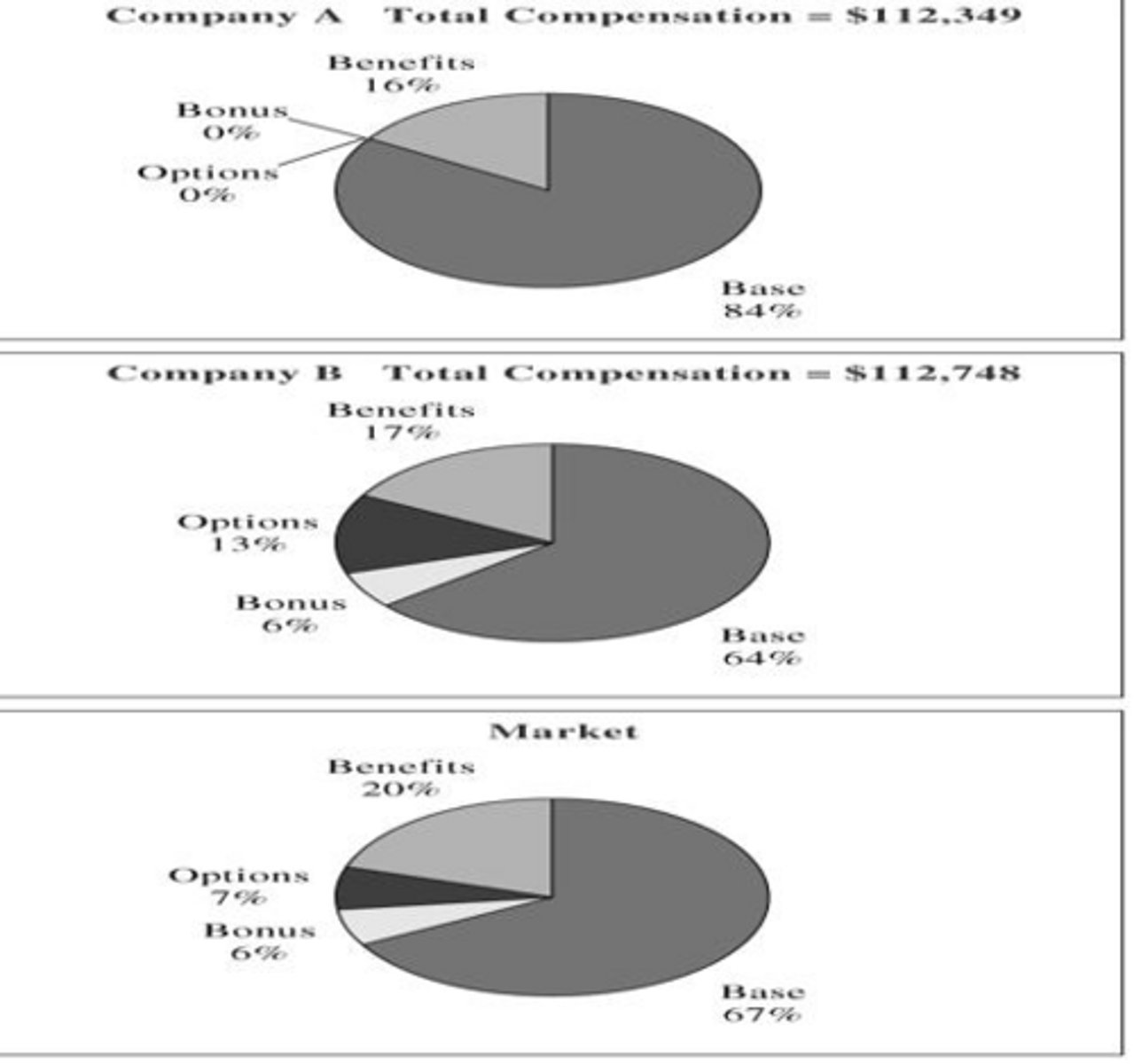
What is the pay mix strategy?
The balance between wages, benefits, and incentives.
What does external competitiveness refer to in benefits strategy?
How a company's benefits compare to those of competitors (match, lead, or lag).
What is a contributory benefits plan?
A plan where employees contribute to the cost of their benefits.
What is a non-contributory benefits plan?
A plan where the employer pays the full cost of the benefits.
How do employee benefits help companies like SAS compete?
By attracting and retaining talent through appealing benefits packages.
Why might not all firms adopt the same benefits strategy as SAS?
Differences in company values, financial capabilities, and employee demographics.
What are the legally required employee benefits?
Workers' compensation, social security, unemployment, family and medical leave, COBRA
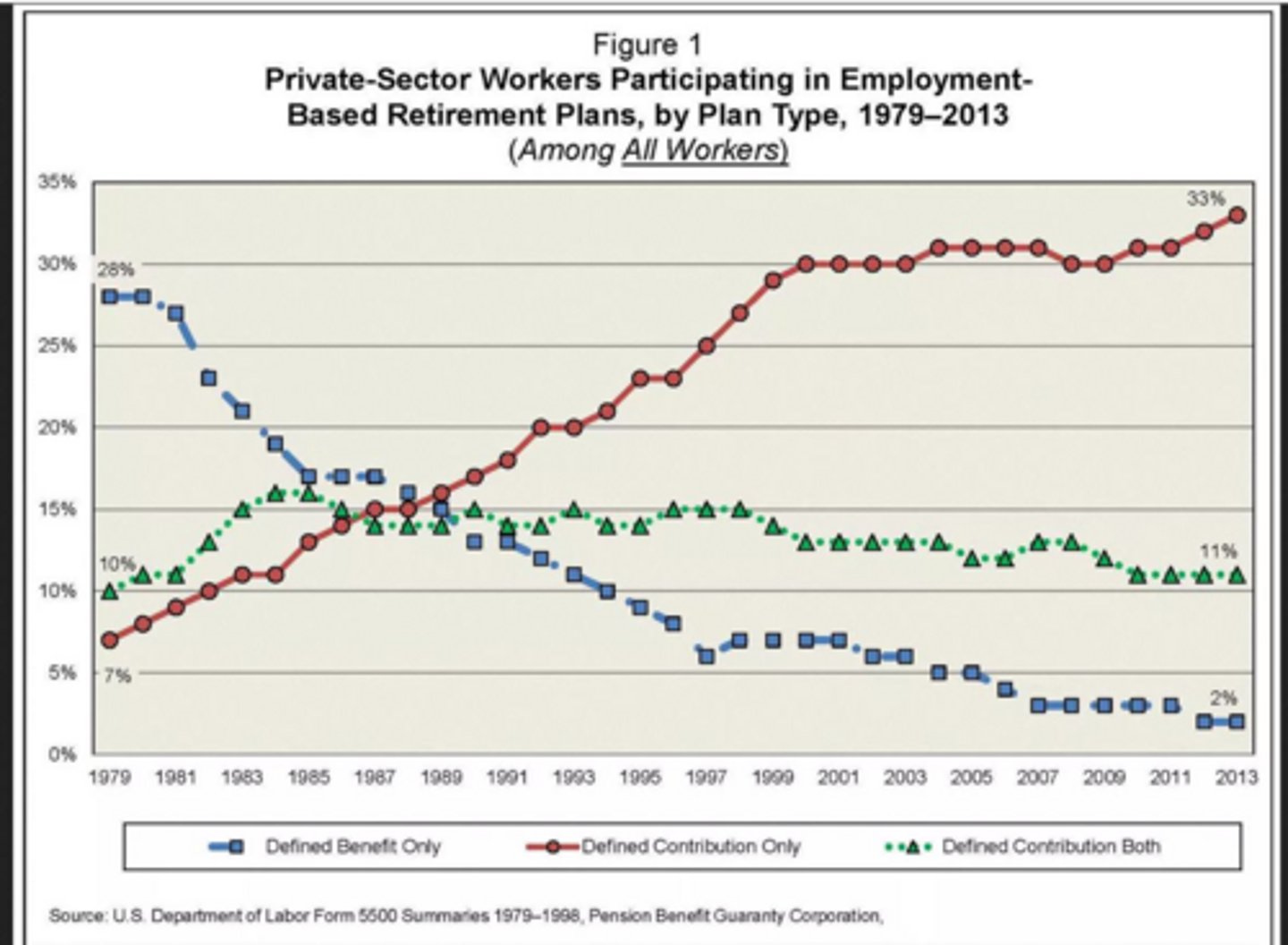
What are the two main types of retirement plans?
Defined benefit and defined contribution plans
What is workers' compensation?
A form of no-fault insurance where employers provide benefits for work-related disabilities or injuries.
Who is responsible for covering workers' compensation?
Employers, through premiums paid to insurance companies or state funds.
What does Social Security provide?
Retirement income, disability benefits, dependent benefits, survivor's benefits, and lump-sum death benefits.
What is the employee and employer contribution rate for Social Security?
6.2% of eligible earnings up to a cap.
What are the two parts of Medicare?
Medicare Part A (Hospital insurance) and Medicare Part B (Medical insurance).
What is the contribution rate for Medicare?
1.45% of eligible earnings with no cap.
What is the maximum unemployment insurance payment in Virginia?
$368 per week.
What are the eligibility requirements for unemployment insurance?
Must have worked 6 months, be unemployed due to job elimination, and be able and looking for work.
What does the Family and Medical Leave Act provide?
Up to 12 weeks of unpaid leave for specified family or medical reasons.
What is COBRA?
A law that provides temporary extension of health care benefits for current and former employees and their families.
How long can COBRA benefits last?
18 to 36 months or until new insurance is obtained.
What is the purpose of the Employee Retirement Income Security Act (E.R.I.S.A.)?
To regulate retirement and savings plan payments and ensure vesting.
What are three strategies employers can use to control health care costs?
Motivate employees to change demand, reduce coverage or change delivery systems, and promote preventive health programs.
What is a Traditional health insurance plan?
Coverage that allows any doctor with a fee-for-service model.
What is a Preferred Provider Organization (PPO)?
A health plan that limits access to a network of physicians with negotiated costs per procedure.
What is a Health Maintenance Organization (HMO)?
A plan with fixed payments per employee, limited access to specialists, and a focus on prevention.
What is the average Social Security distribution?
70% to retirees, 15% to disabled, and 15% to survivors.
What are the potential options for addressing Social Security issues?
Increase the cap, decrease benefits, increase retirement age, or increase funding.
Why are companies like Walmart and Target offering free tuition to employees?
To enhance employee benefits and retention, potentially providing a better deal than wage increases.
What is the notification period for the Family and Medical Leave Act?
30 days.
What is the definition of external competitiveness in compensation?
It refers to the pay relationships among organizations, specifically how an organization pays relative to its competitors.
What are the three primary policy choices for pay level?
Lead, lag, or match the market.
What components typically make up an organization's pay mix?
Base pay, bonuses, stock options, and benefits.
How is 'total cash' defined in the context of compensation?
Total cash is the sum of base pay plus bonuses.
What is the primary limitation of using classical economic theory to determine pay?
It is often difficult to calculate the marginal revenue product or marginal costs for many specific job roles.
What is the 'efficiency wage' theory?
The theory that higher wages can lead to greater efficiency, such as through lower turnover and higher productivity.
How does signaling theory explain pay mix differences?
It suggests that the type of pay (e.g., at-risk pay vs. base) acts as a signal that attracts and retains employees with specific risk preferences and values.
What is the 'sorting effect' in compensation?
The process by which pay level and pay type attract and retain specific types of employees based on their preferences.
How does industry type influence pay level decisions?
Capital-intensive industries, such as technology, tend to offer higher pay levels.
What is the general relationship between firm size and pay level?
Larger firms tend to pay higher wages than smaller firms.
What are the three main goals of an effective pay policy?
To attract, retain, and motivate the right employees while controlling costs.
What is 'shrinkage' in the context of retail operations?
A combination of employee theft, shoplifting, vendor fraud, and administrative errors.
Why might a company choose a 'lead' market pay policy?
To attract top-tier talent and potentially reduce turnover by paying above the market average.
What does a 'lag' market pay policy imply?
The organization pays below the market average, which may help control costs but could make it harder to attract or retain talent.
What is the purpose of a 'match' market pay policy?
To pay the average of the array of rates for jobs, balancing cost control with market competitiveness.
What is the difference between short-term and long-term incentives?
Short-term incentives are typically bonuses, while long-term incentives usually involve stock options.
How does Costco's turnover rate compare to Sam's Club according to the provided data?
Costco has a significantly lower turnover rate (17%) compared to Sam's Club (44%).
What is the relationship between marginal revenue product and labor demand?
Classical theory suggests that labor demand is determined by the marginal revenue product, or the additional revenue generated by hiring one more unit of labor.
Why might a company choose to emphasize benefits over base pay in their pay mix?
To align with the specific values and preferences of their target workforce, potentially increasing retention.
What is the primary function of the 'FastCat Phase 2' software?
It is used for compensation analysis and requires a Virtual Computer Lab (VCL) setup for Mac users.
Does a single 'market rate' exist for all jobs?
No, there is no single market rate; firms make strategic choices about pay level and mix relative to competitors.
How does equity theory relate to pay policy?
It helps explain how employees perceive the fairness of their pay relative to others, which impacts their motivation and retention.
What is the primary takeaway regarding the small business owner's dilemma about paying 'more than he needs to'?
Pay policy is a strategic choice; while high pay can attract talent, firms must balance these costs against their financial sustainability.
What are the three primary pay level policy options?
Lead, lag, or match the market.
What does a 'pay mix' policy determine?
Which aspects of compensation to emphasize, such as base pay, bonuses, stock options, and benefits.
Define 'external competitiveness' in the context of compensation.
The pay relationships among organizations, reflecting the competitive pay levels, mix, and structures.
List four major decisions involved in pay level determination.
Determining pay-level policy, defining the purpose of the survey, specifying the relevant labor market, and designing/conducting the survey.
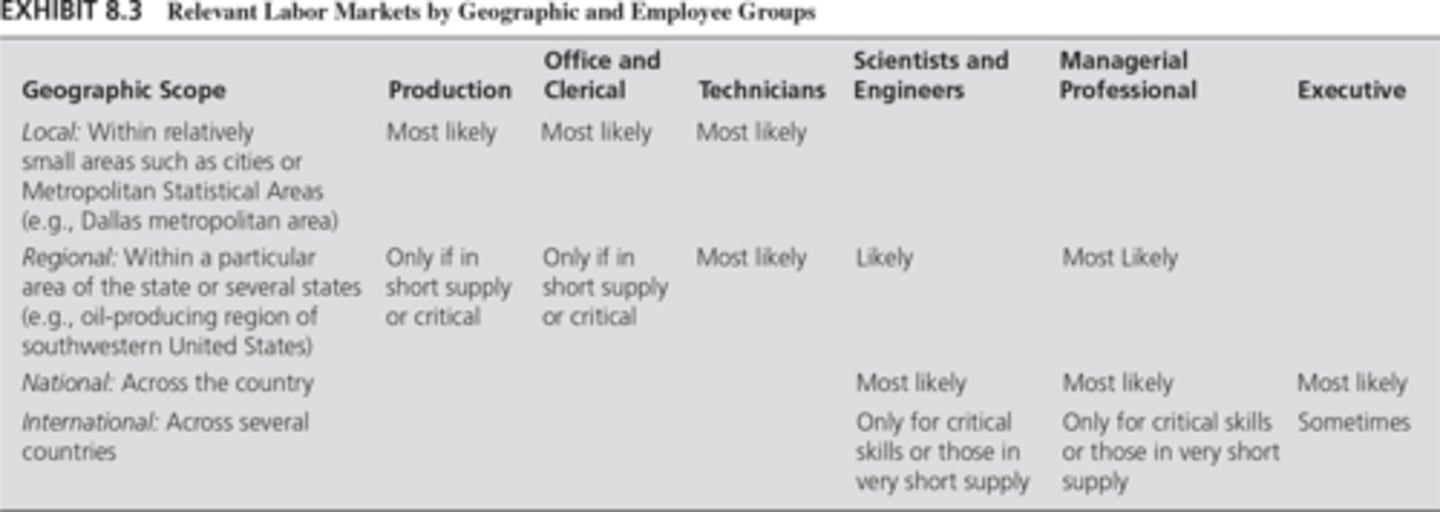
What factors define a 'relevant labor market' when choosing firms to survey?
Labor market competitors (geographic region), product market competitors, and firm characteristics (industry, size, performance).
What are the three common metrics used to compare compensation?
Mean, percentile, and weighted mean.
What are the three components of total compensation measured in the Phase 2 software?
Base wage, total cash (base + bonus), and total compensation.
How does geographic scope relate to job complexity in salary surveys?
As the importance and complexity of job qualifications increase, the geographic limits of the relevant labor market also increase.
What is the 'benchmark conversion approach'?
Selecting a sample of jobs that are common across employers, reflect the entire pay structure, and can be evaluated using a job evaluation system.
What is a pay policy line?
A line that links a company's benchmark jobs (internal structure) on the horizontal axis with market rates paid by competitors (market survey) on the vertical axis.
What are two common approaches to constructing a pay policy line?
The freehand approach and regression analysis.
What does the horizontal axis represent on a pay policy line graph?
Job evaluation points (internal structure).
What does the vertical axis represent on a pay policy line graph?
Market survey salary rates.