Pericyclic Reactions
 Call Kai
 Learn
Learn Practice Test
 Spaced Repetition
 Match
Match Flashcards
 Knowt Play
1/55

There's no tags or description
Looks like no tags are added yet.
Name | Mastery | Learn | Test | Matching | Spaced | Call with Kai |
|---|
No analytics yet
Send a link to your students to track their progress
56 Terms
Define a pericyclic reaction.
Explain the key terms in the definition.
Concerted processes in which bond orbitals overlap in a continuous cycle in the transition state
Concerted: bond breaking and making occur simultaneously (eg. SN2)
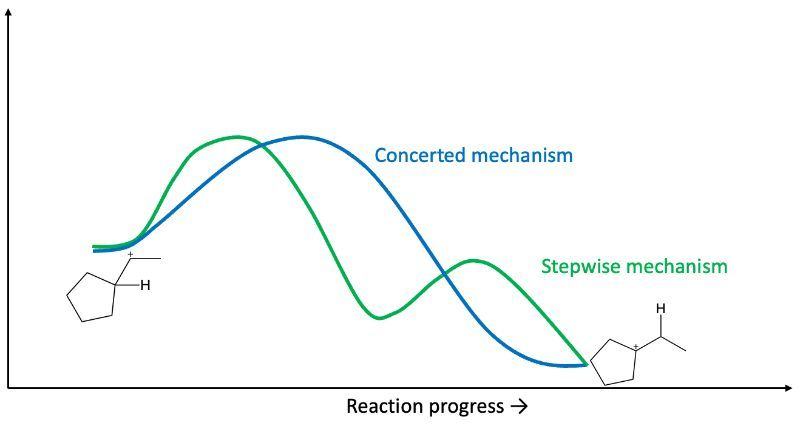
Continuous Cycle: all orbitals involved overlap to form a ring. There is no clear sense of direction because it is a cycle.
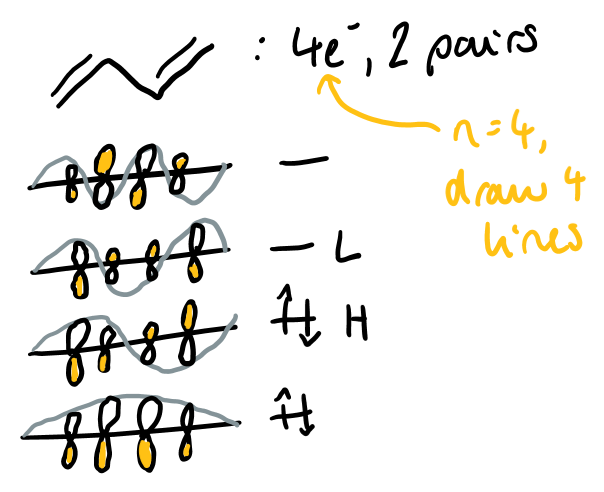
Draw all of the MOs for 1,3-butadiene, including orbital coefficients and phases
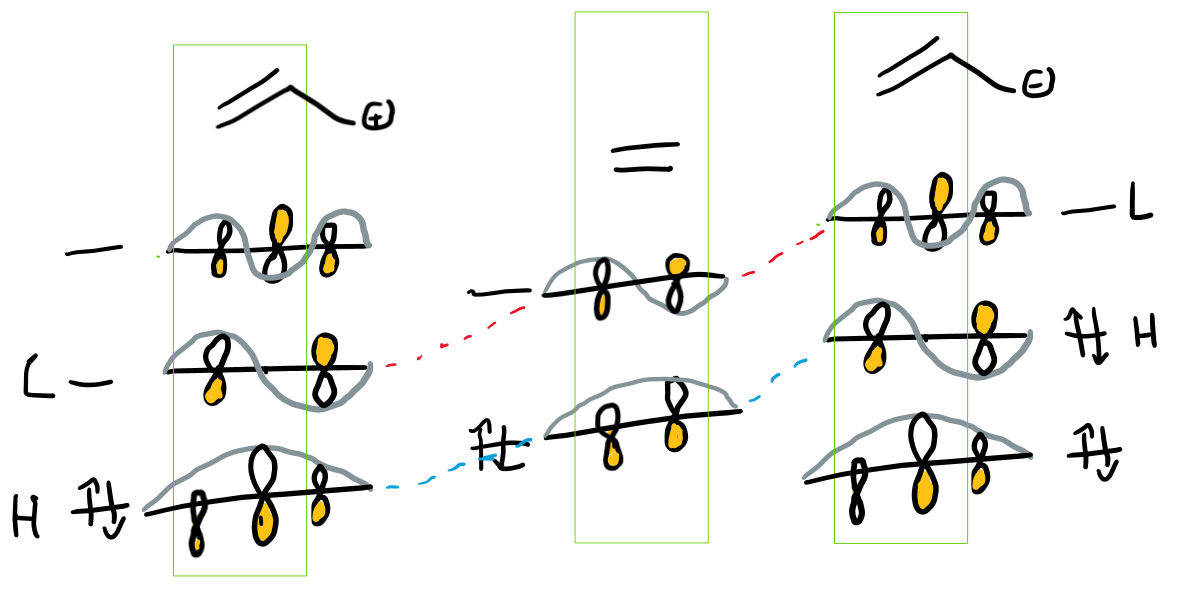
What is the most extreme EWG group on an alkene?
CH2+
ie.
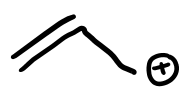
What is the most extreme EDG group on an alkene?
CH2-
ie.
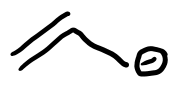
How do you determine orbital coefficients and phases for
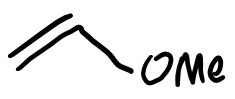
1) Determine if the substituent is electron withdrawing or donating.
Electron donating in this case (+M).
2) Draw orbital coefficients and phases for the two extremes: CH2CH2 and CH2CHCH2-
3) Avergae them to give an approximation for CH2CHOMe
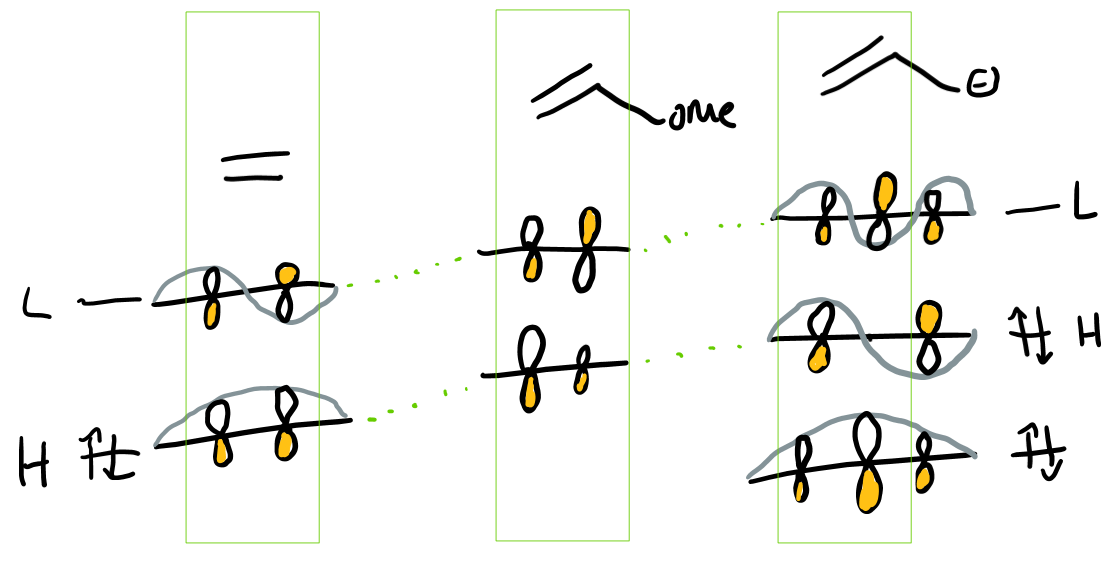
What does this tell you about CH2CHOMe?
There is more electron density on the terminal alkene carbon because the orbital coefficient of this position in the HOMO is larger.
What is the key relationship between EWG/EDGs and HOMO/LUMO orbital energies?
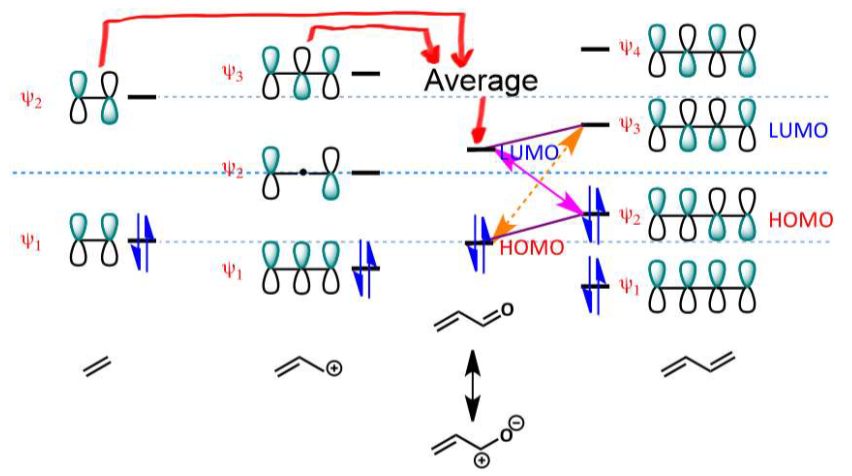
Electron donating groups increase the energies of the HOMO and LUMO because it is easier to remove electrons.
Electron withdrawing groups decrease the energies of the HOMO and LUMO because it is easier to add electrons.
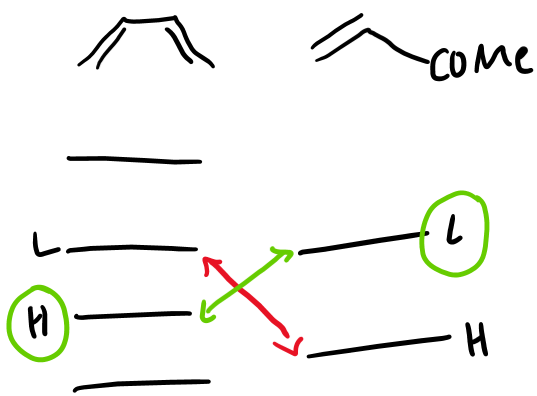
In a Diels-Alder reaction, how can you tell which molecule provides the LUMO and which provides the HOMO?
The smaller energy gap is the reaction that occurs:
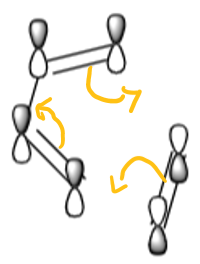
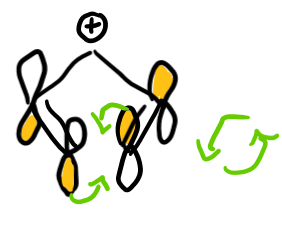
Use the frontier molecular orbital approach to determine whether this reaction is symmetry allowed:
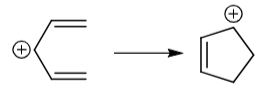
5 atoms, 4 electrons:
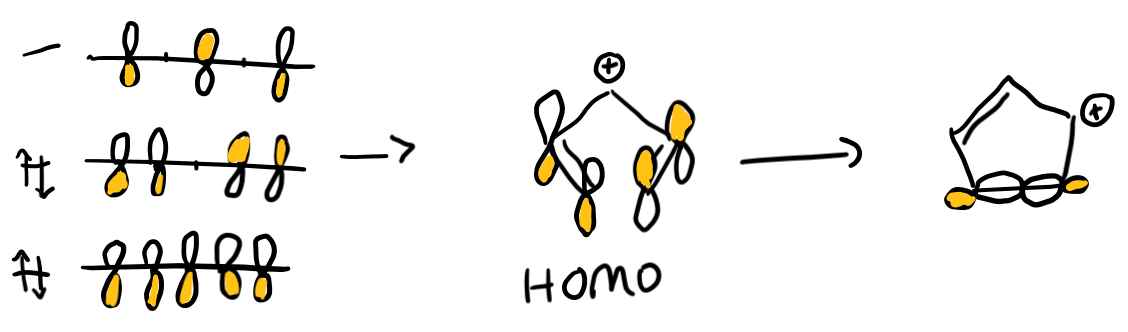
The reaction is symmetry allowed if the orbitals must rotate in the same direction as each other to produce the new bond (to make the phases match).
What is the Woodward-Hoffman rule?
(4q+2) electrons is allowed for suprafacial components
(4r) electrons is allowed for antarafacial components
There must be an odd number of allowed components for a reaction to be symmetry allowed.
Even number to be photochemically allowed.
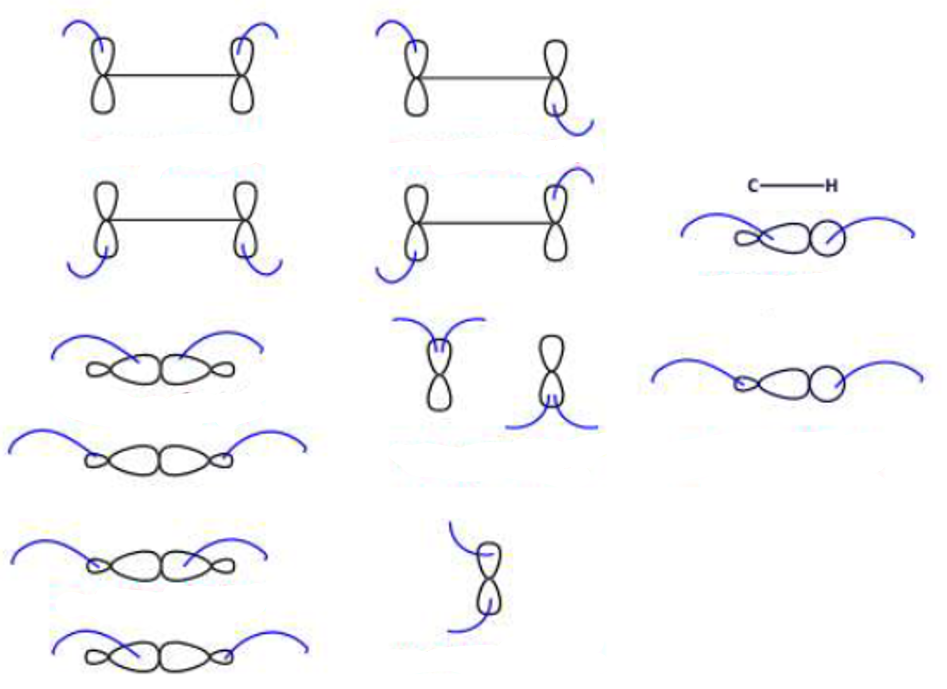
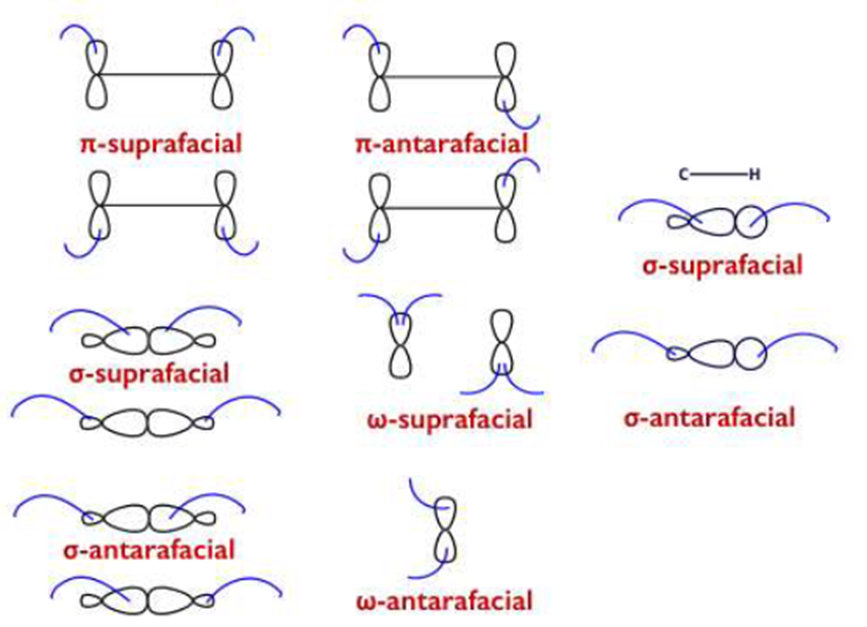
Name these components as super or anatarafacial
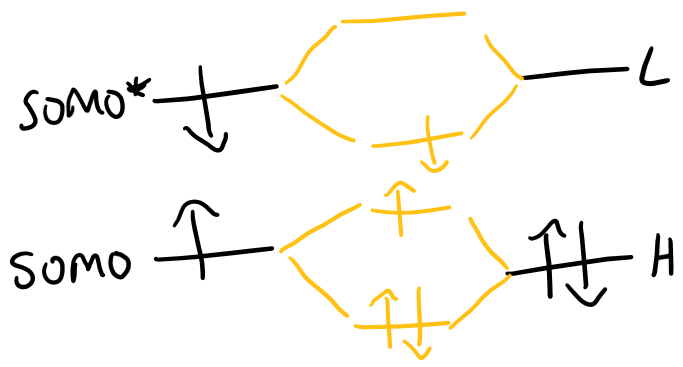
Draw a simple energy level diagram for a photochemical reaction
What are the 4 types of pericyclic reaction?
Draw an example of each
1) Cycloadditions
2) Electrocyclic reactions
3) Sigmatropic rearrangements
4) Group transfer reactions
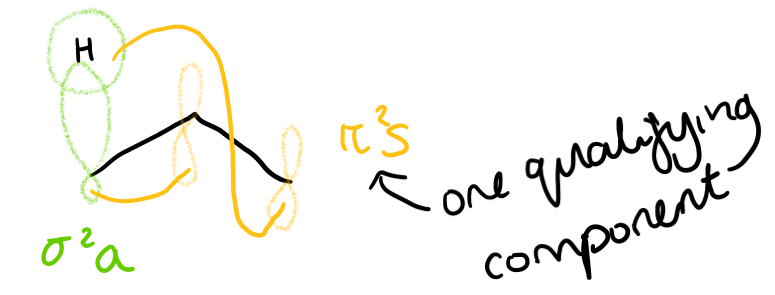
Draw an orbital overlap diagram for an Alder-ene reaction and label the components
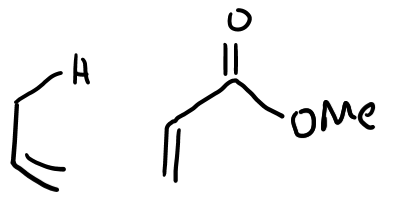
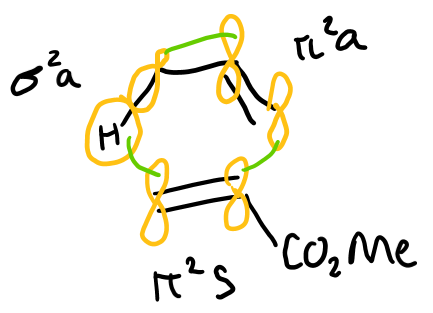
Conduct both the Woodward-Hoffman treatment and Frontier Molecular Orbital treatment on this reaction:
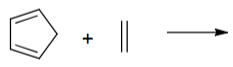
Woodward-Hoffman:
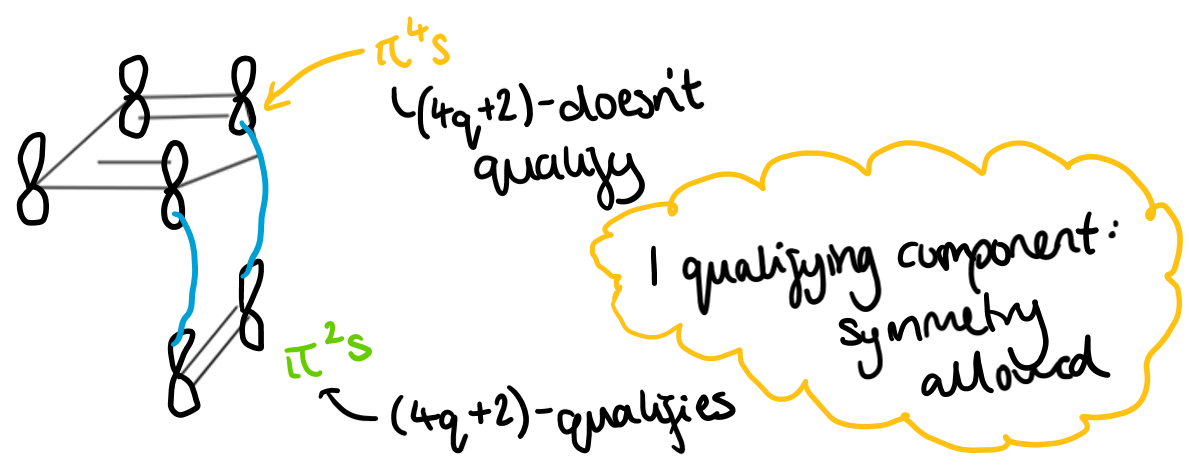
Frontier Molecular Orbitals:
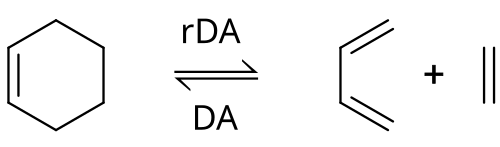
Draw a simple retro-Diels-Alder reaction
Discuss the reactivity and abundance of these conformations:
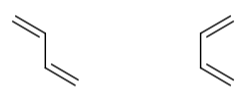
s-trans dienes are more abundant because they are more stable but they are unreactive in Diels-Alder reactions. s-cis dienes are the reactive form.
This isn’t normally an issue in these reactions though because
Explain the relative production of these two products:
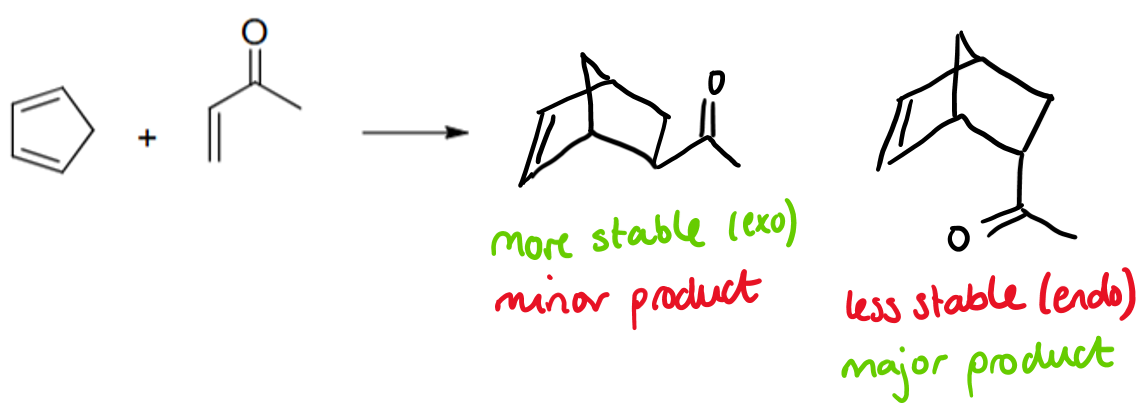
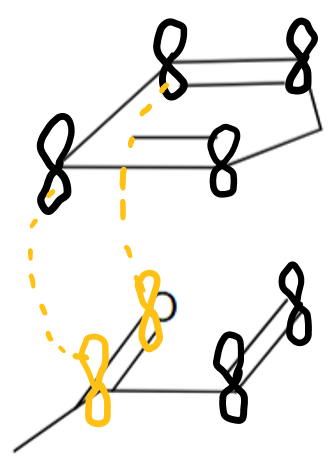
There is a secondary interaction between the carbonyl pi orbitals and the diene which stabilises this orientation.
What would happen if this system was in equilibrium?
The more stable (thermodynamic) product would begin to increase in abundance.
Note: the two products are in fixed orientations due to the bridge
Explain the relative conditions required for these two reactions and why they occur in the context of MOs

Because adding an electron withdrawing group moves the alkene MOs down in energy compared to the unsubstituted alkene. This can cause a smaller energy gap between the reacting HOMO and LUMO, hence less extreme conditions.
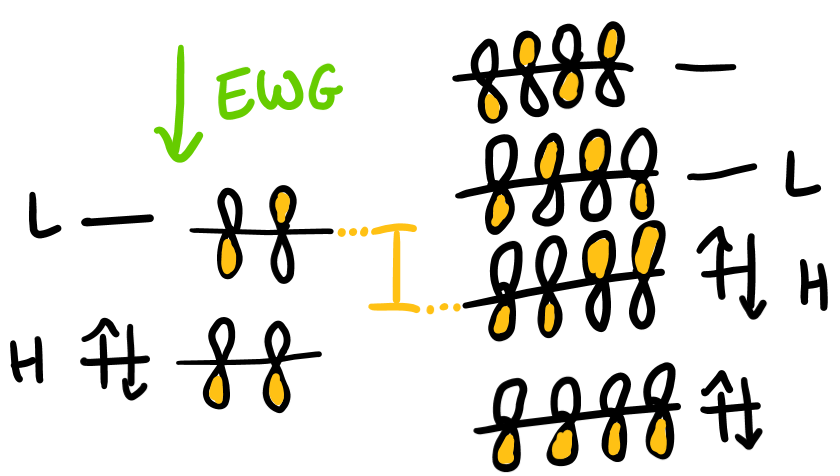
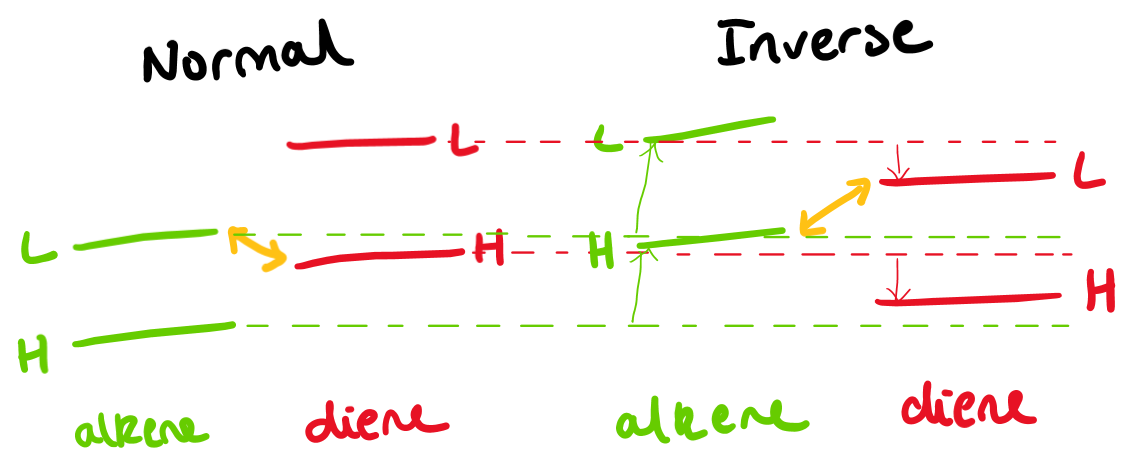
Define ‘normal’ electron demand Diels-Alder.
What type of substituents increase the rate of these reactions?
Normal electron demand: The alkene provides the LUMO, the diene provides the HOMO.
(This is the default unless otherwise specified)
EWGs lower the alkene LUMO to make the energy gap smaller.
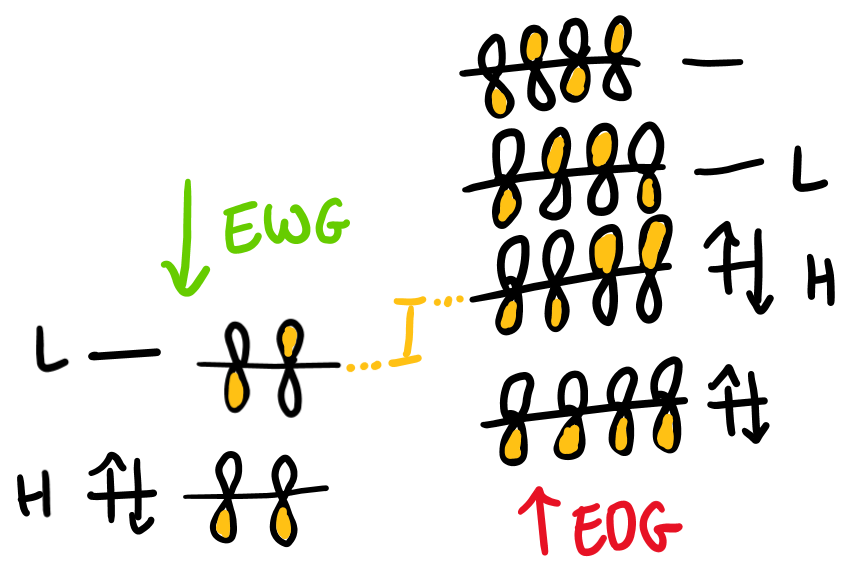
Define ‘inverse’ electron demand Diels-Alder.
What type of substituents increase the rate of these reactions?
Inverse electron demand: The alkene provides the HOMO, the alkene provides the LUMO.
These require EWGs on the alkene and EDGs on the diene
What is the difference between these two Diels-Alder reactants?


The carbonyl is an electron withdrawing group, which lowers the energy of the HOMO and LUMO.
When paired with a suitable electron rich alkene, inverse Diels-Alder reaction can occur.
How can this molecule, as an alkene group in a Diels-Alder reaction, be activated to increase reactivity?
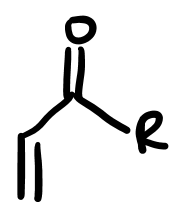
Adding a Lewis Acid Catalyst, like AlCl3, makes the carbonyl group much more electron withdrawing.
This decreases the energies of the alkene HOMO and LUMO, making both normal and inverse Diels-Alder reactions faster.
The energy gap is smaller so reactions occur faster and under less extreme conditions.
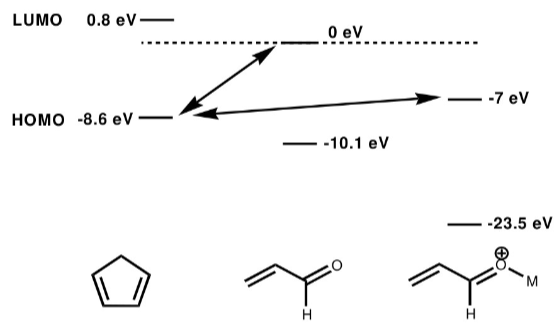
What is the key feature of Lewis Acid Catalysis?
Binding of AlCl3 to the carbonyl is reversible, so only catalytic amounts are required.
What is the simple way of explaining the regioselectivity of this reaction?
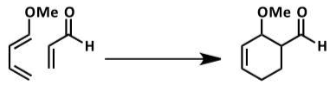
The resonance structures show greater attraction of molecules in this orientation.
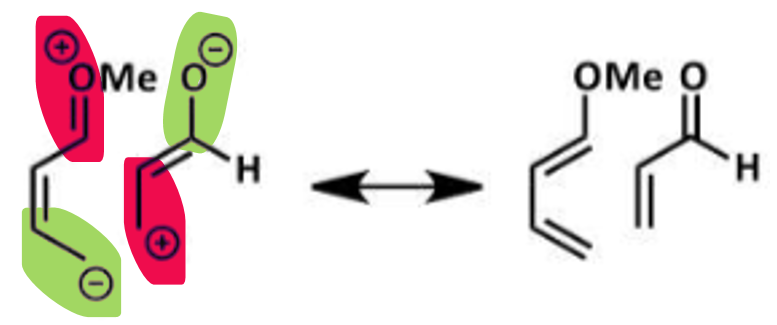
What is the more complex way of explaining the regioselectivity of this reaction?
Looking at the orbital coefficients of the diene and alkene orbtials:
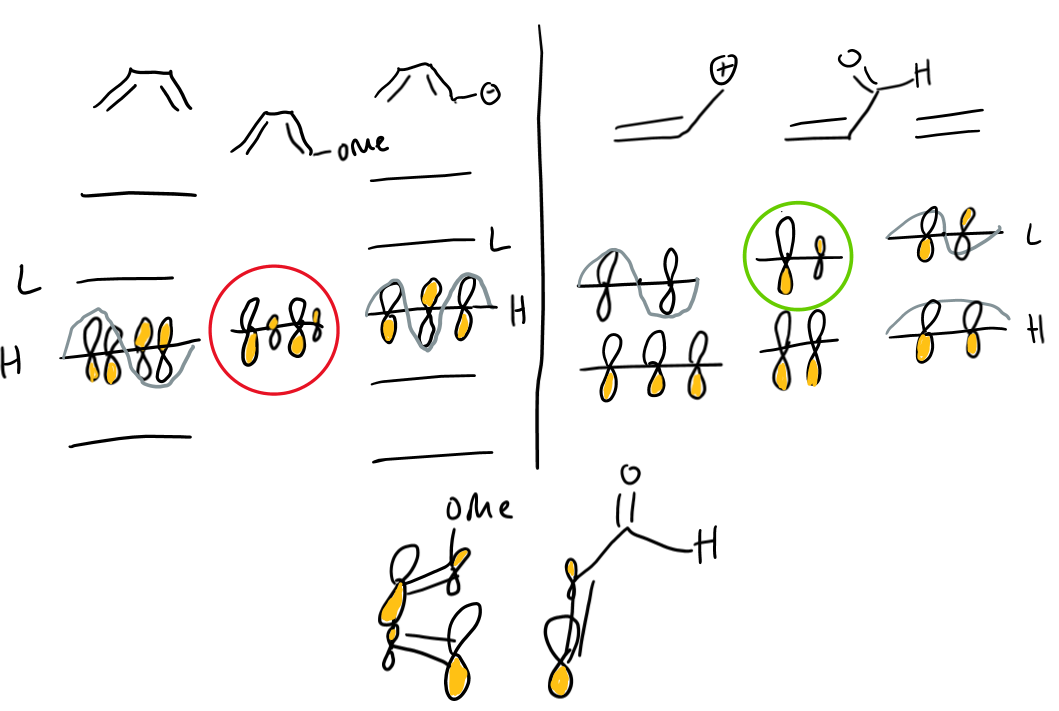
The size of the orbitals of the reacting positions matches in this orientation, making this regiochemistry product more favoured.
How do you explain the regioselectivity of this reaction?
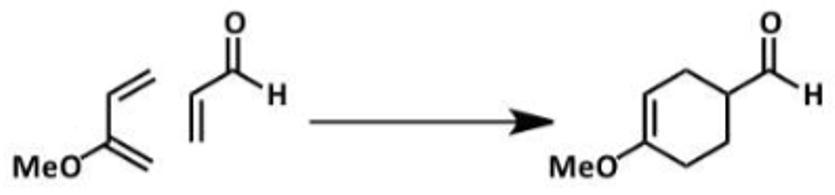
The size of orbital coefficients is difficult to determine here because the substituent isn’t terminal - can’t use this method.
Simple Version:
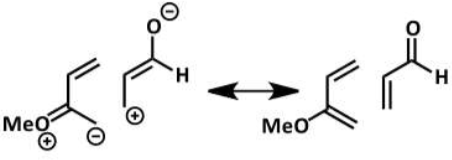
Otherwise, use quantum chemistry (simplified Huckel Theory).
Draw the 3D product of this reaction and explain the positioning of groups in the product.
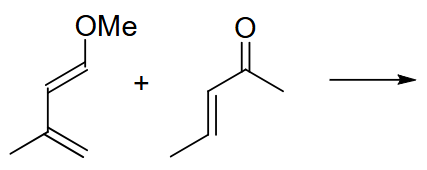
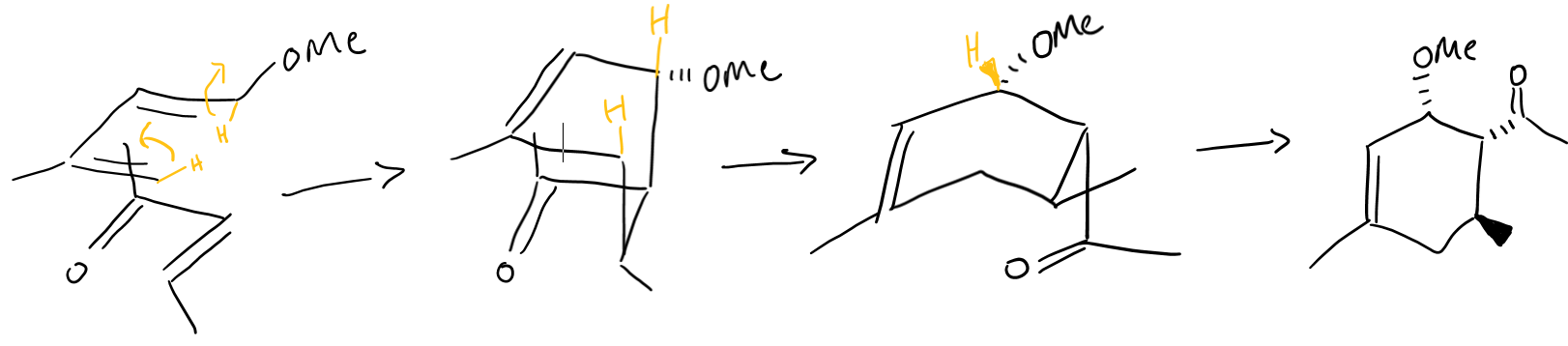
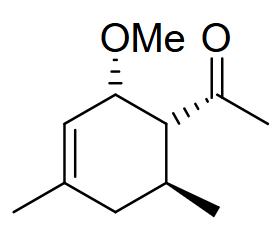
Draw an endo stereoisomer of this molecule:
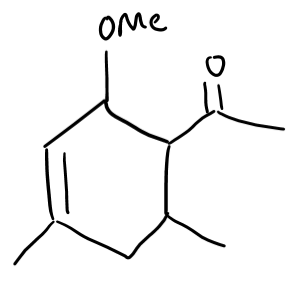
These positions having the same direction:
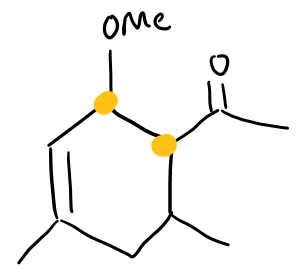
Eg.
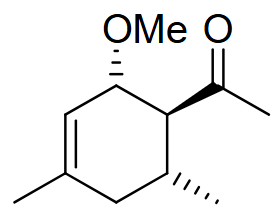
Draw an exo stereoisomer of this molecule:
These positions having different directions:
Eg.
How can you promote stereoselectivity in a Diels-Alder reaction?
What are the limitations to this method?
Using a chiral Lewis Acid Catalyst, eg:
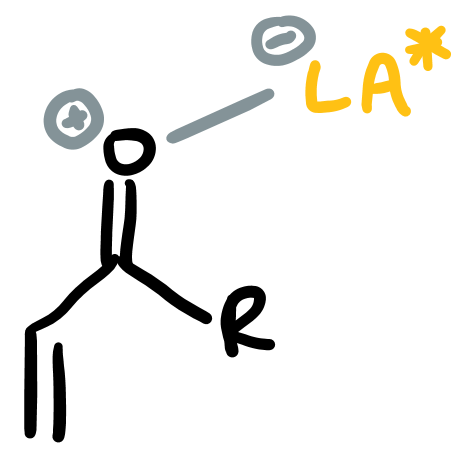
This only works for Lewis Base reactants.
What is the difference between a thermal reaction and photochemical reaction in terms of Woodward-Hoffman rules?
Odd number of qualifying components: thermally (symmetry) allowed
Even number of qualifying components: photochemically allowed
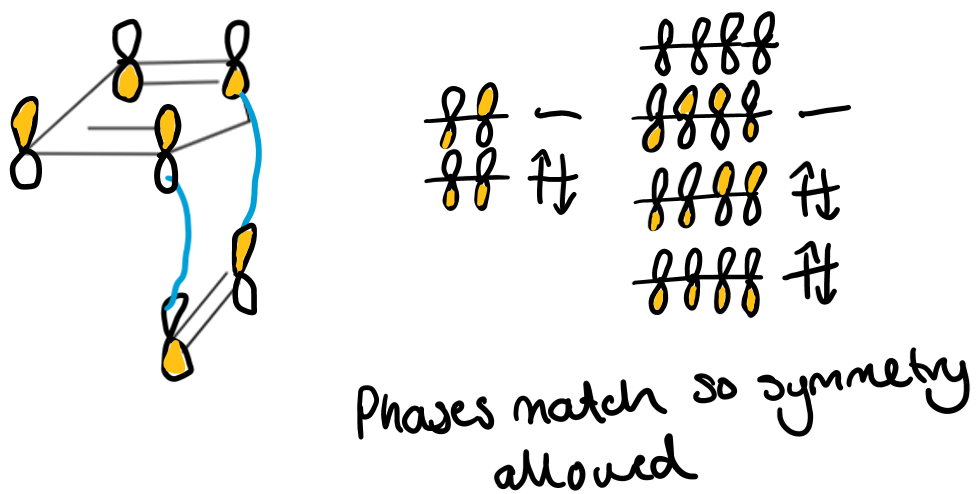
How can you prove that this reaction is photochemically allowed using FMOs?
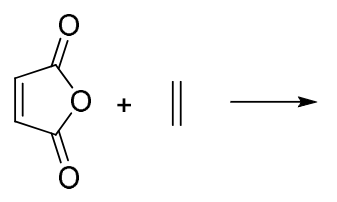
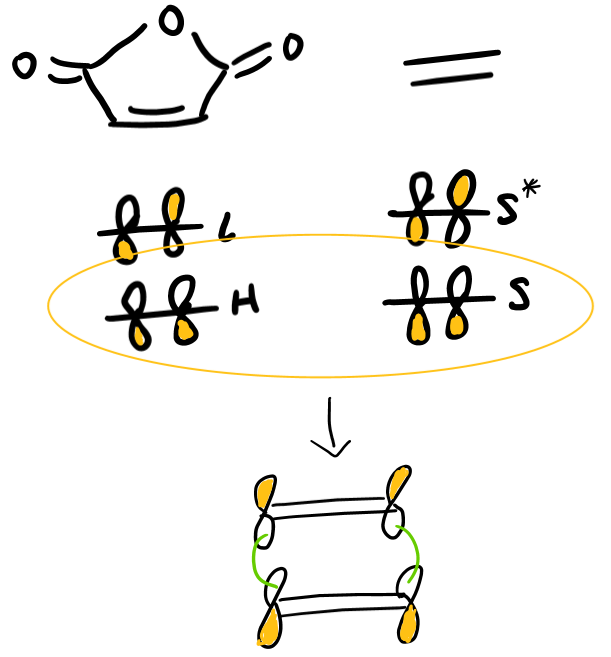
Phases match so this reaction is photochemically allowed.
How can you prove that this reaction is photochemically allowed using the Woodward-Hoffman approach?
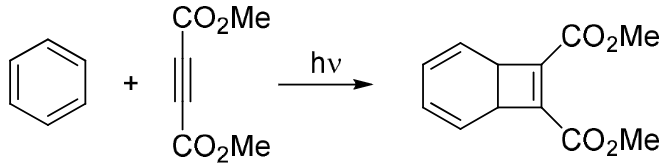
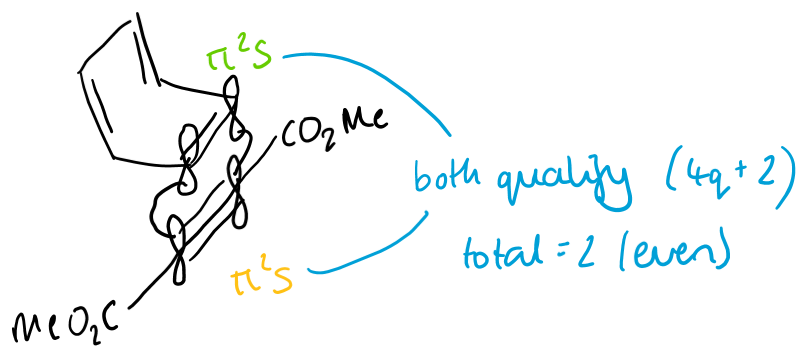
Even number of qualifying components = photochemically allowed
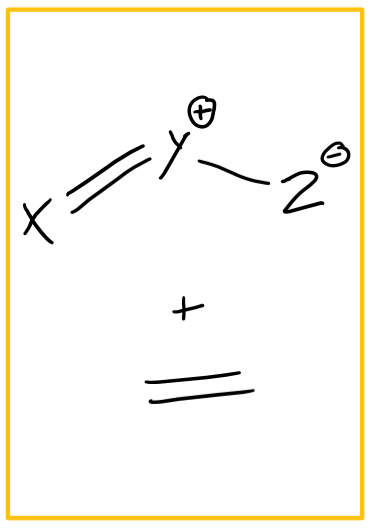
Give the reagents for a 1,3-dipolar cycloaddition that gives this product:

Give examples of X,Y,Z.
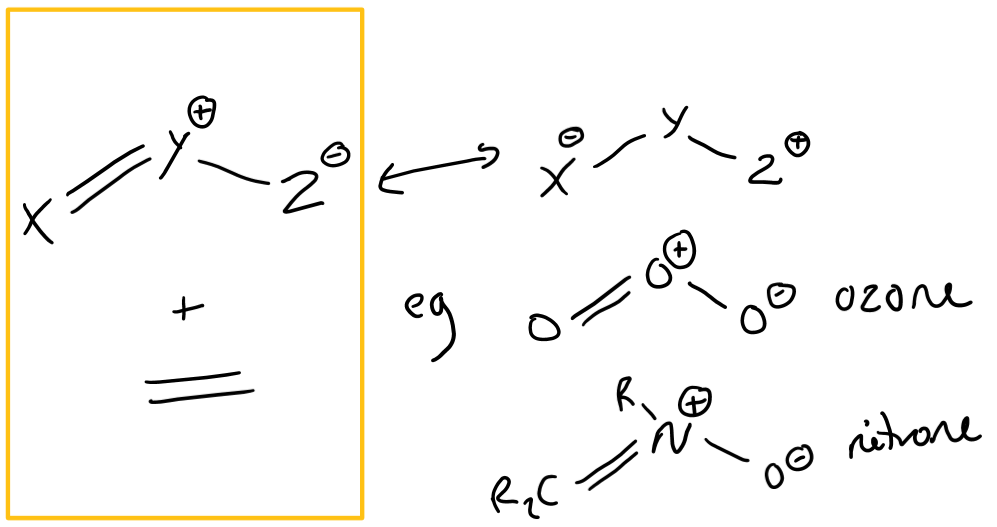
Draw the cube for this reaction and use the FMO approach to determine if it is allowed
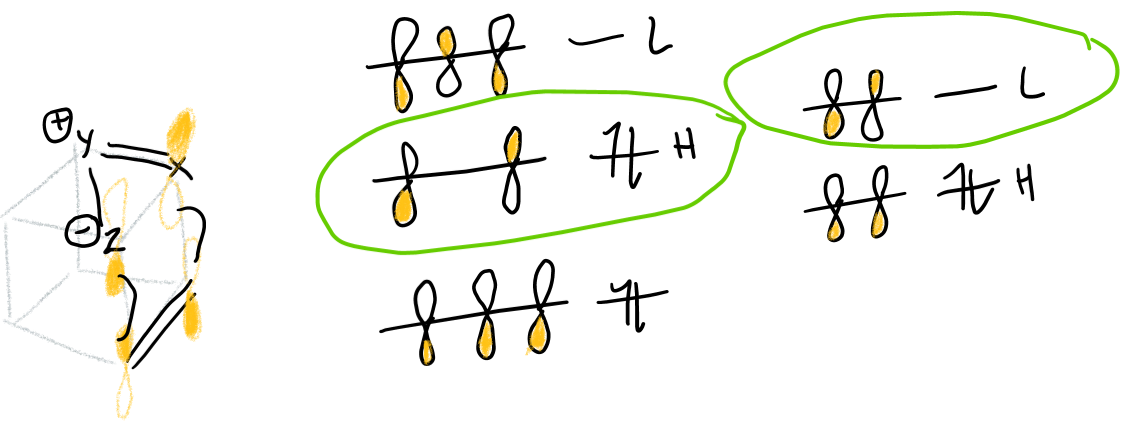
Phases match to reaction is allowed by FMOs
Draw the cube for this reaction and use the Woodward-Hoffman approach to determine if it is allowed
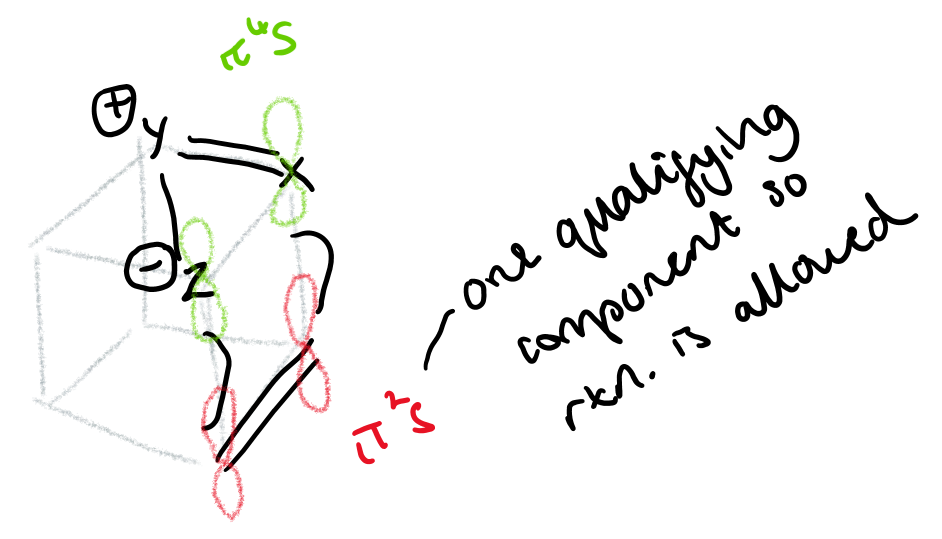
Draw the product of this reaction
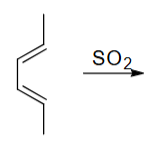
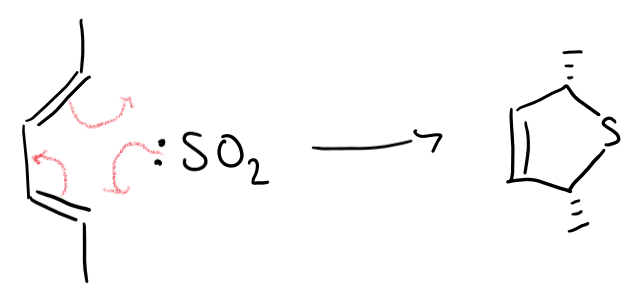
Draw the product of this reaction
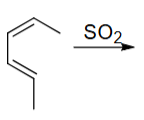
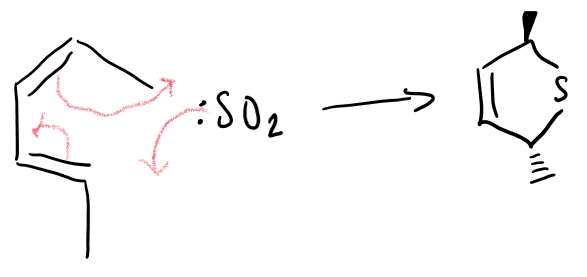
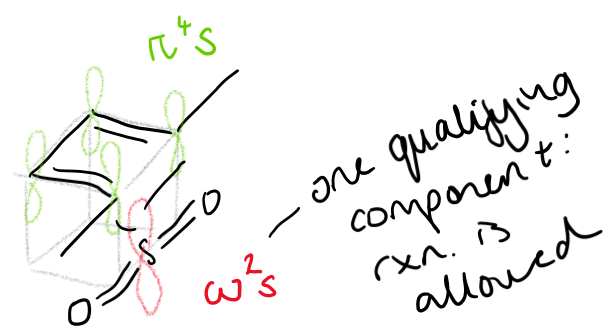
Draw the cube for this reaction and use the Woodward-hoffman approach to determine whether this reaction is allowed
What orbital is used for thermal electrocyclisations?
Give an example of this type of reaction.
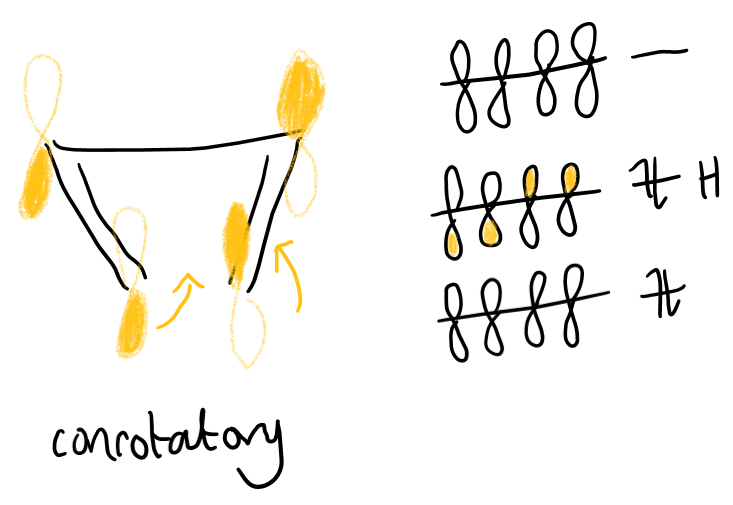
HOMO
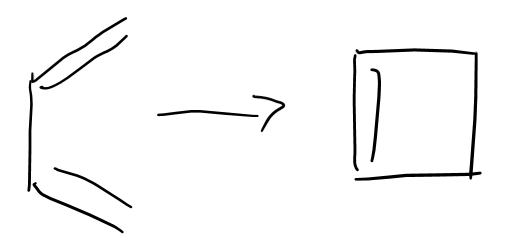
Draw the orbtials involved in this thermal electrocyclisation and determine where con or disrotatory movement is required (FMO approach)
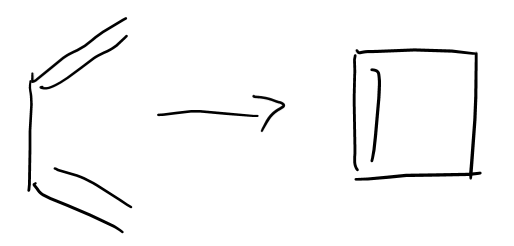
What orbital is used for photochemical electrocyclisations?
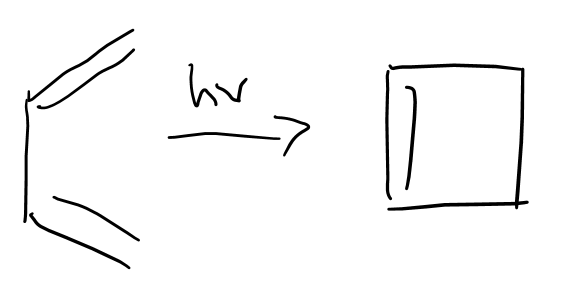
SOMO*
Draw the orbtials involved in this photochemical electrocyclisation and determine where con or disrotatory movement is required (FMO approach)
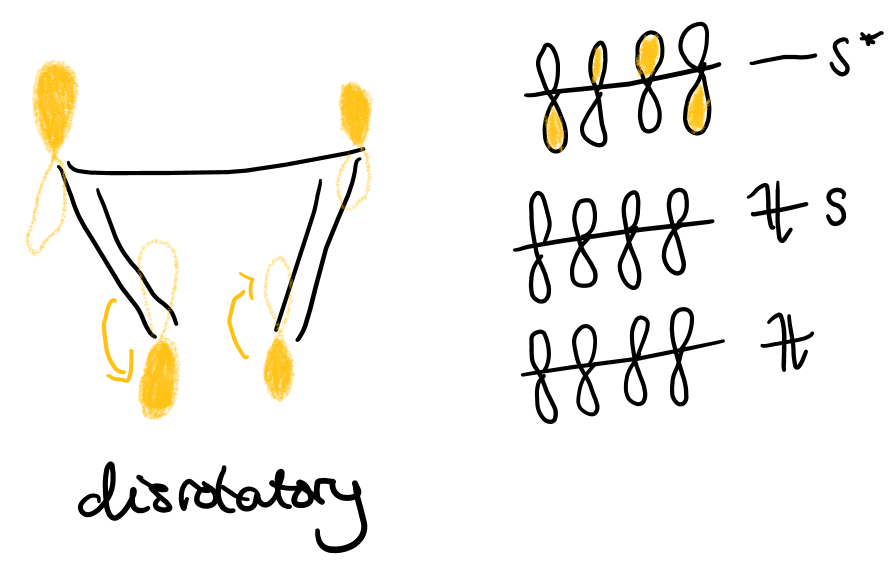
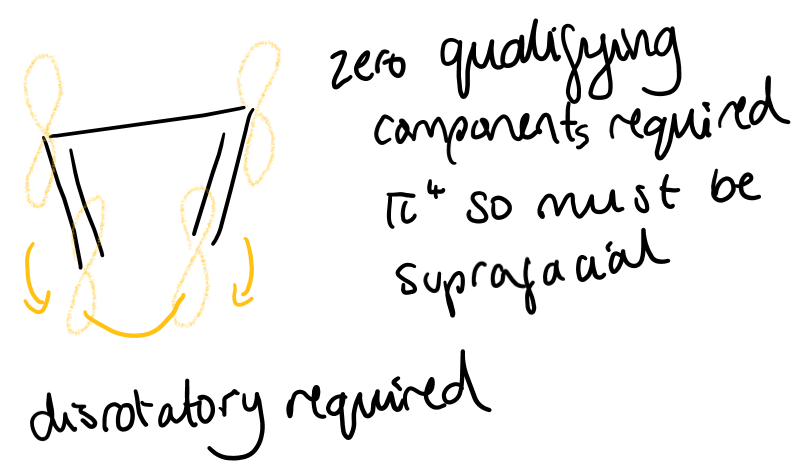
Draw the orbtials involved in this thermal electrocyclisation and determine where con or disrotatory movement is required (Woodward-Hoffman approach)
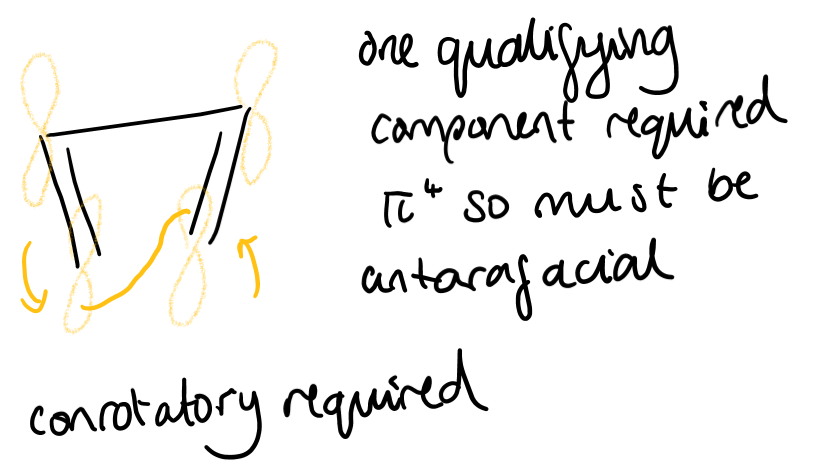
Draw the orbtials involved in this photochemical electrocyclisation and determine where con or disrotatory movement is required (FMO approach)
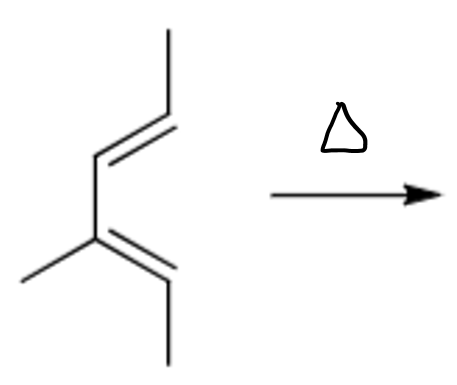
Draw the product of this reaction
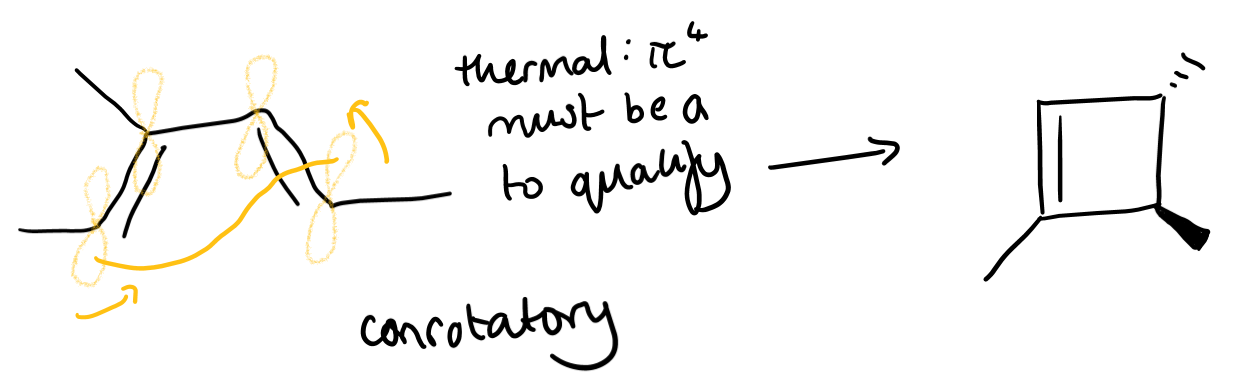
Draw the product of this reaction
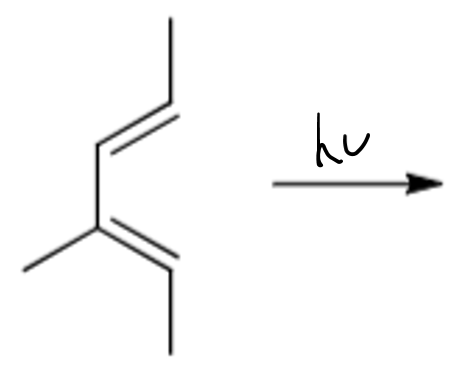
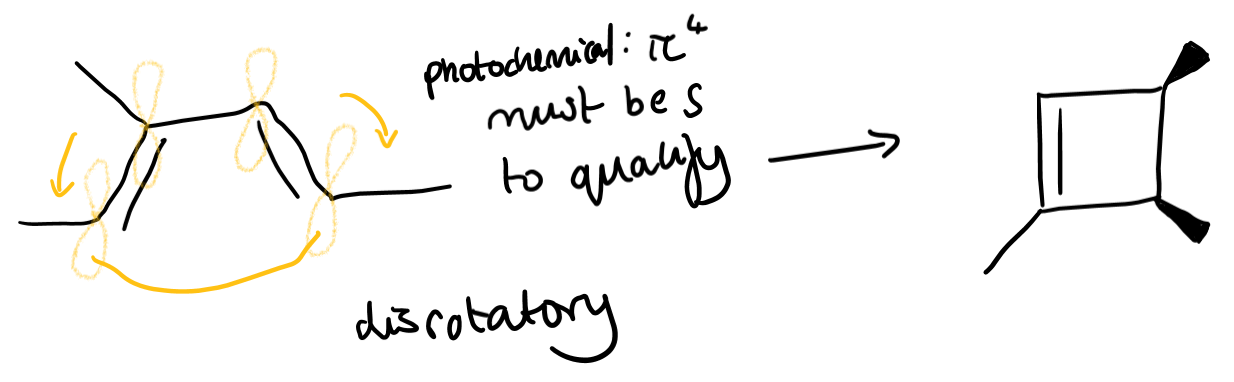
What is the naming convention for sigmatropic rearrangements?
[m,n]-
where m is the number of atoms in the chain on one side of the breaking bond and n is the number on the other side
eg. [3,3]
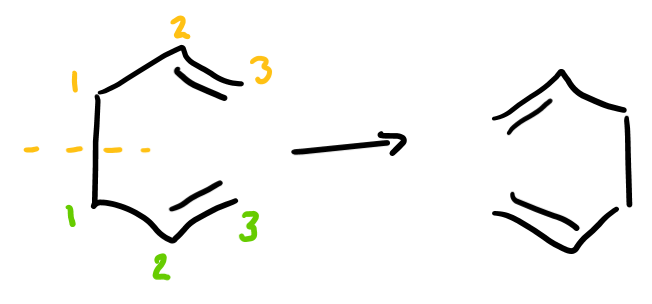
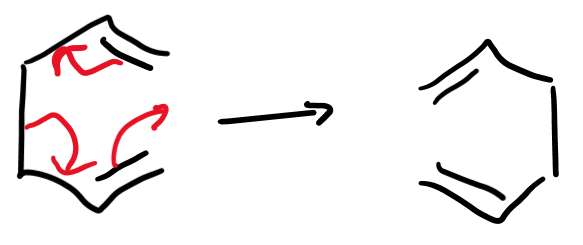
Give the general mechanism for a sigmatropic rearrangement
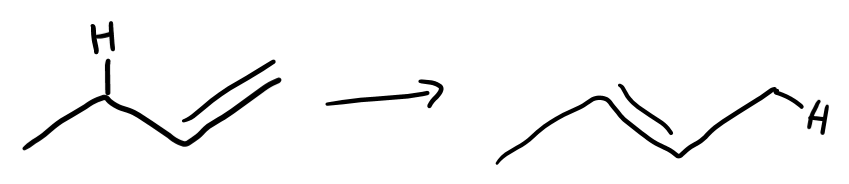
Draw an example of a [1,3]-sigmatropic rearrangement
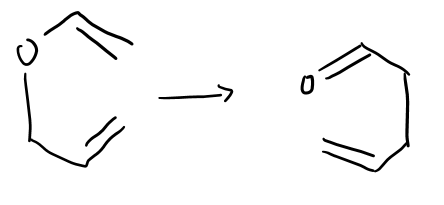
Name the 3 types of sigmatropic rearrangements and explain the differences
1) Cope - C atoms only in the chain
2) Oxy-Cope - When there is an alcohol next to the breaking bond that becomes a carbonyl after the rearrangement

3) Claisen - When there is an oxygen in the ring next to the breaking bond that becomes a carbonyl after the rearrangement
What is the driving force of this sigmatropic rearrangement?
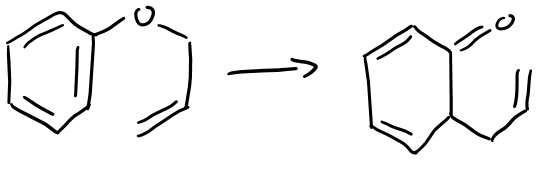
The enolate can tautomerise to reform the aromatic ring:

Use the Woodward-Hoffman approach to determine whether this hydride shift reaction is allowed
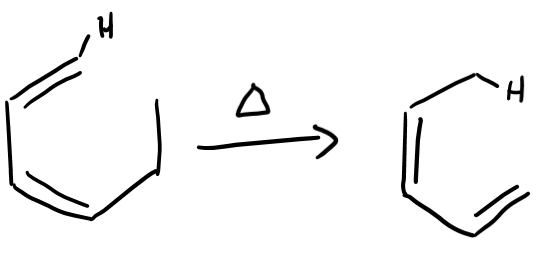
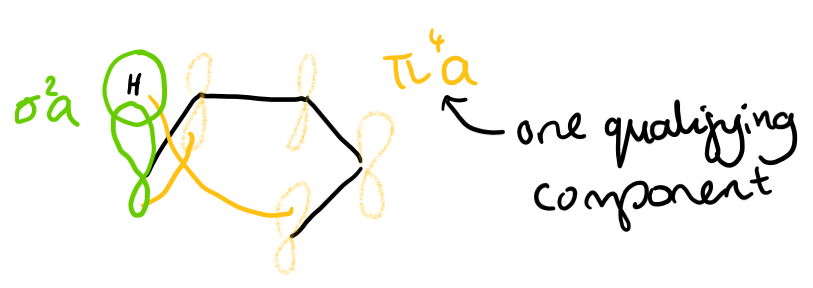
Odd number of qualifying components so thermally allowed
Use the Woodward-Hoffman approach to determine whether this hydride shift reaction is allowed
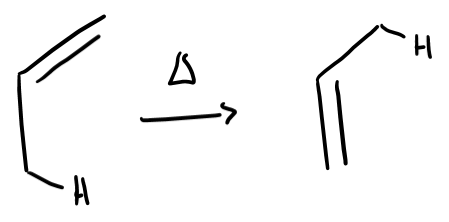
Not allowed in normal orientation:
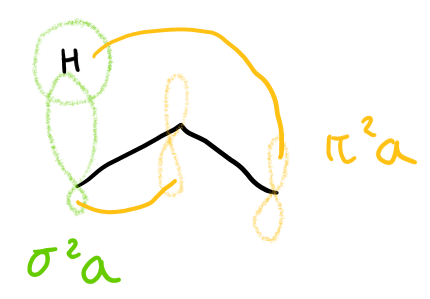
Allowed this way, but geometrically impossible: