GW BGZ 2025 Case 5 - Move, exercise, train
 Call Kai
 Learn
Learn Practice Test
 Spaced Repetition
 Match
Match Flashcards
 Knowt Play
1/36

There's no tags or description
Looks like no tags are added yet.
Name | Mastery | Learn | Test | Matching | Spaced | Call with Kai |
|---|
No analytics yet
Send a link to your students to track their progress
37 Terms
What is physical activity?
Physical activity is any bodily movement produced by skeletal muscles that increases energy expenditure above resting levels. It includes all movement during daily life such as walking, working, household tasks, sports, and exercise.
Energy expenditure is commonly expressed in kilocalories or METs.
1 MET = resting metabolic rate
1 MET = 3.5 mL O₂/kg/min
Examples:
Sitting quietly ≈ 1 MET
Walking ≈ 2–4 METs
Running ≈ 8+ METs
Physical activity can be classified by:
Intensity (light, moderate, vigorous)
Domain (work, leisure, transport)
Frequency and duration
Physical activity is broader than exercise.
What is exercise?
Exercise is a subset of physical activity that is:
Planned
Structured
Repetitive
Performed with the goal of improving or maintaining physical fitness
Examples:
Strength training
Running programs
Cycling sessions
Unlike general physical activity, exercise has a specific training purpose.
What is physical training?
Physical training is a systematic process of repeated and progressive exercise aimed at improving physical fitness or athletic performance.
Training causes physiological adaptations such as:
Increased VO₂max
Increased muscular strength
Improved endurance
Improved metabolic efficiency
A training program should include:
Specific goals
Progressive overload
Recovery periods
Appropriate frequency and intensity
Training is more specific and long-term than general exercise.
What is physical fitness?
Defined as the ability to:
Perform daily tasks with energy and alertness
Avoid excessive fatigue
Handle emergencies and enjoy leisure
Two main categories: health- and performance-related fitness
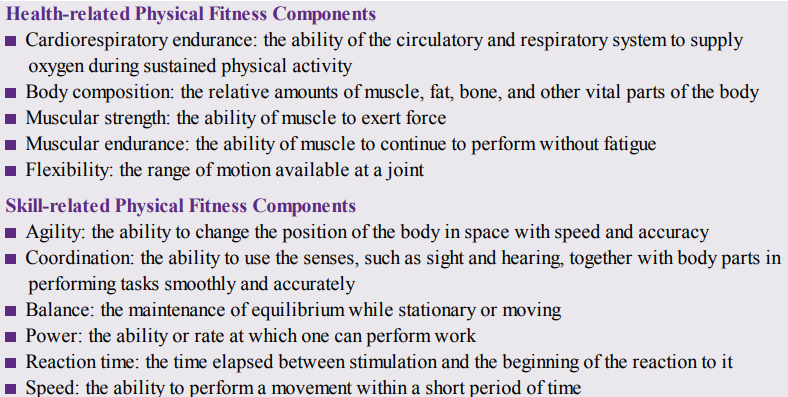
What are the health-related components of fitness?
Health-related fitness components are associated with health and disease prevention.
They include:
Cardiorespiratory endurance
Ability of heart and lungs to supply oxygen during exercise
Muscular strength
Maximal force production
Muscular endurance
Ability to perform repeated contractions over time
Flexibility
Range of motion around a joint
Body composition
Relative amount of fat mass and lean mass
These components are important for:
Daily functioning
Health outcomes
Reduced disease risk
What are the performance-related components of fitness?
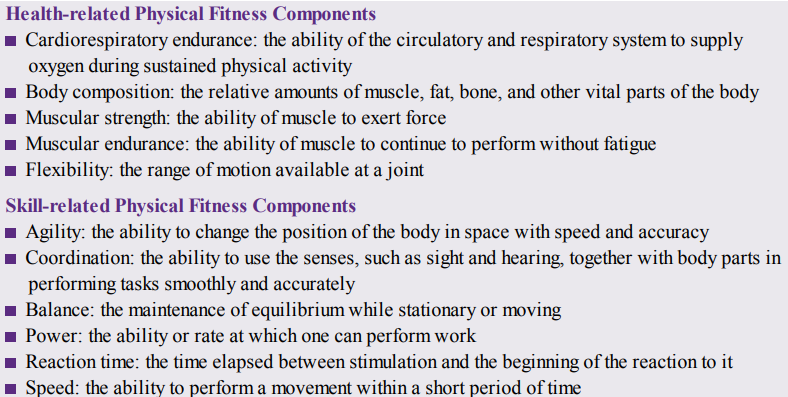
Performance-related fitness components are mainly linked to athletic ability and sports performance.
They include:
Isometric Strength
Ability to exert force without movement
Power
Ability to generate force quickly (strength + speed)
Speed / Agility
Speed: rapid movement
Agility: quick direction changes
Balance
Ability to maintain stability
Arm–Eye Coordination
Ability to synchronize visual input with movement
Reaction time
How quickly you respond to a stimulus
Examples:
Sprinting → speed
Vertical jump → power
Shuttle run → agility
These components are especially important in competitive sports.
How can physical fitness be measured?
hoef je niet alm te weten
Physical fitness can be measured using field tests or laboratory tests.
Health-related fitness tests
VO₂max test → cardiorespiratory fitness
Handgrip or 1RM → strength
Push-ups/sit-ups → muscular endurance
Sit-and-reach → flexibility
BMI/skinfolds → body composition
Performance-related fitness tests
Sprint tests → speed
Vertical jump → power
Balance tests
Agility shuttle runs
Laboratory testing
CPET (cardiopulmonary exercise testing) is the gold standard for aerobic fitness.
It measures:
VO₂max/VO₂peak
Ventilation
Heart rate
Gas exchange
What are the principles of physical training?
Overload Principle
To improve fitness, the body must work harder than normal.
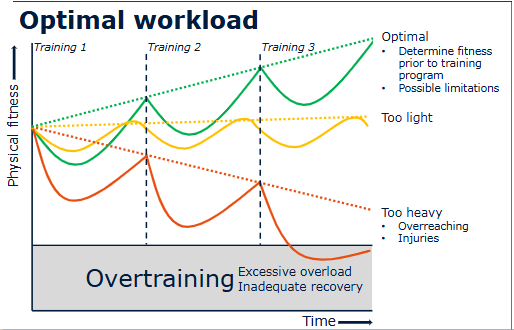
Optimal workload: Training should be challenging but manageable.
Supercompensation: After recovery, the body adapts and becomes stronger than before.
Law of diminishing returns: Beginners improve quickly, while advanced athletes gain improvements more slowly.
Individuality Principle
Everyone responds differently to training because of factors like genetics, age, fitness level, and recovery ability.
Training should be tailored to the individual.
Specificity Principle
Training adaptations are specific to the activity performed.
Train according to the muscles, movements, and energy systems needed for the sport.
“Train the way you want to perform.”
Reversibility Principle
Fitness decreases when training stops or is reduced.
Detraining: Loss of strength, endurance, and skills due to inactivity.
Variation / Periodization
Training should change over time to avoid plateaus and overtraining.
Variation: Regular changes in intensity, volume, or exercises.
Periodization: Structured training phases (preparation, competition, recovery) designed to maximize performance.
What is the optimal workload?
Optimal workload: Training should be challenging but manageable.
What is the supercompensation principle?
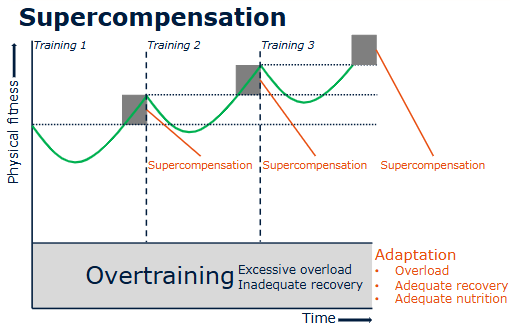
Supercompensation describes the process where performance temporarily improves above baseline after recovery from training.
Phases:
Training stress → fatigue and reduced performance
Recovery phase
Adaptation and performance increase
Return to baseline if no new stimulus occurs
Correct timing of the next training session is important:
Too early → overtraining/fatigue
Too late → adaptation lost
This principle forms the basis of training periodization.
What is the law of diminishing returns?
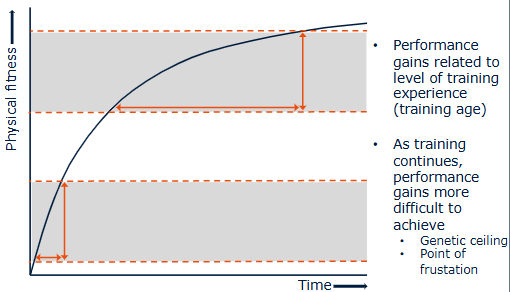
The law of diminishing returns states that training improvements become smaller as fitness level increases.
Beginners
Large and rapid improvements (“newbie gains”)
Trained athletes
Smaller improvements
Require more specific and intensive training
This occurs because the closer someone gets to their genetic potential, the harder it becomes to improve further.
What are “newbie gains”?
Newbie gains are the rapid improvements seen during the first months of training.
Causes:
Neural adaptations
Improved coordination
Rapid muscular adaptation
Beginners can quickly improve:
Strength
Endurance
Technique
Progress slows later due to the law of diminishing returns.
What is the reversibility principle?
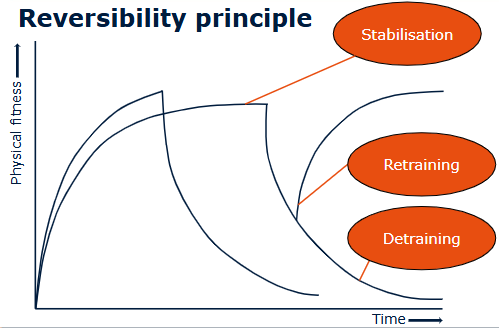
The reversibility principle states that fitness improvements are lost when training stops or is significantly reduced.
Detraining
Detraining refers to the partial or complete loss of training adaptations due to inactivity.
Effects of detraining may include:
Reduced cardiovascular fitness
Loss of strength and muscle mass
Decreased flexibility and coordination
Reduced sport-specific skills
The rate of fitness loss depends on:
The athlete’s training history
The duration of inactivity
The fitness component involved
Generally:
Aerobic fitness declines relatively quickly.
Strength and skill decline more gradually.
What is the variation/periodization principle?
Variation
Training variables are regularly adjusted to prevent boredom, plateaus, and overuse injuries.
Changes may involve:
Intensity
Volume
Exercises
Recovery periods
Periodization
Periodization is the systematic planning of training over time.
Training is divided into phases or cycles.
Common phases include:
Preparation phase
Builds general fitness and foundational skills.
Competition phase
Focuses on peak performance and sport-specific preparation.
Transition/recovery phase
Allows physical and mental recovery after competition.
Benefits of periodization:
Improves long-term performance
Reduces risk of injury and burnout
Helps athletes peak at the right time
Balances workload and recovery
What is the relationship between recovery and tissue type?
Different tissues recover at different speeds.
Muscle
Faster recovery
Higher protein turnover
Muscle protein synthesis (MPS) increases after exercise
Tendons and connective tissue
Slower turnover
Slower adaptation
Require longer recovery periods
This is important because:
Muscles may feel recovered before tendons are fully adapted
Excessive loading increases injury risk
What is muscle protein synthesis (MPS)?
Muscle protein synthesis is the process of building new muscle proteins after exercise.
Resistance training stimulates MPS, especially when combined with protein intake.
Effects:
Muscle repair
Muscle hypertrophy
Training adaptation
MPS remains elevated for hours to days after exercise depending on:
Training status
Nutrition
Exercise intensity
What are the current guidelines for physical activity levels?
Children (4–18 years)
At least 1 hour per day of moderate to vigorous physical activity
At least 3 times per week activities that strengthen muscles and bones
Avoid prolonged sitting
Adults and Older Adults
At least 150 minutes per week of moderate to vigorous physical activity, spread over several days
At least 2 times per week muscle- and bone-strengthening activities
For older adults: include balance exercises
Avoid prolonged sitting
What are the principles of training?
Specificity
Training adaptations are specific to the type of exercise performed.
Endurance training → improves aerobic fitness
Strength training → improves muscle strength
Overload
The body must be challenged beyond its normal level to improve.
Methods:
heavier weights
longer duration
higher intensity
Progression
Training load should increase gradually over time.
Too fast → injury risk
Too slow → little improvement
Reversibility
Fitness decreases when training stops.
Individualization
Training should match the individual:
age
fitness level
goals
health status
Variation
Changing training helps:
prevent plateaus
reduce boredom
reduce overuse injuries
Recovery hoort deze erbij?
Recovery is the time the body needs to repair and adapt after exercise.
Importance of Recovery
Repairs muscles
Restores energy stores
Reduces fatigue
Prevents injury
Improves performance
What is overtraining?
Overtraining happens when exercise exceeds the body’s ability to recover.
Signs of Overtraining
Constant fatigue
Poor performance
Muscle soreness
Increased injuries
Poor sleep
Lack of motivation
Elevated resting heart rate
Prevention
Include recovery days
Vary training intensity
Get enough sleep
Eat properly
Avoid excessive training loads
What is workload and overload?
Workload
Total stress placed on the body during exercise.
Depends on:
intensity
duration
frequency
Overload
Applying more stress than the body is used to in order to stimulate adaptation.
Examples:
increasing weight
running faster
increasing sessions
What are the FITT factors?
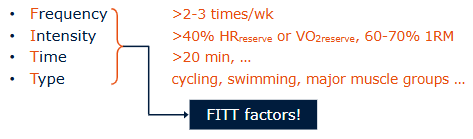
1. Frequency
How often you train
Example: 3–5 sessions per week
More frequent training = more stimulus, but also more recovery needed
2. Intensity
How hard you train
Can be measured by:
Heart rate (cardio)
Weight lifted (% of max) (strength)
Perceived effort (how hard it feels)
Higher intensity = greater stress per session
3. Time (Duration)
How long each session lasts
Example: 30–60 minutes per workout
Includes total time spent doing the activity
4. Type (Mode)
What kind of exercise you do
Examples:
Running, cycling (cardio)
Weight training (strength)
Stretching (flexibility)
Should match your goal (specificity principle)
What is volume?
falls under the type of training
Volume = the total amount of work performed in a training program.
It is determined by combining:
Frequency
Intensity
Time / duration
Volume depends on the type of training being performed.
Endurance training: measured as total distance/duration
Is strongly linked to:
Training pattern
how sessions are organized
Progression / regression
gradually increasing or decreasing workload
Resistance training: described as sets, reps and resistance
Progression and regression: increasing/decreasing weight, reps, sets
What is progression?
falls under the type of training
How the program is gradually made harder
Example:
Increasing weight
Running longer distances
Adding extra training days
Prevents plateaus and drives improvemen
Why is a personal training program important?
People differ in:
fitness level
goals
health status
recovery ability
A personal program:
improves results
reduces injury risk
improves motivation
allows safe progression
No single value determines fitness:
training status
body composition
age
weight
endurance
strength
all matter.
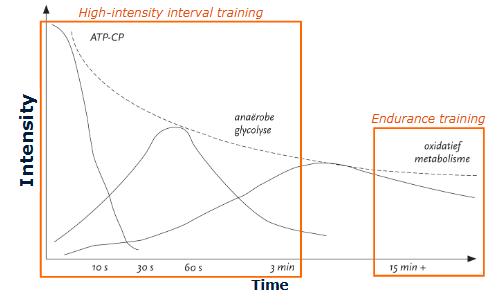
What determines training stimulus?
Training stimulus = intensity × time
Examples:
High intensity + short duration → ATP-PCr + anaerobic glycolysis dominant
Low intensity + long duration → aerobic metabolism dominant
Both can improve fitness differently.
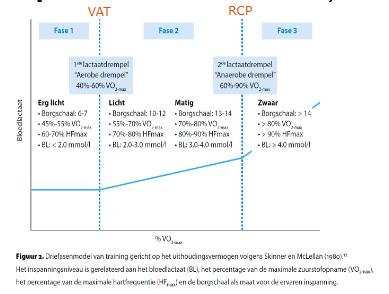
What is the three-phase intensity model?
Intensity zones based on ventilatory/lactate thresholds:
Below VT1
Low intensity
Mainly aerobic fat metabolism
Between VT1 and RCP
Moderate intensity
More carbohydrate oxidation
Above RCP
High intensity
Large anaerobic glycolysis contribution
Rapid lactate accumulation
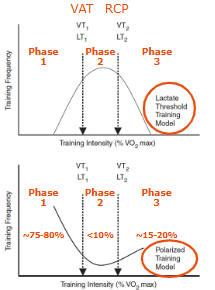
What is the difference between classic lactate and polarized training models?
Classic lactate model
Much training between thresholds
Moderate intensity focus
Common in patients/beginners
Polarized model
Mostly low intensity + small amount very high intensity
Little moderate training
Common in endurance athletes
Helps reduce injury and fatigue risk
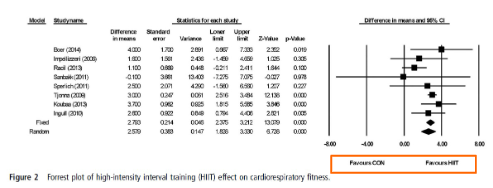
HIT vs endurance training for VO₂peak?
Both improve VO₂peak
Some studies show similar effects
Polarized/HIT approaches may produce greater improvements in trained athletes
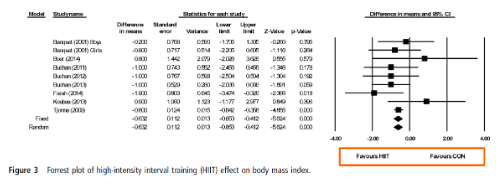
HIT vs endurance training for BMI and weight loss?
High-intensity training often:
burns more calories post-exercise
improves fat loss more efficiently
may reduce BMI more effectively than traditional endurance training
What are ACSM endurance training recommendations?
Cardiorespiratory fitness
Target volume of 500-1000 MET-min/wk
Build up to this recommendation in injured or inactive people
This is more an end goal
It is a broad range
Gradually progressive
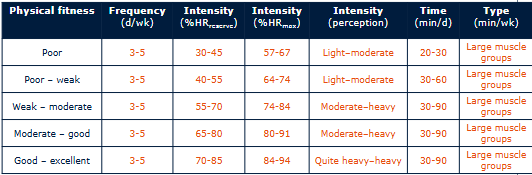
How to set/monitor intensity?
Different options…
Heart rate, HR
(Percentage) of maximum HR, (%)HRmax
(Percentage) of heart rate reserve, (%)HRR
Most accurate
Target (training) HR, THR
(Percentage) of maximum oxygen uptake, (%)VO2max
Not really doable with the mask
Metabolic equivalent, MET
Convenient
Rating of perceived exertion, RPE
Least accurate
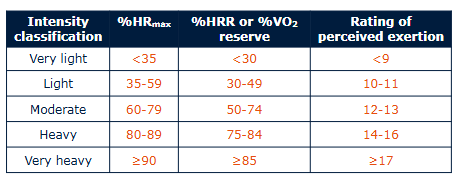
What is the heart rate reserve
HRR = HRmax – HRrest
Easy
HRmax: measure, do not estimate, not trainable, personal
HRrest: resting pulse, the lower – the better trained, personal
Determine training intensity
THR = (%HRR × HRR) + HRrest
Example:
HRmax = 190 bpm
HRrest = 50 bpm
HRR = 140 bpm
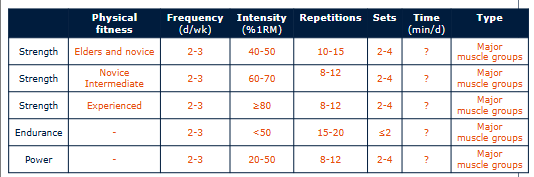
What are ACSM resistance training recommendations?
Muscle strength
Major muscle groups: chest, shoulders, upper- and lower back, abdominal muscles, hips, legs
Multi-articular, agonist and antagonist
Minimal 48 h between two sessions of specific muscle group
Or shift between major muscle groups
To improve muscular
Strength
Expressed as (percentage of) 1RM (in kg)
Endurance
Expressed as the ability to sustain repeated muscle contractions
Power
Expressed as strength × speed
What are ACSM flexibility training recommendations?
Stretch 10–30 seconds
2–4 repetitions
≥2–3 days/week
Best performed when muscles are warm.
To improve range of motion
Joints (capsule, ligaments)
Muscles
Important in daily activities

What are ACSM neuromotor exericse recommendations?
Training focused on:
balance
agility
coordination
gait
Especially important in older adults.

What should a complete exercise program include?
Cardiorespiratory training
Strength training
Muscular endurance
Flexibility
Neuromotor training
Reduced sedentary behavior
What should be considered when designing a program?
Goals
Fitness level
Health status
Time availability
Motivation
Barriers
Exercise history