4.2 Bonding, structure and the properties of matter
 Call Kai
 Learn
Learn Practice Test
 Spaced Repetition
 Match
Match Flashcards
 Knowt Play
1/56

There's no tags or description
Looks like no tags are added yet.
Name | Mastery | Learn | Test | Matching | Spaced | Call with Kai |
|---|
No analytics yet
Send a link to your students to track their progress
57 Terms
Define compound
A substance formed when two or more different elements are chemically bonded together in fixed proportions
Name the three types of strong chemical bonds and describe their bonding
Ionic
the particles are oppositely charged ions
occurs in compounds formed from metals and non-metals (metals lose electrons to form positive ions, non-metals gain electrons to form negative ions)
Metallic
the particles are atoms which share delocalised electrons
occurs in metallic elements and alloys
Covalent
the particles are atoms which share pairs of electrons
occurs in most non-metallic elements and in compounds of non-metals
What is meant by the empirical formula and molecular formula?
Give both formulas for carbon dioxide and glucose
The empirical formula is the simplest whole number ratio of atoms of elements present in a compound
Molecular formula is the actual whole number ratio of elements present in a compound
Carbon dioxide:
Empirical: CO2
Molecular: CO2
Glucose:
CH2O
C6H12O6
Describe what happens when a metal reacts with a non-metal
Metal atoms lose electrons to become positively charged ions
Non-metal atoms gain the electrons to become negatively charged ions
These oppositely charged ions are strongly attracted to one another by electrostatic forces; this attraction is an ionic chemical bond
Draw the dot and cross diagram to show the formation of sodium chloride
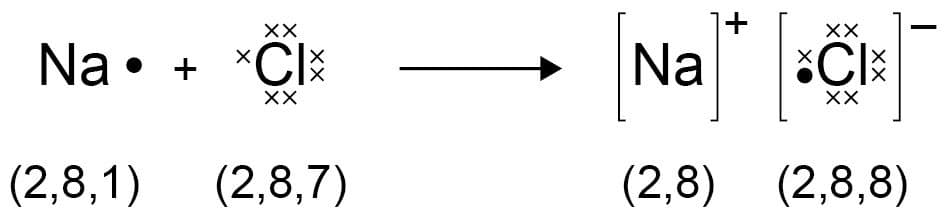
Sodium (metal) and chlorine (non-metal) react to form an ionic compound
Describe the structure of an ionic compound
Ionic compounds form giant ionic lattices:
An ionic compound is a giant structure of ions that form a closely packed regular lattice arrangement
Ionic compounds are held together by strong electrostatic forces of attraction between oppositely charged ions
These forces act in all directions in the lattice
The electrostatic force of attraction is the ionic bond
Describe the limitations of using these diagrams to represent a giant ionic structure:
Dot and cross diagram
Ball and stick diagram
2D diagrams
3D diagrams
Dot and cross diagram:
Don’t show the 3D lattice structure of the ions
Do not show us the ionic bonds between the ions
Ball and stick diagram:
Large gaps between balls suggest that ions are far apart, when they are actually tightly packed
Doesn’t show the electrostatic forces between ions that make up the bonds, and instead shows the bonds as physical ‘sticks’
Does not show how ions were formed
2D diagrams:
Shows only a flat layer, not the full 3D lattice structure
Does not show how ions were formed
3D diagrams:
Usually shows large gaps between ions, when they are actually tightly packed together
Only shows a small part of the lattice, so may be misleading by showing the structure to be much smaller than it actually is
Describe the bonding between non-metal atoms
They share pairs of electrons to form covalent bonds
The positively charged nuclei of the bonded atoms are attracted to the shared pair of electrons by electrostatic forces, making covalent bonds very strong
What are simple molecular substances?
Simple molecular substances are made up of small molecules (molecules containing only a few atoms jointed together by covalent bonds)
Name the types of substances formed from covalent bonding
Simple molecular substances
Polymers
Giant covalent structures
Give examples of giant covalent structures
Diamond
Silicon dioxide
Draw the polymer polyethene

Describe the limitations of using these diagrams to represent a covalent structures:
Dot and cross diagram
Ball and stick diagram
2D diagrams
3D diagrams
Dot and cross diagram:
Don’t tell us about the shape of the molecule
For giant covalent structures, they only show a small section, not the full repeating network
Ball and stick diagram:
Don’t accurately show the shape of the molecule
Cannot tell which electron in the covalent bond came from which atom
Shows the bonds as ‘sticks’ and not shared pairs of electrons
Shows large spaces between the atoms when actually they are very close together
2D diagrams:
Cannot show the full repeating structure of giant covalent structures
Cannot tell which electron in the covalent bond came from which atom
Does not show the covalent bonds
3D diagrams:
Cannot show the full repeating structure of giant covalent molecules
Can show large spaces between the atoms when they are actually very close together
Describe metallic bonding
Metals consist of giant structures of atoms arranged in a regular pattern
The electrons in the outer shell of the atoms are delocalised and so are free to move through the whole structure
The sharing of delocalised electrons gives rise to strong metallic bonds
What temperature does freezing take place?
Below the substance’s melting point
Where does condensation take place?
Below the substance’s boiling point
Draw simple models of the three states of matter
Give the limitations of the models
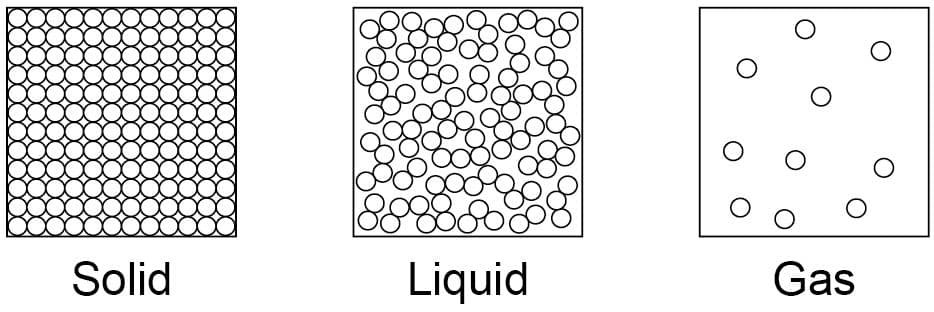
Limitations:
It does not show the intermolecular forces between particles
Represents the particles as spheres
Represents the particles as solid and inelastic (which is not accurate as atoms are mostly empty space)
What does the amount of energy needed to change state from solid to liquid depend on?
The amount of energy needed to change state from solid to liquid depends on the strength of the intermolecular forces between the particles of the substance; the nature of the particles involved depends on the bonding and structure of the substance
The stronger the intermolecular forces between the particles, the higher the melting and boiling point of the substance
When does a change of state occur?
When energy is transferred to overcome the intermolecular forces holding particles of a substance together
Describe how a substance changes from solid to gas in terms of its particles
Within a solid, particles are closely packed together in a regular arrangement
As a solid is heated, the particles gain more energy and begin to vibrate
As the temperature increases the particles gain even more kinetic energy and at a certain temperature (melting point) the particles have enough energy to overcome some of the strong forces of attraction to melt to form a liquid
When a liquid is heated, the particles gain even more energy
This energy makes the particles move faster, and eventually the particles gain enough energy to completely overcome the forces of attraction between particles/ break the bonds holding them together - this is called the boiling point
The particles evaporate to become a gas
Describe how a substance changes from a gas to a liquid in terms of particles
As a gas cools, particles no longer have enough energy to overcome the forces of attraction between them
Bonds form between the particles
At the boiling point, so many bonds have formed between the gas particles that the gas becomes a liquid through condensation
When a liquid cools, the particles have less energy, so move around less
There’s not enough energy to overcome the attraction between particles, so more bonds form between them
At the melting point, so many bonds have formed between the particles that they’re held in place; the liquid freezes to become a solid
True or false: atoms themselves have the bulk properties of materials
FALSE: atoms do not have the bulk properties of materials
Bulk properties: the physical characteristics of a substance that emerge from the collective behaviour of millions of particles/ atoms interacting together
What is the particle theory model used for?
Particle theory is a model that considers each particle as a small, solid inelastic sphere; can be used to explain how the particles in a material behave in each of the three states of matter
Use particle theory to describe the behaviour of particles in solids, liquids and gases
Solids:
Strong forces of attraction between particles
These strong forces of attraction hold them very close together in fixed positions, forming a regular lattice arrangement
Particles don’t move from their fixed positions so keep a definite shape and volume; they do not flow
Particles vibrate about their fixed positions
Liquids:
Weak forces of attraction between particles
Randomly arranged and are free to move past each other
Have a definite volume (cannot be compressed as particles are too close together) but do not have a definite shape (as particles can slide over each other), so can flow
Particles are constantly moving with random motion
Gases:
Very weak forces of attraction between particles
Particles are free to move and far apart
Gases don’t keep a definite shape or volume and fill their container (as particles can spread out)
Particles are constantly moving with random motion
Explain the limitations of the particle theory model
Particles are represented as solid and inelastic
Represents the particles as spheres
Does not show the forces between the particles
Describe and explain the physical properties of solids, liquids and gases
Solids
Has a fixed shape and cannot flow, because the particles are held together by very strong bonds/ forces
Cannot be compressed, because the particles are held very close together and have no space
Liquids
Flow and take the shape of the container as the particles can move around each other due to weaker forces/ bonds
Cannot be compressed as particles are held too close together
Gases
Flow and completely fill their container because the particles can move quickly in all directions
Can be compressed as the particles are very far apart so have space to move into
Give all of the state symbols for chemical equations
Solids (s)
Liquids (s)
Gases (g)
The substance is dissolved in water (aq)
Describe and explain the properties of ionic compounds
High melting and boiling points
Large amounts of energy needed to break the many strong bonds
When melted or dissolved in water they conduct electricity
As when ionic compounds are melted or dissolved in water, the ions are free to move and carry charge
Describe and explain the properties of small molecules
Usually gases or liquids at room temperature as they have relatively low melting and boiling points
Due to weak intermolecular forces between the molecules (it is these intermolecular forces that are overcome when the substance melts/ boils, not the strong covalent bonds)
Substances do not conduct electricity because they do not have an overall electric charge (and have no delocalised electrons)
As the size of the molecules increases, the intermolecular forces between molecules increases (as there are a greater number of electrons), so the melting and boiling points increase
Describe and explain the properties of polymers
Polymers are very large molecules; the atoms in the molecules are linked to other molecules by very strong covalent bonds
They are composed of long chains of smaller, repeating units (monomers)
The intermolecular forces between polymer molecules are relatively strong (as polymer molecules are very large) so these substances are solids at room temperature
Describe the structure of giant covalent structures
Give examples of these structures
All of the atoms in the structure are bonded to other atoms by strong covalent bonds
They have very high melting and boiling points as these many strong bonds must be overcome for the substance to melt or boil
Eg. Diamond, graphite, silica (silicon dioxide)
Describe and explain the properties of all metals
All metals:
Metals are often solids at room temperature as they have high melting and boiling points
This is because they are made up of giant structures of atoms with strong metallic bonding
Metals are good conductors of electricity
As the delocalised electrons in the metal are free to move to carry charge
Metals are good conductors of thermal energy
Thermal energy can be transferred to the delocalised electrons, which are free to move and carry this energy throughout the metals
Describe and explain the differences in the properties of pure metals and alloys
Pure metals:
In pure metals, atoms are arranged in regular layers as all atoms are of the same element and so are of the same size; this means that the layers can slide over each other more easily
This makes them softer and more malleable
Alloys:
In alloys there are different elements, so the different atoms of different elements have different sizes. This distorts the layers of atoms, making it more difficult for them to slide over eachother
This makes them harder and less malleable
Name the different allotropes of carbon
Diamond
Graphite
Graphine
Describe and explain the structure and properties of diamond
Diamond has a giant covalent structure
Made up of carbon atoms that each form four covalent bonds with other carbon atoms
Makes it very hard
These strong covalent bonds require a lot of energy to break, giving diamond a very high melting point
It has no delocalised electrons and has no overall electric change so cannot conduct electricity
Describe and explain the structure and properties of graphite
Graphite is an allotrope of carbon
Each carbon atom forms three covalent bonds with three other carbon atoms, forming layers of hexagonal rings which have no covalent bonds between layers
As there are no covalent bonds between layers, they are held together weakly so are free to move over each other, making graphite soft and slippy and ideal for use as a lubricating material
In graphite, one electron from each carbon atom is delocalised
Allows graphite to conduct electricity and thermal energy
The covalent bonds in the layers require large amounts of energy to break, giving graphite a high melting point
Describe and explain the structure and properties of graphene
Graphene is an allotrope of carbon
It is a single layer of graphite (one atom thick)
It is a layer of carbon atoms that form three covalent bonds with three other carbon atoms; each carbon atoms has one delocalised electron
This means that it can conduct electricity throughout the whole structure (giving it uses in electronics)
The network of covalent bonds also makes it very strong
As it is only one layer, it is very light
Explain the uses of graphene
Graphene is an allotrope of carbon; it is a single layer of graphite
Useful in electronics
As each carbon atom has one delocalised electron
Useful in composite materials (combination of two materials with different chemical and physical properties; graphene can improve the strength of materials without adding much weight)
The network of covalent bonds makes it very strong and as it is only one atom thick, it is very light
What are fullerenes?
Fullerenes are molecules of carbon atoms with hollow shapes
They are nanoparticles
They are mainly made up of hexagonal rings of carbon atoms, but may also contain rings of 5 (pentagon rings) or 7 (heptagon rings) atoms
What was the first fullerene to be discovered? What is its shape?
Buckminsterfullerene (C60)
Spherical shape; forms a hollow sphere
Name the two types of fullerenes (at GCSE level) and give their shapes
Buckminsterfullerene (C60), hollow spherical shape
Carbon nanotubes, cylindrical shape
What are carbon nanotubes?
Carbon nanotubes are cylindrical fullerenes with very high length to diameter ratios
Describe the properties and uses of carbon nanotubes
High length to diameter ratio
Have delocalised electrons, allowing them to conduct both electricity and heat
High tensile strength (the resistance of a material to breaking under tension; stretched, bent)
Uses in:
Nanotechnology
Used in electronics
Specialised sports equipment (strengthen the materials without adding weight)
Can be used to reinforce materials by adding strength without adding weight to composite materials
Give uses of fullerenes
Targeted drug delivery
As fullerenes can be used to ‘cage’ other molecules
Lubricants (spherical)
Due to spherical shape and weak intermolecular forces between molecules
Catalysts
Strengthening materials (cylinderical fullerenes)
State the three categories of particle and their diameters
Coarse particles
Diameter of particles: 2,500nm - 10,000nm
Fine particles
Diameter of particles: 100nm - 2,500nm
Nanoparticles
Diameter of particles: 1nm - 100nm
What does nanoscience refer to?
The science of structures that are 1nm - 100nm in side
What is the relationship between the side of a cube and its surface area to volume ratio
As the side of a cube decreases by a factor of 10
The surface area to volume ratio increases by a factor of 10
What is the defining property of nanoparticles?
Their high surface area to volume ratio
Why may nanoparticles have properties different from those for the same materials in bulk?
Due to their high surface area to volume ratio
What does the high surface area to volume ratio of nanoparticles cause?
Nanoparticles tend to have properties different from those for the same materials in bulk
May mean that smaller quantities are needed to be effective than materials with normal sizr particles
What type of particles are fullerenes?
Nanoparticles
Describe some of the uses of nanoparticles
Uses in medicine
May be more easily absorbed by the body, fullerenes for ‘caged’ drug delivery
Uses in electronics
Carbon nanotubes have one delocalised electron, allowing them to conduct electricity
Sun creams
Deodorants
Catalysts
Due to high surface area to volume ratio
Describe the disadvantages of nanoparticles
Nanoscience technology is still new, so the way that they affect the body is not fully understood (eg. the long term effects on human health are unknown)
As they are so small, they are easily to breathe in and enter the body - they might catalyse reactions that are harmful
Toxic substances could bind to them due to their high surface area to volume ratios, harming health if nanoparticles enter the body
Harmful effects on the environment
Why is it incorrect to say that one molecule of water has a boiling point of 100 degrees?
Boiling point is a bulk property
Referring to the relationships between many particles/ molecules
Describe why electrons can conduct heat
Metals have a sea of delocalised electrons
Which are free to move and transfer heat throughout
Explain why fullerenes are used in catalyst systems
Very high surface area to volume ratio
Many catalyst molecules can be attached to the surface of nanotubes
Providing a large surface area on which reactants can collide
Give benefits of the particle model
Allows the
Arrangement
Movement
of particles to be compared between different states of matter