M3. Moments
 Call Kai
 Learn
Learn Practice Test
 Spaced Repetition
 Match
Match Flashcards
 Knowt Play
1/19

There's no tags or description
Looks like no tags are added yet.
Name | Mastery | Learn | Test | Matching | Spaced | Call with Kai |
|---|
No analytics yet
Send a link to your students to track their progress
20 Terms
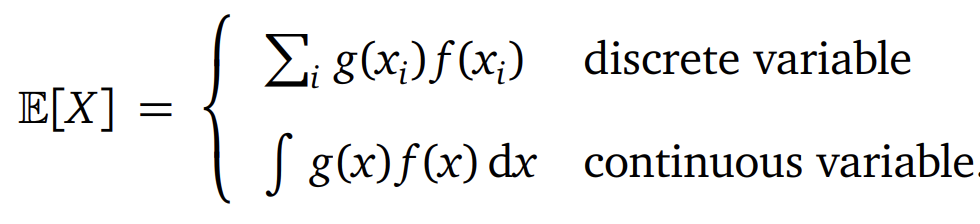
The expected value of a function of a variable, g(X), is defined as
E[a + bX] =
a + bE[X]
Addition: Let h(Y) be a (another) function of (another) variable. Then E[g(X) + h(Y)] =
E[g(X)] + E[h(Y)]
Multiplication: Let h(Y) be a (another) function of (another) variable. If X ⊥ Y then E[g(X)h(Y)] =
E[g(X)]E[h(Y)]
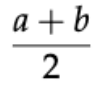
E(X), X~U(a, b)
Jensen’s inequality
The expected value of a nonlinear function of a variable is not equal to the nonlinear function of the expected value

The variance of a variable X is defined as

Let f (y|x) denote a conditional pdf. The conditional expectation is defined as

E[h(X)Y|X] =
h(X)E[Y|X]. Conditioning on X = treating it as known so this is akin to E[aX] = aE[X]
E[Y|X] = E[Y] if
X ⊥ Y. Intuitively, if two variables are independent then conditioning on X has no information about the mean of Y
The Law of Iterated Expectation: E[Y] =
E[E[Y|X]]
Cov(X, Y)
E [(X − E(X)) (Y − E(Y))] = E [XY] − E [X] E [Y]
(where a is a constant) Cov(X, a) =
0
(where a is a constant) Cov(aX, Y) =
aCov(X, Y)
Cov(X, Y + Z) =
Cov(X, Y) + Cov(X, Z)
Var(aX ± bY)
a2Var(X) + b2Var(Y) ± 2abCov(X, Y)
If X and Y are independent then, Cov(X, Y) =
0
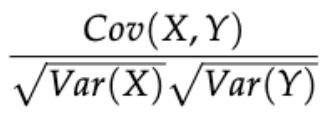
Corr(X, Y) =
If two variables have a covariance of 0 or are uncorrelated must they be independent?
No, although if they are independent they must have a covariance of 0
Mean-independence is defined as
Independence implies mean-independence. However, the converse is not true
