Unit 7 - Magnetism
 Call Kai
 Learn
Learn Practice Test
 Spaced Repetition
 Match
Match Flashcards
 Knowt Play
1/24

There's no tags or description
Looks like no tags are added yet.
Name | Mastery | Learn | Test | Matching | Spaced | Call with Kai |
|---|
No analytics yet
Send a link to your students to track their progress
25 Terms
What is a magnet?
An object that produces a magnetic field
Has a North and South pole
Temporary vs Permanent magnet
Temp:
Only has magnetic properties in the presence of an external magnetic field
Made of ferromagnetic elements like Fe, Ni, Co
Perm:
Retain their magnetic properties regardless of presence of field
What causes magnetic poles?
Atoms all have small magnetic fields, when “neighborhood” of theme atoms all point poles in same direction, creates a DOMAIN
Because all domains point same direction, field lines of atom 1 flows through N pole to S pole of atom 2, etc
Effect COMPOUNDS to whole magnet
Domain theory
Ferromagnetic elements like iron, nickel, and cobalt are made of atoms with tiny magnetic fields
In the presence of a magnetic field, poles spontaneously point the same direction
NOTE: if a magnet is split in half, the new magnets retain poles but are less strong (less domains per)
What 2 factors can cause a permanent magnet to lose its magnetism?
Dropping it - causes domains to become misaligned, loses poles
Heating past Curie temperature - increases kinetic energy, domains become misaligned too
What does the strength of a magnetic field (measured in Tesla, T) rely on?
Strength and distance of source magnet
What direction do field lines always travel?
From North to South
Why can’t magnetic field lines every intersect?
Because that would mean that at the point of intersection, the magnetic field would be going in two directions, implying that point experiences force in two directions as well- this is impossible.
Imagine a charged particle moving thru the magnetic fields, and at the point of intersection, it must be in two different directions (due to two forces). IMPOSSIBLE
Or a compass pointing towards the point of intersection- it must be in two different places, IMPOSSIBLE
Magnetic N/S vs Geographical N/S
Magnetic poles are our “real” poles, earth is a giant magnet
North pole is actually magnetic south - our compasses’ north pole is attracted to earth’s south pole, and vice versa for south pole
RHR for straight conductor
Thumb in direction of current
Fingers wrap around field lines
RHR for coiled conductor
Thumb in direction of North pole
Fingers wrap around current
RHR for electromagnetic force
Thumb in direction of current
Fingers for magnetic field lines (N → S), fingertips south
Palm in directionf of force
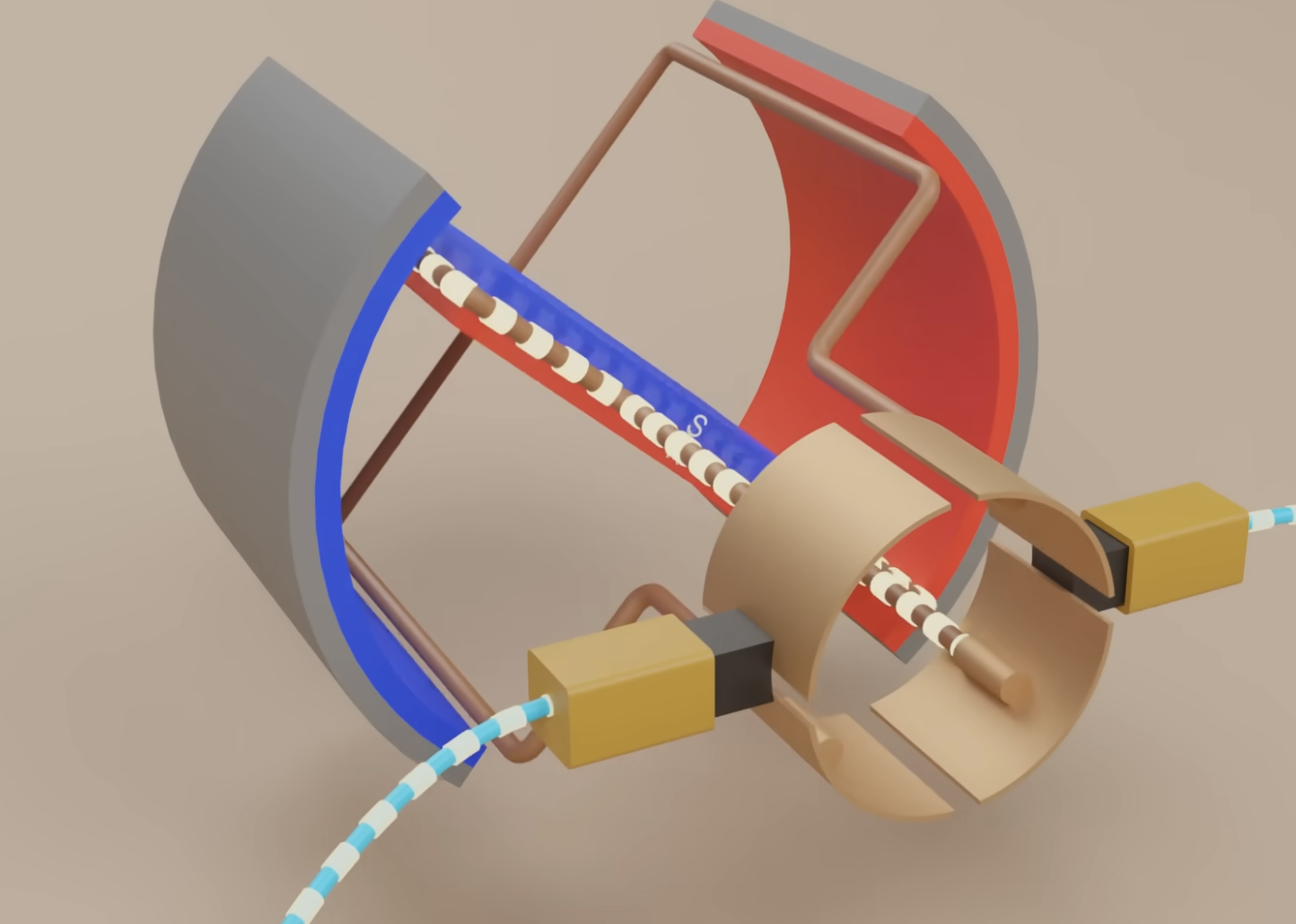
Motor principle
When a current carrying conductor is placed in an external magnetic field, the conductor experiences a force perpendicular to both itself and the external magnetic field.
EXPLAINED BY THE RHR FOR FORCE
Formula for relating strength of magnetic force created by helix to # of loops per unit length
F2F1=N2N1=I2I1
Formula for force that conductor experiences as a result of motor principle
F2F1=I2I1=B2B1
Synonyms for helix
Solenoid, coil, electromagnet
Lenz’s law
Magnetic field created by induced current always opposes the motion of the magnetic field that produced it. (Wants field lines to be in equilibrium, resists change)
If magnet moving towards with N pole facing = develops N pole
If magnet moving away with N pole facing = develops S pole
How is Lenz’s law consistent with the law of conservation of energy?
If the magnetic field created by the induced current is attracted to the magnetic field which created it, the two objects would move together without any inputted energy and produce a current.
Impossible, as the KE and electrical E produced came from nowhere
Energy cannot be created- therefore the above scenario is impossible
What is difference between Alternating Current (AC) and Direct Current (DC)?
Alternating:
Current keeps switching directions
Direct:
Current flows in one direction
Why can’t DC be used in transformers?
Because they rely on changing current to produce a changing magnetic field, which can then induce another current.
As current moves back and forth (alternating) causes oscillating magnetic field bc when e- briefly stop to switch direction, magnetic field collapses to zero
Changing magnetic field is necessary to induce another current
Transformer formulas, relating potential difference, # of coils, and current between primary and secondary coil
VsVp=NsNp=IpIs
Step-up vs Step-down Transformer
Step-up:
Secondary has higher V
Step-down:
Secondary has lower V
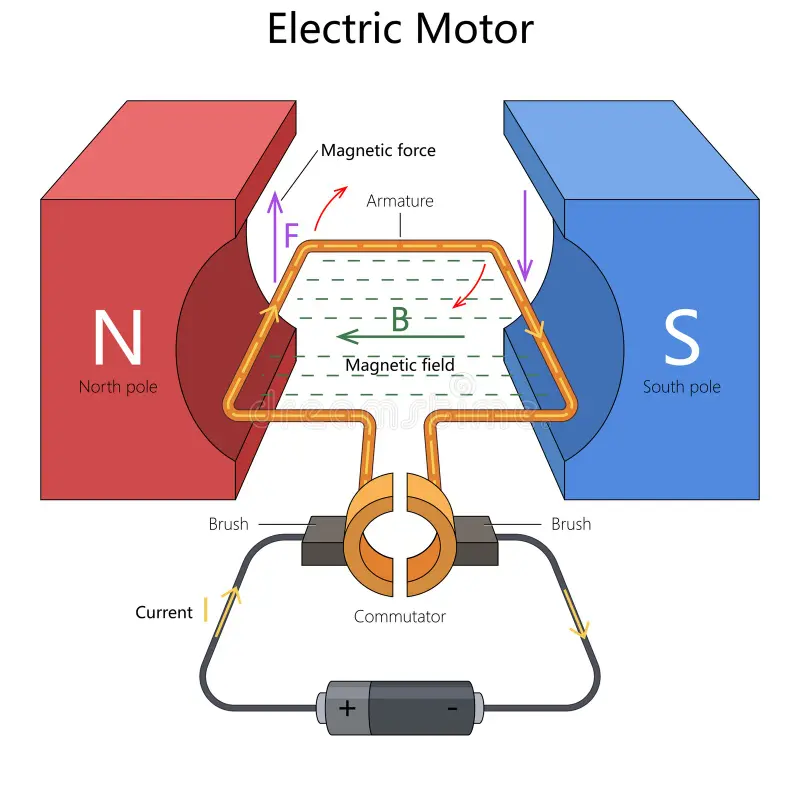
DC motor pieces
Armature
Conductor
Carbon brushes
Split-ring commutator
Permanent magnets
How do DC motors work?
Relies on alternating poles constantly repelling then attracting, causing the armature to rotate
Current switches directions via carbon brushes alternating contact with commutator plates
Changing direction causes flipped poles, which continues to rotations
Mentally draw a DC motor