organic 3 weak areas
 Call Kai
 Learn
Learn Practice Test
 Spaced Repetition
 Match
Match Flashcards
 Knowt Play
1/19

There's no tags or description
Looks like no tags are added yet.
Name | Mastery | Learn | Test | Matching | Spaced | Call with Kai |
|---|
No analytics yet
Send a link to your students to track their progress
20 Terms
describe kekule model of benzene
benzene is made up of a planar (flat) ring of carbon atoms with alternating single and double bonds between them.
each carbon atom is also bonded to one hydrogen atom.
benzene molecule was constantly flipping between two forms (isomers) by switching over the double and single bonds
why is kekule model of benzene wrong
you’d expect benzene to have three bonds with the length of a C–C bond and three bonds with the length of a C=C bond
However X-ray diffraction studies have shown that all the carbon‑carbon bonds in benzene have the same length
describe delocalised model of benzene
each carbon atom forms three s‑bonds — one to a hydrogen atom, and one to each of its neighbouring carbon atoms.
These bonds form due to head-on overlap of their atomic orbitals.
Each carbon atom then has one remaining p‑orbital, containing one electron, which sticks out above and below the plane of the ring.
These p‑orbitals on each of the carbon atoms overlap sideways to form a ring of p‑bonds that are delocalised around the carbon ring.
The delocalised p‑bonds are made up of two ring-shaped clouds of electrons — one above and one below the plane of the six carbon atoms.
All the bonds in the ring are the same — so, they’re all the same length.
5) The electrons in the rings are said to be delocalised because they don’t belong to a specific carbon atom. They are represented as a circle inside the ring of carbons rather than as double or single bonds.
why dont benzene undergo elctrophillic addition reaction?
the delocalised p‑bonds spread out the negative charge and make the benzene ring very stable.
so benzene is unwilling to undergo addition reactions which would destroy the stable ring.
more evidence supporting the delocalised model.
in alkenes, the p-bond in the C=C double bond is an area of localised high electron density which strongly attracts electrophiles. In benzene, this attraction is reduced due to the negative charge being spread out.
so benzene prefers to react by electrophilic substitution
benzene + O2
co2 + h20
observation : smoky flame
there is little o2 to burn benzene completely so carbon atoms stay as carbon and form particulates of soot in the hot gas making the flame smoke
what does a halogen carrier do?
accepts a lone pair of electrons from a halogen atom on an electrophile.
As the lone pair of electrons is pulled away, the polarisation in the molecule increases and sometimes a carbocation forms.
This makes the electrophile stronger
reagents for alkylation of benzene and draw the mechanism
halogenoalkane + halogen carrier (aluminum chloride-AlCL3) + reflux
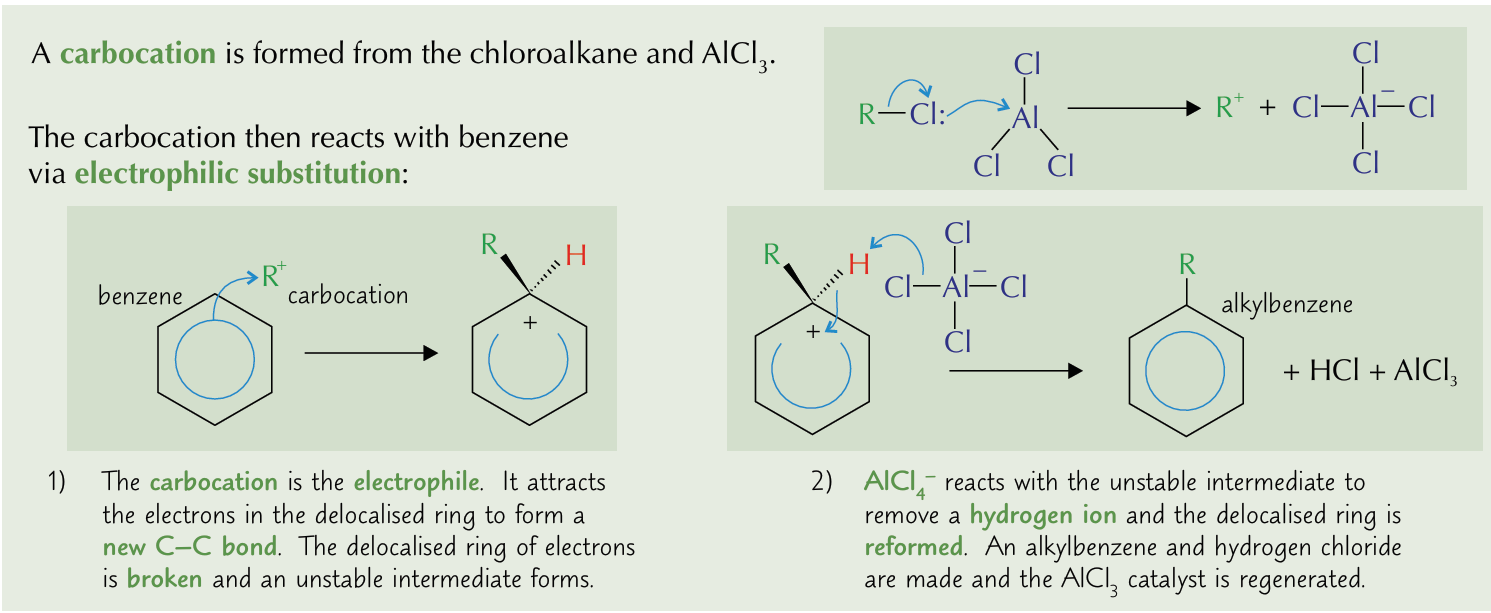
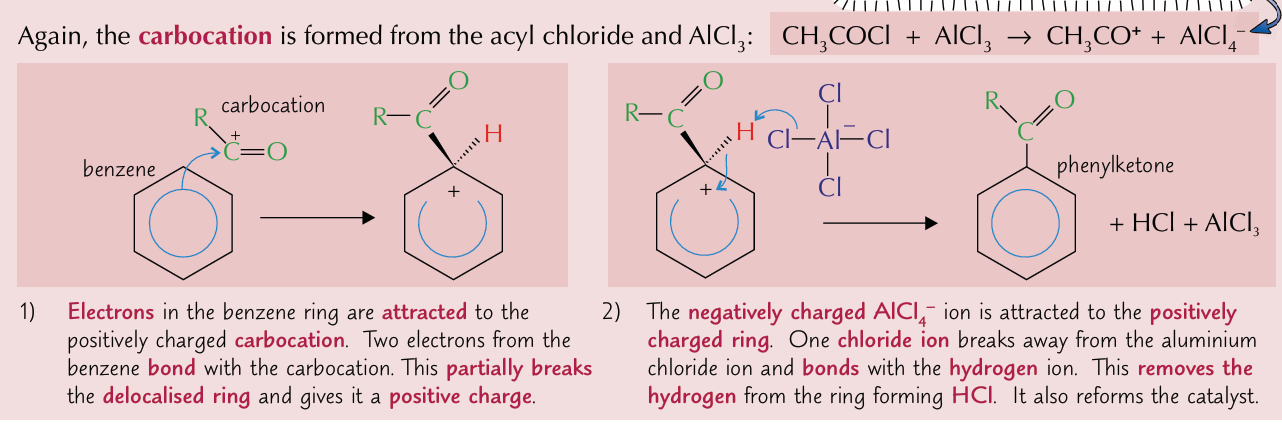
reagents for acylation of benzene and draw mechanism
acyl chloride + heated under reflux in a non-aqueous solvent (like dry ether)
reagents for nitration of benzene and draw mechanism
warm benzene with concentrated nitric acid and concentrated sulfuric acid

reagents to make aliphatic amines from halogenoalkane
halogenolakne
excess ethanolic ammonia
reagents required for both methods of reducing a nitrile to an primary amine
expensive method:
lithium aluminum hydride (LiAlH4)
in a non‑aqueous solvent ( dry ether)
dilute acid.
industrial method:
hydrogen gas
metal catalyst, such as platinum or nickel
high temperature and pressure (catalytic hydrogenation)
reagents for reducing a nitro compound to make a aromatic amine
tin
concentrated HCL
reflux
naOH
reagents and observations for the acylation of amines
reagent: acyl chloride (ethanoyl chloride + concentrated aqueous solution of the amine)
products: N substituted amide + salt
observation: solid, white mixture of the products.
products and reagents for acyl chloride + ammonia or a primary amine
acyl chloride + ammonia
concentrated ammonia
room temperature
product: primary amide
acyl chloride + primary amine
primary amine
room temperature
product: N-substituted amide
reagents to make polyamides and draw the mechanism
dicarboxylic acids + diamines

conditions required for hydrolysis of protein to amino acids and draw the mechanism
Hot aqueous 6 mol dm–3 hydrochloric acid
heated under reflux for 24 hours
product: ammonium salts of the amino acids - neutralised using a base.
chromatography to identify the amino acid monomers

reagents for the condensation polymerisation of polyesters and draw mechanism
dicarboxylic acids + diols

reagents for making Grignard reactants
refluxing
halogenoalkane with magnesium
in dry ether.
reagent and condition for making a carboxylic acid using Grignard reagents
Q: Butanoic acid can be synthesised from bromopropane in three steps. Give the reagents and conditions needed for each step, and the product formed at each stage of the synthesis.
1. bubble thru CO2 (reagent) + dry ether
2. dilute HCL

product, reagents and conditions for Grignard reagents with carbonyl compounds
product: alcohol
1. carbonyl compound is added to the Grignard reagent in dry ether,
2. dilute acid is added to the reaction mixture