GEOG 3105
 Call Kai
 Learn
Learn Practice Test
 Spaced Repetition
 Match
Match Flashcards
 Knowt Play
1/64

There's no tags or description
Looks like no tags are added yet.
Name | Mastery | Learn | Test | Matching | Spaced | Call with Kai |
|---|
No analytics yet
Send a link to your students to track their progress
65 Terms
Weather
current conditions of the atmosphere over the course of a few days
Climate
statistical description of weather over a long time (temperature, precipitation, cycles)
Why is climate important?
supports all life and services
infrastructure design (impacted by climate - ex. roads)
agriculture and food systems
water availability
human health + environment
IPCC stands for…
Intergovernmental Panel on Climate Change
How will climate change affect climate hazards?
Climate change alters the magnitude and probability of climate variables
intensity and magnitude
timing and seasonal shifts
frequency
spatial extent
duration
What is confidence?
relates to evidence and agreement
What is likelihood?
Quantifies uncertainty in the statements. Usually derived from models or statistical evidence
Unless otherwise states, uncertainty is quantified at _______ intervals
90%
What is the UNFCCC?
The United Nations Framework Convention on Climate Change (UNFCCC) is an international environmental treaty that is meant to stabilize GHG emissions
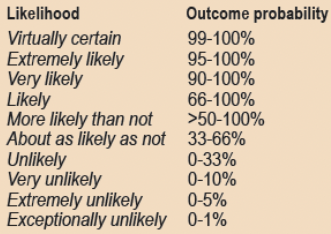
When IPCC says virtually certain, the probability is…
99-100%
When IPCC says extremely likely, the probability is…
95-100%
When IPCC says very likely, the probability is…
90-100%
When IPCC says likely, the probability is…
66-100%
IPCC likelihoods
What is Electromagnetic Radiation (EMR)?
All objects above 0 Kelvins emit EMR. The way that energy is transported from the Sun to the Earth, can be in many different wavelengths that form the electromagnetic spectrum and determine physical properties (visual spectrum, x-rays, etc.).
What is Earth’s energy budget?
The balance between energy/radiation that the Earth receives from the sun (EMR in) and the the energy/radiation that the Earth emits back into space (EMR out)
What is Shortwave Radiation (SW)?
Shortwave radiation (SW) is shorter wavelengths (visual spectrum, UV, shortwave IR) that comes from the sun
shortwave radiation (insolation) is received unevenly across the planet (earth is a sphere, angle of incidence)
Earth naturally balances this to maintain a steady state equilibrium (ex. hadley, ferrell and polar cells)
What factors influence how much shortwave radiation gets to the surface?
Albedo (surface reflectivity)
Latitude (angle of incidence)
Aerosols (scattering of sunlight - reflect cools, absorb warms)
Cloud Cover (reflect incoming sunlight, increase albedo)
Elevation (higher altitude has increased intensity of solar radiation)
What is Longwave Radiation (LW)?
Longwave Radiation (LW) have longer wavelengths (LW to space emitted by Earth, thermal IR)
Diurnal Longwave and Shortwave Radiation Patterns
SW peaks during day
LW throughout day and night
Sensible Heat
changes a substances temperature without changing phase (what we feel)
Latent Heat
Heat required or released during the phase change of a substance
Specific Heat Capacity
Amount of energy required to increase a substance by 1 degree
Conduction
molecule-molecule heat transfer to a substance
Convection
transfer of heat in liquids/gases through circulation (vertical mixing)
Radiation
energy that moves from one place to another as waves/particles
Forcing
external factor that affects climate
What are the three groups of forcings that impact Earth’s energy budget?
Change in solar radiation (S)
Ex. Milankovitch cycles
Change in albedo (𝜶)
Ex. snow cover
Change in longwave radiation to space (L↑)
Ex. GHG effect, aerosols
What is the Solar Constant (S)?
The amount of energy (EMR) that Earth receives from the sun = ~1360 W/m2
Total Solar Irradiance (TSI) since S is not constant (S/4 because Earth is a sphere)
Approx. how much energy is driving our atmospheric processes?
238 W/m2
Black bodies
idealized bodies that perfectly absorb and emit EMR (ex. Earth and Sun)
Wein’s Displacement Law
relationship between an object’s temperature and peak of its emission spectrum
@ 300 K (~Earth) — emit longer wavelength + less power (ex. IR, microwave, radio)
@ 6000 K (~Sun) — emit shorter wavelength + more power (ex. visible spectrum)
@ ~1600 K — metal glows red hot, edge of IR and visible spectrum
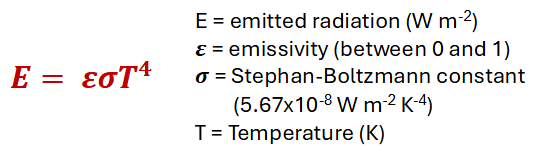
What is this equation? What does it state?
Stephan Boltzmann equation; states that total power emitted by a black body increases as temperature increases
What is earth’s equilibrium temperature (with and without GHG effect)?
No greenhouse = -18.6°C
With greenhouse = 15°C
What is the greenhouse effect?
atmosphere and greenhouse effect keep the surface of the earth warmer by trapping heat radiating from the surface
Mechanism:
absorbs UV and IR light (not visible)
Visible light passes through
Heats surfaces inside greenhouse, which can re-emit heat (LW radiation) which can’t escape because atmosphere absorbs IR
Rayleigh Scattering
The elastic scattering of light particles much smaller than it’s wavelength — most intense for shorter wavelengths
What are not GHGs?
Nitrogen (N) — ~78%
Oxygen (O) — ~21%
N and O are not GHGs as they do not strongly absorb specific wavelengths
What is a greenhouse gas (GHG)?
gases that absorb longwave radiation
contribution of GHG depends on its absorbance across relevant wavelengths and concentrations
What is the largest single contributor to the greenhouse effect?
Water vapour (~36-72%) but is short-lived
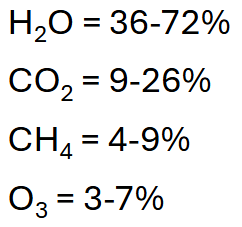
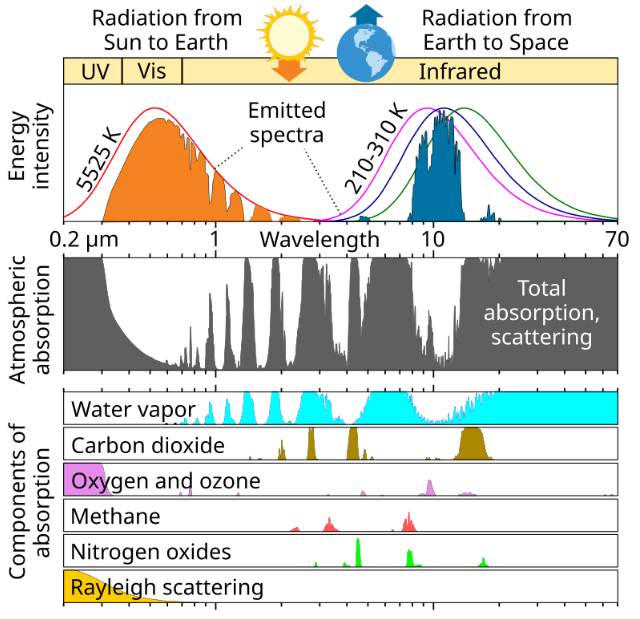
Describe this diagram
Diagram shows the atmospheric windows (electromagnetic wavelengths) of GHGs
Longwave radiation moves freely through the atmosphere
There is almost a direct relationship between energy and absorption
Water vapour and CO2 absorb released IR energy
Oxygen and Ozone absorb UV energy (smaller wave absorption)
How much extra energy does the greenhouse effect contribute to Earth (under equilibrium conditions)?
152 W/m2 (natural GHG forcing)
Earth’s current energy balance indicates and imbalance of ____ at top of atmosphere (TOA)
0.7 W/m2 — more heat going in than out
Atmospheric Window
limited region of the electromagnetic spectrum that can pass through the atmosphere of Earth
What is ERF?
Effective Radiative Forcing (ERF) is a quantification of change in energy budget at the top of the atmosphere that a radiative forcer (GHG, aerosols, etc.) has
shows what contributes to the partition and retention of energy
understand the physical mechanisms of climate change and supports solutions (remote sensing, policy, etc.)
What is the current total ERF?
2.72 W/m2 (estimated change in solar radiative forcing =0.01 W/m2) ~5.4 bulbs
What are the different methods to measure temperature?
weather stations
satellites (measure temp. with LW converted with IR calculation — Stephan Boltzmann)
weather balloons
ships & buoys
Roughly how far back does climate data (evidence) go?
~1850-1880
What are the 2 types of satellites to monitor Earth’s temperature?
Infrared Emissions
Microwave Sounding Unit
Satellites don’t measure temperature, they measure brightness which is then converted to temperature (clouds cause issues)
How do weather balloons work?
launched 2x daily
carry radiosondes that measure temperature, pressure, relative humidity
tracked with GPS + calculates windspeed & direction
tephigrams are used to interpret information
How are ocean temperatures monitored?
tidal gauges
drifting buoys (slow movement)
moored buoys (same spot)
ships
What are issues with temperature records?
Representative sites (ex. if near a body of water, elevation, etc.)
Rural VS Urban locations (experience heat differently - ex. Urban Heat Island effect)
Maritime VS Continental locations (water has a certain specific heat capacity, changes in evaporation = cooling)
Measures skin temperature (not = to surface temp., measures skin temp. which is top layer of ground surface)
Exposure of instrument to sun (placed in different locations, albedo)
What are some solutions to issues with temperature records?
look at the trend as opposed to actual temperatures
look at anomalies and compare to a historical baseline
compare multiple records
interpolate missing data
What is a temperature anomaly?
difference between absolute temperature and a reference temperature (usually multi-decadal period)
the difference between an observed temperature and a long-term average (baseline) for a specific location or time
positive anomaly indicates warmer-than-average conditions, while a negative anomaly indicates cooler conditions
The atmosphere only absorbs ____ of excess energy
1%
Describe energy absorption of the ocean
ocean absorbs most of the energy
higher specific heat capacity
convection in ocean causes energy (and heat) to move downwards)
latent heat (melting, evaporation, sublimation)
Between 1970-2019 energy in ocean has increased by ~380 ZJ ~ 24 trillion Hiroshima explosions (0.7 W/m2 imbalance)
What is Arctic amplification?
Warming on Earth is not evenly distributed. The Arctic is warming 3-4x faster than the global average. This is because of many different temperature feedbacks like the positive sea-ice albedo feedback, where warming causes snow and ice to melt, reduces albedo and increasing the oceans temperature which causes melting from below and more warming. Other temperature feedbacks include the Lapse Rate Feedback, Planck Feedback, Cloud Feedback, and Oceanic Heat Transfer.
Lapse Rate Feedback
As you go up in the atmosphere, the temperature gets cooler
In the Tropics (-), tropopause is higher up which leads to increased convection that causes the troposphere to warm and resulting in cooling at the surface from lift
In the Arctic (+), the tropopause is lower (in comparison to Tropics), causes GHG to pool/stay and is more stratified. This traps heat near the surface causing warming.
Planck Feedback
negative feedback
warmer surface increases outgoing LW radiation @ TOA and promotes cooling
Stephan Boltzmann equation (total power emitted increases with warmer temperatures)
Planck feedback is strongest at Tropics due to warmer temperature, meaning that it is weakest in the Arctic
Cloud Feedbacks
Positive Feedback — As temperatures get warmer, there is more moisture which causes clouds to form at a higher altitude. Higher clouds have a lower reflectivity and trap GHG, more LW radiation, and heat causing more warming. This also decreases the amount of lower level clouds, resulting in less reflectivity and cooling (causes warming).
Cloud Feedbacks can also be a negative feedback as more moisture leads to more water droplets and increased reflectivity.
Oceanic Heat Transfer
Ocean is transporting heat energy to the Arctic through the Barents Sea opening, the Fram Straight, and the Bering Straight, contributing to warmer temperatures
Why is the stratosphere cooling while the troposphere warming?
Troposphere is closer to the Earth’s surface and receives more SW radiation
2 Mechanisms
Ozone Depletion — less ozone layer has resulted in less UV absorption
GHGs — the troposphere traps GHGs causing warming but in the stratosphere there is less pressure which allows CO2 to be emitted more easily (causing cooling)
Clausius Clapeyron Relationship
Amount of water vapour in atmosphere has increased over time
Warmer atmosphere = warmer specific humidity
As temperature increases by 1°C, relative humidity decreases by 7%
Specific VS Relative Humidity
Specific humidity measures the actual mass of water vapor per unit mass of air (constant)
Relative humidity is a percentage comparing current water vapor to the air's maximum capacity at a specific temperature (changes with temperature)
Precipitation over land has _____________ since 1950 and humans have likely contributed to this. Why only likely?
Increased; because precipitation is more difficult to measure so we have lower confidence