Market Research 3
 Call Kai
 Learn
Learn Practice Test
 Spaced Repetition
 Match
Match Flashcards
 Knowt Play
1/24

There's no tags or description
Looks like no tags are added yet.
Name | Mastery | Learn | Test | Matching | Spaced | Call with Kai |
|---|
No analytics yet
Send a link to your students to track their progress
25 Terms
What is a sample?
A subset of a given population (e.g., all vegetarians living in Austria).
What are the main benefits of sampling?
Lower cost, less time investment, higher potential accuracy, and control of the interactive testing effect.
Define "Population" in research.
The set of all objects that possess a common set of characteristics relevant to the research problem.
What is a Sampling Frame?
A list of all sampling units available for selection from which the actual sample is drawn.
What are the 6 steps in the Sampling Process?
Define population,
Specify frame,
Select method,
Determine size,
Select elements,
Collect data.
How is a population defined in Step 1?
In terms of elements (who), units (where they are found), extent (geographic area), and time.
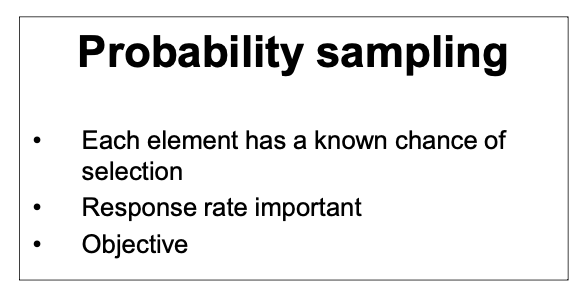
What defines Probability Sampling?
An objective method where every element has a known, non-zero chance of being selected.
types: stratified, clustered, systematic random, simple random
What defines Non-probability Sampling?
A subjective method where selection relies on personal judgment rather than chance.
types: snowball, convenience, judgement, quota, purposive
What is Convenience Sampling?
Selecting cases based on ease of access
What is Judgment Sampling?
A non-probability technique where the researcher selects samples based on expert knowledge.
How does Quota Sampling work?
The population is divided into cells based on characteristics, and a convenience sample is taken until each cell quota is met.
What is Snowball Sampling?
Starting with a key contact who refers others, creating a chain
Define Simple Random Sampling (SRS).
The purest probability method where every element has an equal chance of selection, often using random numbers.
types: with or without replacement
What is Stratified Sampling?
Dividing the population into mutually exclusive groups (strata) and taking a random sample from each.
What is Cluster Sampling?
Dividing the population into groups (clusters) and randomly selecting entire clusters to study.
What is Systematic Sampling?
Selecting every kth element from a list after a random starting point.
What factors determine Sample Size?
Required precision,
population nature,
budget,
time,
and resources.
What is a "homogeneous" population? What are the implications for sample size?
A population where units cannot be easily distinguished by auxiliary information.
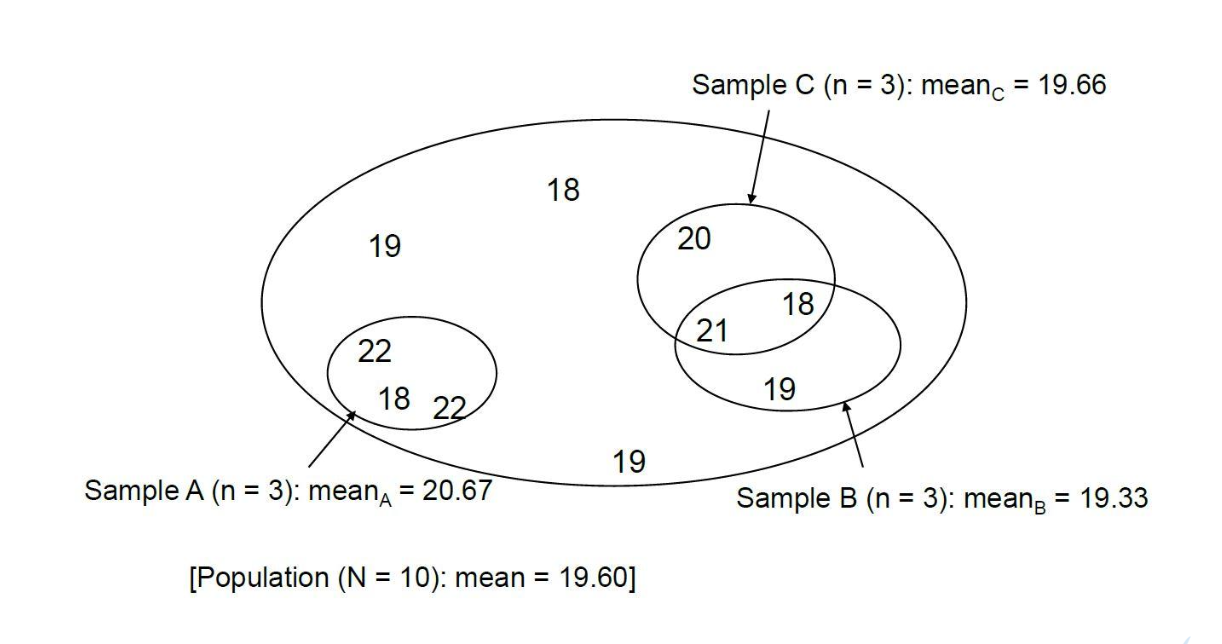
What is Sampling Error?
Inaccuracy caused by studying a sample instead of the whole population - difference btw sample and pop.
Non-sampling error
errors that occur in the research process
types: sampling frame & non-response error
Non-response Error?
Failure to get data from selected elements because they couldn't be reached or refused to participate.
Sampling Frame ?
Failure to include all relevant elements or sections of the target population in the list.
How can you remedy Sampling Error?
By increasing the sample size or using a more statistically efficient sampling method.
Avoiding non-sampling error
improve coverage
improve response rate
improve response quality
Issues with international sample selection
population lists often unavailable
insufficient knowledge of population characteristics
uneven service
reduce expertise
solution
probability samples combined with judgement and convenience samples