The real bio final
 Call Kai
 Learn
Learn Practice Test
 Spaced Repetition
 Match
Match Flashcards
 Knowt Play
1/169

There's no tags or description
Looks like no tags are added yet.
Name | Mastery | Learn | Test | Matching | Spaced | Call with Kai |
|---|
No analytics yet
Send a link to your students to track their progress
170 Terms
What was Darwins theory?
All species evolve over generations through a process called natural selection, where organisms with heritable traits better suited to their environment are more likely to survive and reproduce.
How old is the earth?
4.54 billion years old
How is the earth’s age determined?
It’s determined primarily through radiometric dating of the oldest rocks, moon rocks, and meteorites.
What were the first living organisms on earth?
simple, single-celled anaerobic prokaryotes
When did life first appear on earth?
3.5 billion years ago
When did the diversity of life on earth increase significantly?
600 million years ago
What are the four components of evolution by natural selection?
Variation, inheritance, differential survival and reproduction, and adaption.
How do environment changes affect populations?
May result in an increase in individuals of a particular species, or the extinction of one.
What happens to organisms with adaptions over time?
They increase.
Is the theory of evolution “just a theory“?
No, in science a scientific theory is a well explanation supported by much evidence.
What are the multiple lines of evidence that support common ancestry and biological evolution?
Fossil record, comparative anatomy, comp. biochem, comp. embryology, geographical distri.
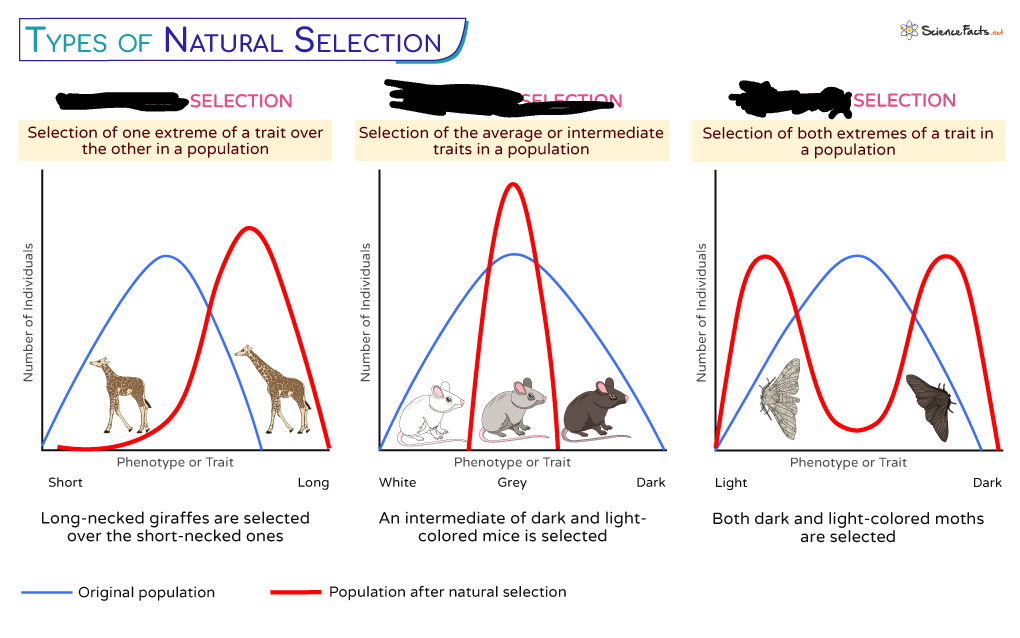
What type of selection is displayed in the first image?
Directional Selection
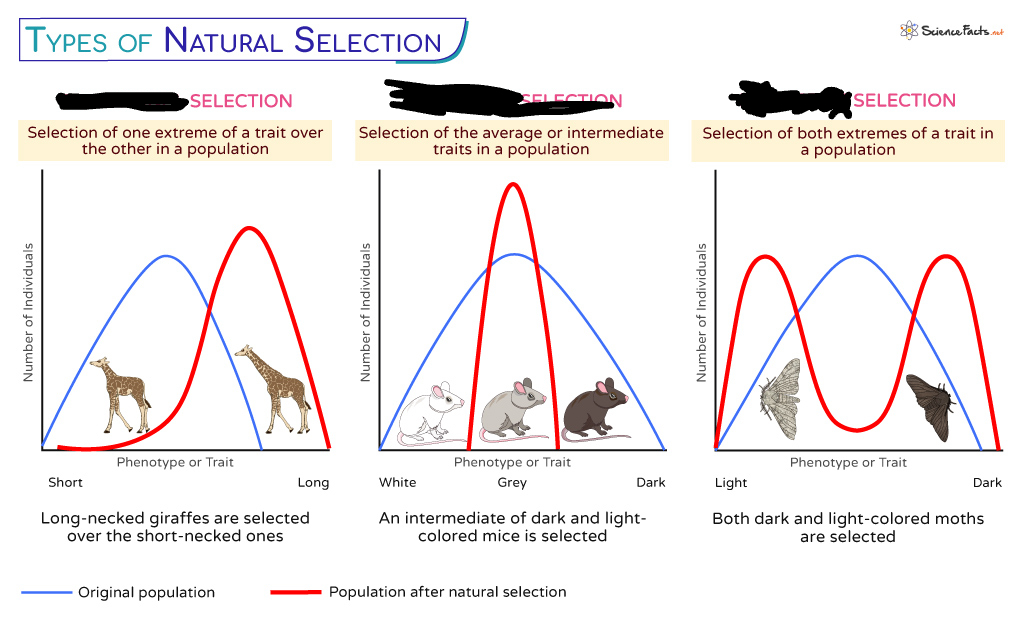
What type of selection is displayed in the second image?
Stabilizing Selection
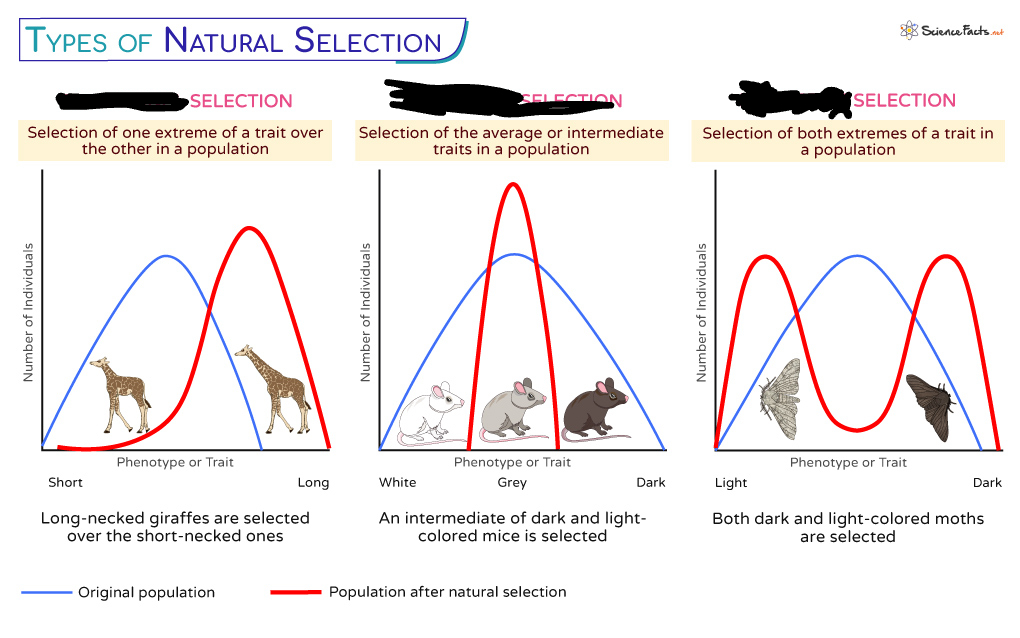
What type of selection is displayed in the third image?
Disruptive Selection
Whats the order of evolution from start to finish?
What is evolution?
The change in species over time through inherited traits
Why is evolution called a scientific theory?
Because it is supported by lots of evidence and testing.
What is common ancestry?
The ideas that all organisms share a common ancestor from the past.
What is the fossil record?
Fossils preserved in rock layers that show how organisms changed over time.
How do fossils support evolution?
They show extinct species and gradual changes between organisms.
What is comparative anatomy?
Comparing body structures of different organisms.
What are analogous structures?
Different structures but similar functions
What is comparative embryology?
Studying similarities in embryos of different species.
Why do similar embryos support evolution?
They suggest species share a common ancestor.
What is comparative biochemistry?
Comparing DNA and proteins between organisms.
What are derived characteristics?
New traits that evolved more recently.
What evidence best supports common ancestry?
Fossils, DNA similarities, and embryos.
What is DNA profiling (DNA fingerprinting)?
A technique used to identify people by analyzing unique patterns in DNA
What is gel electrophoresis?
a lab method used to seperate DNA fragments by size using an electric current
What is a restriction enzyme?
Protien that cuts DNA at a specific sequences
How is DNA used in forensics?
Helps identify suspects or victims by comparing DNA samples from crime scene
What is a monohybrid cross?
A genetic cross involving one trait
What is codominance?
When both alleles are fully expressed
What is incomplete dominance?
When the phenotype is a blend of both
What can a punnet square show?
Genotype ratios and phenotype ratios.
Why do sex-linked traits affect males more often?
Males only have one so recessive genes more likely to show.
What are gender-linked traits?
Traits controlled by genes on X and Y chromosomes.
What’s a carrier?
When a person carriers a gene but down not show it.
What’s a polygenic trait?
A trait controlled by multiple genes (like height or skin color).
What role do antigens play in blood type?
On red blood cells determine blood type
How do blood types show multiple alleles?
There are three alleles: A, B, and O.
What are multiple alleles?
More than two allele options for a gene (like blood types).
What is incomplete dominance?
When phenotype blend of both alleles
What’s codominance?
When both alleles fully expressed
Colorblindness is caused by a recessive allele (b) that is located on the X chromosome. If a girl is colorblind, which of the following must be true?
Her father was color blind
What’s DNA finger printing?
Identifies a person based on their unique DNA sequence.
There are two alleles that determine the shape of the CFTR protein: The normal allele (F) and the mutated allele (f) that can cause the condition known as Cystic Fibrosis. The normal allele (F) is dominant to the cystic fibrosis allele (f). In order to have Cystic Fibrosis a person must have the homozygous recessive genotype. Cystic fibrosis affects males and females the same. Based on this information, which pattern of inheritance controls Cystic Fibrosis?
Complete dominance
Colorblindness is caused by a recessive allele (b) that is located on the X chromosome. If a man that is colorblind marries a woman that is homozygous normal, what is the chance that they will have a child that is colorblind?(%)
0%
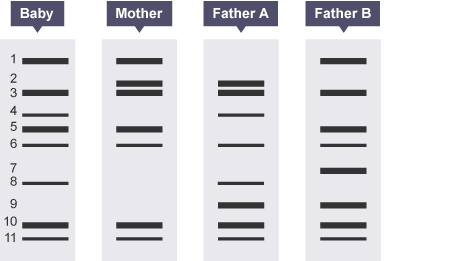
Who is the father?
Father A
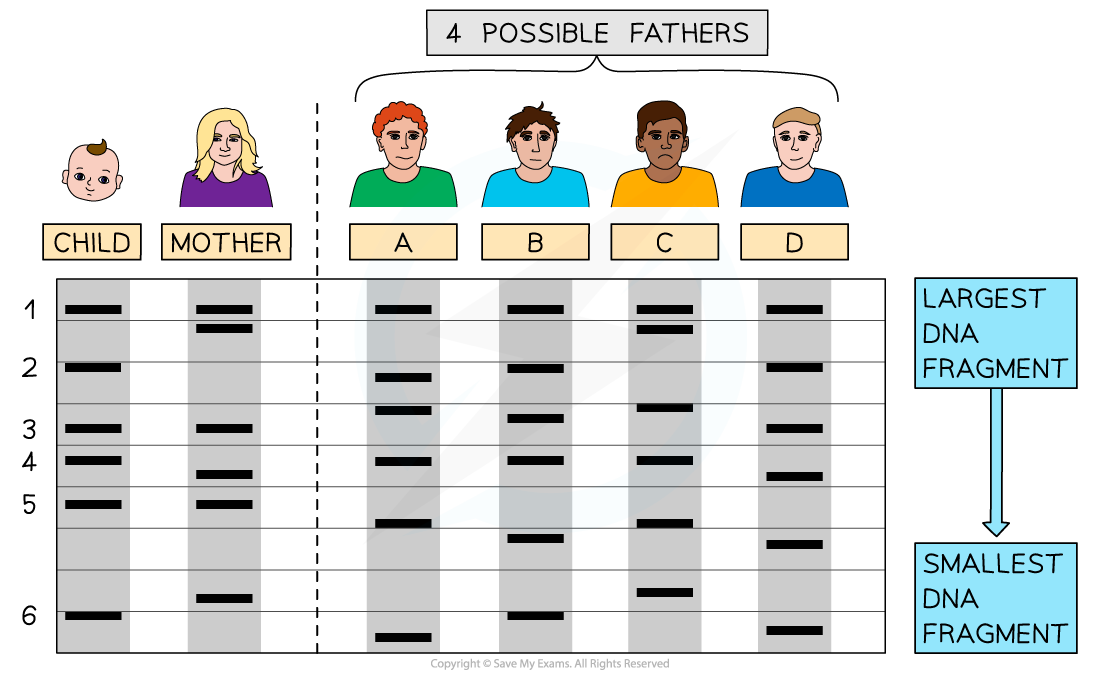
Who is the father?
B
What is a karyotype?
A picture of all the chromosomes in a cell arranged in pairs by size and shape.
What are homologous chromosomes?
Pairs of chromosomes with one from each parent that have the same genes matched in the karyotype.
Whats the difference between autosomes and gender chromosomes?
Autosomes are chromosomes that determine body traits. Gender chromosomes determine biological gender (X and Y)
What is nondisjunction?
When chromosomes fail to separate properly during meiosis, causing cells to have too many or too few chromosomes
What happens during fertilization?
Sperm cell and egg cell combine to form a zygote
What is a zygote?
The first cell formed after fertilization
What does diploid (2n) mean?
A cell that has two sets of chromosomes one from each parent
What does haploid (n) mean?
A cell that has one set of chromosomes
What is meiosis?
A type of cell division that produces four haploid gametes (gender cells)
What is independent assortment?
The random distribution of different chromosomes pairs into gametes
What is crossing over?(recombination)
When homologous chromosomes exchange pieces of DNA during meiosis, creating new gene combinations
What is the purpose of meiosis?
To produce haploid gender cells (gametes) for reproduction
Why is meiosis important for reproduction
It reduces chromosome number so the offspring have the correct number after fertilization.
What is the difference between meiosis and mitosis?
Mitosis makes identical diploid cells and miosis makes four different haploid cells
How does meiosis reduce chromosome number from diploid to haploid?
Homologous chromosomes seperate during meiosisl l.
How does crossing over increase genetic diversity?
It mixes genetic material between chromosomes, creating new allele combinations
How does independent assortment increase variation?
Chromosomes line up randomly, creating many different combinations of genes in gametes.
What happens if nondisjunction occurs during meiosis?
Gametes many have extra or missing chromosomes, which can cause genetic disorders.
Why is random fertilization important for genetic diversity?
Any sperm can fertilize any egg, creating many possible genetic combinations.
What is a trait?
A specific characteristic of an organism (like eye color or height)
What is a gene?
A section of DNA that codes for a trait.
What is an allele?
Different versions of the same gene.
What is the difference between genotype and phenotype?
genotype is the genetic makeup. (TT, Tt, tt) Phenotype is the physical appearance (Tall or Short)
What does heterozygous mean?
Having two different alleles for a trait (Tt)
What does homozygous mean?
Having two identical alleles (TT or tt)
What is a purebred organism?
An organism that is homozygous for a trait
What is a dominant allele?
An allele that shows its trait even if only one copy is present.
What is a recessive allele?
An allele that only appears when two copies are present.
What is a monohybrid cross?
A genetic cross that examines one trait
What is a monogenic trait?
A trait controlled by one gene
What is a polygenic trait?
A trait controlled by multiple genes (like skin color or height)
What is a pedigree?
A chart that tracks the inheritance of a trait through generations.
What is a carrier?
Someone who has one recessive allele but it doesn’t show the trait.
What does the law of dominance state?
Dominant alleles mask recessive alleles.
What does the law of segregation state?
Allele pairs seperate during gemete formation so each gamete gets one allele.
What does the law of independent assortment state?
Genes for different traits seperate independently during gamete formation
Why were mendel’s pea plant experiments important?
They helped scientists understand how traits are inherited
What is the genotype of the parents in TT x tt?
One parent is homozygous dominant (TT) and the other is homozygous recessive (tt)
What percent of offspring will be heterozygous in that cross?
100% will be Tt.
If T = tall and t = short, what phenotypes appear in Tt x Tt
Tall and short plants
What is the genotype ratio for Tt x Tt?
1 TT : 2 Tt : 1 tt
What is the phenotype ratio for Tt x Tt?
3 tall : 1 short
What symbol represents males in a pedigree?
Squares
What symbol represents females?
Circles
What does a shaded symbol mean?
The person has the trait
How can you identify a carrier in a pedigree?
They have one recessive allele but do not show the trait
How can you tell if a trait is recessive in a pedigree?
Two unaffected parents can have an affected child
What is a pedigree?
A recorded lineage, ancestral line, or family tree detailing the descent of a person or animal, often used to verify purebred status or track genetic traits
if two heterozygous parents (Tt x Tt) have a child, what is probability the child is homozygous recessive?
25%
If a trait is polygenic, how will the pheonotypes appear?
They show a wide range of variation (a spectrum)