PURP COMM MIDTERMS
 Call Kai
 Learn
Learn Practice Test
 Spaced Repetition
 Match
Match Flashcards
 Knowt Play
1/38

Earn XP
Description and Tags
gadzooks
Name | Mastery | Learn | Test | Matching | Spaced | Call with Kai |
|---|
No analytics yet
Send a link to your students to track their progress
39 Terms
Multimodals
It is defined as the strategic use of two or more communication modes to make meaning,
While the development of multimodal literacy is strongly associated with the growth of digital communication technologies, multimodal is NOT synonymous with digital.
Linguistic, Visual, Gestural and Audio
Example of Multimodals?
Paper-Based Multimodal Text
Such as books, comics, poster
Digital-Based Multimodal Text
Such as slide presentations, e-books, blogs, eposters, web pages, social media, animation, film, and video games
Live Multimodal Text
Such as a performance or an event
Transmedia Multimodal Text
The story is told using “multiple delivery channels” through a combination of media platforms. For example, book, comic, magazine, film, web series, video game mediums
Video Advocacy Campaign (VAC)
Advocacy refers to the process of bringing about change in policies, law, or people’s behavior and attitude. is about using visual media as a strategic tool to engage people to create change.
Public Service Announcement (PSA)
It is any message that promotes the programs, services, or activities. It is often in the form of commercials and print ads.
It can create awareness about an important topic, show importance of a problem or issue, and promote behavioral change.
Media Campaign (MC)
A planned series of newspaper articles, television interviews, etc. that are intended to achieve a particular aim. There should be a call to action to be delivered by the messenger through a medium during timely opportunities.
Logical Reasoning
As human beings, we have brains that enable us to reason in a logical manner and create valid reasons.
It happens sometimes that due to a host of reasons like our emotional state, ignorance, biases, and others, we become vulnerable and commit flawed reasoning.
Fallacies
are errors or flaws in reasoning that one must avoid in both oral and written communications in the academic world. In general terms, it is an “error in reasoning”.
Argumentum ad Hominem
Argument Against the Person
Instead of finding fault on the claim, proposal, or argument, the arguer directs his attack on the character, appearance, personality, or belief of his opponent.
Example: “We should not listen to her opinion on public health. She failed her medical board exam twice.”
Circular Argument
Argument That Goes in Circles
The arguer evades the real conclusion by restating the same conclusion in new words, making the reasoning circular.
Example: “The Bible is true because it says so in the Bible.”
Non-Sequitur
“It does not follow”
The arguer draws a conclusion not supported by the premises or fails to include assumptions that establish connections between ideas.
Example: “Mary bakes the best cakes in town. She should run for mayor.” (geneuinely not related)
Appeal to Flattery
Argument That Uses Flattery/Praise
Instead of presenting evidence, praises are used to make others agree or to seek approval of the argument.
Example: Praising your mom for a wonderful dinner just before asking if you can get out of washing the dishes tonight.
Appeal to Ignorance
Arguments from Ignorance
This is when an arguer cannot prove the argument to be false, therefore, it is true. This claims that something must be true because it hasn’t been proven false.
Example: “You cannot prove invisible fairies do not live in my nose; therefore, they live in my nose.”
Argumentum ad Baculum
Appeal to Fear
The arguer uses force/threats instead of reasons. It may be physical or psychological.
Example: “If you don't join our demonstration against the expansion of the park, we will evict you from your apartment.”
Bandwagon Fallacy
It appeals to the belief/prejudices of the crowd or masses. It justifies that “might is right” and “many people cannot be wrong”. It claims that a certain action is the right thing to do because it’s popular.
Example: “Millions of people use this supplement daily. It must work.”
Red Herring
Instead of addressing the argument, the arguer introduces an unrelated or irrelevant matter to draw the argument away from the real issue. (still related)
Example: “We can't raise salaries, but we still provide great benefits for our employees.”
Hasty Generalization
The arguer makes a conclusion based on a few instances or even from one single instance only. From one sample, the arguer makes a claim about the whole population. (one to many)
Example: “I felt sick both times I ate pizza from Georgio’s, so I must be allergic to something in pizza.”
Fallacy of Division
It is arguing under the premise that what is true of a whole or class is true to every member. (many to one)
Example: “I just read a report about teachers not being happy with how much they are paid. So, my Aunt Sarah, who is a teacher, must be unhappy with her salary.”
Argumentum ad Misericordiam
Appeal to Pity or Misery
Instead of presenting relevant claims, the arguer resorts to evoking pity or sympathy by pointing or referring to an unfortunate circumstance.
Example: “Could you please change my grade? I worked hard and pulled an all-nighter to finish on time.”
Argumentum ad Verecundiam
Appeal to (Unqualified) Authority
It is committed by citing an opinion or judgment of someone who commands respect but is not a recognized authority on the subject.
Example: “You should take those vitamins because Anne Curtis said they are the best.”
Argumentum ad Novitatem
Appeal to Novelty
“What is new is good.”
It occurs when something is assumed to be either good or better than something else, simply because it's perceived as being newer or more novel.
Example: Every iPhone commercial for a new version of the product argues that it is superior to the previous version.
Globalization
is the increasing economic, political, and cultural integration and interdependence of diverse cultures—the worldwide integration of humanity.
Diversity
is the recognition and valuing of differences, encompassing factors such as age, gender, race, ethnicity, ability, religion, education, marital status, sexual orientation, and income.
Culture
is a system of knowledge, beliefs, values, customs, behaviors, and artifacts that are acquired, shared, and used by its members during daily living.
co-cultures
Within a culture, these are composed of members of the same general culture who differ in some ethnic or sociological way from the parent culture.
Assimilation
is how co-culture members attempt to fit in with members of the dominant culture.
Accommodation
is by which co-culture members maintain their cultural identity while striving to establish relationships with members of the
dominant culture.
Separation
is how co-culture members use to resist interacting with members of the dominant culture.
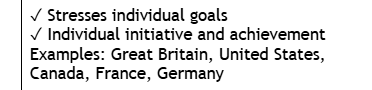
Individualism
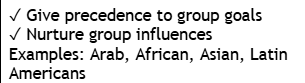
Collectivism
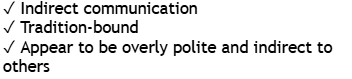
High-Context Communication
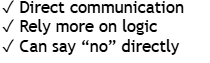
Low-Context Communication
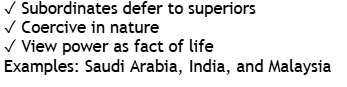
High-Power Distance
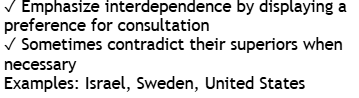
Low-Power Distance
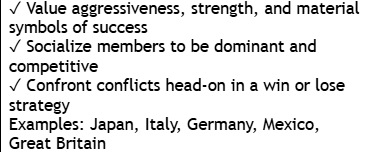
Masculine
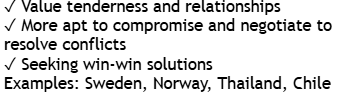
Feminine