(Lecture 3) (p3_ECM_6.pdf) iPSC and ECM
 Call Kai
 Learn
Learn Practice Test
 Spaced Repetition
 Match
Match Flashcards
 Knowt Play
1/34

There's no tags or description
Looks like no tags are added yet.
Name | Mastery | Learn | Test | Matching | Spaced | Call with Kai |
|---|
No analytics yet
Send a link to your students to track their progress
35 Terms
What is the extracellular matrix (ECM)?
The ECM is the collection of secreted products of cells in tissues and organs that provides:
mechanical support
signal transduction for cell-cell and cell-matrix interactions
What are the main types of ECM molecules?
Structural and Functional
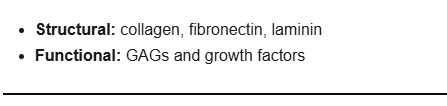
What are the main types of ECM?
Basement membrane (basal lamina)
Elastic fibre ECM
Stromal/interstitial matrix
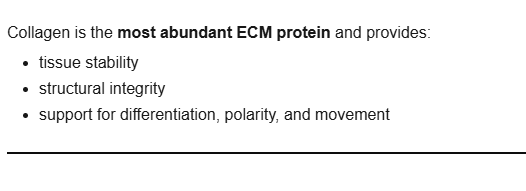
Why is collagen important in the ECM?
tissue stability, structural integrity, support for differentiation, polarity, and movement
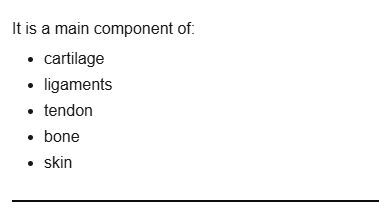
Where is collagen commonly found?
cartilage, ligaments, tendon
What does Type I collagen do?
provides uniaxial and multiaxial mechanical strength

What does Type III collagen do?
Type III collagen is found in flexible, compliant tissues, such as the submucosal layers and urinary bladder.
What does Type IV collagen do?
Type IV collagen is found in the basement membrane of vascular structures and has ligand affinity for endothelial cells.
What is fibronectin?
helps connect cells to collagen fibres

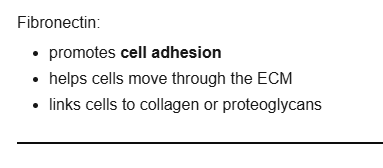
What are the main functions of fibronectin?
promotes cell adhesion, helps cells move through the ECM, links cells to collagen or proteoglycans
What sequence in fibronectin promotes cell adhesion?
RGD sequence (Arg-Gly-Asp)

Why is fibronectin useful in tissue engineering?
It can be used as a coating for synthetic scaffold materials to improve cell attachment.
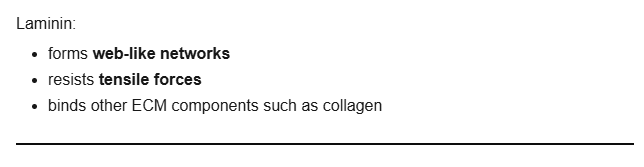
What is laminin?
adhesion molecule found in basal membranes
What does laminin do?
binds other ECM components
What is elastin?
major protein of elastic tissues
What is tropoelastin?
soluble precursor of elastin

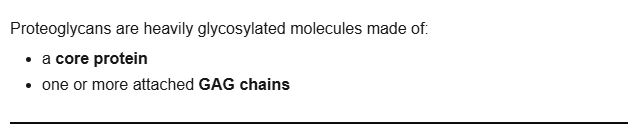
What are proteoglycans?
Heavily glycosylated molecules made of a core protein and one or more attached GAG chains
What are glycosaminoglycans (GAGs)?
long linear carbohydrate polymers

Why are GAGs negatively charged?
Because they contain sulfate and uronic acid groups.
What are the two main subunits of GAGs?
Uronic acid, Aminosugar
How are GAGs attached to proteins?
They are linked to the protein core by a specific trisaccharide linker
What are the main types of GAGs?
Hyaluronic acid
Chondroitin sulfate
Dermatan sulfate
Heparan sulfate
Keratan sulfate
What is special about hyaluronic acid?
non-sulfated, binds lots of water, helps tissues resist compression
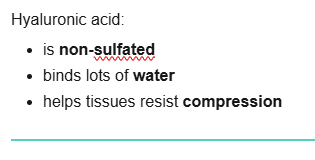
Where is hyaluronic acid especially abundant?
load-bearing joints and interstitial gel
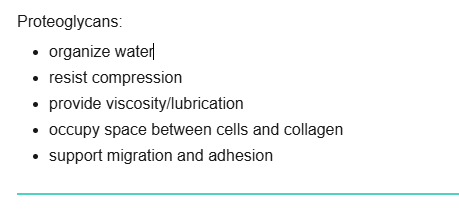
What are the main functions of proteoglycans?
organize water, resist compression, provide viscosity/lubrication
What are the main structural glycoproteins in ECM?
Fibronectin, Laminin
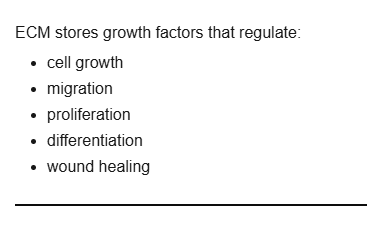
Why are growth factors important in ECM?
regulates cell growth, migration and proliferation
Name some growth factors found in ECM.
Examples:
VEGF
FGF
SDF-1
EGF
TGF-β
PDGF
BMP
What does VEGF do?
stimulates blood vessel formation.
What does BMP do?
induces bone formation

What is decellularised ECM?
It is ECM from which cells have been removed, leaving behind the bioactive scaffold.
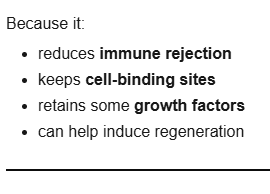
Why is decellularised ECM useful?
reduces immune rejection, keeps cell-binding sites, retains some growth factors
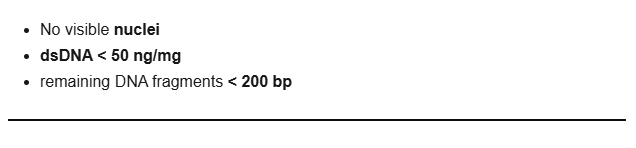
What are the criteria for efficient decellularisation?
No visible nuclei
What is whole-organ decellularisation?
removal of cells from an entire organ

What is the main tissue engineering lesson from ECM?
Successful scaffolds should mimic ECM:
composition
hierarchy
adhesive ligands
hydration/transport properties
dynamic behaviour