psychology paper 2
 Call Kai
 Learn
Learn Practice Test
 Spaced Repetition
 Match
Match Flashcards
 Knowt Play
1/27

There's no tags or description
Looks like no tags are added yet.
Name | Mastery | Learn | Test | Matching | Spaced | Call with Kai |
|---|
No analytics yet
Send a link to your students to track their progress
28 Terms
2 advantages and 2 disadvantages of schemas
Advantages:
Mental frameworks built from prior experience that allow us to rapidly process large amounts of incoming environmental information without becoming overwhelmed
They allow us to predict what is likely to happen in familiar situations, enabling faster and more efficient cognitive processing
Disadvantages:
Can distort our interpretation of sensory information, causing us to perceive what we expect rather than what is actually present
This can lead to errors in EWT or biased recall — and negative/faulty schema may also contribute to mental health difficulties such as depression
Explain what is meant by displacement?
Involves redirecting a strong, threatening emotion away from its original source onto a neutral or less threatening substitute target
Outline the behaviourist approach. Compare the behaviourist approach with the biological approach (16)
Ao1:
Argues that all behaviour is learned from the environment through experience (internal mental processes should be ignored because they cannot be observed directly
Classical conditioning ✅
Operant conditioning: learning through consequences - behaviour followed by + or - reinforcement are more likely to be repeated and behaviours that are followed by punishment are less likely to recur
Skinner’s box demonstrated operant conditioning in rats → behaviourists argue that this generalises to human behaviour
Ao3:
A fundamental point of comparison between the behaviourist and biological approaches concerns the nature-nurture debate. The behaviourist approach adopts an extreme nurture position, arguing that all behaviour is the product of environmental conditioning and past learning experiences. In contrast, the biological approach takes a nature position, attributing behaviour primarily to genetic inheritance, neurochemical functioning, and evolutionary pressures shaped over thousands of years. For example, a behaviourist would explain a phobia as a conditioned fear response acquired through classical conditioning, whereas a biological psychologist would explain it as an adaptive, evolutionarily prepared response to ancestral threats. This difference in explanation leads directly to contrasting therapeutic approaches: the behaviourist approach produces therapies such as systematic desensitisation which work by reconditioning fear responses, whilst the biological approach produces drug therapies that target neurochemical imbalances. This comparison illustrates that the two approaches offer fundamentally incompatible accounts of the origins of behaviour, and suggests that an interactionist perspective which integrates both environmental and biological factors is likely to provide the most complete explanation
Both the behaviourist and biological approaches share a significant methodological similarity in their extensive use of non-human animals in controlled laboratory experiments. Pavlov used dogs, Skinner used rats and pigeons, while biological researchers use animals to study the effects of brain lesions, genetic manipulation, and neurochemical interventions. Both approaches justify this on the grounds that findings from animal research reveal universal principles that can be generalised to human behaviour. However, this reliance on animal models has attracted criticism on two grounds. First, it raises serious ethical concerns about the suffering caused to non-human animals in the pursuit of scientific knowledge. Second, and perhaps more fundamentally, it raises questions about the validity of extrapolating findings from animals to humans, given the considerably greater complexity of the human nervous system and cognitive capacities. This shared limitation suggests that while both approaches benefit from the scientific rigour that controlled animal experiments afford, the conclusions drawn may have restricted applicability to human behaviour and experience
Both the behaviourist and biological approaches can be criticised as reductionist, though they reduce behaviour in different ways. The behaviourist approach reduces all complex human behaviour to simple stimulus-response (S-R) associations, entirely ignoring cognitive processes, emotions, and social context. The biological approach reduces behaviour to physiological mechanisms such as genes, neurotransmitters, hormones, and brain structures. Reductionism does carry scientific advantages — it allows precise, controlled investigation of isolated variables, and breaking behaviour down into component parts can generate testable hypotheses. However, as a sole explanation, both approaches oversimplify the richness and complexity of human experience. For example, reducing depression solely to low serotonin levels or to learned helplessness neglects cognitive appraisals, social factors, and psychodynamic influences that research has shown to be important. This shared limitation suggests that a more holistic, biopsychosocial approach is needed to fully account for behaviour
Exogenous zeitgebers (ao1 + ao3)
Ao1:
External environmental cues that entrain (synchronise) the body’s biological rhythms (sleep wake cycle)
Most powerful exogenous zeitgeber is light: detected by the retina and signals suprachiasmatic nucleus (SCN) → suppresses melatonin production from the pineal gland, promoting wakefulness; darkness triggers melatonin release, inducing sleep
Social cues also act as zeitgebers → noise, temp, social interaction
Ao3
Research provides strong support for light as a powerful exogenous zeitgeber. Campbell and Murphy (1998) shone light onto the back of participants’ knees and found this was sufficient to shift circadian rhythms by up to 3 hours, suggesting that light receptors exist beyond just the retina. This demonstrates that light can entrain biological rhythms through non-visual pathways, strengthening the claim that light is the dominant external cue regulating the sleep/wake cycle. This therefore supports the view that exogenous zeitgebers ,particularly light, play a fundamental and powerful role in entraining circadian rhythms
Research into exogenous zeitgebers has led to a valuable real-world application in the treatment of Seasonal Affective Disorder (SAD). SAD is a form of depression occurring predominantly in winter when daylight hours are reduced, and light therapy (exposing patients to bright artificial light daily) has been shown to be an effective treatment. This directly supports the causal role of light as an exogenous zeitgeber in regulating mood and the sleep/wake cycle, demonstrating that the concept has meaningful practical value beyond laboratory settings and strengthening the credibility of exogenous zeitgebers as a genuine influence on biological rhythms
A limitation of research into exogenous zeitgebers is that it fails to adequately account for individual differences in sensitivity to external cues. Research suggests that chronotype (whether someone is naturally a morning or evening person) is partly genetically determined, meaning identical exposure to the same zeitgebers will not produce the same entrainment effects across all individuals. This reduces the generalisability of findings from zeitgeber research, as conclusions drawn from studies using specific samples may not apply to the wider population, suggesting that a purely environmental account of circadian rhythm regulation is overly simplistic
Much of the research into exogenous zeitgebers has been conducted in highly controlled, artificial laboratory environments, raising concerns about ecological validity. Studies that isolate participants from natural light cycles or manipulate light exposure in controlled chambers do not reflect the complexity of real-world environments, where multiple zeitgebers operate simultaneously. This means findings may not generalise well to how circadian rhythms are actually entrained in everyday life, reducing confidence in the conclusions drawn and limiting how much weight can be placed on laboratory-based evidence when explaining the real-world role of exogenous zeitgeber
One difference between autonomic + somatic nervous system
The autonomic nervous system (ANS) operates involuntarily and controls internal organs and glands (e.g. heart rate, digestion), whereas the somatic nervous system is under conscious voluntary control and governs skeletal muscle
Explain why neurones can only transmit information in one direction at a synapse (3)
Synaptic vesicles containing neurotransmitters are only present on the presynaptic membrane, so neurotransmitters can only be released from one side
Receptor sites for neurotransmitters are only located on the postsynaptic membrane
It is the binding of the neurotransmitter to the postsynaptic receptor that triggers a new electrical impulse
The fight or flight response enables our ancestors to survive but can be less helpful in response to more modern stressors.
Explain how the body responds during fight or flight and why this could be unhelpful in a driving test situation (4)
When a threat is perceived, the hypothalamus activates the sympathetic branch of the ANS, which stimulates the adrenal medulla to release adrenaline into the bloodstream.
This causes increased heart rate and breathing rate (to deliver more oxygen to muscles), pupil dilation, sweating, and redirection of blood away from digestion towards skeletal muscles — preparing the body to fight the threat or flee from it.
In a driving test, these changes are counterproductive: increased sweating could reduce grip on the steering wheel, heightened arousal could impair fine motor control needed for precise manoeuvres, and racing thoughts could disrupt concentration.
The driving test is a modern psychological stressor where neither fighting nor fleeing is an appropriate response — yet the body reacts as though facing a physical threat, ultimately impairing performance.
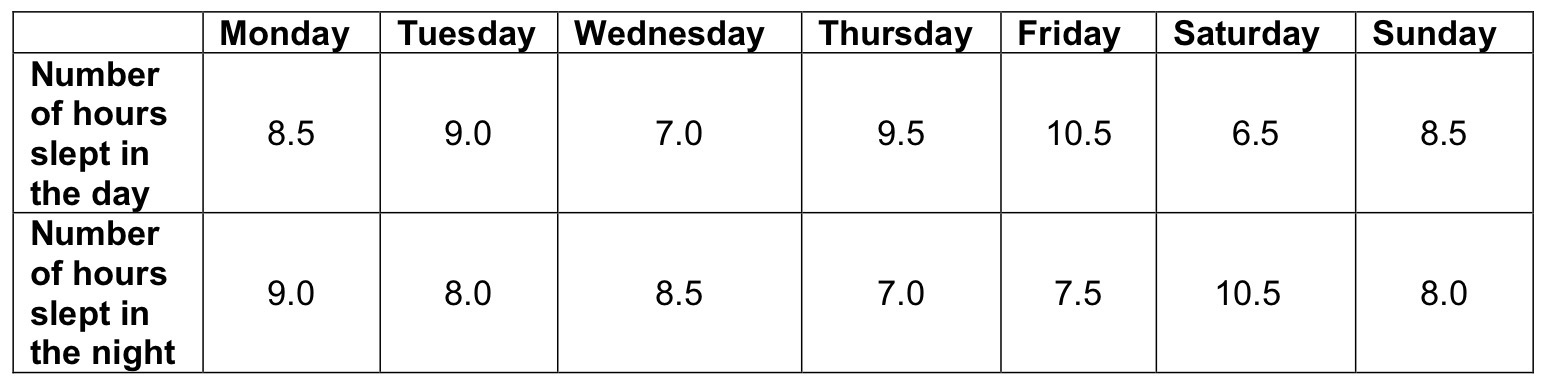
Explain one reason why the mean is the most appropriate measure of central tendency for this set of data (2)
The data is measured on an interval scale (hours of sleep), meaning all values carry equal weight and can be legitimately used in the mean calculation, making it more precise and representative than the median or mode
There are no extreme outliers in this dataset that would skew the mean, so it given an accurate and undistorted reflection of the central tendency
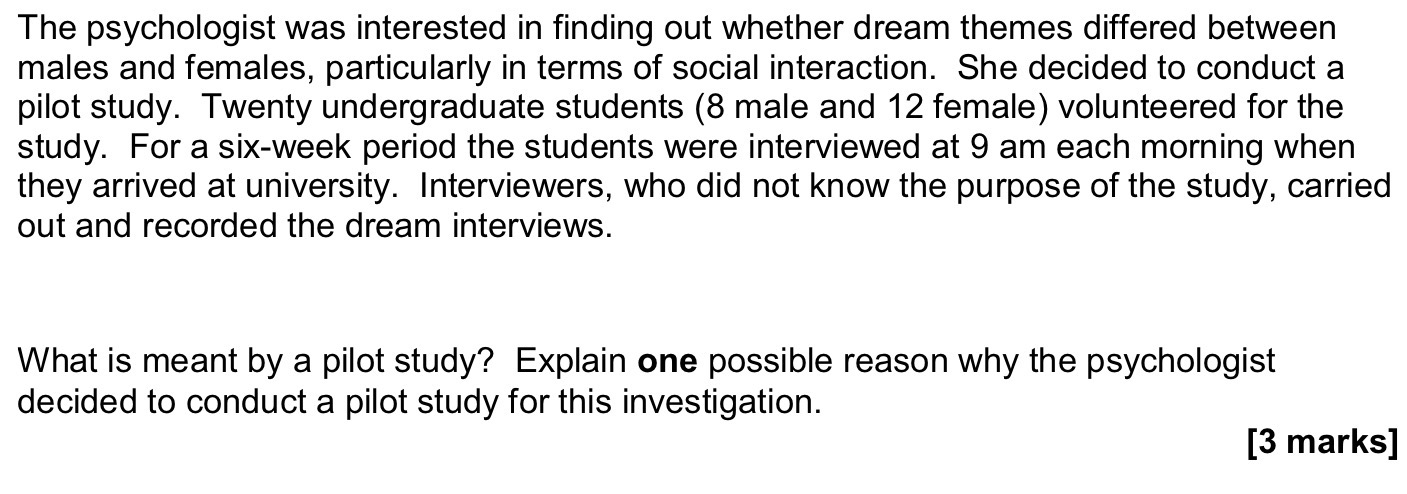
+what is qualitative data and give its advantage
Pilot study: small-scale trial run of a research investigation conduced before the main study, using a small sample, to identify any problems with the design
The psychologist may have conducted a pilot study to check whether the interview questions were appropriate and clearly understood — for example, whether questions about dream content were specific enough to reliably capture social interaction themes. Any problematic questions could then be modified before the full six-week study began, saving considerable time and resources
Qualitative data: non-numerical, descriptive data expressed in words + descriptions
They allow the researcher to develop a nuanced understanding
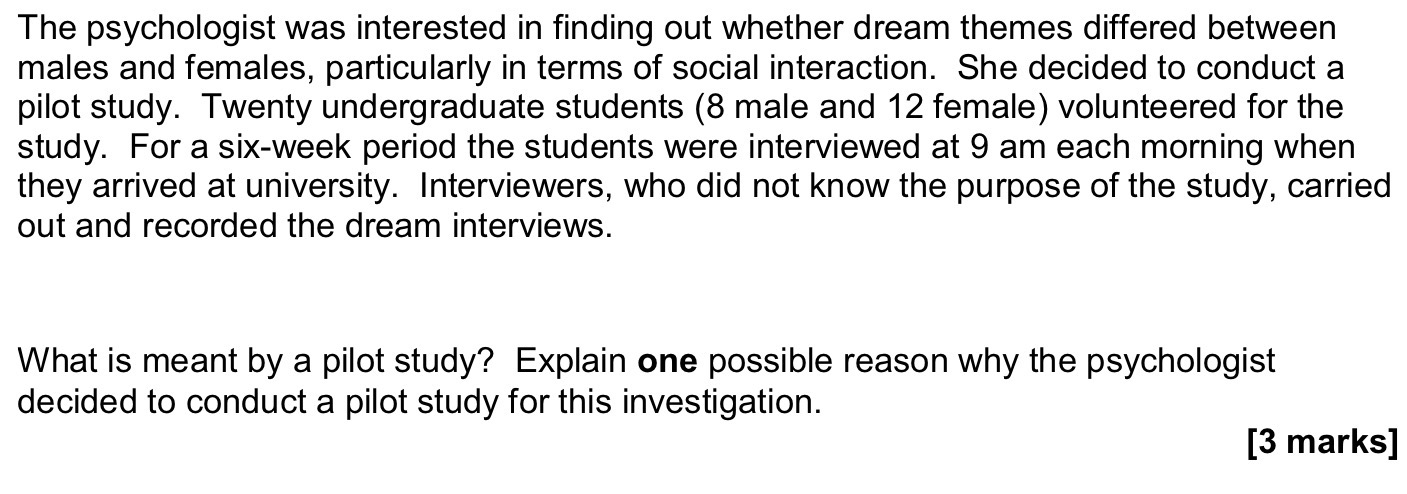
(Ignore Q on pic) what are investigator effects and suggest one way they can be minimised
Investigator effects refer to any unintentional influence of the researcher's behaviour, appearance, or expectations on participants' responses or the outcome of the study
A standardised script could be provided for all interviewers to follow, ensuring every participant is asked the same questions in the same order and with the same neutral tone. This would prevent interviewers from inadvertently prompting or steering participants' dream reports through subtle verbal or non-verbal cues — for example, showing more interest when social interaction is mentioned. By making the interview procedure uniform across all interviewers, the influence of individual interviewer characteristics on participants' responses is minimised, thereby improving the consistency and validity of the data collected
Content analysis (7) FDGcaad
1. Formulate an aim or hypothesis: decide what you want to investigate
2. Gather the data: choose the material you’ll analyse (eg: newspaper articles, interviews, YouTube videos).
3. Develop a coding system: identify specific behaviours or themes to look for (eg: “verbal aggression”,“affection”, “dominance”). Create a coding system with clear, objective, and mutually exclusive categories, along with rules for how each one will be identified and recorded
4. Carry out the analysis: systematically record each instance of the defined categories in the material
5. Assess reliability: check inter-rater reliability (eg: by comparing two independent coders’ results). A correlation of 0.8 or higher is considered good → if below review and clarify category definitions if above then means its clear + consistent
6. Analyse and interpret data: Quantitatively: count frequencies of each category to identify patterns and trends. Qualitatively: perform a thematic analysis by identifying recurring ideas, meanings, or underlying themes within the data
7. Draw conclusions: summarise the key patterns or themes that emerged from the analysis, relate them back to the original aim or hypothesis, and discuss possible implications or applications
4 marks for a graph
Title, key
x-axis → independant variable
y-axis → dependant variable
What does the standard deviation show?
Small SD = consistent data
Large SD = more variety
Role of the unconscious (2)
The unconscious acts as a protective store for traumatic memories, desires, and conflicts that are too anxiety-provoking to remain in conscious awareness → this is achieved through repression.
These repressed contents continue to motivate and shape behaviour from outside conscious awareness, for example through slips of the tongue or dream content.
SLT - why would a famous person be used in an advert
Bandura argued that observers are more likely to identify with and imitate role models who are high-status, attractive, or admired
Because viewers identify with the celebrity, they are more likely to imitate the behaviour shown
Wundt and the emergence of psychology as a science (8)
Ao1:
Wundt established the first experimental psychology laboratory in Leipzig in 1879, marking the formal separation of psychology from philosophy as an independent scientific discipline.
He developed the method of introspection: participants were trained to report their conscious mental experiences (sensations, feelings) in response to controlled stimuli under standardised laboratory conditions.
His approach, known as structuralism, aimed to identify the basic elements of conscious experience
He published Principles of Physiological Psychology (1874), one of the first textbooks defining psychology as a science, and trained many of the field's early researchers
Ao3:
A key strength of Wilhelm Wundt’s work is that it helped establish psychology as a scientific discipline through the use of controlled experimental methods. Wundt set up the first psychology laboratory in 1879 and used standardised procedures in his introspection studies, such as controlling stimuli and ensuring participants were trained to respond in a consistent way. This level of control increased the reliability of findings because procedures could be replicated. Therefore, Wundt’s work was crucial in establishing psychology’s scientific credibility.
However, a major limitation of Wundt’s approach is that introspection is highly subjective and lacks validity. Participants were asked to report their own conscious experiences, which cannot be independently verified, meaning the data may be influenced by individual biases or differences in interpretation. For example, two participants may perceive the same stimulus differently but report conflicting experiences, reducing the consistency of results. This suggests that introspection does not produce truly objective data, which undermines psychology’s claim to be a science. Therefore, despite Wundt’s efforts, his methods may not have been as scientific as initially intended
A further limitation is that Wundt’s approach can be criticised for being reductionist. By focusing on breaking down conscious experience into basic components, introspection ignores the complexity of human behaviour, such as the influence of social, cultural, and unconscious factors. This means his explanations may be overly simplistic and fail to capture the full nature of psychological processes. Consequently, this limits the explanatory power of his work and suggests that early scientific psychology did not fully account for the richness of human experience.
Which method of studying the brain would most accurately identify specific brain areas activated during a cognitive task?
fMRI
Outline the endocrine system + 2 examples
The endocrine system is a network of glands that communicate via chemical messengers called hormones, secreted directly into the bloodstream and carried to target organs.
Unlike the nervous system, hormonal communication is slower but longer-lasting, regulating processes such as metabolism, growth, reproduction, and sleep.
Example: The thyroid gland produces thyroxine, which regulates the body's metabolic rate — increasing heart rate, body temperature, and the speed of cellular chemical reactions.
Another example: The pineal gland secretes melatonin in response to darkness, promoting sleepiness and helping to regulate the circadian (sleep-wake) rhythm.
Localisation of function + hemispheric lateralisation ao1+ao3
Localisation of function
Ao1:
Localisation of function is the idea that specific brain areas are responsible for specific behaviours
The motor cortex controls voluntary movement on the opposite side of the body
The somatosensory cortex processes sensory information such as touch, pressure, and temperature
The visual cortex is responsible for visual processing
The auditory cortex processes sound and is involved in hearing
Broca’s area is involved in speech production; damage leads to slow, non-fluent speech
Wernicke’s area is responsible for language understanding; damage leads to fluent but meaningless speech
Ao3:
A key strength of localisation of function is strong support from scientific research. For example, Paul Broca found that patients with damage to a specific area of the frontal lobe (now known as Broca’s area) consistently had difficulties producing speech. This shows a clear link between a particular brain region and a specific function, suggesting that behaviour is not controlled by the brain as a whole but by specialised areas. In addition, modern brain imaging techniques (e.g. fMRI) show activity in particular regions during specific tasks, further supporting localisation. Therefore, consistent and objective evidence strengthens the validity of localisation theory and supports psychology as a scientific discipline
However, localisation of function may be an oversimplification due to brain plasticity. Research into recovery after brain injury shows that patients can regain lost functions over time, as other brain areas adapt and take over. This suggests that functions are not permanently fixed to specific regions, as localisation theory proposes. Instead, the brain appears flexible and capable of reorganising itself, particularly after trauma. Therefore, localisation cannot fully explain brain functioning, as it underestimates the brain’s ability to adapt and redistribute functions
Hemispheric lateralisation
Ao1:
Hemispheric lateralisation refers to the idea that the left and right hemispheres have specialised functions
The left hemisphere is typically dominant for language (speech
The right hemisphere is more involved in visual motor skills
The corpus callosum connects the two hemispheres and allows communication
Each hemisphere controls the opposite side of the body (contralateral control)
Sperry studied split-brain patients whose corpus callosum had been severed
Sperry found that objects presented to the left visual field could not be verbally described (right hemisphere), but could be identified non-verbally, suggesting language is lateralised to the left hemisphere
Ao3:
A major strength of hemispheric lateralisation is support from split-brain research. Sperry found that split-brain patients could not verbally identify objects presented to the left visual field but could recognise them using touch. This demonstrates that the right hemisphere can process information but lacks language ability, which is controlled by the left hemisphere. The highly controlled lab conditions also increase internal validity, as researchers could isolate which hemisphere processed the information. Therefore, this provides strong scientific evidence that the two hemispheres have specialised and distinct functions
However, evidence for hemispheric lateralisation may lack generalisability. Sperry’s research was conducted on a small, unusual sample of patients with severe epilepsy who had undergone split-brain surgery. These individuals may have atypical brain organisation due to their condition or surgery, meaning their cognitive processes may not reflect those of the general population. Therefore, conclusions about lateralisation may be limited, as findings cannot be confidently generalised to people with intact brains
Which neurone: is only found in the brain/visual system/spinal cord, carries nerve impulses from the brain/spinal cord to muscles/glands, carries nerve impulses between neurones
Relay
Motor
Relay
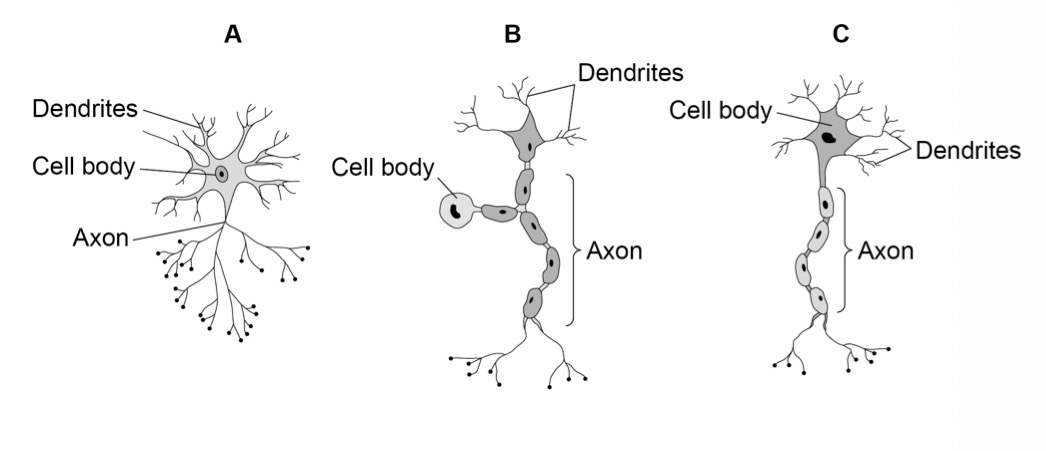
Draw each type of neurone
Relay, sensory, motor
3 reasons why scientific reports include a referencing section
enables readers to track down the sources used
to give credit to other researchers/acknowledge their ideas
can avoid plagiarism
Why would a non-directional hypothesis be used?
No previous evidence available for the researcher to predict the direction of the results
What is it called when a researcher goes out and picks participants for a study and what is a limitation of this sample
Opportunity sample
Unrepresentative of the target population
How are participants assigned in a matched pairs design?
Participants are first paired based on key characteristics relevant to the study (e.g. age, gender, IQ) → ask them to complete the survey
One participant from each pair is then randomly assigned to each condition
Participants with the two highest scores are paired, then the next two highest score are paired and so on until all participants are paired
This ensures that participant variables are controlled, as both conditions have similar individuals
What does it mean for a test to have high concurrent validity? (2)
High concurrent validity is where there is close agreement between the data produced by the new test compared to the established test
Close agreement is indicated if the correlation between the two sets of data produced by the two tests exceeds +0.8
How would you work out S for sign test
Work out the difference between the two sets of data (you need to know whether it is + or -
Add up how many + and - there are
Find the least occurring sign (the amount that sign shows up is S
Make sure to cancel out 0’s when finding significance to take it away from N (amount of participants)
Validity was still a concern because the researcher knew which participants were in each experimental group
1) Explain how this could have affected the validity of the study
2) Suggest how the researcher could improve internal validity of the study
1) Investigator effects → any observed difference cannot be confidently attributed to the IV, reducing internal validity of the study
2) A single-blind or double-bind procedure (research assistant who does not know can carry out) → they do not know aims so cannot unconsciously/ consciously treat participants differently so more confidence