physics mock focus areas
 Call Kai
 Learn
Learn Practice Test
 Spaced Repetition
 Match
Match Flashcards
 Knowt Play
1/38

Earn XP
Description and Tags
unsure on where if anywhere this is going, honestly. itll be fine.
Name | Mastery | Learn | Test | Matching | Spaced | Call with Kai |
|---|
No analytics yet
Send a link to your students to track their progress
39 Terms
types of magnets
permanent and induced. permanent magnets produce their own magnetic field, and include nickel, cobalt and iron. induced magnets are polarised when exposed to magnets, and the force they experience is always attractive.
magnetic field lines
strongest at the poles, weakest in the middle. lines go into the south pole and out of the north
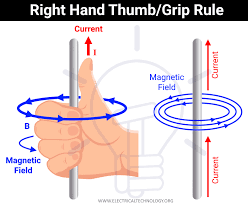
right hand thumb rule
the direction of curled fingers on a right hand where the thumb is facing the direction of the current is the field direction.
electromagnetism
magnetic fields are created by moving currents. the stronger the current and the closer to the wire something is the stronger the force that is experienced.
coiling a wire increases the field strength as the field lines line up. putting a block of iron in the centre further strengthens it, and the iron becomes an induced magnet while the current flows
electromagnets are often used to move heavy parts of induced magnetic material, like in scrap yards, or in circuits like bells.
motor effect - theory
as wires have magnetic fields, putting them in other magnetic fields creates a repulsive force. as the wire is less massive than the magnets it will move.
the motor effect is strongest at 90o and has no effect if parallel to the magnets (the magnetic field lines will be going the same way).
the force always acts at 90o to the magnetic fields of the magnets and the current direction (shown with fleming’s left hand rule).
if the current or magnetic field is reversed, the force direction will be reversed.
fleming’s left hand rule
start with thumb upright | , first finger pointing forward . , second finger pointing to the side —
thuMb represents Motion, First finger represents Force, seCond finger represents Current
rotate as with information given.
‘typical speeds’ of walking cycling and running
1.5m/s walking
3m/s running
6m/s cycling
motor effect in practice
motors (unsurprisingly) use the motor effect. split ring commutators let the contacts switch every half turn, keeping the motor moving in the same direction (instead of negative part/positive part which switch places as it spins, the negative is always on one side and positive on the other, keeping the setup the same)
speakers (loudspeakers, headphones) also use the motor effect. alternating current is sent around a coil of wire on the bottom of a paper cone. the wire is surrounded by one magnetic pole and surrounds the other, causing the motor effect to make it move, pushing out the cone. when the direction switches the effect reverses, causing the cone to move the other way. these movements create pressure variations vibrating air particles and producing sound.
generator effect
formal definition: the induction of a potential difference (and current if there’s a complete circuit) in a wire that is moving relative to a magnetic field, or experiencing a change in magnetic field.
moving a magnet through a coil of wire or wire through a magnet produces a potential difference as field lines are cut across. shifting it back and forth produces an alternating current. this also happens when a magnet is rotated end to end in a coil, or turning a coil in a magnetic field.
the induced current where applicable opposes the magnetic field that created it, as an attempt to reverse that change
use of the generator effect
alternators - a type of generator that produces an alternating current. built like motors, but with two slip rings and brushes to prevent contacts from swapping each half turn. this gives an alternating potential difference.
dynamos - dc generators. uses split-ring commutators instead of slip rings.
oscilloscopes represent PD changes visually - in AC, it shows a consistent wave going in both positive and negative areas, and DC shows only positive going up and down from 0. the height at a point is the PD, and the frequency is the number of peaks in a distance (though increasing the frequency increases PD too)
microphones work like loudspeakers in reverse - sound waves hit a diaphragm that is attached to a coil of wire wrapped around a magnet, causing the diaphragm to move and moving the wire, which generates a current.
transformers
only works on AC.
contains 2 wire coils, primary (input) and secondary (output) joined by an iron core.
the alternating pd in the primary coil induces an alternating pd in the secondary coil. the ratio of turns in the primary to secondary coil is the same as the ratio of the pd (the more coils the higher pd - step ups have more turns in their output than input and vice versa for step down)
series + parallel circuits
series have shared pd and the current is the same universally. resistance is the total of all resistors.
parallel have equal pd across all branches. current is shared across branches, and total resistance is less than resistance of the resistance of the smallest-resisting branch
electric fields
charges go into the negative charges and out of the positive ones (from positive to negative). they are always at a right angle to a surface.
sparking is caused by strong electric fields ionising the air (ripping electrons off of the particles, in this case) making it more conductive. electric current flows creating the spark
types of radiation
alpha - helium nucleus - most ionising, shortest range (stopped by paper or a few inches of air).
beta - high speed electrons - moderately ionising, moderate range (stopped by 5mm of aluminium).
gamma - high frequency EM waves - least ionising, longest range (stopped by thick sheets of lead or metres of concrete).
5 vector and 5 scalar quantity examples
vector: force, velocity, displacement, acceleration, momentum
scalar: speed, distance, mass, temperature, time
3 contact and noncontact forces
contact: normal contact force, friction, air resistance
noncontact: magnetic, gravitational, electrostatic
newton’s first law
A body remains at rest, or in motion at a constant speed in a straight line, unless it is acted upon by a force.
newtons second law
At any instant of time, the net force on a body is equal to the body's acceleration multiplied by its mass or, equivalently, the rate at which the body's momentum is changing with time.
newtons third law
If two bodies exert forces on each other, these forces have the same magnitude but opposite directions.
moment definition
turning effect of a force
wave terms
transverse - right angle to direction of energy transfer, like EM and water waves
amplitude - height from the centre to the crest or the trough (top and bottom respectively)
wavelength - distance between the same point in two adjacent waves (eg two troughs or crests)
frequency - number of complete waves per second, measured in herts Hz
period - 1/frequency
longitudinal - parallel to the direction of energy transfer, like sound and shock waves
em waves in order of increasing wavelength
radio waves → micro waves → infrared → visible light → uv → xr ays → gamma rays
radio waves
made by oscillating charges - electric and magnetic fields. mostly used for communication
use of em waves
microwaves - satellite messaging (eg signal for TVs) as well as heating in microwave ovens
infrared radiation is used to increase or monitor temperature
visible light is used in fibreoptic cables to transmit data
UV radiation is used in tanning salons
x rays are used for x ray imaging in hospitals
gamma rays are used as tracers or in radiotherapy
how sound is processed
sound is funnelled through the outer ear into the ear drum which vibrates, these vibrations travel through the ossicles (small bones) into the cochlea which translates them into electrical signals sent up the outer ear into the brain. frequencies between 20 - 20 000Hz can be heard
ultrasound
frequency over 20 000Hz, used for medical imaging (eg prenatal scans) and industrial imaging (eg checking for faults in pipes etc - cracks cause early reflection) and seeing how deep water is by timing when the pulse returns
earthquake waves
primary - longitudinal
secondary - tranSverse
waves RPs - water
attach a signal generator to the dipper of a ripple tank, and use a lamp to see the wave crests on a screen below the tank. the distance between each shadow line is one wavelength - measure 10, and divide by 10.
wave RPs - string
set up a signal generator attached to a vibration transducer attached to some string attached to a pulley with some masses at the other end on a bench. turn on the generator, adjust its frequency until a clear wave can be seen. measure the length of 5 halfwavelengths, divide by 2.5, find the wave speed with the wave equation
waves interaction with surfaces
either absorbed (transferring energy to the material they hit), transmitted (passing through the new material; often leads to refraction) or reflected (bounced back at an angle from the the surface)
reflection
the angle of incidence (between the incoming ray and the normal) always equals the angle of reflection (between the reflected ray and the normal)
reflection can be specular (clear image from a smooth surface) or diffuse (scattered, no visible image from a rough surface - anything nonreflective)
refraction
a wave being transmitted entering a boundary at an angle causes it to be refracted.
different parts of the wave fronts hitting the boundary at different times changes the angle of the wave. it bends towards the normal when moving into a denser material and away from it if in a less dense substance
in denser substances waves slow down, and they speed up in less dense ones
light RP - refraction
set up a light box with a transparent block of material in front of it at an angle. mark where the light ray enters and leaves the block, remove the block and join up the lines. repeat with other materials if testing varying material density.
light RP - reflection
draw a straight line across a piece of paper, and line one of an object’s sides up with it. shine a ray of light at it at an angle and trace the ray as well as the reflected ray. note the reflected ray’s width and brightness. measure the angles of incidence and reflection. repeat with other materials.
lens terms
convex, or converging - bulges outward - causes light to converge at the principal focus (go in). like in magnifying glasses - represented like an arrow pointing up and down
concave, or diverging - caves inward - causes light to spread out. used in some types of glasses and peepholes in doors - represented like an arrow pointing up and down, but the ‘up’ end is at the bottom and vice versa
axis - line passing through the middle of the lens. light passing through this point will keep going
principal focus - where the rays of light meet or appear to have met (behind the lens in concave, in front in convex)
focal length - distance from the lens centre to the principal focus
rules for lenses - concave
an incident ray parallel to the axis refracts through the lens and travels in line with the principal focus
an incident ray passing through the lens towards the principal focus refracts through the lens and travels parallel to the axis
an incident ray passing through the centre carries on in the same direction
convex lens rules
light entering parallel passes through the principal focus, light entering through the principal focus returns parallel, centre carries on straight
virtual vs real images (lenses)
real images are those where the light comes together to form an image on a screen, and a virtual image is where the rays are diverging, so the object appears to be in a different place. mirrors are virtual (image behind the mirror) as are magnifying glasses, but images in cameras and eyes are real
ray diagrams - convex
starting with an object and a lens, draw a line from the top of the object parallel to the lens, passing through it, and another passing through the axis/middle of the lens.