The Commodification of Aging, Devaluation of Care, and the Aging Enterprise
 Call Kai
 Learn
Learn Practice Test
 Spaced Repetition
 Match
Match Flashcards
 Knowt Play
1/52

Earn XP
Description and Tags
Dr. Annie Rhodes
Name | Mastery | Learn | Test | Matching | Spaced | Call with Kai |
|---|
No analytics yet
Send a link to your students to track their progress
53 Terms
capitalism
The logic of ______ says not everyone is equal
exploitation
the history of capitalism is ______
Neoliberalism
_______is the political approach that favors capitalism
FALSE — does not, typically contraindicated
T/F: Good capitalism requires justice
Commodity
______ is something that can be sold or traded
healthcare
the relationship between capitalism and _______ is very complicated
inherent conflict
3 aspects of _______ affect the relationship between capitalism and healthcare
CONTROL
Healthcare seekers cannot ______ when they enter or exit the healthcare market
equilibrium
A lack of competition prohibits a natural price _______
TRUE
T/F: seekers of healthcare cannot control when they enter and exit the healthcare market
TRUE — we have code of ethics and organizational obligations
T/F: healthcare workers do not have (completely) free will of behavior
Insurance
_______ can dictate what healthcare professionals can and cannot do
equilibrium
Gov’t actions limit ______ which is not always bad but also not always good
commodified
US healthcare is in what seems to be an inexorable transition to corporatized, _____, industrialized health and social care
Productivity
_______ is an example of how conflict stirs up feelings of being undervalued within the company
TRUE
T/F: conflict happens to EVERYONE within the system
TRUE
T/F: Conflict can be leveraged for CHANGE
moral distress
if you know that you’re feeling conflicted, that will reduce _________
change
Understanding that you’re in conflict, will increase capability to support evidence informed ______
evidence based
healthcare policy is often not ________
RATIOS
We know that when there are ______ the healthcare professionals are safer
quality of life
Ratios can support a high ________ for staffing and resident care and overall quality of the facility
Medical Industrial Complex
_________ is also just known as “Health Care’ … it is industrial bc we are always working on improving and rolling new things out on the market
productivity, profit, investment
The MIC is supposed to improve health of workers to promote ________, support production and ______, and provide opportunities of _______
FALSE — it only functions to produce good productivity and profit
T/F: the MIC provides quality health care
Aging enterprise
_______ is anything that supports older adults, organizations/bureaucracies, interest groups, etc.
anging enterprise
The _______ is a tiny part of the MIC
advocacy
We need to use _____ to change the story of the MIC
POLICY
______ always affects you personally
protect, care, high quality
We should study the conflicts in healthcare to _____ ourselves from moral distress by gaining clarity, helps us build advocacy, helps us improve the ____ we give to patients and allows us to select _______ places to work
actions
Individual experiences will be influenced by the _____ of the structures of the greater political economy — we need to be aware of all of these structures and how they relate to each other
culture norms and values
contemporary events
economic factors
3 parts of the individual experience are:
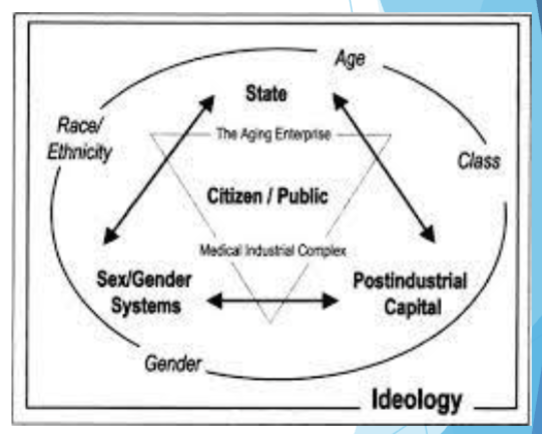
Racism and Sexism are underlying constructs
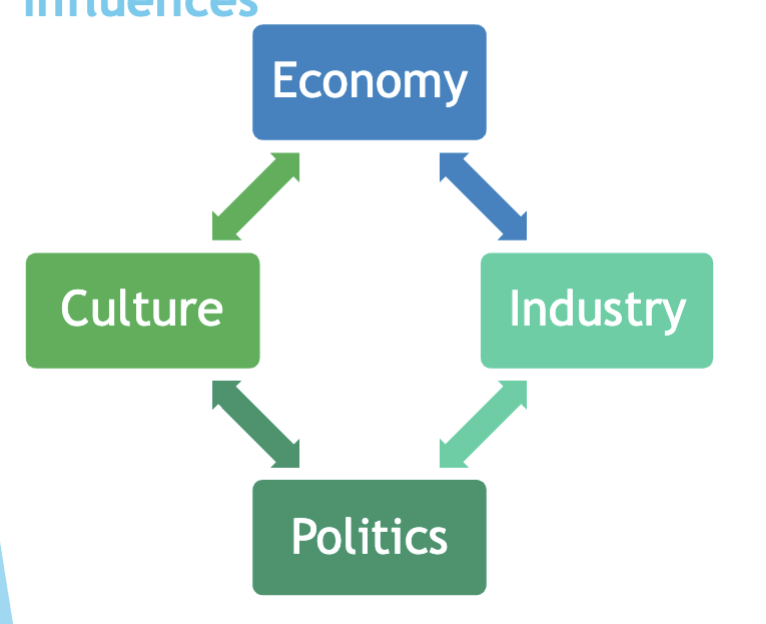
incentive
less ratio equilibrium = smaller salaries
not a lot of support for minority women as CNAs
What relevant cultural/social, financial policy interests contribute to nursing home staffing minimums?
owners
Never construe ______ benefit with patient or staffing benefiti
Ableism
_______ historically has influenced our healthcare system in terms of cultural value/factors
body
You are expected to be productive and produce labor until you age and can no longer do this, then the system commodifies your ______
People
_______ are commodified, some more than others, especially if they are disabled without expectation of recovery/return to baseline
reduce
To extract max profit, there is incentive to ______ expenditure
Cumulative disadvantage
__________ across the lifespan impacts some people more than others
UNJUST
We are in a system that incentivises _______ behavior
“marginalizing characteristics”
Care Workers and older adults/people with disabilities share _________:
lack of acknowledgement/value
impoverished
higher rates of chronic illness
low political and social status
Trauma Informed Care Movement
The ________ evolved from the fact that nursing homes are similar to concentration camps
deconstructed, reconstructed, advocacy
Any system which can be constructed can be ________ and _______ BUT it is dependent on ______
Advocacy
______ is an effort to change individual or group positions, a system’s processes, or policies that are perceived to be flawed, dangerous, unresponsive, unfair or insensitive
corrective, complementary, supplemental, punitive
An advocacy change can be _____, _______, ________, or ________
harm, rights, injustices
The common goal of advocacy is to improve conditions, avoid ____, meet needs, protect ____, defend general interests, or rectify _____
at bedside
as leaders in organization
as leaders in advocacy organizations
as constituents
Where can healthcare practitioners advocate?
structural
Aging is _______ not individual
what does the elder want
what are systems more systematic
when do providers need to call in outside help
is conflict inevitable
what 4 questions should we be asking when participating in elder advocacy
sociopolitical climate
We need to think about the _______ when evaluating an issue, including service provision
BOTH
Advocacy can be (external/internal)
VALUE
when we think about advocacy being internal, we can ______ care work, old age, ability and disability