Market Failure (1.3)
 Call Kai
 Learn
Learn Practice Test
 Spaced Repetition
 Match
Match Flashcards
 Knowt Play
1/43

There's no tags or description
Looks like no tags are added yet.
Name | Mastery | Learn | Test | Matching | Spaced | Call with Kai |
|---|
No analytics yet
Send a link to your students to track their progress
44 Terms
market failure
When the market fails to allocate scarce resources efficiently, causing a loss in social welfare
Three main types of market failure
Externalities
Under-provision of public goods
Information gaps
Externalities
The cost or benefit a third party receives from an economic transaction outside of the market mechanism
Public goods
non-rivalry and non-excludable, meaning that they are under-provided by the private sector due to the free-rider problem. This means the market is unable to ensure that enough of these goods are provided
Examples of public goods
Examples: Streetlights, roads, parks, beaches
Non-rivalry
One person consuming the good does not reduce the amount available to others
Non-excludable
People cannot be prevented from using the good, even if they do not pay
Free-rider problem
When consumers consume a good without paying for it due to the good being non-rivalry and non-excludable
Information gaps
Homo economics is assumed to have perfect information, allowing the making of rational decisions
Firms are assumed to have perfect information on their cost and revenue curves
Governments are assumed to know full costs and benefits of every decision
This is not always the case as economic agents do not always make rational decisions leading to resources not being allocated to maximise welfare
Examples of information gap in consumers
Examples: Consumers do not know the quality of second hand products such as cars, and pension schemes are complex so it is difficult to know which is best.
Private Costs (PC)
Producer’s costs of production
Social Costs (SC)
Private Costs + External Costs
Private Benefits (PB)
Individual consumer benefits upon consumption
External Costs/Benefits
The costs/benefits to a third party not involved in the economic activity.
They are the difference between private costs/benefits and social costs/benefits.
Society surplus
Consumer surplus + Producer surplus
Maximisation of Social benefit
When Marginal Social Benefit (MSB) = Marginal Social costs
When resources perfectly follow consumer demand
Demand = Supply
Externalities diagram
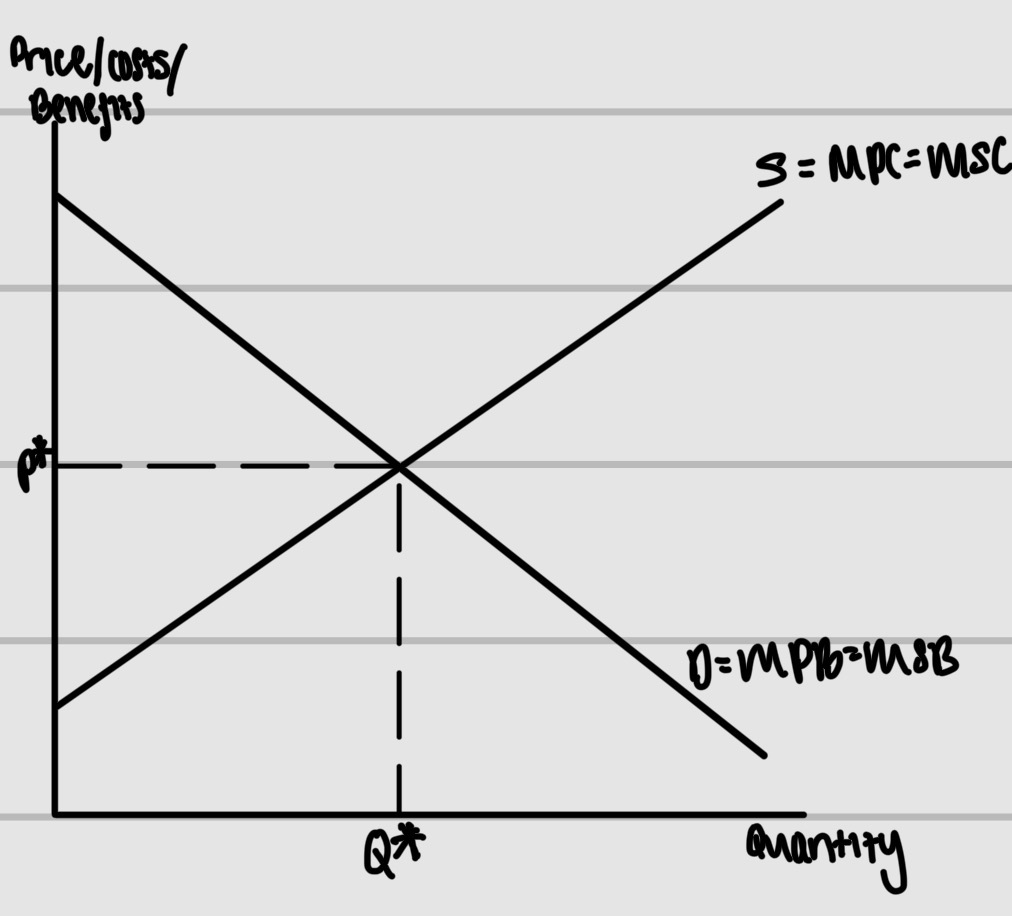
When market equilibrium occurs
When MPC = MPB
When MSC = MSB
Marginal cost/benefit
The extra cost/benefit of producing/consuming one extra unit of the good
Marginal private benefit (MPB)
the extra satisfaction gained by the individual from consuming one more of the good
Marginal social benefit (MSB)
The extra gain to society from the consumption of one more good
Marginal private cost (MPC)
The extra cost to the individual from producing one more of the good
Marginal social cost (MSC)
The extra cost to society from the production of one more good
Assumptions made when discussing externalities
There are many buyers and sellers
Perfect information
No barriers to entry or exit
Firms are profit maximisers and consumers are utility maximisers
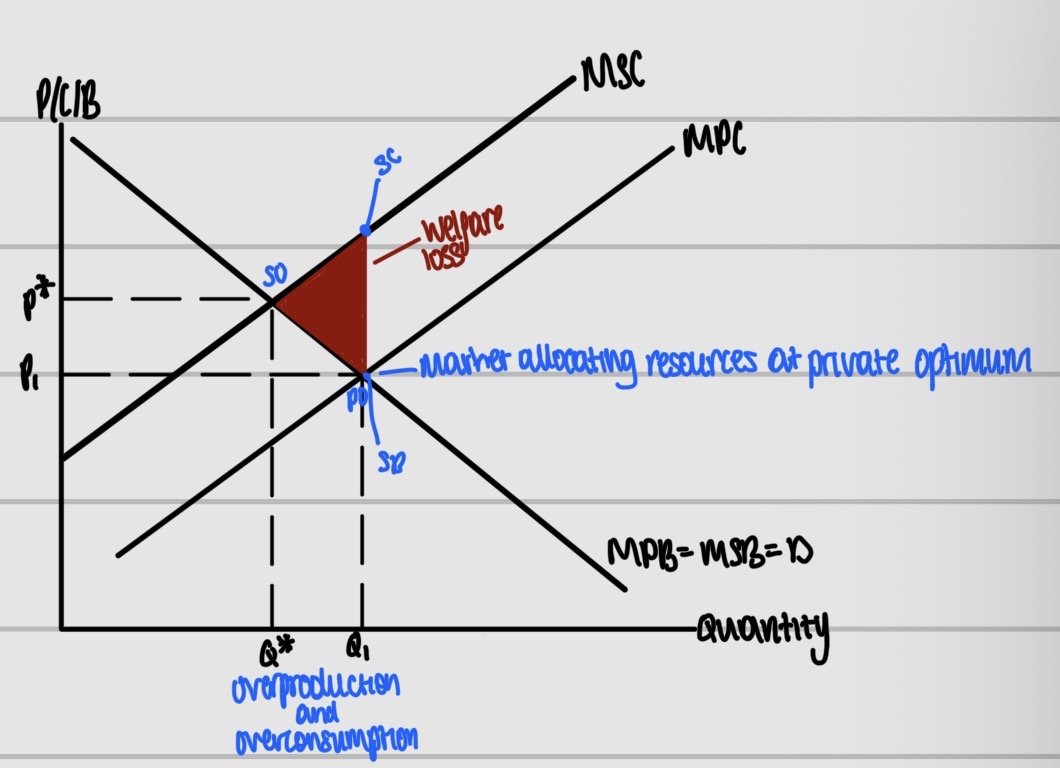
Negative production externalities
Costs to third parties as a result of actions of production
MSC > MPC
Why negative externalities of production occur
Firms ignoring social costs due to self interest - only considering their private cost
Overproduction/consumption
Price too low
Misallocation of resources
Examples of negative externalities of production
Air pollution
Resource depletion
Resource degradation
Deforestation
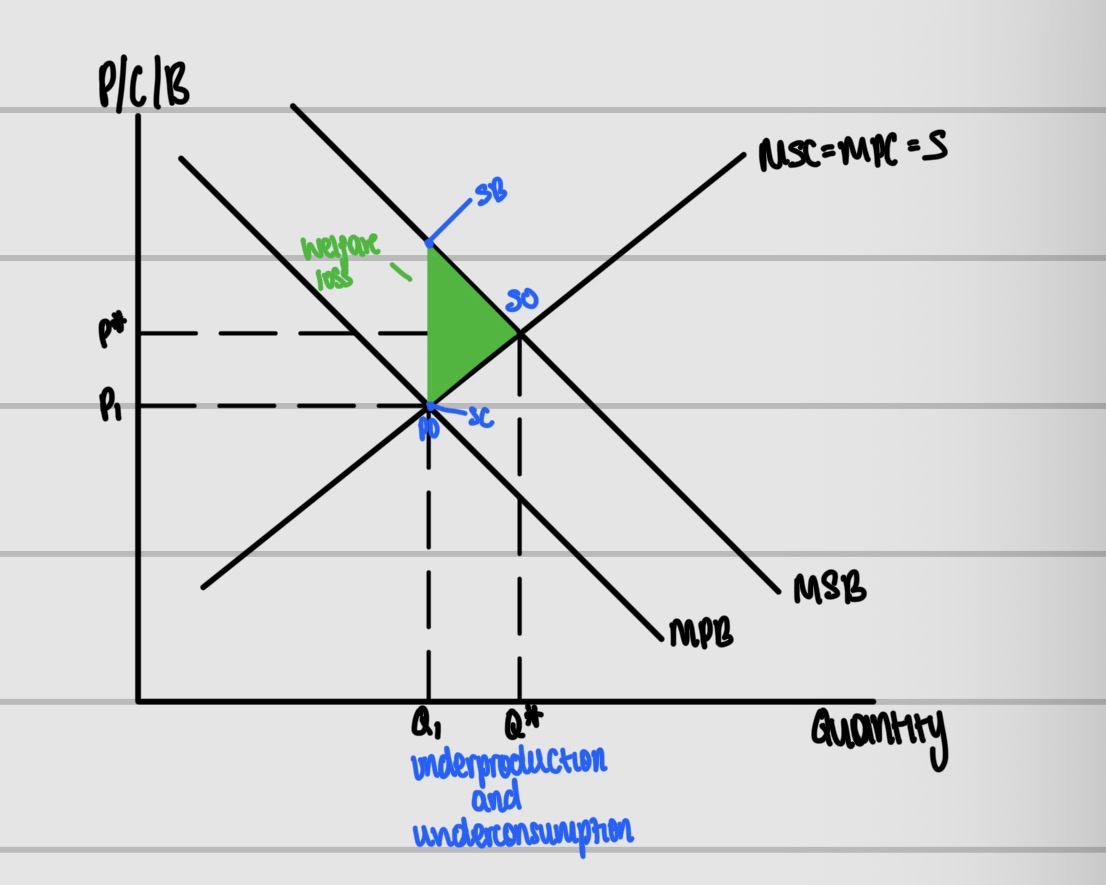
Positive consumption externalities
Benefits to third parties as a result of the actions of consumers
MSB > MPB
Why positive externalities of consumpi
Consumers ignoring full social benefit due to self interest - only considering private benefits
Underproduction/consumption
Misallocation of resources
Examples of private consumption externalities
Healthcare, education, exercise, healthy eating
Gov. Intervention - Indirect taxes and subsidies
Placed on goods with negative externalities. This internalises the externalities , moving production closer to the social optimum
Gov. Intervention - Tradable pollution permits (TPPs)
Allow for firms to produce up to a certain amount of pollution
Can be traded amongst firms so gives them choice while reducing the total level of pollution
Negative production externality diagram
Positive externality of consumption diagram
Government interventions to tackle externalities
Indirect taxes and subsidies
Tradable pollution permits (TPPs)
Provision of the good
Provision of information
Regulation
Gov. Intervention - Provision of the good
When SB are very high the government may decide to provide the good through taxation. e.g education and healthcare
Gov. Intervention - provision of information
Some externalities are associated with information gaps, thus, the government can provide information to help people make informed decisions and acknowledge external costs
Gov. Intervention - regulation
Could limit the consumption of goods with negative externalities. e.g. banning advertising of smoking
Quasi-public goods
Are not properly non-rivalry and non-excludable but aren’t perfectly rivalry or excludable
Example of quasi-public goods
Roads as they are semi-excludable due to tolls. They are also semi-rivalry as people don’t ‘use up’ the roads.
Symmetric information
Occurs where buyers and sellers have potential access to the same information (perfect information)
Asymmetric information
When one party has superior knowledge compared to another
The seller may have more information that the buyer meaning that they can take advantage of the other party’s lack of knowledge
How information gaps lead to market failures
There is a misallocation of resources as people do not buy things that maximise welfare