Ramesh Unit 3 BIOL 2312
 Call Kai
 Learn
Learn Practice Test
 Spaced Repetition
 Match
Match Flashcards
 Knowt Play
1/80

There's no tags or description
Looks like no tags are added yet.
Name | Mastery | Learn | Test | Matching | Spaced | Call with Kai |
|---|
No analytics yet
Send a link to your students to track their progress
81 Terms
In a closed circulatory system, hemolymph is confined to specific vessels separate from the Interstitial fluid. True or False?
False
2 multiple choice options
Amphibians have a 4-chambered heart. True or False?
False
2 multiple choice options
The formed elements of blood are _____________, ____________ and _______________.
Erythrocytes, RBCs and platelets
The collective name for the cellular portion of the total blood volume is referred to as the _____________.
Hematocrit
The plasma proteins are synthesized in which organ?
Liver
3 multiple choice options
The plasma protein _________ is essential for maintaining osmotic balance and pH buffering.
albumin
The plasma protein ___________ is involved in transporting lipids and cholesterol.
globulin
The plasma protein essential for blood clotting is _________________.
fibrinogen
Erythrocytes are formed from which stem cell lineage?
Myeloid stem cells
3 multiple choice options
During blood cell formation, lymphoid stem cells differentiate into ________ and ________.
T-lymphocytes and B-lymphocytes
In adult mammals, blood cells are formed in the ________________ .
bone marrow
Erythrocytes generate ATP by the process of ____________.
Glycolysis
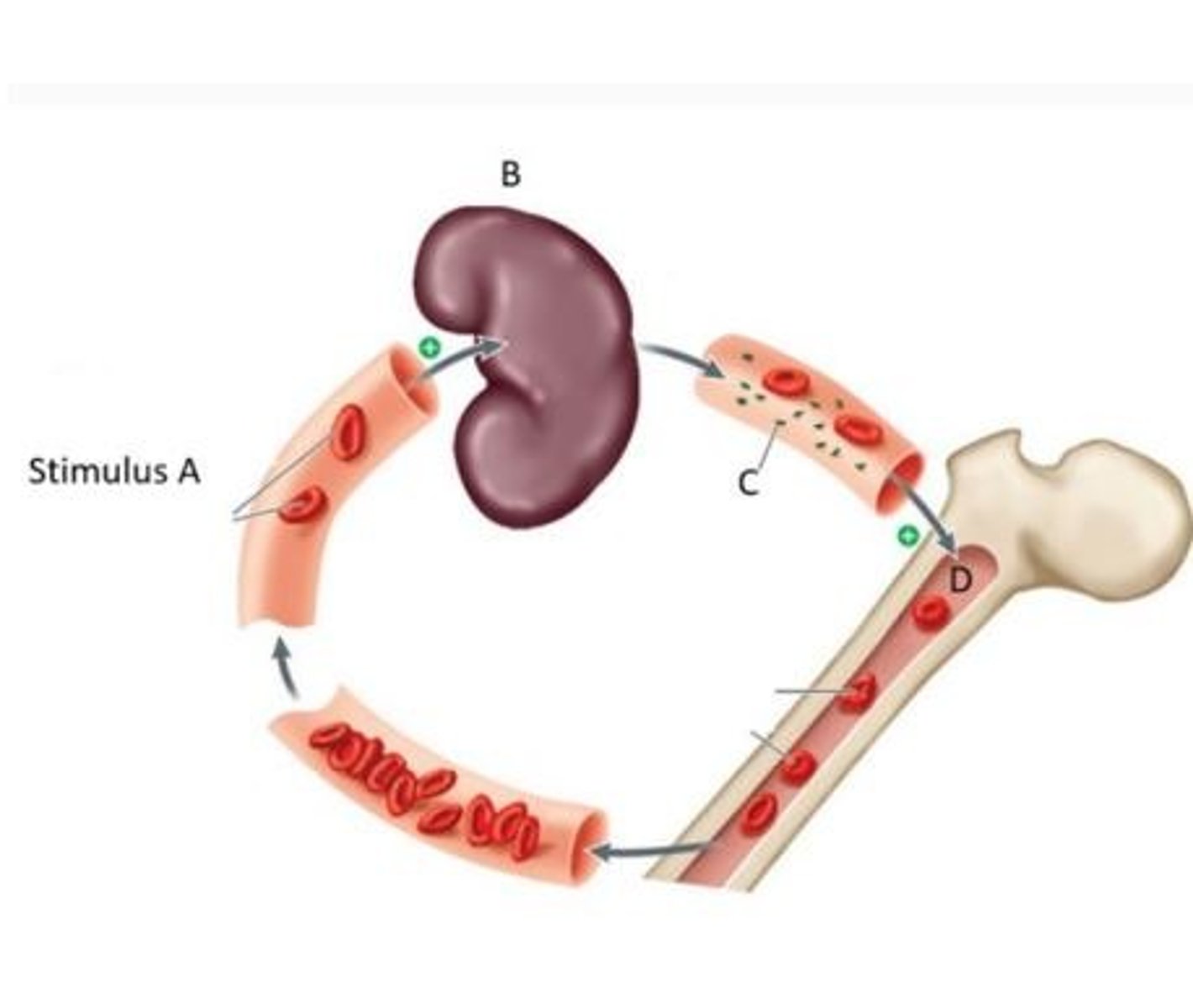
1. What is stimulus A? Low oxygen level in blood or oxygen carrying capacity drops below normal
2. What is the primary function or primary role of organ B? Osmoregulation (Organ B is kidney)
3. What is substance C? Erythropoietin (Do not use acronym EPO)
4. What is tissue D? Bone marrow
5. What is the action of substance C? Stimulates the production of new erythrocytes
6. What type of a feedback mechanism does the process shown in this figure indicate? Negative Feedback mechanism
1. What is stimulus A?
2. What is the primary function or primary role of organ B? 3. What is substance C?
4. What is tissue D?
5. What is the action of substance C?
6. What type of a feedback mechanism does the process shown in this figure indicate?
Human blood groups are determined by ________, the ____________of glycoproteins on erythrocyte membrane.
antigens, carbohydrate groups
All veins carry deoxygenated blood except the _______________.
All arteries carry oxygenated blood except the _______________.
pulmonary vein, pulmonary artery
The blood vessel that supplies the heart is the ______________ .
Coronary artery
1. Aorta
2. Superior vena cava
3. Inferior vena cava
4. Pulmonary artery
5. Pulmonary vein
6. Semilunar valve
Match the word and definition
A. Between ventricle and aorta
B. Carries oxygenated blood to the left atrium
C. Carries blood to all parts of body
D. Conveys blood from abdominal organs and hindlimbs to heart
E. Conveys blood from head and forelimbs to heart
F. Carries deoxygenated blood from right ventricle
6. A. Between ventricle and aorta
5. B. Carries oxygenated blood to the left atrium
1. C. Carries blood to all parts of body
3. D. Conveys blood from abdominal organs and hindlimbs to heart
2. E. Conveys blood from head and forelimbs to heart
4. F. Carries deoxygenated blood from right ventricle
The first heart sound "lub" is produced by the closure of the ____ valves.
AV valves (mitral and tricuspid) during the systole
The second heart sound "dub" is produced by the closure of the ____ valves.
Aortic and pulmonary semilunar valves in diastole
The main function of the heart valves is to _______________.
Prevent backflow of blood
Hearts that beat under the control of action potentials that arise in the nervous system are called ___________. Where as, hearts that maintain contractile activity autonomously are called _____________.
neurogenic hearts, myogenic hearts
The ____________ consists of specialized cardiomyocytes that generates electrical impulses that set the rhythm and rate of the heart, and therefore called to have a _____________ function of the heart.
Sinoatrial node, pacemaker
The SA node is located in the ___________ and the AV node is located in the _____________.
right atrium, interatrial septum
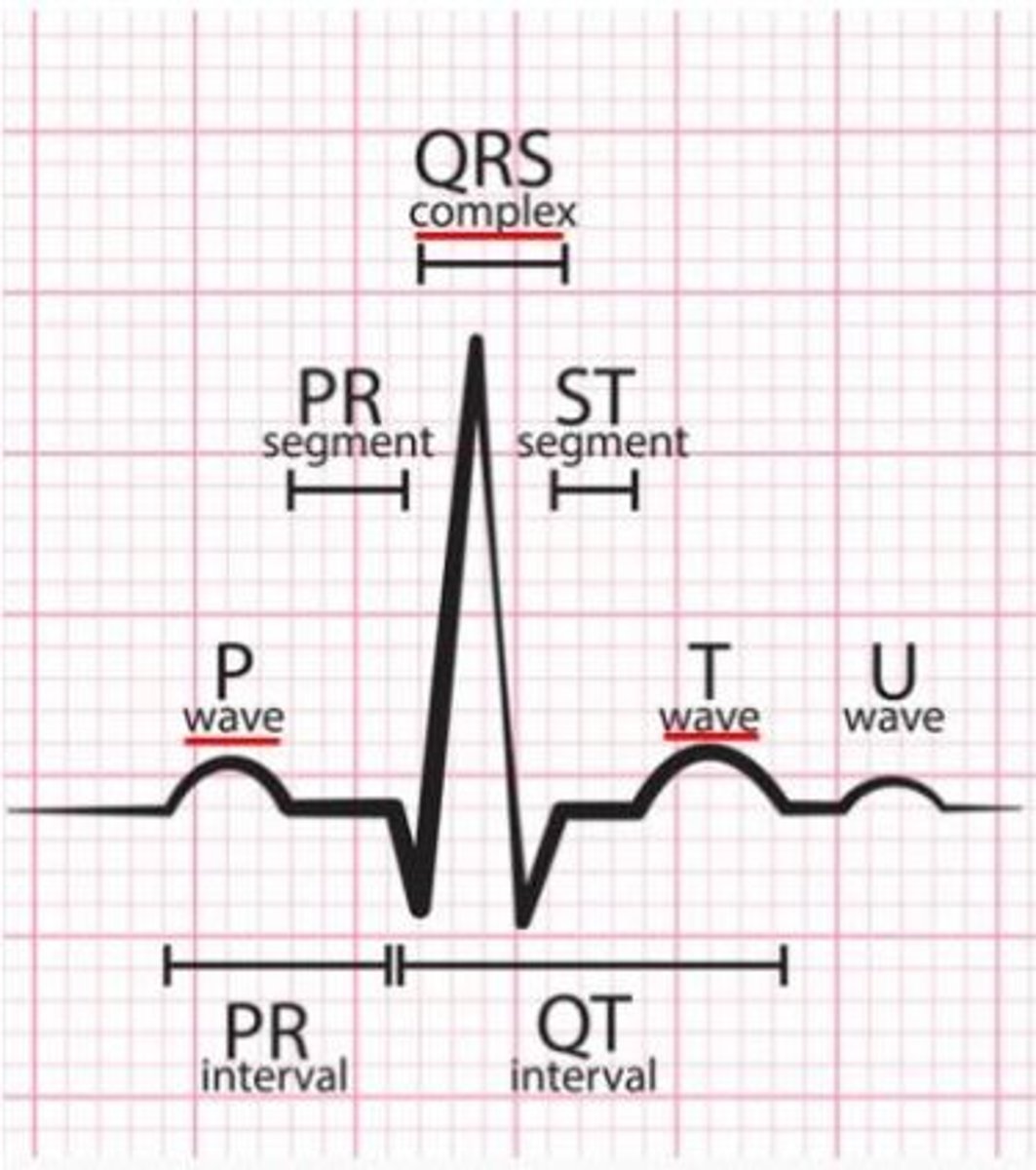
What does this figure represent? A normal ECG.
Name the event that happens during the P-wave? Atrial depolarization.
Name the event that happens during the QRS complex? Ventricular depolarization.
What does this figure represent?
Name the event that happens during the P-wave?
Name the event that happens during the QRS complex?
The technique used to detect the electrical signals of the heart is called the
_____________.
Electrocardiogram
The period of ventricular contraction is called systole and the period of ventricular relaxation and filling is called diastole. True or False?
True
2 multiple choice options
Blood pressure is measured using an instrument called _________________ .
Sphygmomanometer
What is the generally accepted method of representing and reporting blood pressure?
Systolic pressure/diastolic pressure.
BP is always represented as Systolic/Diastolic (and it is called as systolic over diastolic).
The QRS complex in an ECG represents the spread of a ______________ wave in the _________________ tissue.
depolarization, ventricular
Correct order of branching of blood vessels
Arteries—arterioles—capillaries—venules—larger veins-smaller veins
3 multiple choice options
Blood flow through capillaries is regulated by a small ring of ___________ called the _____________.
smooth muscle, precapillary sphincter
Exchange of gases, nutrients and wastes between the blood and the tissues occurs at the level of _____________.
Capillaries
3 multiple choice options
The blood pressure in systemic circuit is highest in arteries and lowest in capillaries. True or False?
False
2 multiple choice options
The compression/contraction of __________________ and the presence of ________________ in the veins permit the blood flow towards the heart.
skeletal muscles, one-way valves
The blockage of arteries by plaques in the brain causes __________ leading to the cause of critical brain function.
stroke
What type of tissue constitutes the endothelium?
Simple squamous epithelium
______________ respiration occurs in the cell organelle ________________which produce(s) ATP from energy-rich molecules.
Cellular respiration, mitochondrion/mitochondria
Gas exchange across respiratory surface occurs by the process of ____________ .
Simple Diffusion
What are the two main structural properties of a respiratory surface that facilitates simple diffusion?
1. Presence of thin epithelium at the respiratory surface
2. Large surface area
The two primary evolutionary adaptations that help maintain the concentration differences between gases outside and inside the respiratory surface are ______________________ and ____________________.
Ventilation and perfusion
3 multiple choice options
Define countercurrent exchange
In countercurrent exchange, water flows over the gills in a direction that is opposite to the flow of the blood under the respiratory surface.
Give an advantage of counter current exchange mechanism
1. Because this process removes 80%-90% of oxygen content in water, it is highly efficient in removal of oxygen from water because of the much lower oxygen content in water.
2. Counter current exchange maintains a favorable concentration gradient across the entire exchange surface.
Insects breathe through a ____________ system and the air enters the ____________ via opening in the chitinous exoskeleton known as ______________.
tracheal system, tracheae, spiracles.
Amphibians use a positive pressure breathing. True or False?
True
2 multiple choice options
1. External gills
2. Internal gills
3. Tracheoles
4. Positive pressure breathing
5. Parabronchi
Match the following with the correct options
A. Insects
B. Amphibians
C. Birds
D. Bony fish
E. Aquatic insects
F. Lungs
G. Trachea
3. A. Insects
4. B. Amphibians
5. C. Birds
2. D. Bony fish
1. E. Aquatic insects
F. Lungs
G. Trachea
The trachea in mammals branches into _______.
Bronchi
During normal inhalation the expansion of lungs is achieved by the contraction of ______________ and _______________ muscles.
diaphragm, external intercostal
The volume of air that is entering and leaving the lungs during normal inspiration and expiration is called the ____________.
Tidal volume
The amount of air that remains in the lungs even after forceful exhalation is called the ___________.
Residual volume
1. Pons
2. Dorsal respiratory group
3. Ventral respiratory group
4. Peripheral chemoreceptors
5. Automated control
6. Partial pressure
Match the following with the correct options
A. Stimulate active expiration during forced breathing
B. Monitor the oxygen level in arterial blood and signal the inspiratory groups to increase the breathing rate
C. When they fire, they stimulate muscles of inspiration
D. Constriction of blood vessel smooth muscles to increase time to pick up more oxygen
E. Concentration gradient allowing for gas exchange during respiration
F. Modulates medullary neuronal groups
3. A. Stimulate active expiration during forced breathing
4. B. Monitor the oxygen level in arterial blood and signal the inspiratory groups to increase the breathing rate
2. C. When they fire, they stimulate muscles of inspiration
5. D. Constriction of blood vessel smooth muscles to increase time to pick up more oxygen
6. E. Concentration gradient allowing for gas exchange during respiration
1. F. Modulates medullary neuronal groups
The proportion of any gas 'X' in air is 10%. What is its partial pressure? Include unit of partial pressure also. (only partial credit without units).
76 atmospheres/76 atm
The proportion of a gas 'X' in air is 15%. Calculate its partial pressure?
114 atmospheres/114 atm
What is Bohr's effect?
The reduced affinity of Hb for oxygen at low pH is called Bohr Effect
Tissues that are actively undergoing metabolism have lowered pH(due to the formation of carbonic acid, pH 7.2). Lowered pH leads to conformational change in hemoglobin which lowers the binding capacity of hemoglobin, which is referred to as Bohr's effect.
The total solute concentration of a solution is called its ________. It is measured in _______.
Osmolarity, Osmoles
Name the three main types nitrogenous breakdown products of metabolism.
urea, uric acid and ammonia
1. Which is the most toxic form of excretory product?
2. Which category of organisms can you find ammonia as the excretory product?
1. Ammonia
2. Ammonia is the most preferred excretory product in animals living in plentiful supply of water. (Aquatic organisms).
The blood vessel that carries blood to the kidneys is ________.
Renal artery
The mammalian kidney is divided into two portions. An outer __________ and an inner ___________.
Renal cortex; renal medulla
The specialized excretory tubules, nephrons are found in __________ (invertebrates or vertebrates).
Vertebrates
1. Metanephridia
2. Protonephridia
3. Malphigian tubules
4. Nephron
5. Marine invertebrates
Match the Term with option
A. Osmoconformers
B. Bowman's capsule
C. Flame cells
D. Arthropods
E. Annelids
E 1. Metanephridia
C 2. Protonephridia
D 3. Malphigian tubules
B 4. Nephron
A 5. Marine invertebrates
The first step in urine formation is __________.
Glomerular filtration
During the first step in urine formation, the plasma gets filtered through the glomerular capillaries into _______________.
Bowman's capsule
What are aquaporins?
Aquaporins are transport proteins that form passageways for water molecule in transport epithelium.
Name one place in the nephron where aquaporins are present?
Proximal convoluted tubule, OR Descending segment of loop of Henle, OR Distal convoluted tubule, OR collecting ducts.
Name one place in the nephron where aquaporins are absent?
Ascending segment of the loop of Henle.
The tube or conduit through which urine is emptied from the urinary bladder is called the __________.
urethra
What are chloride cells? Give an example where chloride cells are found?
Chloride cells are specialized cells in the gills of marine teleosts involved in actively transporting chloride, sodium and potassium ions.
What are salt glands? Give one example where salt glands are found.
Salt glands specialized glands found in the heads of reptiles and birds living around sea water. These are involved in excreting excess salt
Name the four mechanisms of heat exchange?
Conduction, convection, radiation, evaporation.
▪ Name the primary layers of skin.
Epidermis, dermis and hypodermis
Give 2 functions of collagen fibers in dermis.
Collagen fibers support your skin's overall structure, as well as allow it to move and stretch (Resist compression, tearing, and puncture of the skin).
The process of _______ is the transfer of heat from a body to a fluid that passes over its surface
Convection
The tube through which urine leaves the urinary bladder is called the ____
urethra
The osmolarity of the tubular fluid as it enters the proximal convoluted tubule is _____ mosm/L
300
Molecules and ions reabsorbed from the nephron reenter the blood at the _______ __________
Pertibular Capillaries
Name the region in the kidney tubule where aquaporins are absent
Ascending thick limb of the loop of Henle
The ____ components of blood are involved in the formation of clots
fibrinogen and platelets
In humans, blood cells are produced in the _____
bone marrow
An open circulatory system _______
mixes hemolymph and interstitial fluids together
Erythroprotein a hormone that stimulates stem cells in the bone marrow to increase erythrocytes is found where
bone marrow
The _____ carries oxygenated blood
pulmonary vein