Regression Analysis
 Call Kai
 Learn
Learn Practice Test
 Spaced Repetition
 Match
Match Flashcards
 Knowt Play
1/20

Earn XP
Description and Tags
MKTG 3260
Name | Mastery | Learn | Test | Matching | Spaced | Call with Kai |
|---|
No analytics yet
Send a link to your students to track their progress
21 Terms
Regression Analysis
technique in which one or more variables are
used to predict the level of another by use of the straight-line formula
Bivariate Regression
only two variables are being analyzed, and
researchers sometimes refer to this case as “simple regression”
Multiple Regression
more than one IV are used to predict a single DV
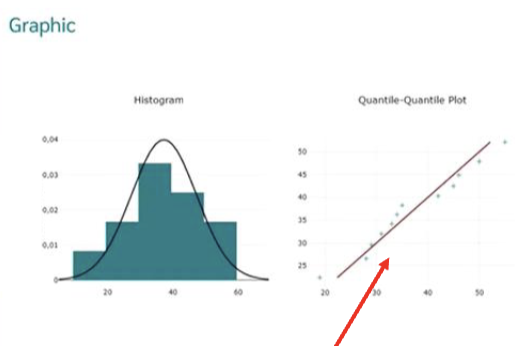
The closer the points are to the line…
the more normally distributed the data is
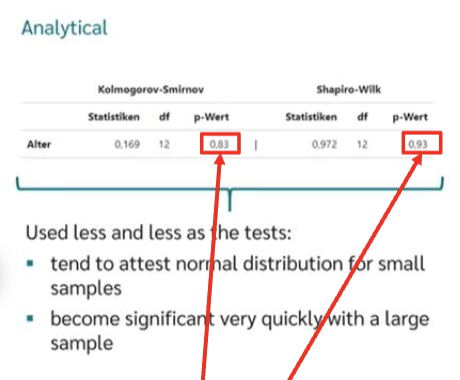
The p-value is greater than 0.05 then..
there is no deviation from the normal distribution
Intercept
the constant, or a, in the straight-line relationship that is the value of y when x equals to 0
Slope
the b, or the amount of change in y for a one-unit change in x
DV
y, the variable that is being estimated by the x(s) or IVs
IV
the x variable(s) used in the straight-line equation to estimate y
Least squares criterion
a procedure that assures that the computed regression equation is the best one possible for the data being used
R square
a number ranging from 0 to 1 that reveals how well the straight- line model fits the scatter of data points, the higher, the better. Below .25 is bad
Adjusted R Squared
for the number of IVs and the sample size; the higher, the better
Independence assumption
a statistical requirement that when more than one x variable is used, no pair of x variables has a high correlation
Multicollinearity
2 or more predictors correlate strongly with each other (= violation of the independence assumption that causes regression results to be in error)
Variance Inflation Factor (VIF)
identifies that x variables contribute to multicollinearity and should be removed from the analysis to eliminate it. Any variable with a ____ if 10 or greater should be removed
Multiple R
also called the coeffience of determination, a number that ranges from 0 to 1 that indicates the strength of the overall linear relationship in a multiple regression: the higher the better
Trimming
process of iteratively removing x variables in multiple regression which are not statistically significant, rerunning the regression, and repeating until all the remaining x variables are significant
Beta coefficients and standardized beta coefficients
are the slopes (b values) determined by multiple regression for each IV x. These are standardized to range from .00 to .99, so they can be compared directly to determine their relative importance in y's prediction
Dummy Variable
use of an x variable that has a 0, 1 or similar nominal coding.
Stepwise multiple regression
appropriate when there is a large number of IVs that need to be trimmed down to a small, significant set and the researcher wishes the statistical program to do this automatically
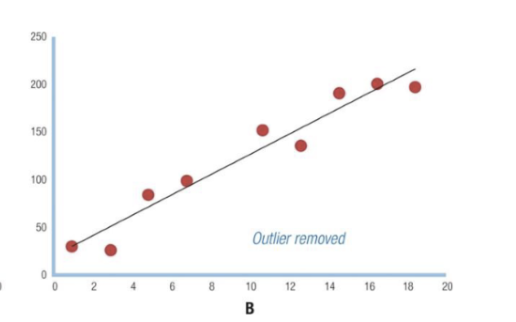
Removing outliers…
can improve regression results. Often identified as mean +/- 2 s.d.