(3) The behavioural approach to explaining Phobias
 Call Kai
 Learn
Learn Practice Test
 Spaced Repetition
 Match
Match Flashcards
 Knowt Play
1/10

There's no tags or description
Looks like no tags are added yet.
Name | Mastery | Learn | Test | Matching | Spaced | Call with Kai |
|---|
No analytics yet
Send a link to your students to track their progress
11 Terms
What is the two process model?
Mowrer (1960) proposed that phobias are learned/initiated and then maintained by two different processes. They are learned/initiated via classical conditioning, and then maintained through operant conditioning.
What is classical conditioning in terms of Phobias?
Initiation of a phobia
How does Watson and Ryan’s experiment represent classical conditioning?
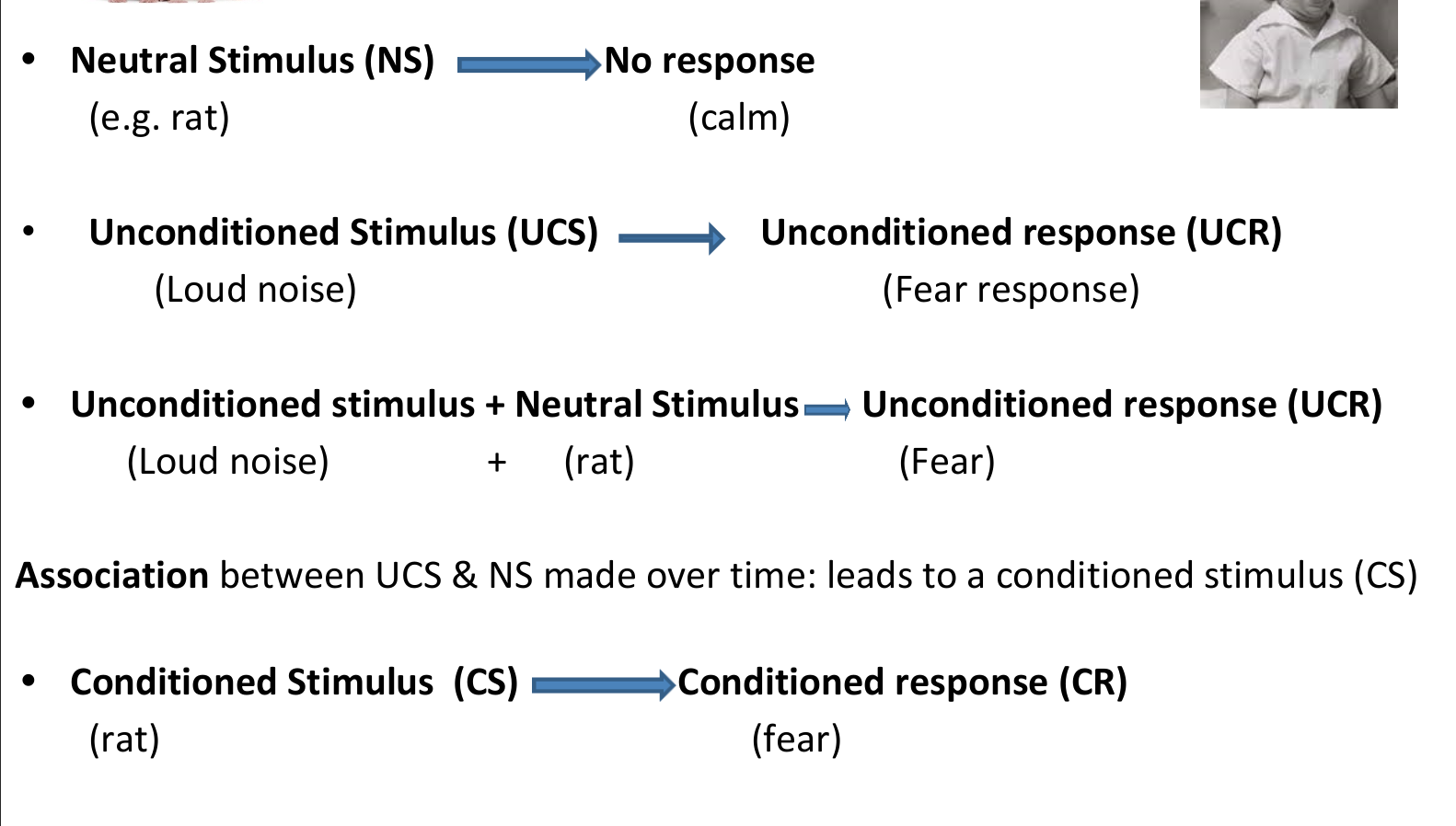
What is stimulus generalisation?
People are also wary of other similar things.
What is extinction of an object?
If an object is now a phobic stimulus caused by a negative association through classical conditioning. It will remain so for some time, but this association is not permanent. Over time, with repeated exposure to the phobic stimulus, without the negative UCS present, this association will deteriorate and eventually become extinct.
What is operant conditioning in terms of Phobias?
Maintenance of a Phobia
What is negative reinforcement?
removing an unwanted negative state. (e.g. removal of being ignored, removal of fear). Leads to maintenance or increase of behaviour.
How does negative reinforcement prevent the extinction of a phobia (maintain it)?
An individual learns that avoiding their feared object completely is rewarding, so continues to do so, and therefore they would prevent extinction of the fear – so maintain the phobia long term.
Evaluation of the two process model: Falsifiable model
The Behavioural model allows clear predictions. to be made that can be measured scientifically (mostly laboratory evidence). It is therefore a scientific, falsifiable model which adds credibility to the theory.
Evaluation of the two process model: Little Albert
Support from Little Albert increasing the validity of the theory
Evaluation of the two process model: I/D
The behaviourist model is reductionist, seeing behaviour as purely a result of conditioning, reducing the explanation to simple terms.
Phobia cases could be more complex than this and to involve biological (heritability), psychodynamic (trauma) or cognitive (irrational beliefs) elements.
An interaction with a more holist view (involving more of these explanations) may be a more valid explanation of phobia acquisition.