phy ch3 definition
 Call Kai
 Learn
Learn Practice Test
 Spaced Repetition
 Match
Match Flashcards
 Knowt Play
1/13

There's no tags or description
Looks like no tags are added yet.
Name | Mastery | Learn | Test | Matching | Spaced | Call with Kai |
|---|
No analytics yet
Send a link to your students to track their progress
14 Terms
difference between hydrodynamics and hydrostatic.
the study of the flow of liquid is called hydrodynamics, whereas hydrostatic is the study of liquid at rest.
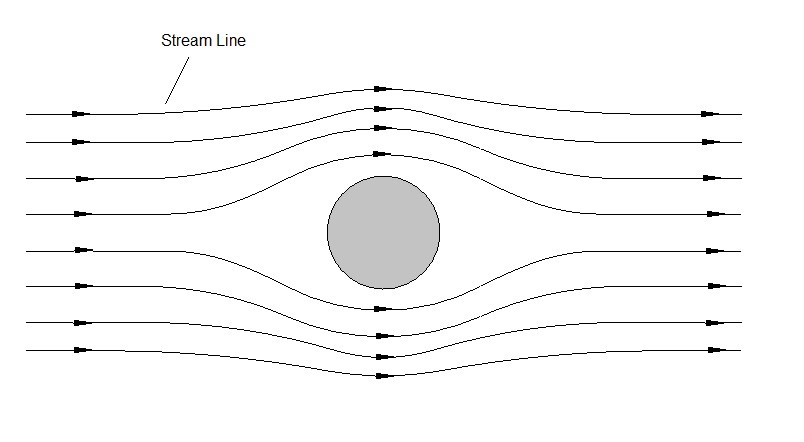
what is streamline?
in the flow of fluids, the path or flow of the fluid particles is called streamline.
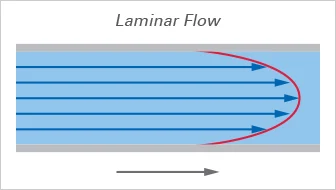
how do you understand laminar flow?
if fluid particles are moving steady in smooth paths in layers, with each layer moving smoothly past the adjacent layers with no mixing; such a flow is called laminar flow.
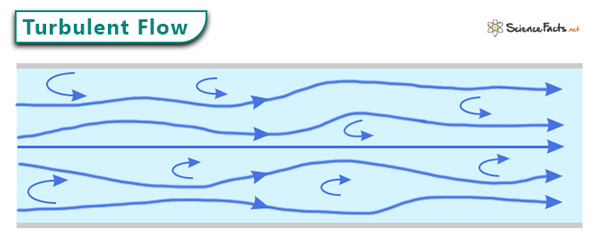
how do you understand turbulent flow?
if the flow or path of the fluid particles are irregular, their direction is always changing or whirling; this fluid movement is called turbulent flow.
how do you understand Ideal laminar fluid flow?
the fluid is incompressible.
the flow has no friction or friction is neglected. (Internal friction in fluids is called viscosity; and hence, zero viscosity.
the fluid flow is laminar (steady) and turbulent flow is not taken into account. (For example, sea breeze is a laminar flow and storm is a turbulent flow.)
Bernoulli’s theorem
Bernoulli’s theorem states that the sum of pressure energy, kinetic energy and potential energy per unit volume of an incompressible, non-viscous fluid in a streamlined laminar flow remains constant
what is viscosity?
The resistance to fluid motion (or) internal resistance of fluid is called viscosity.
Newton’s law of viscosity
Newton’s law of viscosity states that the shear stress between the two adjacent layers of fluid is directly proportional to the negative value of the velocity gradient between the same two adjacent fluid layers.
defined viscosity (coefficient of viscosity)
Viscosity is defined as the ratio of shearing stress to the velocity gradient.
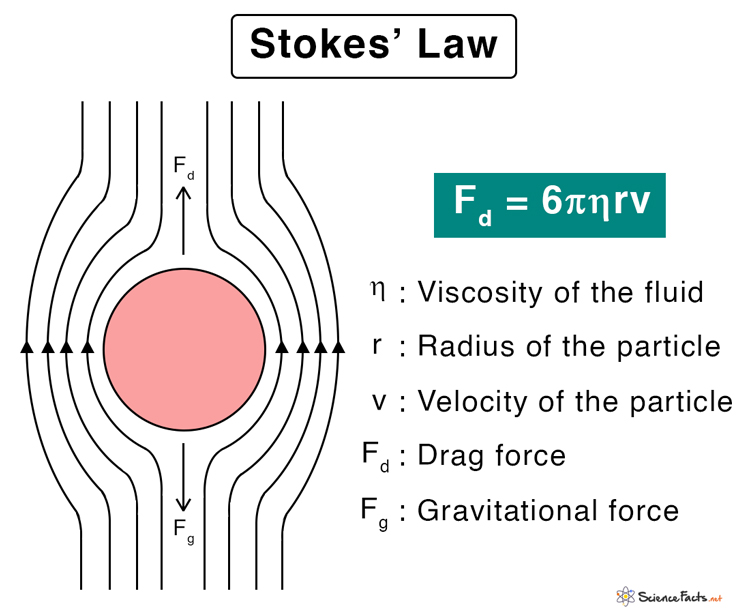
stokes’ law
Stokes’ law states that the drag force F acting upward in resistance to the fall of a spherical object in a viscous liquid is
what is surface tension?
Surface tension is the tendency of the surface of a liquid to behave like a stretched elastic skin (or membrane).
defined surface tension.
Surface tension is defined as the force per unit length that acts across any line on a surface tending to pull the surface apart.
where F = force, l = length, r = surface tension
The SI unit of surface tension is newton per metre ( Nm-1 )
what is capillary action?
Capillary action is defined as the spontaneous flow of a liquid into a narrow tube or porous material.
what are cohesion and adhesion? Difference between them.
Cohesion and adhesion are two types of intermolecular forces. Cohesion refers to forces between molecules of same substance; whereas, adhesion refers to forces between molecules of different substances.