Midterm Physical Assessment
 Call Kai
 Learn
Learn Practice Test
 Spaced Repetition
 Match
Match Flashcards
 Knowt Play
1/15

There's no tags or description
Looks like no tags are added yet.
Name | Mastery | Learn | Test | Matching | Spaced | Call with Kai |
|---|
No analytics yet
Send a link to your students to track their progress
16 Terms
introduction
Hi my name is Caitlin I will be your nurse.
- hand hygeine
patient identification
explain what you are doing
inspect
symmetry, skin color appropriate
patient is awake and alert and relaxed, making eye contact
scalp and hair
even hair distribution and volume
scalp is mobile
tempromandibular joint
palpate
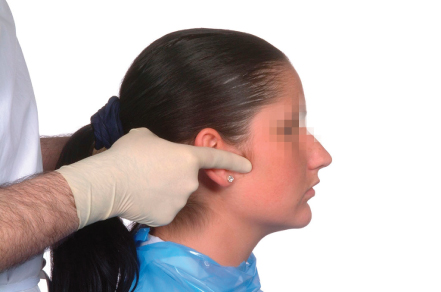
frontal and maxillary sinuses + facial bones
lacrimal glands
on forehead and below eyes
below eyebrows
inspect eyes, brows, sclerae
mouth
inspect oral mucosa (cheeks, teeth, gums)
tonsils : +1 normal, describe palate and pillars
check bite
mouth cranial nerves
smile and puff out cheeks (CNVII - facial)
stick out tongue, move side to side (CNXII - hypoglossal)
say Ah (CNIX and CNX - glossopharyngeal and vagus)
neck
ROM - 4 directions, 2 directions with resistance
shoulder shrug with resistance (CNXI - accessory)
lymph nodes
preauricular (front ear), postauricular (behind ear), occipital (below ear in back), tonsillar, submandibular (jaw), submental (chin), superficial cervical (right under jaw in front of jugular), posterior (neck spinal chain) and deep cervical (below jugular), supraclavicular (deep spot above collarbone), infraclavicular (under clavicle, next to armpit)
trachea + thyroid
trachea is midline
thyroid:
Stand directly behind the sitting patient.
Ask them to tilt their head slightly forward and down to relax the neck muscles (sternocleidomastoid muscles).
Place the finger pads of both your hands on the front of the patient's neck.
Locate the cricoid cartilage (the firm ring of cartilage just below the thyroid cartilage / Adam's apple). The thyroid gland sits just beneath this ring.
To check the right lobe: Use your left hand fingers to gently push the trachea (windpipe) slightly to the patient's right. This pushes the right thyroid lobe out so it is easier to feel. Place your right hand fingers just out from the windpipe and feel for the tissue.
To check the left lobe: Do the opposite. Use your right hand fingers to gently push the trachea to the patient's left, and use your left hand fingers to feel the left lobe.
ask patient to swallow
face sensation
CNV - trigeminal
Test light touch sensation- forehead, cheeks, chin
ears
Inspect and palpate the auricles (tragus, mastoid and pull helix forward)
Inspect the external auditory canals and tympanic membranes with otoscope (describe)
pearly gray, cone of light R 5o’clock L 7o’clock
evaluate hearing
whisper test
rinne - side of ear (normal air > bone)
abnormal: sensorineual is air > bone. conductive is bone > air
weber - top of head (same in both ears)
abnormal: hear more in affected ear conductive. hear more in normal ear sensorineural
takes care of CNVIII - vestibulococlear (auditory)
nose
look in nostril with light
findings: striaght septum, pink moist mucosa, intact turbinate tissue
sense of smell with coffee or whatever (CN1 - olfactory)
eyes
start with snellen
penlight : accomodation and light reflex
corneal light reflex - the sparkle in your eye
eyes cranial nerves
EOM - CNIII, CNIV, CNVI - oculomotor, trochlear, abducens
peripheral vision and retina inspection with the red reflex - CNII - optic