3: Viruses & Bacteriophages
 Call Kai
 Learn
Learn Practice Test
 Spaced Repetition
 Match
Match Flashcards
 Knowt Play
1/63

There's no tags or description
Looks like no tags are added yet.
Name | Mastery | Learn | Test | Matching | Spaced | Call with Kai | Chat |
|---|
No analytics yet
Send a link to your students to track their progress
64 Terms
What are viruses?
intracellular obligate parasites
What do viruses need to replciate?
Host cell (thus “obligate”)
Why refer to viruses as “intracellular”?
Once inside a host cell, host cell enzymes will be used to the benefit of the virus during the processes of viral replication, protein synthesis, and assembly
Why refer to viruses as “parasite”?
the host cell can undergo damage and, in some cases, complete destruction via cell lysi
What are the different states of viruses?
Intracellular —> virus
Extraceullar —> virion
also considered mobile genetic elements
What kind of genome do viruses have?
DNA or RNA
What early evidence was there of viral diseases?
Smallpox in ancient Egypt.
Smallpox is the only human virus thats been eradicated off of earth
What expeirment disovered viruses and virology?
In late 1800s when researchers studying a plant disease of the tobacco discovered that infectious particles could pass through filter systems that would normally trap bacteria. (the filter is called a Pasteur-Chamberland filter).
These earlier results were initially obtained by Dimitri Ivanovski and subsequently by Martinus Beijerinick.
In 1901, Walter Reed showed that a human disease, yellow fever, was caused by a virus transmitted by mosquitoes
What does a virus consist of?
Nucleic acid
DNA/RNA, ds or ss
Capsid (protein coat)
shields genome from environment (UV/pH)
made of multiple capsomere (repeating globular proteins)
Envelope (sometimes)
plasma membrane (lipid membrane from host cell plasma membrane)
with envelope = enveloped
no envelope = naked
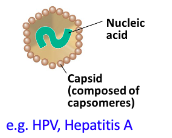
What are some examples of naked viruses?
What are some examples of enveloped viruses?
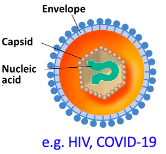
What is a nucleocapsid?
Nucleic acid + capsid
What determines the shapes of viruses?
organization of capsid protein coat
What are some examples of different virus shapes?
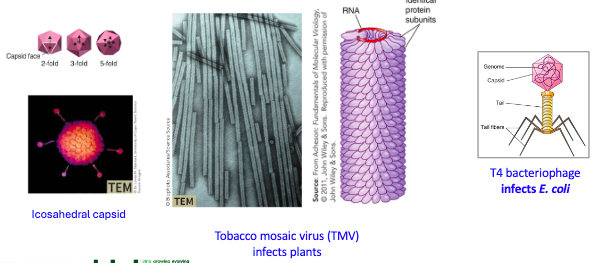
icosahedral > geometric pattern, 2-fold, 3-fold, and 5-fold symmetry
helical/tubular structure (TMV)
bacteriophages (T4) . complex icosahedral head and tail apparatus
What size are viruses?
Vary. usually between 10-100nm.
What are some examples of very small viruses with small genomes?
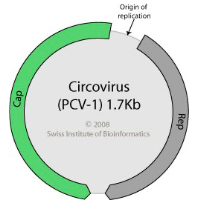
Circovirus (infects birds and some mammals)
ssDNA virus
diameer of 15-25nm
genome size is <2kb encoding only 2 genes
capsomere and replication egens
What are some examples of very large viruses (giant viruses)?
CroV —> marine single celled organisms
739,000bp genome
Megavirus chelensis —> amoeba virus
1.2 mega bp genome encoding 1,200 proteins
Mimivirus —> dsDNA virus of amoebas
400nm in diameter
1.2mega bp genome encoding 979 proteins
What are the types of viral genomes?
DNA or RNA genomes but never both in the same virus.
can be linear or circular and some have segmented genomes
ex. Orthomyxoviridae (influenca) has multiple RNA segments
What are the types of DNA viruses?
dsDNA
ssDNA
What are the types of RNA viruses?
dsDNA
ss + sense
mRNA is positive sense, 5’ to 3’ (nromal)
ss - sense
3’ to 5’ (opppostoe)
No strat codon.
Not recognized by ribospmes so no translation to protein
cant be direcrly translated
synthesize + first then make the -
What are the types of Reverse Transcribing viruses?
RNA
DNA
use reverse transcriptase during replication and gene expression
What are some examples of ssDNA linear viral genomes?
Parvovirus
What are some examples of dsDNA linear viral genomes?
Herpesvirus
What are some examples of ssDNA circular viral genomes?
M13
What are some examples of dsDNA circular viral genomes?
Baculovirus
What are some examples of ssRNA linear viral genomes?
TMV
What are some examples of dsRNA linear viral genomes?
Reovirus
What are some examples of ssRNA circular viral genomes?
Hep D
What are some examples of ssRNA circular viral genomes?
None exist
What is virus host specificity?
many restricted to infecting only a single species
ex. Hep A virus and poliomyelitis virus mainly infect humans whereas T4 bacteriophage infect E.coli bacteria
What does a narrow host range means?
Only infect closely related species
ex. FMD infects cloven hoofed animals like cattle/sheep/goats/pigs/bison/moose but not other animals
What does a broad host range means?
Can infect multiple hosts and across multiple species
ex. influenza, infect birds,pigs,humans
What causes the common cold?
Rhinovirus
What is HMFD?
Hand mouth and foot disease HMFD
Caused by kosaki virus
Ailment can affect children in daycare settings
What host range does Influenza A have?
Broad host range but only infect warm blooded vertebrate animals so not fish or insects or plants or fungi.
Which is more stable in the enviro: naked or enveloped viruses?
Naked viruses = more stable in the enviroment
Has protein coat and covalent bonds
When does a viral infection begin?
bind to specific cell surface receptors
penetrate and uncoat genome in cytoplasm
cell express viral genes using host cells/dNTPs, to make proteins (using host ribos and AAs) and replicate genome
Assembly: pack viral genomes into new viral capsids to make new virions which are then released.
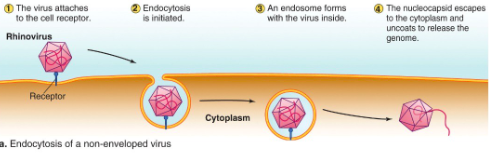
How do naked viruses infect and replicate?
Endocytosis: The virus escapes the endosome and undergo uncoating to release the viral genome into the cytoplasm
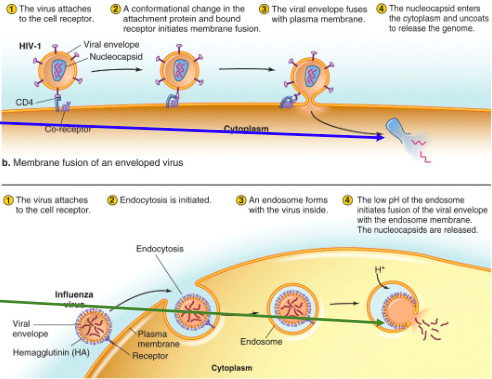
How do enveloped viruses infect and replicate?
Membrane fusion or endocytosis + membrane fusion
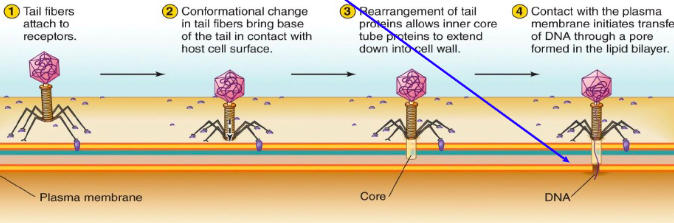
How do bacteriophages infect bacterical cells?
only genome enteres the host cell via penetration
The tail fibers of the bacteriophage are specially involved with host cell attachment.
Once stable contact is established, a small pore will be created through the cell wall and cell membrane of the bacterium.
Through this small pore, the bacteriophage will inject its genomic material into the prokaryotic cell via penetration
What impact do bacteriophages have on bacteria?
regulate bacterial populations by infecting and killing bact
integrate into genetic material to alter traists (lysogeny)
horizontal gene transfer —> transfer of host genes by moving between cells (transduction)
What is more abundant in nature?
a) eukaryotes
b) prokaryotes
c) viruses
c) viruses
What are temperate phages?
can switch btween replication cycles dependong on conditions
What happens in the lytic cycle?
phage replicates rapidly inside the host and ultimately lyses the bacterial cell to release new virion
What happens in the lysogenic cycle?
host cell replicates the viral genome along with its own DNA.
Host cells are not lysed.
The viral genome is either integrated into host genome or kept as plasmid
What do most bacteria isolated from nature have?
carry temperate bacteriophage DNA integrated into their genomes as prophage
When can the viral genome undergo excision?
when viral genome is integrated
How do temperate phages silentky exist in bacterial cells and beocme virulent when needed?
environmental stress or changes in conditions can trigger an exit from lysogeny and switch into the lytic cycle, transitioning the infection toward active viral replication
What happens in the virulent stage?
active DNA replication
synthesis
assembly
cell lysis
What are the impacts of viral genes on bacterial genes?
can lead to more virulent bacteria (problemactic if pathogenic)
ex. Diphtheria caused by Corynebacterium diphtheriae
Only severe if bact gets infected and lysogenized by specific bacteriophage
so the phage adds toxin gene that integrates into chromosomes —> bact produces diphtheia toxin
What is lysogenic conversion>
transforms a normally less harmful bacterium into a highly pathogenic strain
ex. Diphtheria
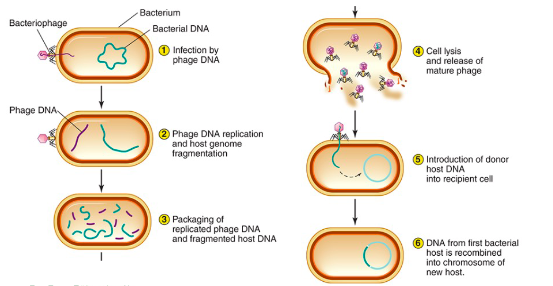
What is transduction?
trasnfer of host genes from one cell to another
What are the steps of transduction?
Bactphage infects donor cell, lytic cycle, take over host machinery
chromo broken down into fragments
viral replication in the cell
new phage particles assembled, sometimes capsid takes in bact DNA instead of viral DNA
Donor cell lyses
normal phages and tranducing phages with bact genes released
trandcing phage attaches anf injects dna into new bact cell
genetic change in new host cell
What is a plaque assay?
used to measure # of infectious bactphages in samples
diluted phage soln mized w bact host and spread on agar
phages infect and lyse bact, clear zones created = plaques
# of plaques used t calc the viral conc (PFUs/mL)
rely on abiloty to grow host cells on agar
Viruses are not considered cells because they have no...
a) Membrane-bound nucleus.
b) Phospholipid-based cytoplasmic membrane.
c) Genetic material.
d) Ability to replicate independently.
d) Ability to replicate independently.d) Ability to replicate independently.
Which of the following is true?
a) All viruses include RNA and DNA.
b) All viruses have a protein coat.
c) All viruses have a plasma membrane.
d) All viruses have a cell wall
b) All viruses have a protein coat.
The shape of viruses is determined by their...
a) Genome
b) Membrane
c) Capsid
d) Enzymes
c) Capsid
Which of the following describes a positive sense RNA virus?
a) The viral genome can integrate into the host genome.
b) The viral genome can be directly translated by host cell machinery.
c) An RNA strand complementary to the host genome is generated before translation.
d) The viral genome is transcribed by host machinery to make mRNA.
b) The viral genome can be directly translated by host cell machinery.
Naked animal viruses enter host cells by...
a) Endocytosis
b) Active transport
c) Facilitated diffusion
d) Fusion of membranes
a) Endocytosis
Both naked and enveloped animal viruses can enter host cells via fusion of membranes...
a) True
b) False
b) False
Which of the following is a distinguishing feature of bacteriophages and animal viruses?
a) Phages enter the host cell via endocytosis, animal virus membranes fuse with the host cell membrane.
b) Phages enter the host cell via membrane fusion, animal viruses enter via endocytosis.
c) Phages never enter the host cell, animal viruses enter via endocytosis or membrane fusion.
d) Phages always have DNA, animal viruses can have either DNA or RNA.
c) Phages never enter the host cell, animal viruses enter via endocytosis or membrane fusion.
Lytic viruses replicate within the host cell and lyse the host cell, whereas temperate phages do not lyse the host cell.
a) True
b) False
b) False
Transduction results in...
a) Incorporation of viral RNA into the host genome.
b) Introduction of bacterial genes from one cell to another cell.
c) A lysogenic cycle.
d) Scrambling of the host genome
b) Introduction of bacterial genes from one cell to another cell.
b)