PSYC 1200 CH. 13
 Call Kai
 Learn
Learn Practice Test
 Spaced Repetition
 Match
Match Flashcards
 Knowt Play
1/66

There's no tags or description
Looks like no tags are added yet.
Name | Mastery | Learn | Test | Matching | Spaced | Call with Kai |
|---|
No analytics yet
Send a link to your students to track their progress
67 Terms
What is mimicry?
Copying the behaviours of others
(13.1)
_________ facilitates social bonding
“Synchrony”
(13.1)
What are social norms?
Unwritten guidelines that dictate how we behave
(13.1)
What is social loafing?
Putting in less effort when working with others
(13.2)
What is social facilitation?
When one’s performance is enhanced by the presence of others
(13.2)
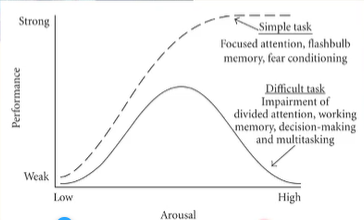
What law is described in the image?
Yerkes-Dodson law
(13.2)
What is the phenomena of groupthink?
When group members lean towards the same ideas/values to minimize conflict
(13.2)
What is group polarization?
The tendency for people’s opinions to become stronger/more extreme after discussing them in a group
(13.2)
What is conformity?
A change in behaviour to fit into a group
(13.3)
What occurs when conforming due to a normative influence?
Conforming to avoid creating a social cost (e.g. you know the rest of the group is wrong but you don’t want to put yourself out there)
(13.3)
What occurs when conforming due to a informational influence?
Concluding the group must be right
(13.3)
What is ostracism?
Being ignored/excluded from a social situation (anxiety inducing, violates our need to belong)
(13.3)
Ostracism can lead to a strengthened belief of?
The group be are being ostracized/excluded from - as we try to gain social acceptance
(13.3)
What is the bystander effect?
The presence of other people reduces the likelihood of helping behaviour
(13.4)
What is the diffusion of responsibility (which causes the bystander effect?
Feeling of responsibility is spread across members of a group, so no single individual feels a concentrated sense of personal responsibility
(13.4)
Bystanders with ____-_______ are more likely to help (overcoming the bystander effect)
“self-efficiacy” (the belief in one's capability to succeed)
(13.4)
What is pluralistic ignorance?
When uncertain, we look to see how others are reacting and act accordingly
(13.4)
What are social roles?
Specific sets of expectations for how someone in a specific position should behave
(13.5)
What does the psychological state of deindividuation entail?
Decreased self-evaluation, leading to a loss of accountability → disinhibited behaviour
(13.5)
The horribly unethical Stanford Prison Experiment led by Zimbardo was accused of telling prisoners they could not…
…leave
(13.6)
The horribly unethical Stanford Prison Experiment led by Zimbardo was accused of coaching guards to be more…
…extreme
(13.6)
What occurred in Milgram’s infamous obedience to authority study?
Participants instructed to give electric shocks increasing in intensity to what they believed was another participant experiencing pain from the shocks
(13.7)
Which variation of Milgram’s study experienced the largest reduction in obedience (up to 48%)?
Different location (rather than the prestigious Yale campus)
(13.7)
What is person perception?
Describes how we make judgements on other people
(13.8)
What 2 processes are included in the dual-process model?
Implicit + explicit
(13.8)
What are implicit processes?
Automatic thinking
(13.8)
What are explicit processes?
Effortful thinking
(13.8)
What can first impressions lead to?
Self-fulfilling prophecies
(13.8)
What are self-fulfilling prophecies?
Originally false belief leads to its own confirmation
(13.8)
What are self-serving biases?
Biases that let us maintain a positive view of ourselves in comparison to others
(13.9)
What is false consensus effect?
Assuming that our views are representative of society
(13.9)
What is naive realism?
Assuming that our perceptions of reality are correct, therefore those who differ must be wrong
(13.9)
What is the better than average effect?
Assumption that we are better than average people
(13.9)
What is the Dunning-Kruger effect?
Tendency for those who know the least to be at the greatest risk of overestimating their abilities
(13.9)
What are the 2 attributions to explain the behaviours of others?
Internal + external
(13.10)
What is an internal attribution?
Behaviour due to something internal about that person
(13.10)
What is an external attribution?
Behaviour as the result of the social context
(13.10)
What is a locus of control?
Degree to which people believe they have control over their life (Adopt whatever attribution that suits us in the moment)
(13.10)
When we judge others behaviour, we often commit a fundamental attribution error. What is meant by this?
Tend to be less forgiving of others behaviours than our own in that we apply internal attributions when judging others (i.e. something wrong with them, not the environment)
(13.10)
Differenciate between in-groups + out-groups.
In-groups: Group of people we identify with
Out-groups: Anyone we consider different than us
(13.11)
Taking what you know about in-groups + out-groups, which group are we most likely to apply a fundamental attribution error to?
Out-groups
(13.11)
What is an in-group bias?
We are more likely to attribute positive qualities to our in-group
(13.11)
What is a stereotype?
Set of common beliefs about a group
(13.11)
What is a prejudice?
Adopting stereotypes
(13.11)
What is discrimination?
Behaviours based on prejudice
(13.11)
Who was the first woman president of the American Psychological Association, who was denied her PhD by Harvard despite her defense being described as most brilliant?
Mary Whiton Calkins
(13.11)
What is implicit bias?
Attitudes/stereotypes we hold against a group that unconsciously affects our perceptions
(13.12)
What test can we use to identify people’s forms of biases?
Implicit associations test
(13.12)
What does the implicit associations test measure?
How fast people respond to stereotype-consistent + stereotype-inconsistent stimuli
(13.12)
Implicit associations test is not perfect as results are not always stable across repeating testing, and does not predict an individuals tendency for ___________
“discrimination”
(13.12)
What is the contact hypothesis, a way to reduce bias?
We need to have regular contact with diverse people in order to overcoming prejudice
(13.13)
We can go about changing people’s minds by using the elaboration likelihood model, which describes?
A dual-process model (includes both implicit + explicit processes) of when/how we become persuaded
(13.14)
What 2 things does the route of persuasion depend on?
If we have motivation + time to process an argument
(13.14)
When using explicit processes to persuade, we go down the central route, which entails a higher motivation + effort. . Does this lead to a lasting or temporary change in attitude?
Lasting
(13.14)
When using implicit processes to persuade, we go down the peripheral route, which entails low motivation + effort. Does this lead to a lasting or temporary change in attitude?
Temporary
(13.14)
Is the central or peripheral route to persuasion easier to process quickly + activates people’s feelings?
Peripheral route
(13.14)
One of the best ways to ensure the central route is effective is by taking the lessons of the construal level theory. What does this describe?
Information affects us differently depending on our ‘psychological distance’ from the information
(13.15)
The construal level theory values appeals, as well as the importance of avoiding what previously discussed effect?
False consensus effect
(13.15)
What is the identifiable victim effect?
Tendency to be more moved to action when we hear about personal stories of suffering than when we hear about mass suffering (e.g. 1 child dies vs. bomb)
(13.15)
What 2 systems coordinate with implicit + explicit processes, respectively?
Experiential system (implicit), analytic system (explicit)
(13.15)
What strategy is that of attitude inoculation?
Making attitudes more resistant to change by first exposing people to a weak counter-argument that is then proven
(13.15)
What 2 things hinder the central route?
Complex messaging + negativity
(13.15)
What 2 things can enhance the peripheral route?
Authority (experts) + liking another person (halo effect, attractiveness)
(13.16)
The peripheral route makes use of social validation, which entails?
Conformity of other groups members to facilitate persuasion
(13.16)
The peripheral route makes use of our sense for reciprocity, which is?
That we often feel a sense of obligation to others if they have done us a favour
(13.16)
What is the cognitive dissonance theory?
When we hold inconsistent beliefs, inner tension is created that we are motivated to reduce
(13.17)
What is justification of effort?
We are constantly trying to justify our actions/beliefs
(13.17)