mechanism of nucleophilic substitution
 Call Kai
 Learn
Learn Practice Test
 Spaced Repetition
 Match
Match Flashcards
 Knowt Play
1/7

There's no tags or description
Looks like no tags are added yet.
Name | Mastery | Learn | Test | Matching | Spaced | Call with Kai |
|---|
No analytics yet
Send a link to your students to track their progress
8 Terms
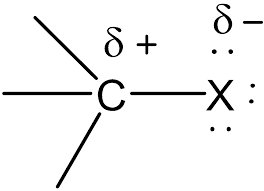
carbon halogen bond
polarised due to halogen being more electronegative than carbon…halogen draws electron pair in the bond away from carbon nearer to itself and carbon becomes positive
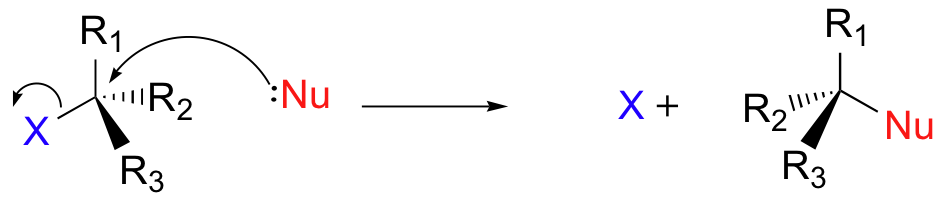
primary halogenoalkane mechanisms (SN2)
steps in a nucelophilic substitution which determines the rate of reaction involves 2 reacting species
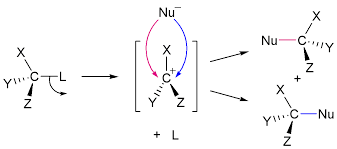
tertiary halogenoalkanes (SN1) mechanisms
steps in nucleophilic substitution which determines the rate of reaction and only involves the organic reactant
carbocation stability
primary are least stable and tertiary is most stable
secondary carbocations
make use of both SN1 and SN2 mechanisms
elimination reactions using NaOH in ethanol
alkene is formed
using aqueous NaOH in a nucleophilic substitution
an alcohol is formed
positive inductive effect
the pushing away of electrons from an organic group such as an alkyl group towards the rest of the molecule