10: Perception of Action
 Call Kai
 Learn
Learn Practice Test
 Spaced Repetition
 Match
Match Flashcards
 Knowt Play
1/46

Earn XP
Description and Tags
Imitation and Mirror Neurons
Name | Mastery | Learn | Test | Matching | Spaced | Call with Kai |
|---|
No analytics yet
Send a link to your students to track their progress
47 Terms
crossmodal transfer
the transfer of abilities across different sensory modalities
perception-action mapping
the ability to seamlessly map visual representations of actions onto our motor systems to produce a copy of the action
developmental evidence for perception action mapping
infants can imitate caregiver’s facial expressions, hand and mouth movements, head turns, etc.— babies build up a representation of the visual image of the caregiver’s face/mouth and map this onto their own motor representation of the movement
age that babies can allegedly imitate specific facial expressions (meltzoff and moore, 1977)
12-21 days
what specific acts do infants imitate (meltzoff and moore, 1977)
lip and tongue protrusions, open mouth
evidence against neonate imitation
when does true imitation occur (oostenbroek et al., 2016)
6-9 months
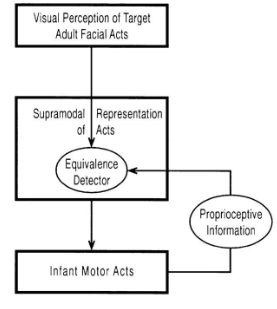
active intermodal matching (AIM; meltzoff & moore, 1997)
neonates recognise equivalences between body transformations they see and those of their own body that they “feel” themselves— their emotional expressions induce adults to produce similar expressions, which provides the infant with a visual input to match his motor output
AIM involves:
perception and action having independent coding/representation
a “specialist” module for imitation
aim vs other models (e.g. IM and ASL)
others posit common coding for perception and action, and an imitation part of “generalist” processes for motor control and learning
ideomotor (IM) theory
close link between motor movements and perception as they are very similar
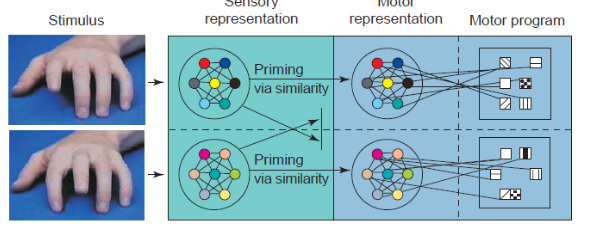
associative sequence learning (ASL)
emphasises learning through experience (e.g. see consequence of own hand action)
dual route of imitation (rumiati & tessari, 2002)
semantic: meaningful actions, stored in repetoire
visuomotor/direct: meaningless actions— mirror neurons
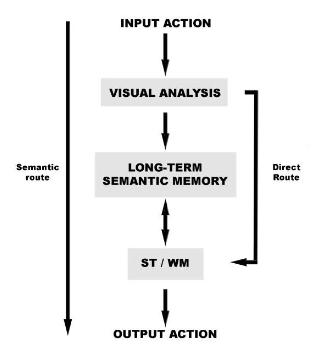
semantic route of imitation
stored representation of doing things
visuomotor/direct route of imitation
carefully observe an action and then map it onto one’s own motor system
mirror neurons
bimodal, visuo-motor neurons (respond to both visual and motor stimuli) that discharge when an individual performs an action and when they observe the same action performed by another individual
mirror neurons and action understanding (umilta et al., 2001)
mirror neurons active during observation of partially hidden actions predicts action outcome even in absence of complete visual information (no response in the absence of an object)
mirror neurons and action understanding (kohler et al., 2002)
audio-visual mirror neurons respond to the sound typically produced by the action (though no activity in audio-only stimulus, as macaques are not aware of what is about to be done until it is done/do not imitate)
mirror neuron properties
somatotopically organised
responds only to goal-directed actions
also canonical visuomotor neurons (also called “object observation-related” neurons)
mirror neurons in monkey
found in area F5 of premotor cortex and inferior parietal lobe
mirror neurons in humans (location)
human homologue in
broca’s area (B144)
ventral inferior frontal gyrus (BA6)
posterior parietal lobe
superior temporal lobe
indirect evidence of human mirror neurons
close link between perception and action
behavioural
brain imaging (fMRI)
transcranial magnetic stimulation (TMS)
direct evidence of human mirror neurons
recording from neurons (difficult to obtain as it unlikely to be ethically cleared due to risk)
behavioural human mirror neurons
faster responses observed when compatibility between observed and executed movements, known as “automatic imitation” (brass et al., 2000; 2001)
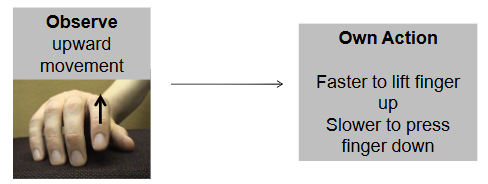
automatic imitation
lab analogue of mimicry
human mirror neurons and brain imaging
somatotopic activation of pre-motor and parietal cortex, areas correspond to observations of different body parts (buccino et al., 2001)
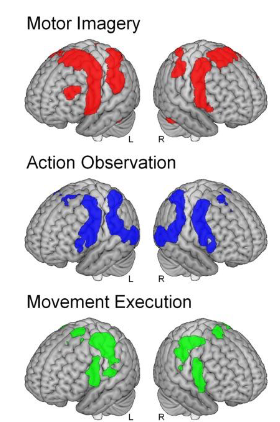
perception-action overlap (hardwick et al., 2018)
overlap in brain activity between imagined, observed and executed movements
motor imagery
imagined movement without action
TMS and human mirror neurons (fadiga et al., 2005)
motor evoked potentials to show that observing an action produces increased motor excitability
direct recording of human mirror neurons (mukamel et al., 2010)
action observation-related neurons found in medial frontal lobe (SMA) and medial temporal lobe (hippocampus)
mukamel et al. (2010) study
recorded from 1177 neurons in 21 patients undergoing surgery for intractable epilepsy
examples of mirror neurons beyond movement (bonini et al., 2022)
evolution of language
empathy
social cognition
“broken mirror” theories of autism and schizophrenia
intersubjectivity
imitation, empathy and intention reading allowing us to predict the behaviours of others
empathy and direct mapping
viewing pain in others and feeling pain yourself has an overlap in anterior cingulate cortex (BA24b; morrison et al., 2004)
limitations in primate data (dinstein et al., 2008)
small number of examples
often qualitative rather than quantitative
need more studies to ask how well cells can distinguish pairs of movements (e.g. keysers et al., 2003)
need evidence of mirror neurons firing in spontaneous social interaction
limitations with human data
many areas outside of mirror neuron areas are activated during action observation
adaptation protocols concerning what neurons are firing
TMS effects could be produced by areas outside of mirror neurons
use of adaption
can be used to explore whether the same area is involved in different tasks
problems for mirror neuron theory
motor theories of perception are not new
over-emphasis on “action-understanding” function
do mirror neurons go beyond other sensory-motor neurons?
evaluation of mirror neurons supporting action understanding in monkeys
inactivation of F5 disrupted grasping but not perception
could just be association or working memory
no measurement of understanding
evidence of action understanding existing without mirror neurons
F5 also responds to objects, but it is not argued to underpin understanding of objects
superior temporal sulcus may be more critical for action understanding
human-monkey differences
higher cognitive functions attributed to mirror neurons are not seen in monkeys
assumed that MNs in humans have developed to include both action understanding and imitation
cannot assume that conclusions from monkey MNs apply in humans (few human imaging studies examine overlap between observation and own action