Goats & Sheep Test 4
 Call Kai
 Learn
Learn Practice Test
 Spaced Repetition
 Match
Match Flashcards
 Knowt Play
1/64

There's no tags or description
Looks like no tags are added yet.
Name | Mastery | Learn | Test | Matching | Spaced | Call with Kai |
|---|
No analytics yet
Send a link to your students to track their progress
65 Terms
How many chromosomes do sheep have?
27
How many chromosomes do goats have?
30
What is the equation for estimated breeding values?
EBV = b (P1 - PA)
Where b= the weighting factor of inheritability
P1= individual record
PA= contemporary age group
What is the EBV for this animal? Ram A has a grease fleece weight of 18 pounds and his contemporaries average 12 pounds. The inheritance of grease fleece weight is 0.4.
Ram A has an EBV for grease fleece weight of 0.4 x (18-12) = 2.4 pounds
Information on ______ is important in estimating breeding values for lowly heritable traits
relatives
____ is used to denote this sample half of an animal’s breeding value that is passed to offspring. This is half of EBV
expected progeny difference (EPD)
The average EPD in the base population is
zero
The generation interval (L) for sheep is
five to six years
The generation interval for rams is
one to four years
What is a progeny test?
A method of estimating the breeding value of an animal by the average performance or phenotype of it’s offspring
Which method estimates an animal’s breeding value by combining all the performance information available for a trait
Combined selection
Which method of selection addresses the multiple-trait issue by focusing on one trait at a time?
Tandem selection
Which method of selection may be practiced for two or more traits simultaneously?
Multiple-trait method
WHat is the selection index?
It ranks individual animals for overall economic merit based on two or more traits and is the most efficient method
What tends to happen during crossbreeding?
They tend to be more vigorous, fertile, and may grow faster than average purebreds
Levels of heterosis tend to be the highest for ____ and _____, lower for _____, and near zero for ______
survivability and early growth, birth weight, carcass traits
In replacement females, heterosis has large effects on
fertility (especially in ewe lambs) and on preweaning growth and survival, with modest effects on ewe birth weight and fleece traits
Purebred flocks sell
breeding stock or breeding value
commercial flocks do not sell breeding value but pounds of
quality lamb, wool, and/or milk
What does NSIP stand for? What do they do?
National Sheep Improvement Program (also includes goats)
accepts on-farm, performance records from participating flocks and returns Estimated Breeding Values (EBVs) for reported traits
NSIP is the organization that provides what for the US sheep and goat industry?
EBV’s, they provide both a LAMBPLAN and a KIDPLAN
EBV is ____ the value of an EPD
twice
What are the 2 kinds of EBVs
Herd EBVs
Across-herd EBVs
What are Herd EBVs
Calculated when a herd is not connected to other NSIP flocks
What are Across-herd EBVs
Herd has genetic linkages with other NSIP herds, EBVs from individuals in other herds
Half-siblings share about ____% of their genes
25%
First cousins share approx. ____% of their genes
12.5%
What does WWT stand for?
Weaning weight
What is maternal weaning weight (MWWT)
milk production, mothering ability
What is the postweaning weight (PWWT) based on?
the 120-day weight
What is Fleece weight (GFW)?
Grease fleece weight, wool production
How is the fat depth for an EBV measured?
mm - fatness between the 12th & 13th ribs
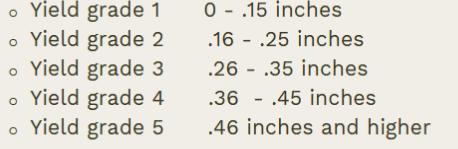
How does the USDA classify yield grades for carcasses based on estimated fat depth over the loin eye at the 12th rib
Yeild grade 1-5
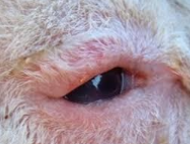
What is Entropion?
Inverted eyelids, a heritable trait that can be aggravated by environmental conditions
Treatment by removing extra skin (done by a veterinarian)
What is cryptochidism?
One (unilateral) or both (bilateral) testes of the ram are retained in the abdomen rather than descending into the scrotum.
What is Neuronal Ceroid Lipofuscinosis?
Inherent blindness, animals may wander aimlessly and become separated from the flock and stand with head
“stargazing”
An earless animal also probably has this defect too:
cleft palatte
What is wattles?
extra skin appendage-like tissues on the neck
How many different genetic tests can goats go through?
3
WHat are the standard pregnancy rates?
100% for 200 ewes or less
98% for 201-750 ewes
96% for 751 or more
All ewes must breed within a ____-day time period
34
All does must breed within a __-day time period
42
How do you determine pregnancy rate?
pregnancy rate = # of ewes pregnant / number of ewes exposed to a ram x100
The standard lambing rate should be
120%-150%
How do you find lambing percentage?
number of lambs raised / number of ewes exposed
What is the standard lamb/kid survival rate?
95%
What are the two culling methods?
Tandem - selecting one trait at a time until a certain level of performance is achieved
Independent culling levels - set minimum standards for traits involved in multi-trait selection
What is the 1st decision when it comes to managing ewes?
Buying vs. raising
What are the pros/cons of buying your ewes?
It’s easier → can breed all females and sell lamb/kids
Can purchase replacements from farms
sometime mature females (still sound) are available
Might be cheaper to buy replacements
What are the pros/cons of raising you own ewes?
You get to maintain a (mostly) closed flock/herd
Can breed traits that are most important to you
Can raise replacements the way you want
Might be cheaper to raise instead of buy replacements
When buying, what do you need to be conscious of?
Most diseases walk onto your farm in an animal
Purchased animals may introduce resistance worms to your farm
What are the types of sires?
Maternal -sires that excel in maternal and fitness traits (use to sire replacement females)
Terminal - sires that excel in growth and carcass traits (used to sire market lambs/kids)
Dual purpose - suitable as either sire or dam breed
What should you consider when choosing sires for replacement female production
Should be of desired breed/cross
Need to have desired coat/fiber type
Need to have desired level of reproduction
Need to have desired level of fitness
Need to have desired milk production
What are the criteria for selecting replacement females?
Visual Appraisal
Performance Evaluation
Genotype or Serotype
What is important to ewe conformation?
Length, width, and depth of body. She needs to eat, walk, and feed two lambs. W
What is the order of checking for ewe conformation
Teeth - for eating
Feet - need to be able to walk to find food
Udder - to rear two lambs
What are the methods of performance evaluation?
Individual - selection on the basis of the individual animal’s own performance
Pedigree - selection on the basis of the performance of the animal’s parents and other relatives
Progeny - selection on the basis of the performance of the individual’s offspring
Breeding values - mathematical prediction of a genetic merit of an animal that uses multiple data sources including performance of individual and and all of it’s relatives
Individual animal performance is based on
season and date of birth
type of birth and rearing
weaning weight / weaning ratios
post -weaning weights /ratios
Fecal egg counts (weaning and post)
FAMACHA scores
Fiber traits; weight length yield
Carcass traits; fat depth, loin depth
It is customary to cull ~___% of the flock each year
15%
What is the primary reason for culling ewes?
Age
Ewes tend to be most productive between the ages of
3 AND 6
You cull anytime there is a
prolapse. Rectal, vaginal, or uterine
You should cull females that are chronically infected with
foot rot or scald.
It is genetic
You should cull females that require frequent or regular
deworming
To improve parasite resistance in a flock, cull females with the
highest fecal egg counts