introduction to accounting
 Call Kai
 Learn
Learn Practice Test
 Spaced Repetition
 Match
Match Flashcards
 Knowt Play
1/196

There's no tags or description
Looks like no tags are added yet.
Name | Mastery | Learn | Test | Matching | Spaced | Call with Kai |
|---|
No analytics yet
Send a link to your students to track their progress
197 Terms
fundamental qualitative characteristics
relevance: if it has
predictive value
confirmatory value
→ must also cross threshold of materiality
faithful representation
completeness
neutrality
freedom from error
difference between management and financial accounting
management: for internal users, managers making decisions
unregulated, forward looking, tailored to need
financial: for external users, shareholders, lenders regulators
regulated, historical, standardised
four enhancing qualitative characteristics
comparability
verifiability
timeliness
understandability
sole proprietorship
owned by one individual, often small eg. driving instructors
+easy to set up and dissolve
+no legal obligation to disclose to external users other than tax authorities
-unlimited liability
partnership
owned by two or more individuals, eg. dentists/lawyers
+shared ownership and burden
+specialisation opportunities
-limited individual decision-making
-usually unlimited liability
limited liability
owned by one or more individuals, eg. loyds bank plc
+limited liability
+more financing opportunities than sole proprietorships and partnerships
-regulations
statement of financial position
provides a ‘snapshot’ of financial position at a point in time
income statement
measures financial performance of a business over a period
statement of cash flows
summaries the inflows and outflows of cash and cash equivalents for a business over a period
assets
resources held by the company, is an economic resource under the control of the business , measured in money
liabilities
what the company owes to parties apart from the owner(s), claim of other parties
equity
what is left for the owner(s) after liabilities are settled, owner’s residual claim
the accounting equation
assets = equity + liabilities
current assets
short-term held assets which meet any of the following:
held for sale/consumption during normal operating cycle/ 12 months after date of the relevant SoFP
eg. cash & cash equivalents, inventories, trade receivables, prepaid expenses
non current assets
long term assets held for continuing use, fixed (tangible or intangible)
claim
an obligation to provide cash or some form of benefit to an outside party. two types:
equity
liabilities
current liabilities
amounts due for settlement in the short term (12 months or normal operating cycle)
accrued expenses
trade payables
eg. bank overdrafts
bank loan to be repaid in 12 months
non-current liabilities
amounts due that do not meet the definition of current liabilities (eg. long term loans over 1 year)
long-term bank loans
loan notes/ bonds/ debentures
5 accounting conventions
business entity: business ≠ owner(s). they are separate economic units - regardless of legal form
historic cost: records assets as acquisition cost. reliable, but may not reflect current market value
prudence: be cautious. don’t overstate or understate the financial position
going concern: assume the business will continue operating into the foreseeable future → ‘exit’ values have limited relevance and historic costs can continue to be used as a valuation basis
dual aspect: every transaction affects at least 2 accounts (has 2 effects) and both need recirding if the entity uses a double entry system- this is what keeps the SoFP in balance
difference between business entity and limited liability
entity is an accounting concept ; limited liability is a legal status of the owners
standard layout of SoFP
non-current assets + current assets = total assets
equity + non current liabilities + current liabilities = total equity and liabilities
4 key profit formulas
profit = revenue - expenses
gross profit = sales - CoS
CoS = opening inventory + purchases - closing inventory
operating profit = gross profit - operating expenses
cost of sales
cost of goods that are sold during the period
some goods bought during the period may remain as inventories at the end of the period
in some businesses, the cost of sales for each individual item is identified at the time of the sale
calculation of cost of sales
cost of sales = opening investments + purchases - closing inventories
accruals convention
revenue is recognised when earned and expenses recognised when incurred regardless of when cash is paid/received
profit = revenue - expenses
cash sale - revenue = cash
revenue increases/ income statement increases (equity up)
trade receivables increase (asset up)
accrued expenses
expenses that are outstanding at the end of the reporting period
recorded as liabilities (usually current0 on the SoFP)
prepaid expenses
expenses that have been paid in advance at the end of the reporting period
recorded as assets (usually current) on the SoFP
non-current assets with finite lives
provides benefits for a limited period due to market changes, wear and tear ect.
amount used up is referred to as depreciation for tangible non-current assets and amortisation for intangible ones
carrying amount (aka net book value) is cost accumulated depreciation (amortisation)
non-current assets with indefinite lives
provides continuous benefits without a foreseeable time limit, not subject to depreciation/ amortisation
two methods of depreciation
straight line method and reducing balance method
straight line method
use when economic benefits are consumed evenly over time (eg. buildings)
annual depreciation expense = [ cost(fair value) - estimated residual value]/estimated useful life
cost - accumulated depreciation = carrying amount
reducing balance method
use when economic benefits consumed decline over time (eg. cars)
annual depreciation expense = carrying amount x depreciation rate
disposal (and equation)
when an asset is sold, we need to calculate the gain/loss on disposal
gain(loss) on disposal = sale proceeds - carrying amount
statement of comprehensive income
extends the conventional income statement to include other comprehensive income (OCI): unrealised gains and some unrealised losses that affect equity
unrealised gain(loss)
refers to an increase(decrease) in the value of an asset/ investment that has not been sold eg. property revaluation gain
impact of bad debts (such as credit sales) on financial statements
where is is reasonably certain the customer won’t pay, the amount owed is considered an irrecoverable debt(bad debt) and written off
where it is doubtful a customer will pay, an allowance for trade receivables expense should be created
when you make a prepayment:
cash goes down (asset down)
prepayment goes up (asset up)
control over an asset
the entity has the ability to direct use of the asset and obtain the economic benefits from it
→ ownership is not necessary for a resource to be classified as an asset
business entity convention
establishes a clear separation between a business and its owners for accounting purposes
accurate assessment of financial performance easier to compare financial data with other entities personal tax vs. corporate tax
applies to limited companies, sole proprietorships and partnerships
general ledgers
record transactions in general ledgers, which includes different accounts
trial balance
general trial balance (i.e summary of account balances) from general ledger
double-entry bookkeeping
each transaction is recorded in account
an account (T-account) is a record of transactions relating to an item of asset, claim, revenue or expense
trial balance
shows the balances on each account at a date, making cure total debits=total credits
providing some assurance that the accounts have been recorded correctly when the totals agree
trade receivables equation
beg. trade receivables + credit sales - receipts from credit customers - bad debts written off = end. trade receivables
net trade receivables = gross trade receivables - allowance for trade receivables
trade payables equation
beg. trade payables + credit purchases - payments to credit suppliers = end. trade payables
ordinary shares (or equities)
represent basic units of ownership of a company
ordinary shareholders
may receive a dividend (if they’re given) only after claims of lenders and preference are satisfied, have voting rights, face limited downside risk but unlimited upside potential
issue price
the price at which shares are initially offered to investors
nominal (par) value
total nominal value of shares issued by the company
issue share capital
total nominal value of shares issued by the company
share premium
additional amount paid by shareholders over the nominal value of shares
statement of changes in equity
provides details on changes in a company’s equity (share capital and reserves) over a specific period
retained earnings equation
beg. retained earnings + profit for the year - dividends declared = end. retained earnings
dividends
distribution of wealth to shareholders, but not an expense (listed as cash distribution not operating expense in income statement)
declaration of dividends
board of directors formally announces the intention to pay dividends at a specific date
statement of cash flows
summarises the inflows and outflows of cash and cash equivalents over a period
key components:
cash flows from operating activities (CFO)
cash flows from investing activities (CFI)
cash flows from financing activities (CFF)
net CFO + net CFF = net increase/(decrease) in cash and cash equivalents
cash flows from operating activities (CFO)
principle revenue - producing activity of the entity
cash flows from investing activities (CFI)
acquisition and disposal of long-term assets and other investments not included in cash equivalents
cash flows from financing activities (CFF)
activities that result in changes in the size and composition of the contributed equity and borrowings of the entity
cash equation
beg. cash + net increase/(decrease) = end. cash
cash flows from operating activities : direct method
major classes of gross receipts and gross cash payments are disclosed
cash flows from operating activities: indirect method
profit/loss adjusted for for the effects of transactions of a non-cash nature, any deferrals or accruals of past or future operating cash receipts/payments , and items of income or expense associated with investing or financing cash flows
profitability
measuring how successful a business is in creating wealth for its owners
return on capital employed (ROCE) equation
ROCE=(operating profit)/(equity+non-current liabilities) * 100%
gross profit margin equation
GPM= gross profit/ sales * 100%
operating profit margin (OPM) equation
OPM= operating profit/ sales * 100%
net profit margin equation
NPM = profit for the year/ sales * 100%
efficiency
measuring how efficient a business is in using resources (eg. inventory or employees)
average inventories turnover period equation
average inventories held/ cost of sales * 365 days
average settlement period for trade receivables
average trade receivables/ credit sales * 365 days
average settlement period for trade payables equation
average trade payables/ credit purchases * 365 days
sales revenue to capital employed (SRCE)
sales/ (equity + non-current liabilities)
sales revenue per employee
sales/ number of employees
liquidity
measuring a business’s ability to meet maturing obligations using liquid resources
current ratio equation
current assets/ current liabilities
quick ratio (aka ‘acid test ratio’) equation
(current assets-inventories)/ current liabilities
financial gearing
measuring the extent to which loan finance is employed and the consequent effect on the level of risk borne by a business
gearing ration equation
non-current liabilities/ (equity + non-current liabilities) *100%
investment
helping shareholders assess the returns on their investment
dividend payout ratio equation
dividends announced for the year/ (profit for the year-preference dividends) *100%
dividend cover ratio equation
1/ dividend payout ratio
dividend yield equation
dividend per share/ market price per share * 100%
earnings per share (EPS)
(profit for the year- preference dividends)/ number of ordinary shares in issue
price/earnings (p/e) ratio
market price share/ earnings per share
depreciation
non-current asset decreasing in value
why we do management accounting?
strategies/ long-range plans- helps companies plan future
resource allocation, pricing- methods of costing/ pricing strategies
planning and control- revises budget compared to actual output and revises previous budget
performance measurement, staff evaluation
functions of management accounting:
helping manager of company make better decisions about the business in terms of operation
→decision making
cost
a resource sacrificed or forgone to achieve a specific objective
eg. resources such as labour, raw materials, time
in the context of decision making, managers need to know costs for:
controlling (regards the past):
measuring/ evaluating performance
forecasting (regards the past):
budgeting/ planning
operational decisions vs. one off decisions
operational:
pricing
output levels
profit shares
bonuses for employees- related to performance measurement
one off decisions:
accept/ reject project
price for one off contract
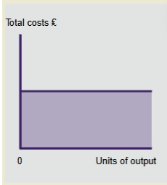
fixed cost
independent of the level of activity
remains constant regardless of change in production/ sales volume
such as rent and salary
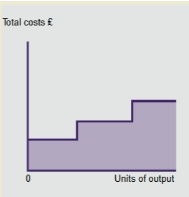
stepped costs
an extension of fixed cost, where cost is fixed up until a certain level of activity
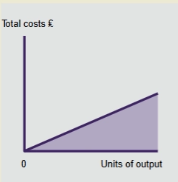
variable costs
varies with the level of activity
fluctuate in direct proportion to changes in production levels or sales volume
such as raw material
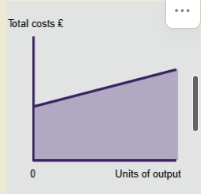
semi-fixed (semi-variable cost)
consists of both fixed and variable cost, components where overall cost increases, only due to the variable element
break-even point
company is not losing money at this level of output, yet profit is not made yet
number of units required to cover the cost
why is breakeven analysis useful?
how many products they need to sell to ensure a profit
whether a product is worth selling or is too risky
the amount of revenue the business will make at each level of output
whether costs need to be reduced to lower the BEP
quick and easy to analyse
break even analysis limitations
ignores behaviour outside range of analysis
assumes constant variable cost per unit
assumes constant selling price per unit
must be single product or constant product mix
assumes no change in efficiency or productivity of workers
assumes volume is the only factor affecting costs (eg. weather effects)
formula for break even point (remember)
b* = fixed cost/ (sales revenue per unit - variable cost per unit)
BEP = FC/ contribution per unit
→ the denominator leads to the notion of contribution which is valuable in making short term decisions
contribution equation
contribution = sales revenue - variable cost
= price minus variable/marginal costs
contribution per unit = (revenue - variable costs) / units
→ positive contribution is good
margin of safety and equation
the planned volume of output/ salles lies above the breakeven point, which can also be used as a partial measure of risk
→ how much production can decrease before the starts losing money
margin of safety = t - b = target output - breakeven point