HNES 368 Chap 6
 Call Kai
 Learn
Learn Practice Test
 Spaced Repetition
 Match
Match Flashcards
 Knowt Play
1/24

There's no tags or description
Looks like no tags are added yet.
Name | Mastery | Learn | Test | Matching | Spaced | Call with Kai |
|---|
No analytics yet
Send a link to your students to track their progress
25 Terms
Angular Kinematics
Description of angular motion
Angular motion
all the points in an object move in a circular path about the same axis
Absolute angular position/segment angle:
one of the planes or lines is fixed and immovable relative to the earth
-exp: The thigh with a horizontal plane
Relative angular position (Joint angle) (intersegmental angle)
Both of the planes or lines are capable of moving
-exp: Upper arm with the forearm, the thigh with the lower leg
Angle measurements with flexion and extension
Sometimes an increasing flexion angle is measured as an increasing angle and the opposite for extension
Angles can be measured in:
-Degrees (360 deg in a circle)
-Radians-> (rads) the angle that is formed when the length of the radius is put on a circle (1 rad = 57.3deg)
-Revolution: One revolution is an arc equal to a circle (one time around the circle)
-Multiples of pi
Tools for measuring angles of the body
-Goniometer, electrogoniometer, Flexometer, inclinometer, software programs such as dartfish, motion capture
Angular distance
The sum of all angular changes undergone by rotating body
-Similar to the concept of linear distance
Angular displacement
The angle formed between the final position and the initial position of a rotating line (a line between two points on an object)
-Similar to concept of linear displacement
Direction of angular motion
-Clockwise (-) counterclockwise (+)
-Different perspectives can change the way you describe motion
-> Therefore, must know the viewing position
-Use the right-hand thumb rule
Right hand thumb rule
1)Identify the axis of rotation and plane
2) along the axis of rotation establish a positive direction
3) right thumb points in the positive direction along the axis
4) Direction in which your finger curl is positive (
For a rotating object or body segment, the farther a point is from the axis of rotation:
-The greater the arc length (distance) it will move through
-> must use radians when solving
-The greater the chord length (displacement) it will move through
->relationship between radius and chord length
Relationship between angular and linear distance and displacement
-Muscles can only shorten ~50% of their resting length
-Advantage of having the tendon insertions close to the joints
->The muscle only has to shorten a small distance to produce a large movement at the end of the limb
Angular speed
the rate of change of angular distance
Angular velocity
rate of change of angular displacement
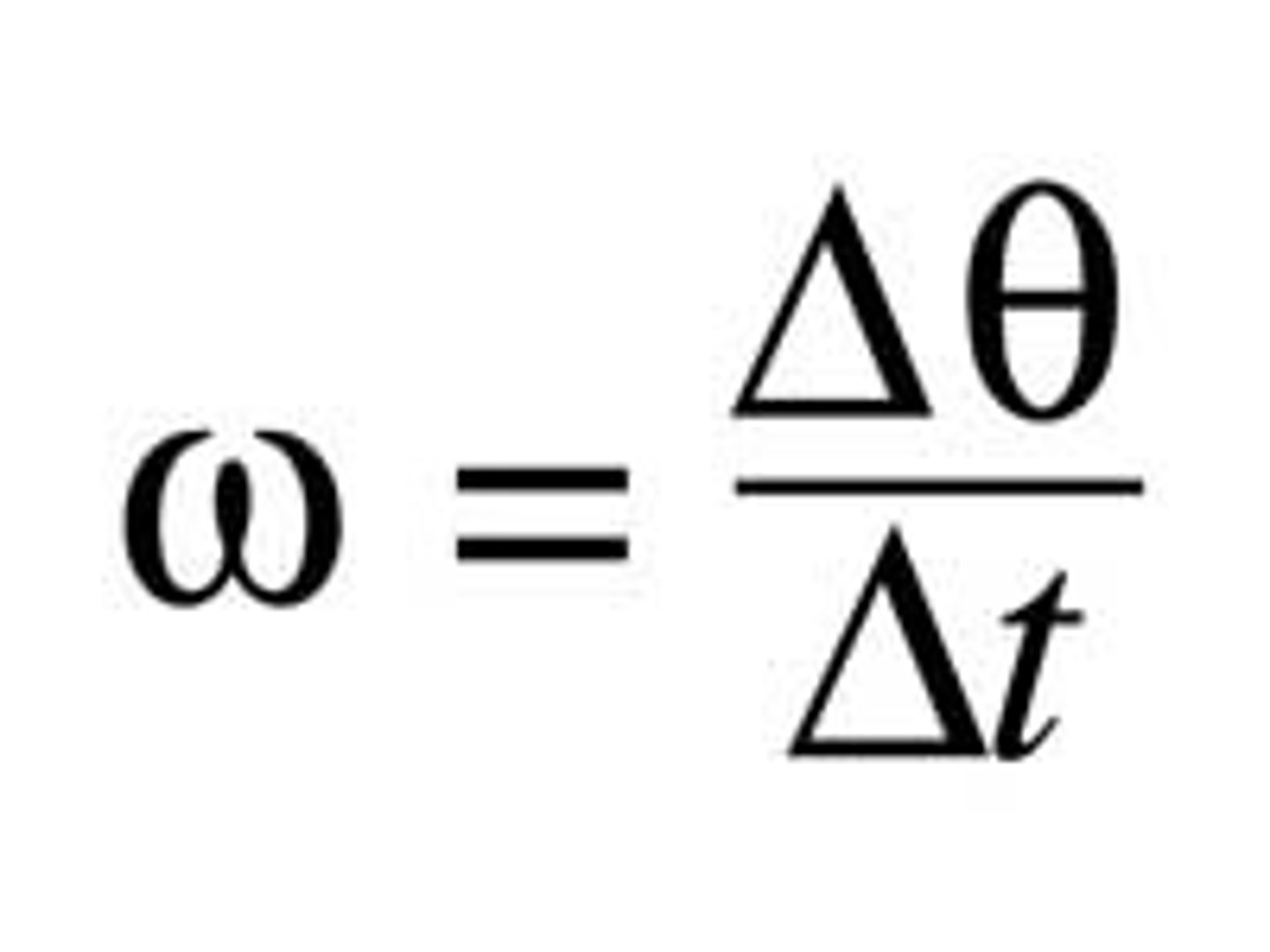
Units of measure for Angular speed/velocity
-Deg/s
-rad/s
-rev/min
Instantaneous Angular velocity
how fast something is rotating at specific instant of time
-Important indicator of how fast and how far the ball with go in such sports as baseball and racquetball
Why Increase length of sporting implements
-in order to increase length of our limbs leads to an increase in linear velocity of struck object because
→ all points of the implement goes through the same angular displacement
->The points take the same amount of time to go through the displacement so all point share the same average angular velocity
-.>points farther form the axis of rotation undergo a linger arc length BUT the time is still the same at points closer to the axis
->Since distance is longer but the time is the same, points farther from the axis must have greater linear speed
Exp of Angular and linear velocity relationship
-Using longer implements as long as you can maintain the same angular velocity will increase the linear velocity. Gripping the end of the handle will also help increase this relationship
-> baseball bats, tennis racquet
Body/stance manipulation when looking at Angular and linear velocity
-Manipulating your body to create a longer radius, like bending at the waist
-Longer limbed people have an advantage in many sports assuming they can develop similar angular velocity
Angular acceleration
The rate of change of angular velocity
-Deg/s^2 or rad/s^2
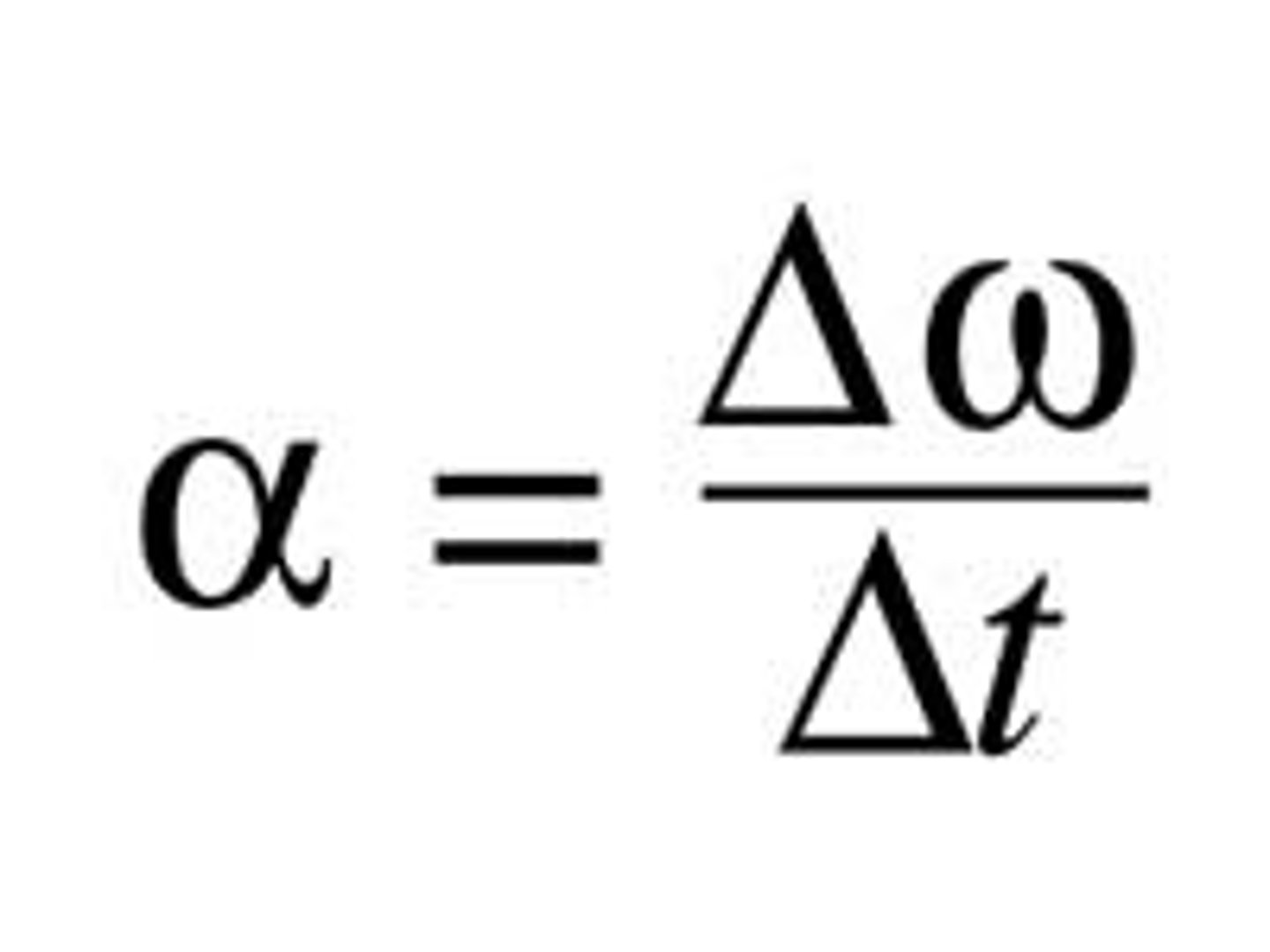
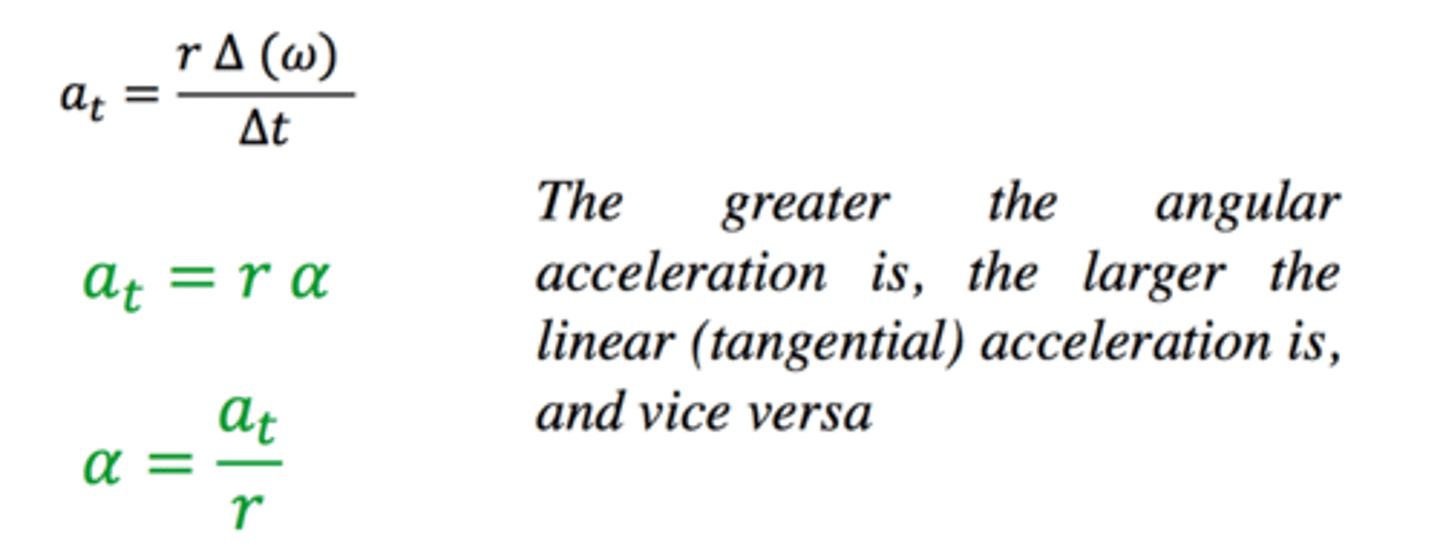
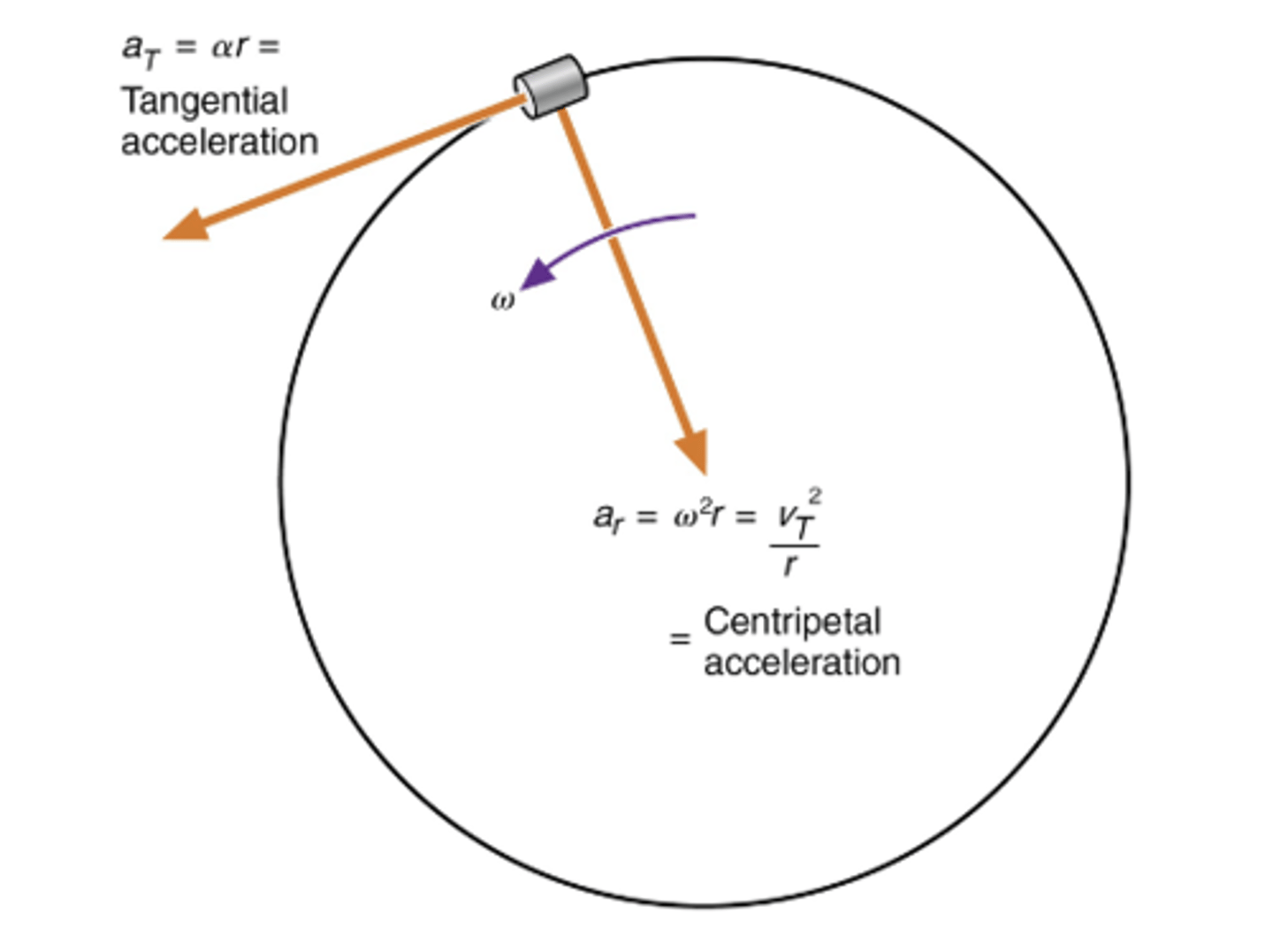
tangential acceleration
The component of linear acceleration tangent to the circular path of a point on a rotating object
Centripetal (radial) acceleration
Linear acceleration of a point on a rotating object measured in the direction perpendicular to the circular path of the object (along a line through the axis of rotation)
Centripetal Force
-An external force directed toward the axis of rotation of an object moving in a circular path
-A constant center-seeking force that acts to move an object tangent to the direction in which it is moving at any instant
->Counteracts natural tendency to move in straight line (Newton's 1st law)
-> Proportional to mass, square of tangential linear velocity, inversely proportional to radius
Examples of Centripetal Force
-Runners, cyclists leaning into the curve
-Hanner throw, speed skating, racecar driving