PSY 260 Cognitive Psychology SBU Zelinksy Exam 1 Diagram | Quizlet
 Call Kai
 Learn
Learn Practice Test
 Spaced Repetition
 Match
Match Flashcards
 Knowt Play
1/97

There's no tags or description
Looks like no tags are added yet.
Name | Mastery | Learn | Test | Matching | Spaced | Call with Kai |
|---|
No analytics yet
Send a link to your students to track their progress
98 Terms
What is cognitive psychology?
The study of the mind controls our perceptions, attention, memory, emotions, language, decision making, thinking, and reasoning.
What does cognitive psychology refer to?
Cog. Psychology refers to all the processes by which sensory input is transformed, reduced, elaborated, stored, retrieved, and used.
What is at the root of cognition?
Sensation
Reduction
filtering out task irrelevant sensory information
Elaboration
Adding more information to the sensory input to perform a task.
Retention
The encoding of information in memory where it can be used in behavior.
Recall
Involves using a deliberate act of will to retrieve information from memory.
Reaction Time (RT)
How long it takes to press a button in response to a stimulus.
Simple RT
A person presses a button as soon as some stimulus appears. There is only one stimulus and one button - no decision or choice. Time to detect stimulus + press button.
Choice RT
Press one button for one stimulus and another button for another stimulus. Two possible stimuli and two buttons; subjects have to make a choice. Time to detect a stimulus + decide what button to press.
Forgetting Function/Curve
Most forgetting occurs soon after initial learning. After about 3 days the function flattens and very litter is forgotten from then on.
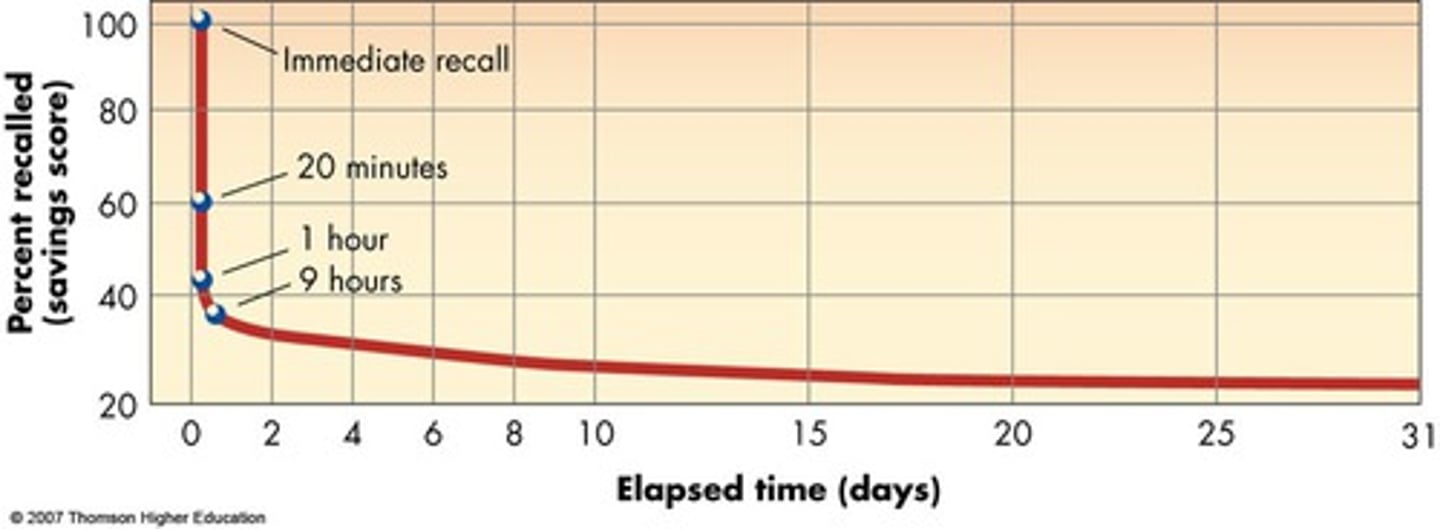
analytical introspection
Perception and cognition was studied by having trained observers describe their mental states.
Behaviorism
Only directly observable behavior, and the factors affecting behavior, should be studied, not "mental states." Founded by Watson.
Operant Condtioning
How a behavior can be strengthened or weakened using positive or negative reinforcement.
information processing model
model of memory that assumes the processing of information for memory storage is similar to the way a computer processes memory.
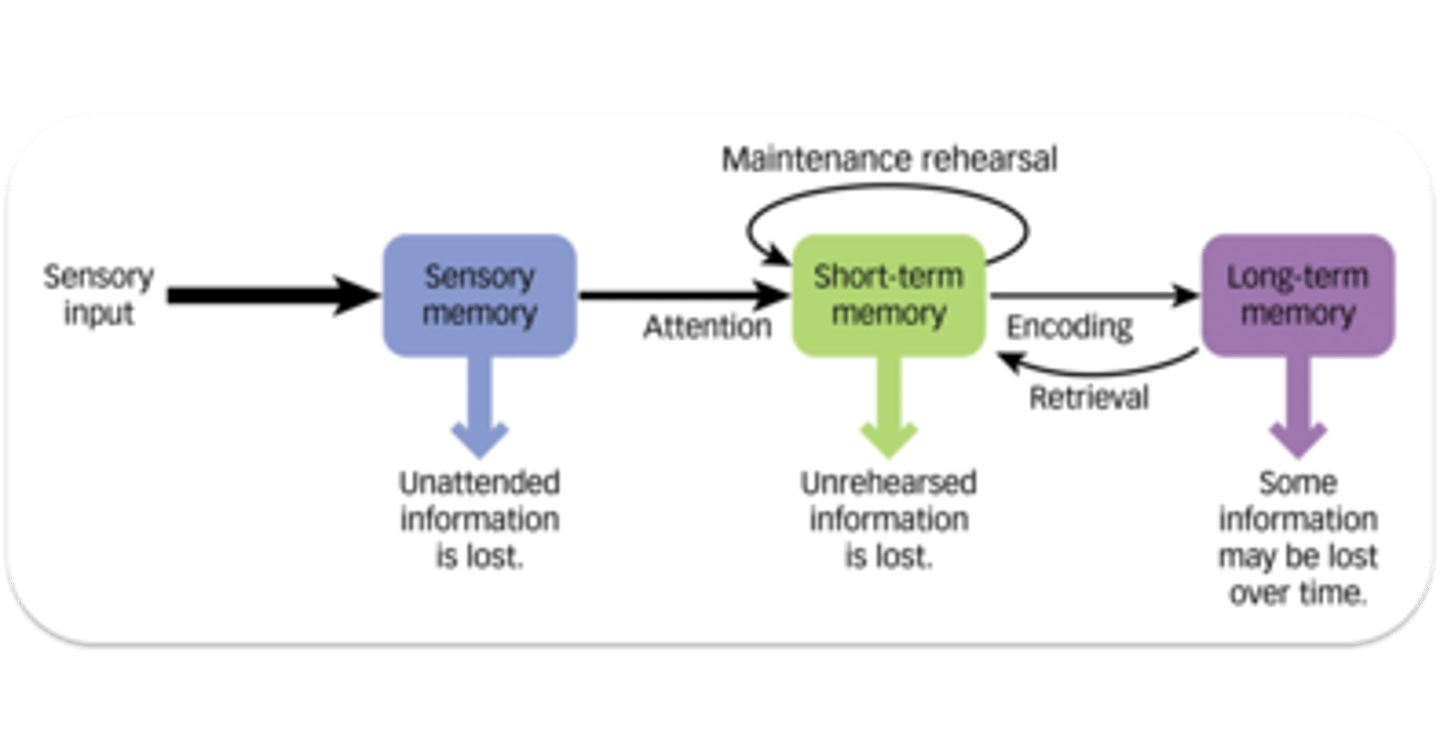
Sensory Memory
a memory for unprocessed sensory information. Only held for a very short time, about 250 msec in the case of vision.
short-term memory (STM)
A memory for processed (recognized) information. Can only hold about 7 things for only about 20-30 secs.
long-term memory (LTM)
A permanent and unlimited capacity memory system.
Attention
Reduces information by selecting only what is relevant to a task. First stage of attention filters out sensory info (helping recognition), the second stage filters our recognized info (helping STM)
TERM
Dendrite
DEFINITION
Collects signals from other neurons.
TERM
Cell Body
DEFINITION
Largest part of a typical neuron; contains the nucleus and much of the cytoplasm
TERM
Axon
DEFINITION
Signal transmission within a neuron.
TERM
Terminal Branches
DEFINITION
Transmits a signal to the dendrites of another neuron
cognitive neuroscience
The study of cognitive behaviors and processes in the brain.
Neurons
Cell specialized to receive and transmit info in the nervous system.
Neural Doctrine (Ramon y Cajal)
this network consists of interconnected neurons
Electron Potential of a Neuron
When a neuron is at rest, the inside of the cell has an electrical potential of -70mV relative to the outside of the cell. When a neuron fires, sodium ions (na-) rushes into the cell causing electrical potential to change from -70mV to +40mV. Ions flow through protein channels in the cell membrane. Potassium ions (K+) then floods out of the neuron, restoring the -70mV gradient.
Action Potential (AP)
Primary method of neural communication. The AP starts at the axon hillock, then moves down the length of the axon in a propagating wave. When the AP reaches the end of the axon, it triggers the release of neurotransmitters from the terminal branches.
The Synapse
The gap between two neurons, typically between the terminal branches of one and the dendrites of another.
Neurotransmitters (NT)
A neurotransmitter can either excite or inhibit another neuron. Excitatory and inhibitory signals from pre-synaptic neurons are summed by the post-synaptic neuron.
Excitatory NT
increase firing rate of a neuron
Inhibitory NT
Reduce firing rate of a neuron
Firing rate
will generally be slow for low intensity stimuli and faster for high intensity stimuli.
localization of function
specific functions are served by specific areas of the brain
Cortex
A thin layer of cells that encloses the brain, is most responsible for perceptual and cognitive functions
Four lobes of the brain
Occipital = vision, temporal = language, speech and vision, parietal = body sensations, frontal = decision making and problem solving
Brain Lesions
If a part of the brain is damaged, the function coded by that part is lost.
Visual Neglect
Damage to the right parietal lobe sometimes results in a syndrome known as visual neglect. Refers to a perceptual suppression of stimuli appearing in the visual field opposite the lesioned brain hemisphere.
single cell neurophysiology
The activity of a single neuron is recorded in response to a stimulus.
A microelectrode is inserted
into a neuron; the firing rate
of the neuron is recorded. of the neuron is recorded.
The experimenter notes
which types of stimuli make
the neuron fire best. the neuron fire best.
Neurons have preferred
stimuli, and only respond
when these stimuli are in
their receptive field.
□ Pros: Enabled the discovery of feature detectors, and their
localization in the brain localization in the brain.
□ Cons: The technique can only be used on animals.
It is also limited to single cells; brain circuits involving
multiple cells are harder to study multiple cells are harder to study.
event-related potential (ERP)
Electrical brain activity is measured from the scalp following the presentation of a stimulus. The greater the response to a stimulus, the more active the
brain and the larger the electrical signal.
□ Pros: Can be used with human subjects; fairly easy; very good : Can be used with human subjects; fairly easy; very good temporal resolution (shows how the brain changes every msec)
□ Cons: Very poor spatial resolution (requires summing over
many cells to get a signal) Also, because only scalp activity is
measured, it doesn't show activity from deeper brain regions.
scalp topography map
A visualization A visualization
of the electrical activity from millions of millions of neurons.
Red is more active, blue is less active
Zero on the x-axis corresponds to the presentation the presentation of a stimulus.
The waveforms indicate how the indicate how the brain responded
to this stimulus
Different waveforms indicate different mental operations
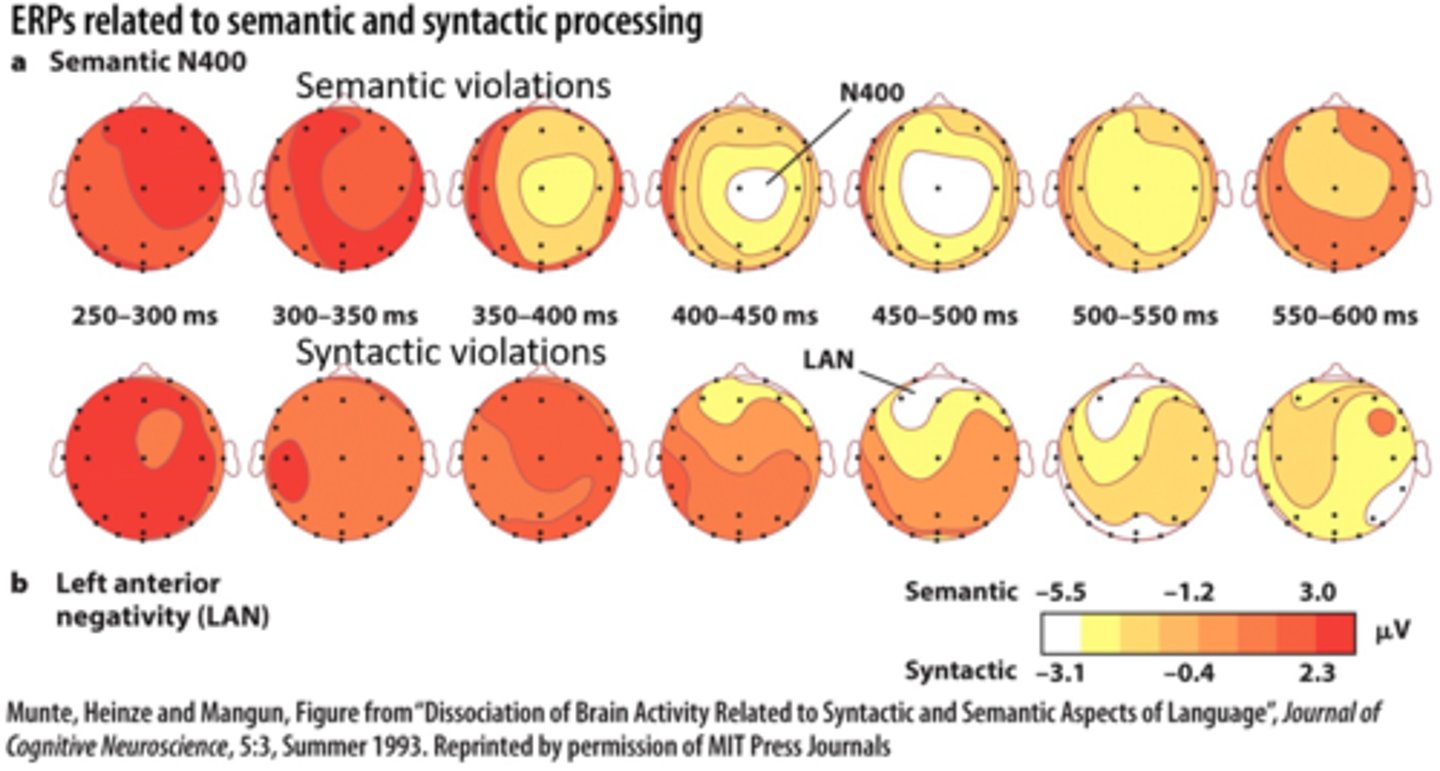
N400
Is sensitive to the meaning of a sentence (semantics)
P600
is sensitive to the sentence form (syntax)
hemodynamic response
measures blood flow to the brain
Subtraction Logic
Control activation is subtracted from the experimental activation. This isolates the brain activity resulting from the stimulus.
Positron Emission Tomography (PET)
A radioactive glucose A radioactive glucose
-like substance is injected into the like substance is injected into the
bloodstream.
Because it is radioactive, it can be tracked as it moves
through the body (i e captured on film) through the body (i.e., captured on film).
Because it is glucose-based, it will be taken up by
metabolically active regions in the brain.
Big Picture: stimulus
→ firing in brain
→ r-glucose uptake
→ active regions are labeled
Pros: Relatively good spatial resolution.
Cons: (1) Relatively poor temporal resolution- relies on a
hemodynamic response, and this introduces a delay. (2) because it exposes people to radiation, there are limits on how often it can be used on the same subjects.
functional magnetic resonance imaging (fMRI)
An active brain requires more oxygen; oxygen in the blood can be imaged by MRI
Brain activity (color) due to the stimulus is superimposed over a standard MR image.
Highly precise spatial localization of stimulus-related activity throughout activity throughout the brain.
BOLD Signal (Blood Oxygen Level Dependency)
How much oxygen there is in the blood; what the fMRI technique measures.
fusiform face area (FFA)
Brain area in the temporal love specialized for perceiving faces; more likely to activate to a face than a non-face pattern.
parahippocampal place area (PPA)
Brain region specialized for the perception of spatial layout. More likely to activate to a visual scene compared to an equally complex non-scene.
extrastriate body area (EBA)
Brain region specialized for the perception of the human form.
Specificity code
Each face is coded by a dedicated group of neurons; when these neurons fire, a specific face is perceived or recognized.
Grandmother cell
a neuron that responds only to a specific stimulus
Distributed code
The neural code for a pattern is distributed across several neuron groups, not just one.
information processing
transforming low-level sensory representations into higher level representations capable of mediating cognitive behavior.
Sensation
Absorbing raw energy through our sensory organs
Transduction
Conversion of environmental energy into neural signals.
Perception
Selecting, organizing, and interpreting these sensory signals to create some "theory" of reality.
bottom-up processing
perceptions are assembled
systematically from a series of analyses of the stimulus.
□ A low-level process acts on the sensory representation to
create a new, slightly more abstract representation. Another
process acts on this one to create an even more abstract
representation, and so on until the percept is constructed.
□ This is how your perceptual system builds an apple.
top-down processing
perceptions are assembled from
pre-existing knowledge or expectations or memories,
and are less directly tied to the stimulus.
□ This is how your perceptual system built the Dalmatian. If
you didn't have knowledge of what a Dalmatian looked like,
you would never have perceived a dog because there was no you would never have perceived
a dog because there was no
dog in the physical stimulus.
Photoreceptors
the light-sensitive neurons responsible for transducing light energy into neural firing.
primary visual cortex
transforms the neural signal from the eyes to create visual patterns.
Simple cells
Simple cells respond best to an oriented bar, with different cells coding for different orientations. This transformation results in the extraction of edges.
Complex cells
code for bars of a particular orientation moving in a particular direction.
End-stopped cells
code for bar length and width, in addition to orientation and direction of motion.
recognition by components theory
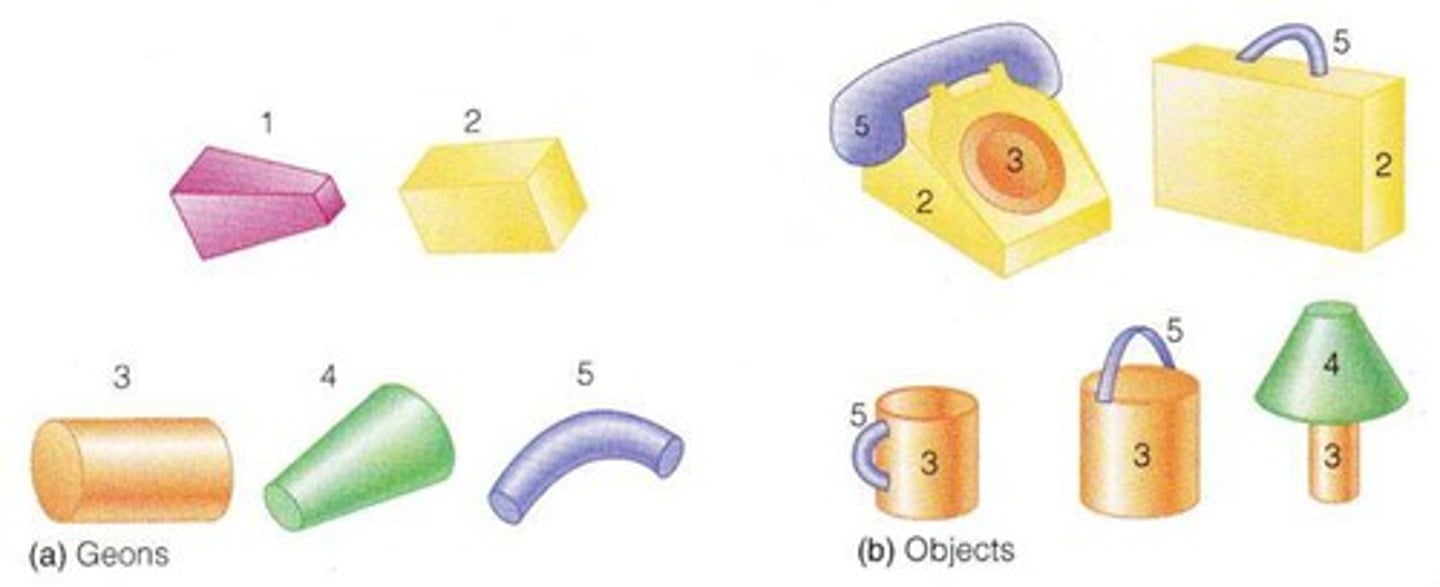
Object recognition results from matching a visual pattern to three-dimensional features called geons.
Geons
volumetric features used to represent objects for recognition, things like: cylinders , rectangular solids, cones, pyramids, etc.
Different objects are represented by combining different geons. Because there are so many possible combinations, any object can be represented in terms of its component geons.
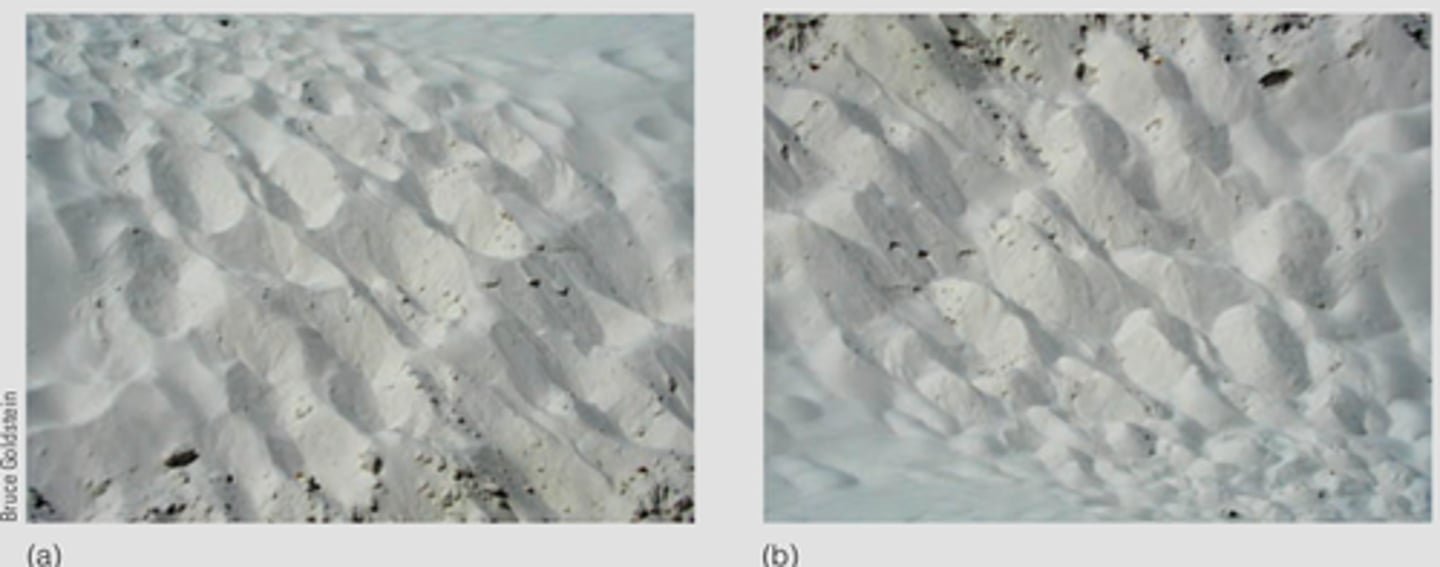
Light-from-above heuristic
the assumption that light is coming from above affects how patterns are recognized.
theory of unconscious inference
Our perceptions are often influenced by unconscious assumptions that we make about the environment. We use knowledge to inform our perceptions.
likelihood principle
we perceive the world in the way that is "most likely" based on our past experiences
gestatlt psychology
"The whole differs from the sum of its parts." Perception is not built entirely from sensations, it is also the result of perceptual organization.
perceptual organization
the process by which stimuli are organized into meaningful units.
Pragnanz
Patterns are perceived in their simplest form.
Similarity
similar things are often grouped together
good continuation
points that, when connected, result in straight or smoothly curving lines are seen as belonging together, and the lines tend to be seen in such a way as to follow the smoothest path
Grouping by meaning
Things are grouped to form meaningful or familiar patterns. We may see a bear, even when it's not there.
Perception and Action
Perception guides action; action changes perception
what vs. where pathways
There are separate cortical pathways in the brain coding for object recognition (what) and object position (where)
Temporal lobe lesion
knocks out "what" pathway. A "what" judgement (object discrimination) was disrupted by knocking out the ventral pathway (temporal lobe), but a dorsal lesion (parietal lobe) had no effect.
Dorsal lobe lesion
A "where" judgement (landmark discrimination) was disrupted by knocking out the dorsal pathway (parietal lobe), but a ventral lesion (temporal lobe) had no effect.
Selective attention
Our ability to focus on a particular thing, and ignore everything else (give one thing all your coins)
Divided attention
Our ability to simultaneously process multiple things (give two or more things a coin at the same time).
The shadowing task
Evidence for perceptual limitations. People are unable to process a message going into their unattended ear when they are shadowing a message going into their attended ear.
Perceptual Channels
Information arriving from the senses
Single Central Channel
Processing here is serial, like in your computer.
Bottleneck
The rate of input to the system (info from the perceptual channels) exceeds the rate of output (info passing through the central channel).
Attentional flap
The most important info is selected, then preferentially directed down the central channel for more processing.
Broadbent
First model of attention.
Attentional limitations
result from a single central
channel imposing serial
processing on our system.
Information from feature
analyzers (color, size, etc.)
enters the system in
parallel through the
perceptual channels.
Before meaning can be
attached to this info
(recognition), it must pass
down the central channel.
early selection theory
Processing turns from parallel to serial early (before recognition)
parallel processing
the processing of many aspects of a problem simultaneously; the brain's natural mode of information processing for many functions, including vision. Contrasts with the step-by-step (serial) processing of most computers and of conscious problem solving.
serial processing
occurs when the brain computes information step-by-step in a methodical and linear matter
late selection theory
processing turns from parallel to serial later (before short term memory)
cocktail party effect
If someone says your name at a party, you are likely to hear it even if you are attending to something else.
Attenuation
the lessening or weakening in strength, value, or quality of a sr
recognition threshold
the concentration at which quality can be recognized
resource theory
• Goal: To explain To explain "why" processing bottlenecks exist processing bottlenecks exist,
not "where" they are located.
• Motivation: Doing two things at the same time
generally leads to worse performance than doing each
task individually.
• Assumption 1: Assumption 1: There is a limited amount of attention There is a limited amount of attention
that can be allocated to tasks. Once it is used, trying to
do another task will result in worse performance.
• Assumption 2: The more attention you allocate to a
task, the better you will perform that task.
Innatentional Blindness
The failure to perceive an object or event due to the direction of attention.
change blindness
The failure to perceive some salient change across two views of a scene.