CC 8 - AAC - Chapter 12: Literacy Intervention
 Call Kai
 Learn
Learn Practice Test
 Spaced Repetition
 Match
Match Flashcards
 Knowt Play
1/18

There's no tags or description
Looks like no tags are added yet.
Name | Mastery | Learn | Test | Matching | Spaced | Call with Kai |
|---|
No analytics yet
Send a link to your students to track their progress
19 Terms
True or False: Teaching literacy skills is the single most empowering thing that we can do for individuals who require AAC
True
Literacy skills fosters:
cognitive development
learning
better access to employment opportunities
use of a wide range of technologies
development of social relationships (e.g., texting, social media, networking)
personal expression and allows access to enjoyable leisure pursuits
True or False: Literacy skills expand the communication options available to those who have CCN who use AAC-they can generate independent messages
True
What does literacy skills do?
Literacy skills also enhance other’s perceptions of the competence of individuals who use an AAC device
Increases the self-esteem of the AAC user
Acquisition of literacy decreases opportunity barriers imposed by others and facilitates the includes of individuals in schools, at work, and in the community
Estimated that up to 90% of individuals who rely on AAC enter into adulthood without acquiring functional literacy skills which restrict positive outcomes in all areas of their life
What does literacy require?
Literacy requires a multidisciplinary approach to maximize sensory/perceptual, motor, cognitive, language, world knowledge and speech function to as great an extent as possible to support literacy learning
Remember no matter the disability (e.g., Down Syndrome, CP, non-verbal, etc) doesn’t mean that person cannot learn to read and write using an AAC system; this can be the means to an independent world for this person. The only limit the person with CCN or a disability has are the ones YOU place
Factors that affect literacy learning
Learning to read and write requires the integration of knowledge and skills across a variety of domains
1) orthographic processing (i.e., processing and identification of letters and letter patterns)
2) phonological processing (i.e., detection and manipulation of the sound structure of speech and mapping of letters to sounds and sounds to letters)
3) context processing (i.e., use of vocabulary knowledge, syntactic/grammatical understanding, and world knowledge to derive meaning from text or encode meaning into text)
4) meaning processing (i.e., integration of orthographic, phonological, and contextual processing to build a coherent understanding of the meaning of the text or to encode meaning into a coherent text
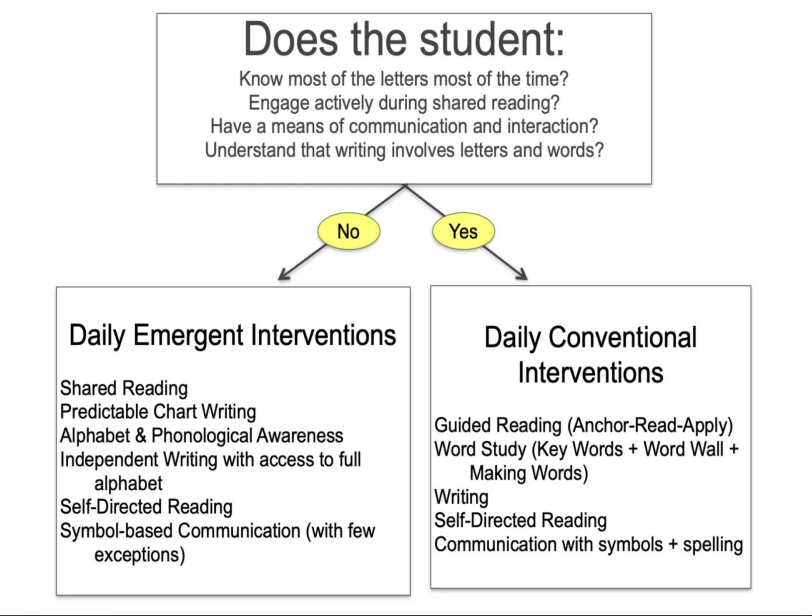
Does the student image:
Intrinsic vs. Extrinsic Factors Image
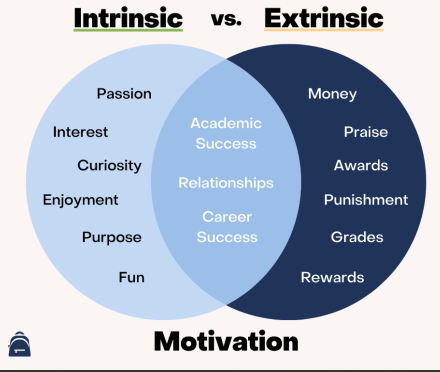
Intrinsic
Factors refer to internal or inherent characteristics or qualities that are essential to something's nature.
Intrinsic Examples
Intrinsic Motivation: Motivation that comes from within oneself, driven by personal enjoyment, curiosity, or satisfaction from the activity itself rather than external rewards
Intrinsic Value: The inherent worth or importance of something, independent of its external or instrumental value.
Extrinsic
Factors are external influences or circumstances that impact or affect something from the outside.
Extrinsic Examples
Extrinsic Motivation: Motivation that comes from external sources such as rewards, praise, or recognition rather than internal desires or enjoyment of the task itself
Extrinsic Rewards: Tangible rewards like money, gifts, or prizes offered as incentives to motivate behavior.
Intrinsic vs. extrinsic
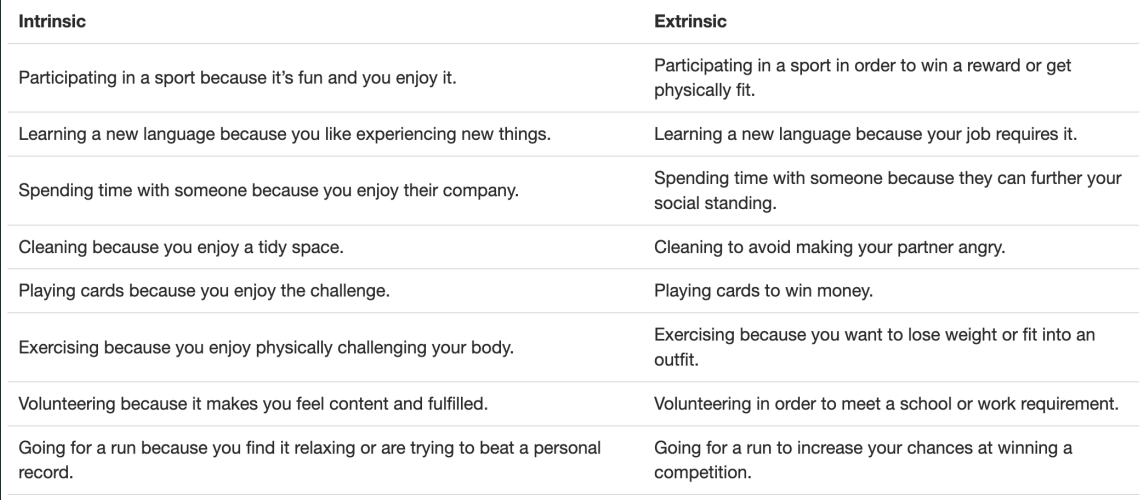
Intrinsic Factors
Visual impairments that limit their perception of printed text and their ability to recognize and discriminate between letters
Hearing impairments that limit their perception of the sounds of spoken language and thereby affect the translation of spoken language into written code (and vice versa)
Motor impairments that limit or complicate physical access to reading materials and writing implements (e.g., pencils, pens, computer keyboards, or other technologies)
Cognitive impairments that impact working memory and other processing skills that are required to learn to read and write
History or current medical issues that jeopardize their health
Language impairments that limit the semantic, syntactic, and morphological knowledge (i.e., knowledge of vocabulary, grammar, and sentence structures) required to understand and produce written texts
Speech impairments that impact the accurate and consistent translation of spoken language into written language (and vice versa)
Lack of experiences and world knowledge that restricts understanding of texts as well as limits the production of cohesive written texts on a range of topics
A history of limited participation and lack of success in literacy activities that result in a lack of motivation or consistency in performance and the time and attention given to literacy instruction
The physical and functional contexts of extrinsic factors
Same reading and writing materials as non CCN- the difference is the access to those materials. Many times these parents are just in survival mode and are completing tasks of daily living and that leaves little time for literacy-based activities; The same in the classroom especially with children who are are included in the regular classrooms; this leaves little time for literacy-based instruction for those with CCN who use AAC
Social contexts of extrinsic factors
Research indicates that those with CCN who use AAC have less opportunities in social situations to ask questions using novel communication, comment and answer questions. In fact, these opportunities are often dominated by communication partners such as teachers, siblings, parents, etc rather than the person who uses the AAC.
Langage contexts - extrinsic factors
It is critical that individuals with CCN have access to AAC systems that supports communication, language development and the transition to traditional orthography
The cultural context - extrinsic factos
Low expectations of CCN persons often affect the way a person is viewed with regards to their ability to learn to read and write using AAC
“the only way to know if a student can learn to read is to try to teach them (Kliewer, 2009), and if a student fails to learn, the instruction’s effectiveness is to be questioned rather than the student’s ability to learn” (Jorgensen, 2005)
Instructional factors - extrinsic factors
Literacy skills are not innate. They require appropriate and effective instruction to learn
Learning to read and write is a complex process that
1) begins well before formal schooling with the development of emergent literacy skills
2) transitions to the acquisition of basic conventional reading and writing skills, typically through the first 3 to 4 years of formal schooling (i.e., learning to read and write)
3) culminates in the realization of advanced literacy skills and the application of those skills to facilitate learning and participation in society (i.e., reading and writing to learn)