Psychology Unit 2a-b
 Call Kai
 Learn
Learn Practice Test
 Spaced Repetition
 Match
Match Flashcards
 Knowt Play
1/107

There's no tags or description
Looks like no tags are added yet.
Name | Mastery | Learn | Test | Matching | Spaced | Call with Kai |
|---|
No analytics yet
Send a link to your students to track their progress
108 Terms
Gestalt psychology
The idea that we see the whole picture before individual parts. understanding the human mind as a whole and not just parts.
Closure
Filling in missing parts to see a complete image.
Figure and ground
The figure is what you focus on — the main object or subject. The ground is everything else — the background behind it.
Proximity
Grouping objects that are close together.
Similarity
Grouping things that look alike.
Selective attention
Focusing on one thing while ignoring everything else. someone in a loud cafe reading a book while blocking out conversations
Cocktail party effect
Hearing something important (like your name) even in a noisy environment.
Inattentional blindness
Missing something obvious because your attention is somewhere else. Gorilla video
Change blindness
Not noticing a change in the environment because attention is elsewhere. zack kings shirt
Depth perception
The ability to see the world in 3D and judge distance. relies on Binocular and monocular cues
Binocular cues
Depth cues that require both eyes.
Retinal disparity
Each eye sees a slightly different image and the brain uses it to judge distance. t
he object is close because the difference (disparity) between what each eye sees is large.
The object is far because the images in each eye are more similar (less disparity).
Convergence
the object is close so Eyes turn inward to focus on close objects.
The object is far because your eyes are more relaxed and straight. |
Monocular cues
Depth cues that only require one eye.
Relative clarity
Closer objects look sharp
The object is far because it looks blurry or hazy. |
Relative size
If an object looks bigger it's closer
Texture gradient
Close objects show more texture
Linear perspective
Parallel lines appear far apart when close and converge when far away.
Interposition
When one object blocks another the one in front is closer
Perceptual constancy
Seeing an object as the same even when lighting, angle, or distance changes.
Color constancy
An object looks the same color even in different lighting.
Shape constancy
An object looks the same shape even from different angles.
Size constancy
An object appears the same size even when distance changes.
Apparent movement
Perceiving motion where there is none.
Phi phenomenon
Lights flashing in sequence appear to move.
Stroboscopic movement
Still images shown rapidly appear to move (like movies or stop-motion).
Concept
A mental category that groups similar objects. To categorize and simplify information. basic unit of knowledge
Prototype
The most typical or best example of something within a concept that the brain uses as a mental reference. Example: When thinking of the concept “bird
Schemas
Mental frameworks or blueprints that help us organize and interpret information based on past experiences; they shape expectations. Example: You expect a server to take your order at a restaurant because your “restaurant schema” tells you how the situation should work.
Assimilation
Interpreting new information by fitting it into an existing schema without changing what you already believe. Example: Seeing a zebra for the first time and calling it a “striped horse” because it fits your current understanding of horses.
Accommodation
Changing or expanding an existing schema when new information doesn’t fit what you previously thought. Example: Learning that a zebra is a different species than a horse and adjusting your understanding of the animal category.
Algorithm
A step-by-step method that guarantees a correct answer if followed properly
Heuristic
A mental shortcut that speeds up decision-making but can lead to errors. Example: Choosing a product because it looks familiar instead of reading the details.
Representativeness heuristic
Judging something based on how closely it matches a typical prototype. assuming someone is an accountant because they are quiet and wear glasses, or a musician because they are outgoing and wear a band t-shirt
Availability heuristic
Judging how likely something is based on how easily examples come to mind. A highly publicized plane crash may make you believe flying is more dangerous than driving, even though statistics show air travel is much safer. odds are higher
Mental set
The tendency to solve problems using the same method that worked before. it can lmit creative problem solving
Priming
When exposure to a stimulus influences how you respond later without you realizing it. Example: Watching a scary movie makes you interpret shadows or noises as threats afterward.
Framing
The way information is presented influences decisions. Example: People are more likely to buy meat labeled “90% lean” than “10% fat
Gambler’s fallacy
mistaken belief that if a random event has occurred more frequently than normal during a given period, it is less likely to happen again in the future (or vice versa). The coin landed on heads 5 times, so tails is more likely now. odds are due to change
Sunk cost fallacy
Continuing something because of what you’ve already invested
Executive function
frontal lobe, decision making, planing, control center
Creativity
The ability to generate new
Divergent thinking
Generating multiple different ideas or solutions for one open-ended problem; emphasizes brainstorming and creativity. Example: Coming up with 10 different uses for a brick (paperweight. emphasizing quantity, variety, and exploring multiple directions.
Convergent thinking
Narrowing multiple ideas down to find the single best answer; logic-based and precise. Example: Solving a multiple-choice question where only one option is correct.
Functional fixedness
Being unable to see a new use for an object beyond its original purpose. Example: Not realizing a shoe can be used as a hammer because you only think of it as footwear.
Encoding
The process of taking information in and converting it into a form the brain can process and store. Computer analogy =Keyboard (typing information into the system).
Storage
Keeping encoded information in the brain over time so it can be used later. Example: Remembering multiplication facts years after learning them in school. Computer analogy =Hard drive (where files are saved long-term).
Retrieval
The process of accessing and bringing stored memories back into your awareness. Example: Remembering the answer during a test. Computer analogy =Opening a saved file.
Explicit memory
Memory you consciously think about and intentionally recall. have to work to think about it and rechieve it. Example: Remembering your last birthday party. Brain part: Hippocampus (forms and retrieves explicit memories).
Semantic memory
Explicit memory for facts and general knowledge
Episodic memory
Explicit memory of personal events with time
Prospective memory
Remembering to do something in the future. Example: Remembering to take out the trash later tonight.
Long-term potentiation
The strengthening of neural connections through repeated use
Working memory model
a framework for how we temporarily hold and manipulate information in long-term memory Example: Remembering ingredients while cooking. Central Executive, Phonological Loop, Sketchpad, Episodic Buffer
Central executive
The control center that directs attention, and manages other working memory parts. it acts as the conductor. Example: Deciding what to focus on while studying.
Phonological loop
Holds and rehearses sounds and spoken information. Example: Repeating a phone number in your head to remember it.
Visuospatial sketchpad
Holds visual and spatial information. Example: Imagining how to navigate your room in the dark.
Multi-store model
A model saying memory goes through 3 stages: sensory → short-term → long-term. Example: Hearing a song (sensory)
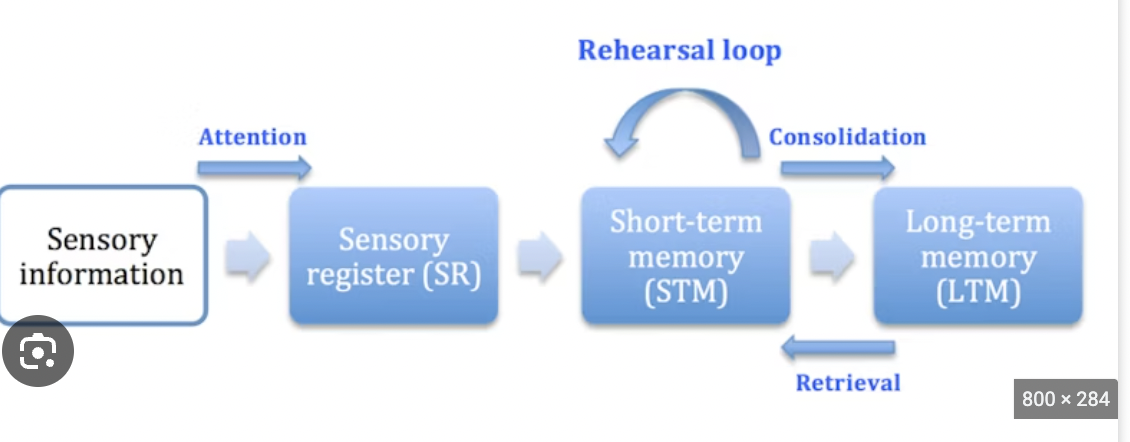
Sensory memory
Very brief memory of sensory input before deciding if it’s important. Example: Seeing a lightning flash and it lingering in your mind for a split second. george sperling
Short-term memory (STM)
Temporarily holds small amounts of info for about 20–30 seconds. Example: Remembering a code long enough to type it in. P: MILLER 7±2 rule saying STM holds about 5–9 items at once.
Long-term memory (LTM)
Stores unlimited information for very long periods. Example: Remembering your childhood phone number years later.
Automatic processing
Encoding info without effort or intent. Example: Remembering where the stairs are without trying.
Effortful processing
Encoding that requires attention and conscious effort. Example: Studying vocabulary for a test.
Iconic memory
Sensory memory for visual images lasting a fraction of a second. Example: The world seeming to “freeze” when you blink. Sensory memory- Visual.
visual memory only lasting for like a sec
Echoic memory
Sensory memory for sound lasting 3–4 seconds. Example: Saying “What?” but still hearing what was said without it being repeated. Sensory memory- Auditory.
Semantic encoding
Deep encoding based on meaning. Example: Remembering the word “apple” by thinking of the taste and fruit category. Deepest level.
Phonemic encoding
Encoding based on sound. Example: Remembering a word by how it rhymes (“cat” sounds like “hat”). Middle level.
Structural encoding
Encoding based on physical appearance. Example: Remembering a word because it’s written in all caps. Shallowest level.
Shallow processing
Encoding based on surface details
Deep processing
Encoding based on meaning
Mnemonics
Memory tricks that improve recall. Example: “PEMDAS” to remember math order of operations.
Method of loci
Remembering info by picturing items in familiar locations. Example: Imagining grocery items in rooms of your house.
Chunking
Grouping items into smaller “chunks” to remember more. Example: 867-5309 instead of 8-6-7-5-3-0-9.
Hierarchies
form of studying. Organizing info into levels like categories and subcategories. Example: Organizing animals into mammals → dogs → bulldogs.
Spacing effect
Learning is better when spread out over time. Example: Studying 20 minutes a day for a week > 2 hours the night before.
Distributed practice
Studying in smaller sessions over time. Example: Flashcards 10 min a night.
Massed practice
Cramming all at once. Example: 3 hours straight before a test.
Serial position effect
Remembering items at the beginning and end of a list best. Example: Forgetting middle grocery items.
Primacy effect
Better memory for first items on a list. Example: Remembering the first speeches in presentations.
Recency effect
Better memory for last items because they’re freshest in STM. Example: Remembering the last thing you studied
Maintenance rehearsal
Repeating info to keep it in STM but not store long-term. Example: Repeating a phone number until you dial it.
Elaborative rehearsal
Connecting new info to meaning or prior knowledge so it enters LTM. Example: Relating a vocab word to your life.
Highly superior autobiographical memory (HSAM)
Rare ability to remember nearly every detail of one’s life. Example: Recalling what happened on a random date years ago.
Alzheimer’s disease
Brain disorder that destroys memory and cognition. Example: Forgetting family members over time.
Amnesia
Memory loss from brain injury
Retrograde amnesia
Loss of past memories but ability to form new ones stays. Example: Forgetting your identity after a crash but learning new facts is fine.
Anterograde amnesia
Can’t form new memories but past memories stay intact. Example: Meeting someone repeatedly but never remembering them.
Infantile amnesia
Inability to remember early childhood (before age 3–4). Example: No memories from being a baby.
Recall
Retrieving info with no cues. Example: Short-answer tests.Fill-in-the-blank or open-response.
Recognition
Identifying info when given options. Example: Multiple choice. Multiple choice.
Retrieval cues
Hints that help you access memories. Example: Smell of food triggering childhood memories.
Context-dependent
Remembering better in the same environment you learned in. Example: Studying in the room where you’ll test helps recall. Godden & Baddeley study (Figure)- Scuba divers recalled words better if they learned and were tested in the same place (both on land or both underwater).
State-dependent
Memory is better when your physical or mental state matches learning. Example: Learning something tired → recalling it better when tired.
Mood-congruent
You remember info that matches your current mood. Example: When sad
Testing effect
Memory improves through practice testing instead of just reviewing. Example: Quizzing yourself works better than rereading notes.
Metacognition
Thinking about your own thinking and learning. Example: Knowing you study better with flashcards.
Forgetting curve
Shows that memory fades quickly if not reviewed
Encoding failure
Not storing info because you never paid attention. Example: Not remembering a shirt color you never noticed.
Proactive interference
Old memories block new ones. Example: Calling your new teacher by last year’s teacher’s name.