Math - Final
 Call Kai
 Learn
Learn Practice Test
 Spaced Repetition
 Match
Match Flashcards
 Knowt Play
1/103

Earn XP
Description and Tags
Mx. Haynes @Trinity
Name | Mastery | Learn | Test | Matching | Spaced | Call with Kai |
|---|
No analytics yet
Send a link to your students to track their progress
104 Terms
Before you continue…
This test will cover all the concepts from Book 2, Problem 123 all the way to Book 3, problem 135.
This was from logarithmic equations to graphing and finding limits of complex graphs involving division (holes, vertical asymptotes, etc).
Test #4
OK
Sequence tip … ദ്ദി(ᵔᗜᵔ)
Arithmetic: an = a1 + d(n-1)
Geometric: an = a1rn-1
Summation of sequence tip… ദ്ദി(ᵔᗜᵔ)
Arithmetic: Sn = (n / 2)(a1 + an)
Geometric:
Sn = a1(r)0 + a1(r)1 + … + a1(r)n-1
- (r Sn = a1(r)1 + a1(r)2 + … + a1(r)n)
1 - r Sn = a1(r)0 - a1(r)n
Sn = (a1 - a1(r)n) / (1 - r)
42-log48
42 / 4log48
16 / 8
2
3log278
27(1/3)log278
27log278^(1/3)
81/3
2
log881 * log34
(log381 / log38) × log34
((4)log34 / log38)
log3256 / log38
log8256
8x = 256
23x = 28
3x = 8
x = 8/3
(log1/5(625) / log2(1/8))
log1/5(1/5)-4 / log2(2-3)
-4 / -3
4/3
log2(x-2) + log2(x+1) = 2
log2((x-2)(x+1)) = 2
22 = x2 - x - 2
0 = x2 - x - 6
0 = (x-3)(x+2)
x = -2 → log2(-4) [DNE]
x = 3
Remember to check back in the equation for these problems!
xlog2x / x2 = 8
xlog2x * x-2 = xlogx8
log2x - 2 = logx8
log2x - ((log28) / (log2x)) - 2 = 0
log2x - (3/log2x) - 2 =0
(log2x)2 - 3 - 2 log2x = 0
a2 - 2a - 3 = 0
(a-3)(a+1) = 0
a = 3; a = -1
log2x = 3; log2x = -1
x = 23; x = 2-1
x = 8; x = 1/2
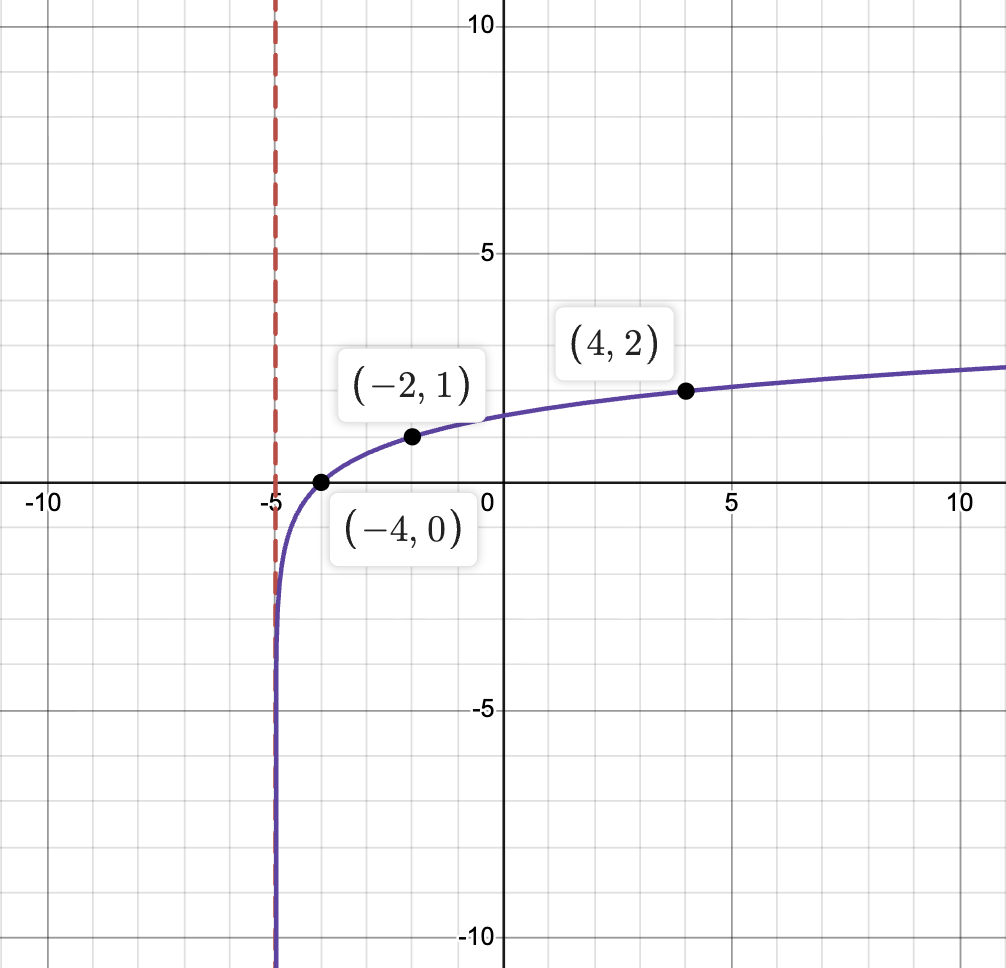
The function f(x) is graphed below.
a) Find an equation for f(x).
b) For what value of x does f(x) = 3?
a) Vertical asymp. → log; x = -5
f(x) = loga(x+5)
1 = loga(-2+5)
a = 3
f(x) = log3(x+5)
b) 3 = log3(x+5)
33 = x + 5
27 = x + 5
22 = x
Given the equation bx = 8b2 / 100. Write a simplified expression for the log(b) in terms of x. The answer may contain a logarithm.
log(bx) = log(8b2/100)
x log b = log(8b2) - log(100)
x log(b) = log 8 + 2 log b - 2
log(b) = (log 8 + 2 log b - 2) / x
Given that log 8 ≈ 0.9 and log27 = 2.8, find log 28.
log 7 / log 2 = 2.8
3 log 2 = 9/10
log 2 = 3/10
log(7 × 4) = log(28)
log(7) + 2 log(2) = log(28)
2.8 log(2) + 2 log(2) = log(28)
24/5 log(2) = log(28)
24/5 × 3/10 = 72/50 = 36/25 = log(28)
Test #5
OK
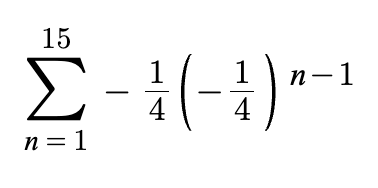
Given the series: -1/4 + 1/16 - 1/64 + …
a) Write the sum of the first 15 terms using sigma notation.
b) Find the sum of the first 15 terms of the series. Leave your answer as an unsimplified expression.
a) Geometric with rate of -1/4 and start term of -1/4; See image.
b) S15 = -1/4(-1/4)0 - 1/4(-1/4)1 - 1/4(-1/4)2 - … -1/4(-1/4)14
- (-1/4 S15 = -1/4(-1/4)1 - 1/4(-1/4)2 - … - 1/4(-1/4)15)
5/4 S15 = -1/4 + 1/4(-1/4)15
S15 = 4(-1/4+ 1/4(-1/4)15) / 5
Find the sum of the following series.
-5 - 2 + 1 + … + 112
Arithmetic with start term of -5 and difference of 3
-5 + 3(n-1) = 112
3(n-1) = 117
n - 1 = 39
n = 40
Sn = (n / 2)(a1 + an)
S40 = (40/2)(-5+112)
S40 = (20)(107)
S40 = 2140
log9(x2) + log3(x-2) = 1
( log3(x2) / log3(9)) + log3(x-2) = 1
(2 log3(x) / 2) + log3(x-2) = 1
log3((x)(x-2)) = 1
3 = x2 - 2x
0 = x2 - 2x - 3
0 = (x-3)(x+1)
x = -1 → log3(-3) [DNE]
x = 3
bx-2 = 8b3 / 100x
log(bx-2) = log(8) + log(b3) - log(100x)
(x-2) log b = 3 log(2) + 3 log(b) - 2x
(x-2) log b + 2x = 3 log 2 + 3 log b
a = log b
ax - 2a + 2x = 3 log 2 + 3a
(a+2)x = 3 log 2 + 5a
x = (3 log 2 + 5a) / a + 2
x = (3 log 2 + 5 log b) / log b + 2
Sigma notation tip… ദ്ദി(ᵔᗜᵔ)
Top - bottom + 1 = # of terms
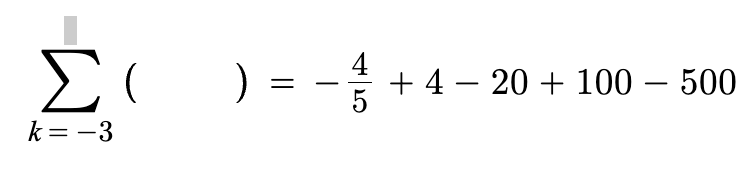
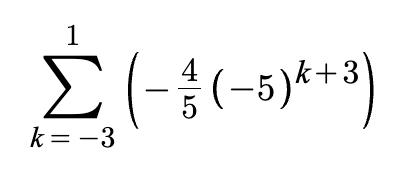
Complete the statement to make the equation correct. (You do not need to find the sum)
5 terms!
x - (-3) + 1 = 5
x + 4 = 5
x = 1 (upper limit)
-4/5 = first term
-5 = rate
k+3 → needs to = 0 when n = -3
-4/5(-5)k+3
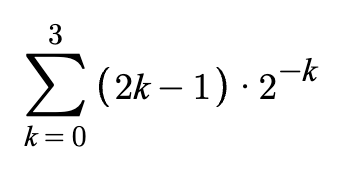
Calculate the following sum. Do not simplify.
3 - 0 + 1 = 4 → 4 terms! (0, 1, 2, 3)
(2(0) - 1) * 20 = -1
(2(1) - 1) * 2-1 = 1/2
(2(2) - 1) * 2-2 = 3/4
(2(3) - 1) * 2-3 = 5/8
5/8 + 6/8 + 4/8 - 8/8 = 7/8
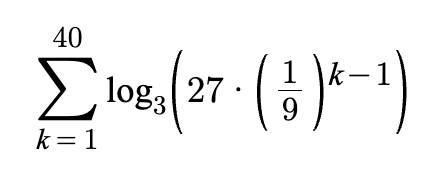
Evaluate the following sum.
Hint: Write out the first few terms of the series and the last few terms to see a pattern.
40 terms
log3(27 * (1/9)0) = 3
log3(27 * (1/9)1) = 1
log3(27 * (1/9)2) = -1
Arithmetic, difference of -2
3 - 2(40 - 1) = -75 (last term)
Sn = (a1 + an)(n/2)
S40 = (-75+3)(40/2)
S40 = (-72)(20)
S40 = -1440
Quiz #3
OK
Write the equation in standard form for the polynomial p(x) that has rational coefficients. p(x) has roots x = 3/2, and 3 + √2, with p(3) = 2.
x = 3 + √2
x - 3 = √2
(x-3)2 = 2
x2 - 6x + 9 - 2 = 0
x2 - 6x + 7 = 0
p(x) = a(2x-3)(x2-6x+7)
2 = a(2(3)-3)(32 - 6(3) + 7)
2 = a(3)(-2)
2 = -6a
-1/3 = a
p(x) = -1/3(2x-3)(x2-6x+7)
p(x) = -1/3(2x3-12x2+14x-3x2+18x-21)
p(x) = -1/3(2x3-15x2+32x-21)
p(x) = -2/3x3 + 5x2 - 32/3x + 7
Is x - 3 a factor of h(x) = 3x5 - 2x4 + x2 - 13x + 14? Justify your answer.
No, because 3 is not a factor of 14.
If x2-2x+3 is a factor of the polynomial g(x) = 2x4-7x3+3x2+9x-27, find all roots of g(x).
Highest degree → 4 roots for g(x)
Divide g(x) by x2-2x+3 to get 2x2-3x-9
2x2-3x-9 = (2x+3)(x-3)
2x+3 = 0; x = -3/2
x-3 = 0; x = 3
x2-2x+3 = 0
x2-2x+1 = -2
(x-1)2 = -2
x - 1 = ±√-2
x = 1 ± √-1 * √2
x = 1 ± i√2
f(x) is a polynomial with integer coefficients and roots of x = 5, x =4, and x = 1 - i√7. What is the lowest possible degree of f(x)? What are the x-intercepts of f(x)? Justify your answer.
4 because degree = # of roots
X-intercepts = roots, excluding imaginary → (5, 0); (4,0)
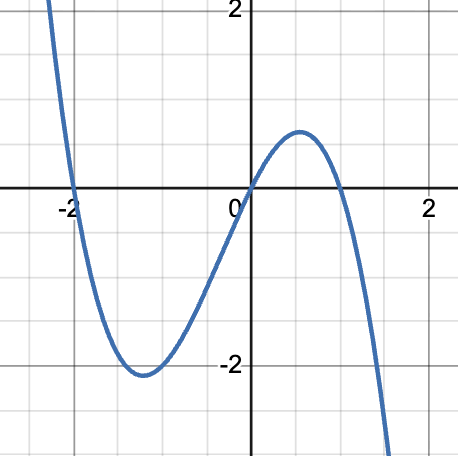
Match the graph with one of the following equations.
A) -(x-1)2(x+2)(x2+1)
B) -x(x-1)(x+2)
C) (x-1)3(x+2)
D) -(x-1)2(x+2)
Has a root at x = 0
B
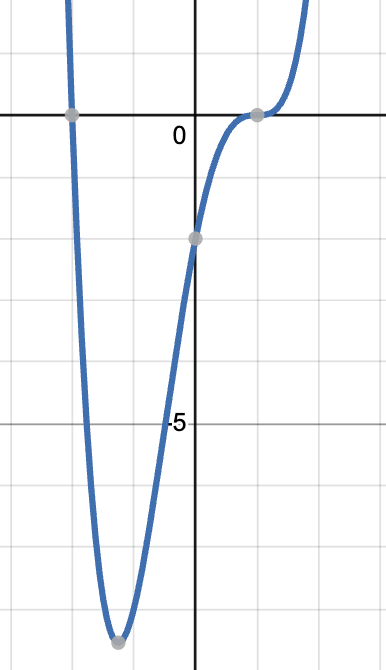
Match the graph with one of the following equations.
A) -(x-1)2(x+2)(x2+1)
B) -x(x-1)(x+2)
C) (x-1)3(x+2)
D) -(x-1)2(x+2)
Passes through x = 1 cubically
C
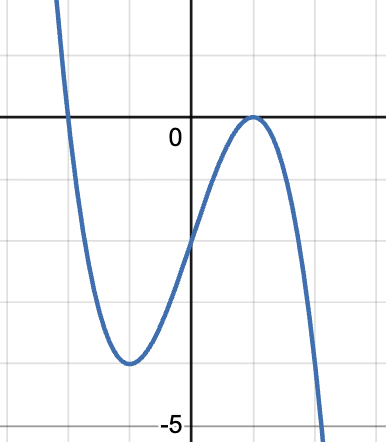
Match the graph with one of the following equations.
A) -(x-1)2(x+2)(x2+1)
B) -x(x-1)(x+2)
C) (x-1)3(x+2)
D) -(x-1)2(x+2)
Point (-1,-4)
-(-1-1)2(-1+2) = (-4)(1) = -4
D
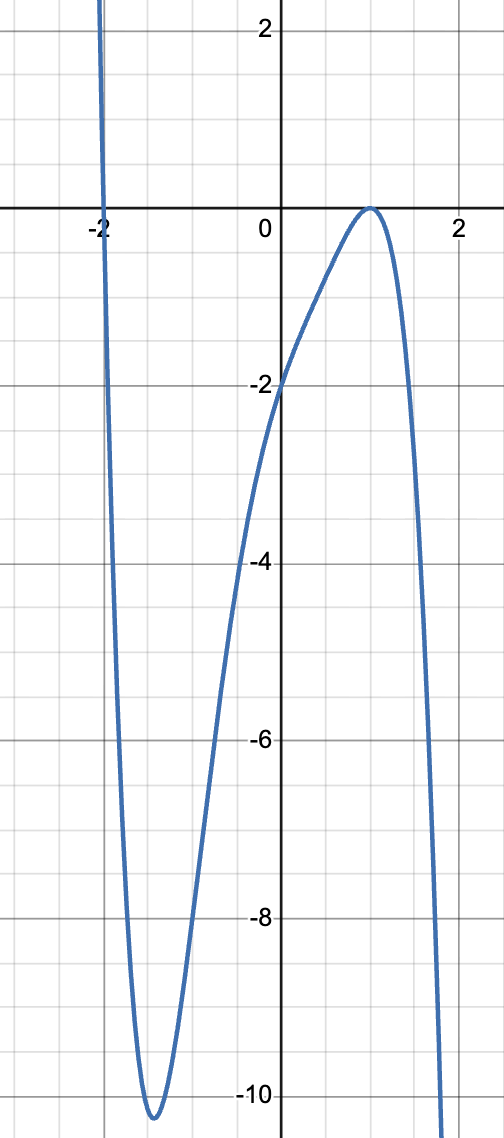
Match the graph with one of the following equations.
A) -(x-1)2(x+2)(x2+1)
B) -x(x-1)(x+2)
C) (x-1)3(x+2)
D) -(x-1)2(x+2)
Process of elimination
A
Test #6
OK
Exponentiated i tip… ദ്ദി(ᵔᗜᵔ)
i1067 = ?
You might be blanking, oh no! Never fear, just divide.
See, i1 = i, i2 = -1, i3 = -i and i4 = 1; remainder will give you your answer.
1067 / 4 = 266 R3
i1067 = i3 = -i
As simple as that!
Simplify the following fully. (Any complex answers should be written in standard a + bi form).
i1 + i2 + i3 + … + i314
Sn = i(i)0 + i(i)1 + i(i)2 + … + i(i)313
- (i Sn = i(i)1 + i(i)2 + i(i)3 + … + i(i)314)
(1 - i) Sn = i - i315
Sn = (i - i315) / 1 - i
315 / 4 = 78 R3; i315 = i3 = -i
Sn = 2i / (1-i)
Sn = 2i(1+i) / (1-i)(1+i)
Sn = (-2 + 2i) / 2
Sn = -1 + i
Find the other five trigonometric ratios if csc(x) = -2, π < x < 3π/2
Q3 (sin negative, cos negative)
sin x = -1/2 (reciprocal of csc x)
cos x = -√3/2 (30-60-90)
tan x = 1/2 * 2/√3 (sinx/cosx)
tan x = √3/3
sec x = -(2√3) / 3 (reciprocal of cos x)
cot x = 3√3 / 3
cot x = √3 (reciprocal of tan x)
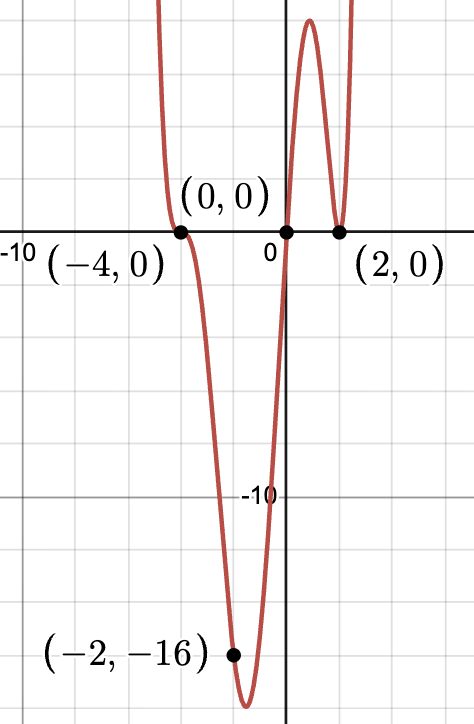
Write the equation in factored form for the polynomial graphed below. Assume the smallest degree for each root.
Cubically @x=-4, Bounce @x=2, Linear @x=0
ax(x+4)3(x-2)2
-16 = -2a(-2+4)3(-2-2)2
-16 = -2a(8)(16)
-16 / (-16)(16) = a
1/16 = a
y = 1/16x(x+4)3(x-2)2
Verify the following identity: (sin(x) + cos(x)) / (sec(x) + csc(x)) = sin(2x) / 2
(sinx+cosx)(secx-cscx) / (secx+cscx)(secx-cscx)
(sinx+cosx)(1/cosx-1/sinx) / (secx+cscx)(secx-cscx)
(sinx/cosx - cosx/sinx) / (sec2x - csc2x)
(sinx/cosx - cosx/sinx) / (1/cos2x - 1/sin2x)
(sin2x - cos2x / sinxcosx) / (sin2x-cos2x / sin2xcos2x)
sin2xcos2x / sinxcosx = sinxcosx
2sinxcosx = sin(2x) → sinxcosx = sin(2x) / 2
Sketching the reciprocal of a graph
x → -∞, y → 3
x → -4, y → 0
x-intercepts of the graph are __ of the reciprocal
vertical asymptotes of the graph with both sides going same way are __ of the reciprocal
What is important to note about select points?
x → -∞, y → 1/3
x → -4, y → ∞ (y gets very small in graph, so its reciprocal gets very big)
vertical asymptotes
x-intercepts (usually ends up forming a parabola as a result
Points at y = 1 or y = -1 on the graph keep the same position in the reciprocal graph! This is because the reciprocal of 1 or -1 is still 1 or -1. :)
Give an equation of a polynomial p(x) that satisfies all of the following properties.
p(x) is an odd function
limx→∞p(x) = ∞
x = -2 is a root
x = -i is a root
Odd function → -p(x) = p(-x)
if p(-2) = 0, then -p(2) = 0… so p(2) = 0; same with i and -i
-p(0) = p(-0); (0,0) must be included
p(x) = ax(x-2)(x+2)(x-i)(x+i)
p(x) = ax(x2-4)(x2+1)
p(x) = ax(x4-3x2-4)
p(x)=a(x5-3x3-4x)
x+2 is rightmost root, so test with 3?
35-3(3)3-4(3) = 243 - 81 - 12 = 150
^ Since it’s positive, a just needs to be greater than 0.
p(x) = x5-3x3-4x
Quiz #4
OK
Horizontal asymptote tip… ദ്ദി(ᵔᗜᵔ)
If degreenum > degreedenom, most likely a slant asymptote. Divide to find.
If degreenum = degreedenom, horizontal asymptote @y = a/b, where a is the coeff of num highest degree and b is the coeff of denom highest degree.
If degreenum < degreedenom, horizontal asymptote @y = 0.
A
Fill in tomorrow when you can ig
Tricky Book Problems
OK
Interest tip… ദ്ദി(ᵔᗜᵔ)
Regular Compounding
P(1 + r/t))nt
Compounding Continuously
Pert
t = amount of compounding
r = rate of change
n = number of years
p = principal amount
Suppose you invest $100 at 12% interest compounded semi-annually. This means that each half-year, your money grows by 6%. What happens if the interest is compounded quarterly?
P(1 + r/t))nt
t = amount of compounding
r = rate of change
n = number of years
p = principal amount
100(1 + 0.12/4)4(1)
100(1.03)4 = $112.55
Simplify log 2 + log 3 + log 4 + … + log n.
log(1) = 0, so…
log(n!)
If a = log23 and b = log25, what is log2(32/25) in terms of a and b.
log2(25) - log2(52)
5 - 2 log2(5)
5 - 2b
If log95 = x and log94 = y, write the following in terms of x and y.
a) log9(10)
b) log9(0.2)
a) log95 + log92
2 log92 = y; y = log92 / 2
x + y/2
b) log9(1/5)
log9(5-1) = -log9(5)
-x
Rewrite as a sum or difference of logarithms. Leave no exponents or radicals.
log(a3√(b2/c))
log(a3) + log((b2/c)1/2)
log(a3) + log(b/c1/2)
3 log a + log b - ½ log c
Suppose you invest $10,000 at an annual rate of 9% and that interest is compounded continuously. How much money would you have at the end of the year?
Pert
t = amount of compounding
r = rate of change
n = number of years
p = principal amount
10000(e)0.09 × 1
$10941.74
Solve for x (this applies to the next couple of problems).
log6(log2(x)) = 1
log2(x) = 6
x = 26
x = 64
x = log(log 10100)
x = log 100
x = 2
logx(0.0016) = -4
1/x4 = 16/10000
1/x4 = 4/2500
1/x4 = 1/625
x4 = 625
x = 5
x = log7(log5(log232))
x = log7(log5(5))
x = log7(1)
x = 0
(log8x)2 - 3log8x + 2 = 0
a2 - 3a + 2 = 0
(a-2)(a-1) = 0
log8x = 2; log8x = 1
x = 82; x = 81
x = 64; x = 8
log4(x+2) + log4(x-4) = 2
log4((x+2)(x-4)) = 2
16 = x2-2x-8
0 = x2-2x-24
0 = (x-6)(x+4)
x = -4 [log4(-2) → DNE]
x = 6
6log6x² = x + 30
x2 - x - 30 = 0
(x-6)(x+5) = 0
x = 6; x = -5
log3(2x+1) = log3(3x-6)
2x + 1 = 3x - 6
-x = -7
x = 7
log9x = (1/2) log9144 - (1/3) log98
log9x = log912 - log92
log9x = log9(12/2)
log9x = log96
x = 6
What is the sum of 1 + 2 + 3 + … + 100?
(First + last)(# terms / 2)
(50)(101) = 5050
Solve each equation or inequality (this applies for the next few problems).
log2(x-1) ≤ 3
x-1 ≤ 8
ax can never be negative or 0… so:
1 < x ≤ 9
2 log2(x) - log(x3) = 2
2 log2x - 3 log x - 2
a = log x
2a2 - 3a - 2 = 0
(2a+1)(a-2) = 0
a = -1/2 → log x = -1/2 → x = 10-1/2 → x = (√10)/10
a = 2 → log x = 2 → x = 102 → x = 100
√(log(x) - 1) = log √x
(log(x)-1)1/2 = 1/2 log x
y = log x
(y - 1)1/2 = 1/2y
y - 1 = 1/4y2
-1/4y2 + y - 1 = 0
-y2 + 4y - 4 = 0
(-y+2)(y-2) = 0
y = 2 → log(x) = 2 → x = 100
x3-log7x = 49
(7log7x)3-log7x = 72
log7x(3 - log7x) = 2
3 log7x - (log7x)2 -2 = 0
a = log7x
-a2 + 3a - 2 = 0
(-a+2)(a-1) = 0
a = 2 → log7x = 2 → x = 49
a = 1 → log7x = 1 → x = 7
(4x-1) / (2x + 1) = 5
(22x-1) / (2x+1) = 5
(2x+1)(2x-1) / (2x+1) = 5
2x-1 = 5
2x = 6
log2(6) = x
log3(x2-2x) ≤ 1
x2-2x ≤ 3
x2-2x-3 ≤ 0
(x-3)(x+1) ≤ 0
x-3 ≤ 0 → x ≤ 3
x+1 ≤ 0 → x ≥ -1
x2-2x ≠ 0
x(x-2) ≠ 0
x ≠ 0; x ≠ 2
[-1,0) U (2, 3]
Is (x-3) a factor of f(x) = x3 - 4x2 + 5? Justify your answer.
No, because 3 is not a factor of 5.
Calculate the magnitude of |3+2i|.
√(32 + 22) = √13
Graphing complex numbers
Regular numbers: x-axis, complex numbers: y-axis
3-2i → (3,-2)
Simplify i6769
i = i; i2 = -1; i3 = -i; i4 = 1
6769 / 4 = 1692 R1
i3243 = i
Graphing tip… ദ്ദി(ᵔᗜᵔ)
You can use a sign chart! Find the x-intercepts and then plug in something less (or more) than that and see what the signs result to.
Multiplicity of 1: Passes through linearly
Multiplicity of 2: Bounces
Multiplicity of 3: Passes through cubically
Types of functions tip… ദ്ദി(ᵔᗜᵔ)
Even: f(x) = f(-x)
Odd: f(-x) = -f(x)
sin(2x) / (1 + sin(2x)) = 2/((1+tanx)(1+cotx))
2sinxcosx / (1 + 2sinxcosx)
2sinxcosx / sin2x + cos2x + 2sinxcosx
2sinxcosx / (sinx+cosx)2
2 / ((sinx+cosx)2 / sinxcosx)
2/(sinx+cosx / sinx)(sinx+cosx/cosx)
2 / (1+cotx)(tanx+1)
Identities
OK
sin2x + cos2x = ?
1
tan x = ?
sin x / cos x
sin(2x) = ?
2sinxcosx
cos(2x) = ? (x3)
1 - 2 sin2x
2 cos2x - 1
cos2x - sin2x
Review Guide
OK
Given that sin x = (√5)/5 and cos x < 0, find the exact value in simplest radical form of the remaining five trigonometric functions of x.
sin2x + cos2x = 1
5/25 + cos2x = 1
cos2x = 20/25
cos x = ±(2√5)/5 … cos x < 0
tan x = sinx/cosx = √5/5 / (-2√5)/5 = -1/2
cos x = -(2√5)/5
tan x = -1/2
csc x = 5√5 / 5 = √5
sec x = -(√5)/ 2
cot x = -2
If sin x = 0.3, find the value of:
sin(-x) + sin x + sin(x + π) + sin(x + 2π) + sin(x + 3π)
Draw triangles.
sin(-x) = -0.3
sin(x+π) = (√91)/10
sin(x+2π) = -0.3
sin(x+3π) = -(√91)/10
-0.3 + 0.3 + (√91)/10 - (√91)/10 - 0.3 = -0.3
Find the exact values of x on the interval [0, 2π).
a) sec x = -2
b) 2 sin x = -√3
c) cot x = -1
a) cos x = -1/2
x = 2π/3, 4π/3
b) sin x = -(√3)/2
x = 4π/3, 5π/3
c) tan x = -1
x = 3π/4, 7π/4
Consider the trigonometric function f(x) = 3 sec(x/4) + 2.
a) Draw a sketch of f(x) on the interval (-6π, 6π).
b) Evaluate f(4π).
c) Determine the exact value(s) of x for which f(x) = -4 on the interval (-6π, 6π).
a) 2π / 1/4 = 8π (Period)
1/cosx (Reciprocal graph: parabola down, parabola up, parabola down)
Amplitude of 3 (Multiply y-vals by 3)
Vertical Translation Up 2 (Add 2 to y-vals)
b) See graph…
f(4π) = -1
c) 3 sec(x/4) + 2 = -4
sec(x/4) = -2
cos(x/4) = -1/2
x/4 = -4π/3, -2π/3, 2π/3, 4π/3
x = -16π/3, -8π/3, 8π/3, 16π/3
Determine the domain of g(x) = (√3x+4) / (2x2 - x -15).
3x+4 ≥ 0; x ≥ -4/3 … -8/6
(2x+5)(x-3); x ≠ 3, x ≠ -5/2 … -15/6
Domain: [-4/3, 3) U (3, ∞)
f(x) is an odd function and g(x) is an even function.
a) Complete the table.
x: -4, -2, 0, 2, 4
f(x): 2, _, 0, -2, _
g(x): 5, -6, -2, _, _
b) f(-2) + g(2)
c) g(f(-4))
d) (f(4)*g(0)) / (g(-2) - f(-2))
a) f(-x) = -f(x); g(x) = g(-x)
f(-2) = -f(2) = 2
f(-4) = -f(4) = 2; f(4) = -2
g(2) = g(-2) = -6
g(4) = g(-4) = 5
b) 2 - 6 = -4
c) g(2) = -6
d) -2 * -2 / -6 - 2 = 4/-8 = -1/2
Given f(x) = (2x+3) / (5x+2), find the inverse f-1(x) and determine the domain and range of both f(x) and f-1(x).
5x + 2 ≠ 0
x ≠ -2/5
Domain f(x) = Range f-1(x): (-∞, -2/5) U (-2/5, ∞)
x = (2y+3) / (5y+2)
5xy+2x = 2y+3
5xy-2y = -2x+3
y(5x-2) = -2x+3
f-1(x) = (-2x+3) / (5x-2)
5x - 2 ≠ 0
x ≠ 2/5
Domain f-1(x) = Range f(x): (-∞, 2/5) U (2/5, ∞)
sin x + (csc x / sec2x) = csc x
sin x + (cos2x / sin x)
(sin2x + cos2x) / sin x
1/sin x
csc x
(cosx / 1+sinx) + (1+sinx / cosx) = 2 sec x
cos2x / cosx(1+sinx) + (1+sinx)(1+sinx) / cosx(1+sinx)
(cos2x + sin2x + 2sinx + 1) / cosx(1+sinx)
2 + 2 sinx / cosx(1+sinx)
2(1+sinx) / cosx(1+sinx)
2/cosx
2 sec x
(1+sinx / sinx) + (cotx - cosx / cosx) = 2 csc x
(cosx(1+sinx) / sinxcosx) + (sinx(cotx - cosx) / sinxcosx)
(cosx + sinxcosx / sinxcosx) + (cosx - sinxcosx / sinxcosx)
2 cosx / sinxcosx
2/sinx
2 csc x
limx→2(x2-x-2)/(x2-4)
(x-2)(x+1) / (x-2)(x+2)
hole @ (2, 3/4)
3/4
limx→2(x2+4x+4)/(x2-4)
(x+2)(x-2)/(x-2)(x+2)
hole @(-2,0)
1+2 / 1-2 = 3/-1 = -3
3+2 / 3-2 = 5/1 = 5
DNE [diff signs]
limx→∞(x2-4)/(3x2+x+1)
infinite limit, num & denom are = so highest degree coeffs
1/3
limx→1(x3+2×2-2x-1)/(x2+2x-3)
(x-1)(x2+3x+1)/(x-1)(x+3)
hole @ (1, 5/4)
5/4
logx64 = 2
x2 = 64
x = ±8 (logarithms are positive only)
x = 8
log3(4x-7) = 2
4x - 7 = 9
4x = 16
x = 4
log5(x+6) + log5(x+2) = 1
log5((x+6)(x+2)) = 1
(x+6)(x+2) = 5
x2 + 8x + 12 = 5
x2 + 8x + 7 = 0
(x+7)(x+1) = 0
x = -7 [DNE]; x = -1
(Plug back into equation and see if logs remain positive.)
16x + 4x+1 - 21 = 0
42x + 4x * 4 - 21 = 0
a = 4x
a2 + 4a - 21 = 0
(a+7)(a-3) = 0
a = -7 → 4x = -7 → x = log4(-7) = DNE
a = 3 → 4x = 3 → x = log4(3)
x: -2, -1, 0, 1, 2
f(x) = 2x: _, _, _, _, _
x: _, _, _, _, _
g(x) = log2x: -2, -1, 0, 1, 2
x: _, _, _, _, _
y = 2f(x+4): _, _, _, _, _
1/4, 1/2, 1, 2, 4
1/4, 1/2, 1, 2, 4
x: -6, -5, -4, -3, -2
y = 2f(x+4): 1/2, 1, 2, 4, 8
x: 1, 2, 4, 8, 16
y = g(x/4)+3: 1, 2, 3, 4, 5
f(x) = (2(x+3)2(x-3)(x-1)2) / ((x+2)(x-2)2(x-1)2(x-5))
a) limx→-2-f(x) = ?
b) limx→-2+f(x) = ?
c) limx→-2f(x) = ?
d) limx→2f(x) = ?
e) limx→5f(x) = ?
f) limx→1f(x) = ?
g) limx→∞f(x) = ?
h) limx→-∞f(x) = ?
a) (2(-4+3)2(-4-3)(-4-1)2) / ((-4+2)(-4-2)2(-4-1)2(-4-5))
2(1)(-7)(25)/(-2)(36)(25)(-9) = (-)/(+) = (-)
limx→-2-f(x) = -∞
b) (2(-1+3)2(-1-3)(-1-1)2) / ((-1+2)(-1-2)2(-1-1)2(-1-5))
2(4)(-4)(4)/(1)(9)(4)(-6) = (-)/(-) = (+)
limx→-2+f(x) = ∞
c) two values
limx→-2f(x) = DNE
d) no hole, vertical asymptote
2(2+3)2(2-3)(2-1)2 = 2(25)(-1)(1) = -50
2-: (1.5+2)(1.5-2)2(1.5-1)2(1.5-5) = (+)(-)2(+)2(-) = (+)(-) = (-)
2+: (3+2)(3-2)2(3-1)2(3-5) = (5)(1)2(2)2(-2) = -40 → as it approaches 2, - gets smaller and smaller in the denominator; since both are -, this means that there IS a limit.
big negative / small negative = -∞
limx→2f(x) = ∞
e) no hole, vertical asymptote
2(5+3)2(5-3)(5-1)2 = 2(64)(2)(16) = 4096
5-: (4+2)(4-2)2(4-1)2(4-5) = (+)(+)2(+)2(-) = (-)
5+: (6+2)(6-2)2(6-1)2(6-5) = (+)(+)2(+)2(+) = (+)
Different directions
limx→5f(x) = DNE
f) hole
2(1+3)2(1-3) / (1+2)(1-2)2(1-5) = 2(4)2(-2) / (3)(-1)2(-4) = -64 / -12 = 16/3
limx→2f(x) = 16/3
g) 2(big+3)2(big-3)(big-1)2 / (big+2)(big-2)2(big-1)2(big-5)
2(big-3) is WAY less than (big+2)(big-5)
small / big means it approaches zero
limx→∞f(x) = 0
h) 2(-big+3)2(-big-3)(-big-1)2 / (-big+2)(-big-2)2(-big-1)2(-big-5)
Still… 2(-big-3) is WAY less than (-big+2)(-big-5)
small / big means approaching zero
limx→-∞f(x) = 0
Identify any x-intercepts, vertical asymptotes, holes, and end behavior of the graph h(x) = (x3-3x2-6x+8) / (x2-7x+12)
h(x) = (x-4)(x2+x-2) / (x-4)(x-3)
h(x) = (x-4)(x+2)(x-1) / (x-4)(x-3)
hole at (4, 18)
vertical asymptote at x=3
x-ints: (-2,0); (1,0)
y-int: (0, 2/3)
x3/x2 → num>denom; slant asymptote… divide to find
slant asymptote at y = x + 4